
OffSec training is the industry-standard, hands-on penetration-testing curriculum that prepares candidates for practical exams such as the OSCP. If you are ready to enroll, pursue an authorized, instructor-led path that includes guided lab access and exam-focused mentoring.
- Core outcomes: practical exploit skills, live lab experience across realistic network environments, and exam-style readiness through timed, evidence-based assessments
- Who benefits most: aspiring penetration testers, security engineers moving into red-team roles, career changers, and veterans transitioning into cybersecurity
- TL;DR next step: evaluate any provider by three criteria — confirmed authorization or partnership status, documented lab hours, and verifiable instructor experience in active security work
Table of Contents
- What does OffSec training cover, and who is it for?
- Which OffSec courses should you take, and in what order?
- How do OffSec exams actually work?
- What do OffSec courses cost, and how long does preparation take?
- How do you choose the right OffSec training provider?
- Why practical exam credentials carry more weight now
- Key Takeaways
- The case for guided preparation over going it alone
- Totalcyber’s path to OffSec-style certification
- Useful sources and further reading
What does OffSec training cover, and who is it for?
Hands-on lab-based training is the defining feature of OffSec’s curriculum. Rather than testing recall through multiple-choice questions, OffSec courses teach penetration-testing methodology by requiring students to execute real attacks against live lab machines, document their findings, and submit technical evidence. The curriculum spans network exploitation, web application attacks, privilege escalation, Active Directory abuse, and, at advanced levels, custom exploit development.
Delivery takes three primary forms: self-paced lab access with course materials, proctored practical exams requiring written reports, and authorized instructor-led bootcamps that add live mentoring and structured exam prep. The self-paced path suits disciplined, experienced practitioners; the instructor-led format benefits anyone who needs accountability, guided lab walkthroughs, and feedback on report quality before exam day.
The typical candidate profile includes:
- Career changers with a foundation in Linux and basic networking who want a recognized offensive security certification
- Junior security engineers or SOC analysts ready to move into penetration testing roles
- Veterans leveraging prior technical training to enter the cybersecurity workforce
- Red-team aspirants who need a credential employers recognize as proof of practical skill
Recommended prerequisites before starting any OffSec course: comfort with the Linux command line, a working knowledge of TCP/IP networking, and at least basic scripting in Python or Bash. Candidates without that baseline typically spend more lab hours on fundamentals rather than exploitation technique.
Pro Tip: Instructor-led mentorship shortens the learning curve significantly. A mentor who has passed the exam can redirect your lab approach within hours; self-study can leave you stuck on the same machine for days, burning lab time without progress.
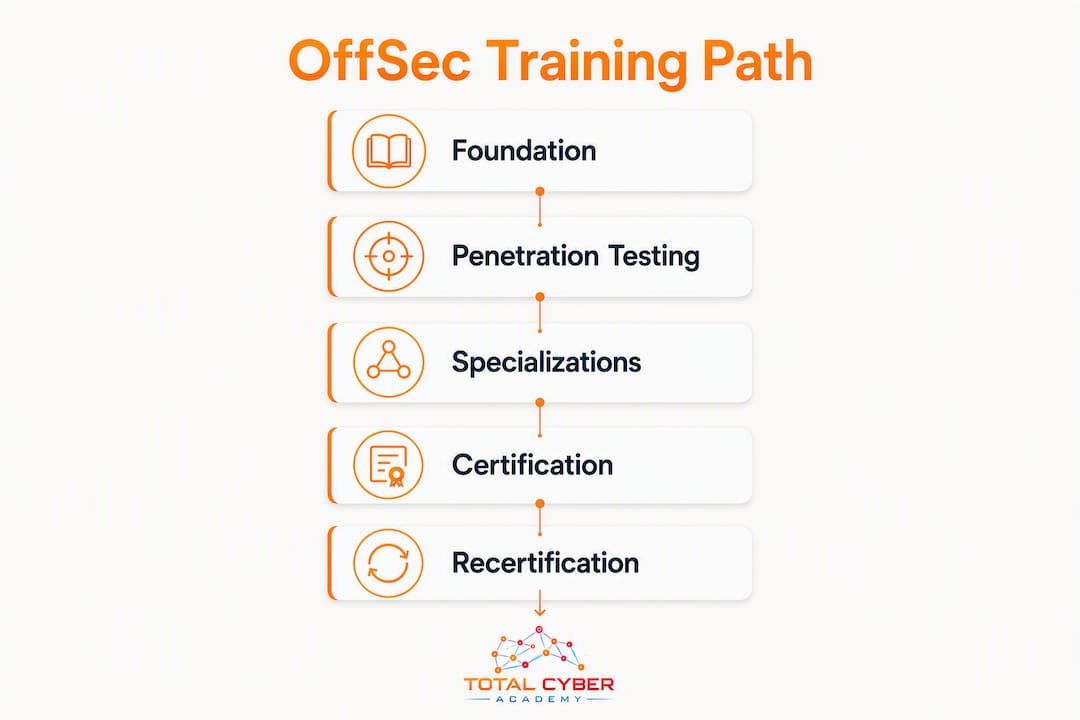
Employers increasingly expect proof of current, demonstrable skills rather than credentials earned years ago. That shift makes the OffSec model, with its practical exam format and the newer OSCP+ renewal requirement, well aligned with what hiring managers actually want to see.
Which OffSec courses should you take, and in what order?
OffSec’s catalog is organized by skill level and specialization. Each course leads to a specific certification, and the progression from PEN-200 through EXP-401 maps directly to increasing technical depth.

| Course | Best For | Format | Typical Lab Access | Exam Format |
|---|---|---|---|---|
| SEC-100 (CyberCore) | Absolute beginners | Self-paced | Introductory modules | Knowledge assessment |
| PEN-200 (PWK) | Entry-to-intermediate pentesters | Self-paced + labs | 90 days (standard) | full-day practical + report |
| PEN-210 (WiFu) | Wireless security specialists | Self-paced + labs | Varies by tier | Practical wireless exam |
| EXP-401 (AWAE/OSED) | Advanced exploit developers | Self-paced + labs | Extended lab access | multi-day practical + report |
SEC-100 is the entry point for candidates who need to build foundational knowledge before committing to a full penetration-testing track. It covers core security concepts without assuming prior IT experience.
PEN-200 (Penetration Testing with Kali Linux) is the most widely recognized course in the OffSec catalog and the prerequisite track for the OSCP. It covers the full penetration-testing methodology: reconnaissance, enumeration, exploitation, post-exploitation, and reporting. Most candidates spend multiple weeks to a few months in the lab environment before attempting the exam.
PEN-210 (Offensive Wireless Security) targets wireless attack vectors, including WPA/WPA2 cracking, rogue access points, and client-side attacks. It suits security engineers who need to assess wireless infrastructure specifically, and it leads to the OSWP credential.
EXP-401 (Advanced Windows Exploitation) is the most technically demanding course in the standard catalog, covering custom shellcode, kernel exploits, and bypass techniques for modern mitigations. It leads to the OSED credential and is appropriate only for candidates who have already passed the OSCP or hold equivalent practical experience.
Prerequisites by level:
- Beginner (SEC-100): No prior experience required; basic computer literacy helps
- Intermediate (PEN-200, PEN-210): Linux command-line proficiency, TCP/IP fundamentals, basic scripting
- Advanced (EXP-401): OSCP or equivalent; C/C++ familiarity, Windows internals knowledge, assembly basics
How do OffSec exams actually work?
The OSCP is a practical, hands-on certification that requires candidates to attack and compromise live lab machines inside a private network, then submit technical evidence of their work. There are no multiple-choice questions. The exam tests whether you can actually execute an attack chain under time pressure, not whether you can recall a definition.
Key mechanics of the practical exam format:
- Time window: The OSCP exam runs for a full day of active testing, followed by additional time to write and submit the penetration-testing report
- Evidence requirements: Candidates must provide screenshots of exploitation steps, proof files (typically a local.txt or proof.txt from each compromised machine), and a structured technical report documenting methodology, findings, and remediation recommendations
- Scoring: Points are awarded per machine compromised; a minimum score threshold must be reached to pass, and the report quality can affect the outcome
- Difficulty gradient: OffSec practical exams are widely regarded as significantly more rigorous than theory-only certifications, with EXP-401’s OSED exam considered the most technically demanding in the standard catalog
Statistic: Completing the OSCP exam qualifies the candidate for 40 (ISC)² CPE credits, making it directly applicable to maintaining other professional credentials such as the CISSP.
The OSCP+ renewal model, introduced November 1, 2024, changed how new earners maintain the credential. Candidates who earned the OSCP before that date retain a lifetime credential. Those who earn it afterward receive the OSCP+, which requires renewal every three years. Recertification options include passing a recertification exam, earning another qualifying OffSec certification, or completing OffSec-approved CPE activities. This dual-credential structure reflects a broader industry shift: employers want evidence of current skills, not credentials earned a decade ago.
Pro Tip: Structure your exam report before you start the clock. Prepare a report template with sections for executive summary, methodology, findings, and remediation. Capture screenshots with timestamps as you work — reconstructing evidence after the fact is harder than it sounds under exam fatigue.

What do OffSec courses cost, and how long does preparation take?
Course packages typically bundle syllabus access, a set number of lab hours, and an exam voucher. Higher tiers extend lab time and may include additional mentoring or support options. Exact pricing varies by course edition and the lab-duration tier selected, so the figures below reflect the general structure rather than a specific current price.
Cost components to budget for:
- Course fee: Covers access to course materials, video content, and exercises
- Lab access: Tiered by hours or duration (30-day, 60-day, and 90-day options are common for PEN-200); more lab time generally correlates with higher pass rates
- Exam voucher: Typically included in the base package for the first attempt; retakes are purchased separately
- Optional add-ons: Extended lab access, proctoring services, and mentorship packages
Timeline expectations by level:
- SEC-100: 2–4 weeks for candidates with no prior background
- PEN-200 / OSCP track: 60–90 days of active lab work is the most commonly recommended preparation window; candidates with strong networking and scripting backgrounds may be ready sooner
- PEN-210: 30–60 days depending on prior wireless security exposure
- EXP-401: 90+ days; this course assumes deep prior knowledge and the lab machines are designed to require original problem-solving
A standard PEN-200 package includes the course PDF and video content, lab access for the selected duration, one exam attempt, and access to student forums. Some authorized instructor-led programs layer on live mentoring sessions, exam report reviews, and structured study schedules, which meaningfully changes the preparation experience compared with self-study alone.
Note: Lab hours are the single most predictive factor in exam readiness. Candidates who exhaust their lab time before attempting the exam consistently report lower confidence on exam day. Budget for more lab time than you think you need.
How do you choose the right OffSec training provider?
Authorization status and lab realism are the two criteria that separate credible providers from those offering generic cybersecurity content rebranded as OffSec prep. Hands-on lab experience that mirrors the actual exam environment is what prepares candidates for the practical assessment, and not every provider delivers that.
Use this checklist when evaluating any OffSec training provider:
- Confirm authorization or partnership status. Ask directly whether the provider is an authorized OffSec training partner. Authorized partners have a formal relationship with OffSec and deliver curriculum aligned with current exam objectives.
- Verify lab hours and lab realism. Ask how many lab hours are included, whether the lab environment includes realistic network scope and logging, and whether machines reflect current exam difficulty. Realistic, constrained lab environments are a measurable differentiator in provider quality.
- Review instructor credentials. Instructors should hold current OffSec certifications (OSCP at minimum) and have recent, active penetration-testing experience. Ask for instructor bios and verify credentials independently.
- Request sample labs or course materials. Reputable providers share sample lab exercises or a detailed syllabus. Vague descriptions of “hands-on content” without specifics are a red flag.
- Ask about exam pass guidance. Does the provider offer mock exam environments, report templates, or structured exam-day walkthroughs? These elements directly affect pass rates.
- Understand the mentorship model. Is mentoring included, or is it an add-on? How are questions handled — async forum, live session, or dedicated instructor time?
- Clarify retake and refund policies. Know the cost of a retake exam voucher and whether the provider offers any support between a failed attempt and a retake.
- Ask about CPE handling. For candidates maintaining other credentials, confirm whether the provider documents CPE credits and whether the OSCP’s 40 (ISC)² CPE credits are tracked and communicated.
Red flags to avoid: providers with no published instructor bios, no sample labs or syllabus preview, unclear statements about authorization status, and no documented student outcomes or placement guidance.
Why practical exam credentials carry more weight now
OffSec is recognized across the security industry for its practical exam model, and the OSCP+ renewal structure introduced in 2024 reflects a deliberate response to employer demand. Employers increasingly want evidence of current, demonstrable capability, not credentials earned years ago and never refreshed. The three-year recertification cycle for OSCP+ keeps certified professionals technically relevant in a field where attack techniques and defensive architectures evolve continuously.
The OSCP’s 40 (ISC)² CPE credits upon completion also make it a practical investment for professionals maintaining credentials like the CISSP or SSCP, since a single exam can satisfy a significant portion of annual continuing education requirements.
Statistic: The OSCP+ requires renewal every three years, with recertification achievable through a recert exam, a qualifying OffSec certification, or OffSec-approved CPE activities — a structure designed to keep certified professionals current with evolving attack techniques.
Totalcyber’s approach to this reality is built around hands-on labs, structured exam preparation, and instructor mentoring from practitioners who hold current certifications. The academy’s veteran-owned structure also means students who are transitioning from military service receive targeted support aligned with their specific career-change needs.
Pro Tip: If you hold a CISSP or are working toward one, time your OSCP attempt strategically. The 40 CPE credits from a single OSCP completion can satisfy a meaningful portion of your (ISC)² annual requirement, effectively compressing two professional development goals into one exam cycle.
Key Takeaways
Authorized, instructor-led OffSec training with verified lab hours and a current OSCP-certified instructor is the most reliable path to passing practical penetration-testing exams and building a credible security career.
| Point | Details |
|---|---|
| Practical exam format | OSCP and related exams require live exploitation and a written report, not multiple-choice answers. |
| Course progression | Start with PEN-200 for the OSCP track; advance to EXP-401 only after earning the OSCP or equivalent experience. |
| OSCP+ renewal | New OSCP earners (post-November 1, 2024) receive OSCP+, which requires renewal every three years via exam, qualifying cert, or CPE. |
| Provider checklist | Verify authorization status, lab realism, instructor credentials, and exam pass guidance before enrolling. |
| Totalcyber option | Totalcyber offers hands-on, instructor-led training with lab access, exam prep coaching, and dedicated veteran support. |
The case for guided preparation over going it alone
There is a persistent assumption in the penetration-testing community that self-study through OffSec’s own materials is the only credible path, and that seeking instructor guidance somehow diminishes the credential. That view misreads what the exam actually tests.
The OSCP does not reward candidates who studied in isolation. It rewards candidates who can enumerate methodically, pivot under pressure, and write a clear technical report while exhausted. Those are skills that benefit from feedback, not just repetition. A mentor who has passed the exam can identify flawed enumeration habits in a lab session and correct them before they cost you points on exam day. Self-study cannot do that.
The OSCP+ renewal model reinforces this point. OffSec’s decision to introduce a three-year recertification cycle signals that the credential’s value is tied to current knowledge, not a one-time achievement. Candidates who build relationships with instructors and training communities during their initial prep are better positioned to maintain those credentials over time, because they already have the support infrastructure in place.
The practical question is not whether to seek guidance, but whether the guidance comes from someone with current, verifiable experience. That is why authorization status and instructor credentials belong at the top of any provider evaluation checklist, not as a formality, but as the primary filter.
Totalcyber’s path to OffSec-style certification
Candidates who want structured, career-focused preparation for penetration-testing certifications have a direct option in Totalcyber. The academy is veteran-owned and built specifically for the career changers, veterans, and early-career security professionals who make up the core OffSec candidate pool.
What Totalcyber brings to exam preparation:
- Instructor-led and on-demand formats covering the full range from foundational security concepts through advanced penetration-testing technique, with self-paced options available for candidates who need scheduling flexibility
- Hands-on lab environments designed to replicate the practical, evidence-based assessment model that OffSec exams demand
- Live mentoring and exam prep coaching from instructors with current certifications and active industry experience
- Veteran support programs that address the specific transition challenges military personnel face when entering the cybersecurity workforce
- Career-focused outcomes with training aligned to the job roles that follow OffSec certifications: penetration tester, red team analyst, security engineer
The course catalog at Totalcyber maps from entry-level security foundations through certification-focused penetration-testing preparation, with payment options designed for individuals rather than corporate training budgets. Review the available programs and confirm which delivery format fits your timeline, then reach out to discuss lab access, mentoring, and exam prep support before you commit.
Useful sources and further reading
- Offensive Security Certified Professional (Wikipedia): Covers the OSCP exam format, evidence requirements, the OSCP+ renewal model introduced November 1, 2024, and the 40 (ISC)² CPE credit qualification — the primary reference for exam mechanics cited throughout this guide.
- Total Cyber Academy course catalog: Main landing page for enrollment, delivery formats, and program overviews; the starting point for evaluating Totalcyber’s instructor-led and on-demand offerings.
- Hands-on cybersecurity training explained: Totalcyber’s overview of lab-based training models and how practical curricula prepare candidates for performance-based exams like the OSCP.
- Practical cybersecurity experience: a career starter guide: Explains the difference between practical and theory-based certification prep; useful for candidates deciding between self-paced and instructor-led paths.
- Role of penetration testing in startups: Industry context on why realistic lab environments and demonstrable pentesting skills matter to employers and small organizations evaluating candidates.
- Cyber workforce development: what it means in 2026: Covers employer expectations for current, demonstrable skills and the industry shift toward renewable credentials that underpins the OSCP+ model.
Recommended
- Cybersecurity Training Prerequisites Checklist 2026 – Total Cyber Academy!
- Practical Cybersecurity Experience: A Career Starter Guide – Total Cyber Academy!
- Hands-On Cybersecurity Training: What It Is in 2026 – Total Cyber Academy!
- Cloud Security Skills for Beginners: A Career Starter Guide – Total Cyber Academy!