
The National Initiative for Cybersecurity Education (NICE) is the U.S. government’s coordinating framework for cybersecurity workforce development, managed by the National Institute of Standards and Technology (NIST) and supported by CISA, federal agencies, academic institutions, and private-sector partners. If you are planning a cybersecurity career, the most direct next step is to open the NICCS training catalog, identify a target work role, and map your existing skills against the Knowledge, Skills, and Abilities (KSAs) that role requires.
Here is what NICE gives you as a learner:
- A standardized taxonomy of cybersecurity work roles and KSAs, published as NIST SP 800-181
- A searchable federal training catalog (NICCS) with filters for delivery method, proficiency level, and location
- No-cost micro-challenges and CISA Learning courses to test role fit before committing to paid programs
- A clear path from skill gap to recognized certifications such as CompTIA Security+, EC-Council CEH, and ISC2 CISSP
For learners ready to move from mapping to training, Totalcyber’s cybersecurity career guide walks through how NICE-aligned programs translate into job-ready skills.
Table of Contents
- What is NICE’s mission and who runs it?
- How does the NICE Cybersecurity Workforce Framework work?
- How do you find training through NICCS?
- How does NICE mobilize community efforts?
- How can you use NICE to plan your cybersecurity career?
- What is the legal basis for NICE?
- How Totalcyber aligns its courses to NICE roles
- Key Takeaways
- NICE alignment matters more than most learners realize
- Totalcyber’s NICE-aligned training programs
- Useful sources
What is NICE’s mission and who runs it?
NICE exists to energize, promote, and coordinate a national strategy for cybersecurity education and workforce development across government, academia, and industry. NIST serves as the lead federal coordinator, developing the standards and taxonomy that anchor the initiative. CISA describes NICE as the foundation for increasing both the size and capability of the U.S. cybersecurity workforce, and it publishes the tools, guides, and employer resources that translate the Framework into practice.
The governance model is deliberately public-private. Federal agencies, universities, community colleges, nonprofit organizations, and commercial training providers all participate. NICCS, the National Initiative for Cybersecurity Careers and Studies, serves as the public-facing portal where that coordination becomes searchable and usable by individuals.
Federal mandate: Under 15 U.S.C. 7443, the NIST Director is directed to coordinate a national cybersecurity awareness and education program in consultation with federal agencies, educational institutions, and the private sector — giving NICE its statutory authority and ensuring continuity across administrations.
How does the NICE Cybersecurity Workforce Framework work?
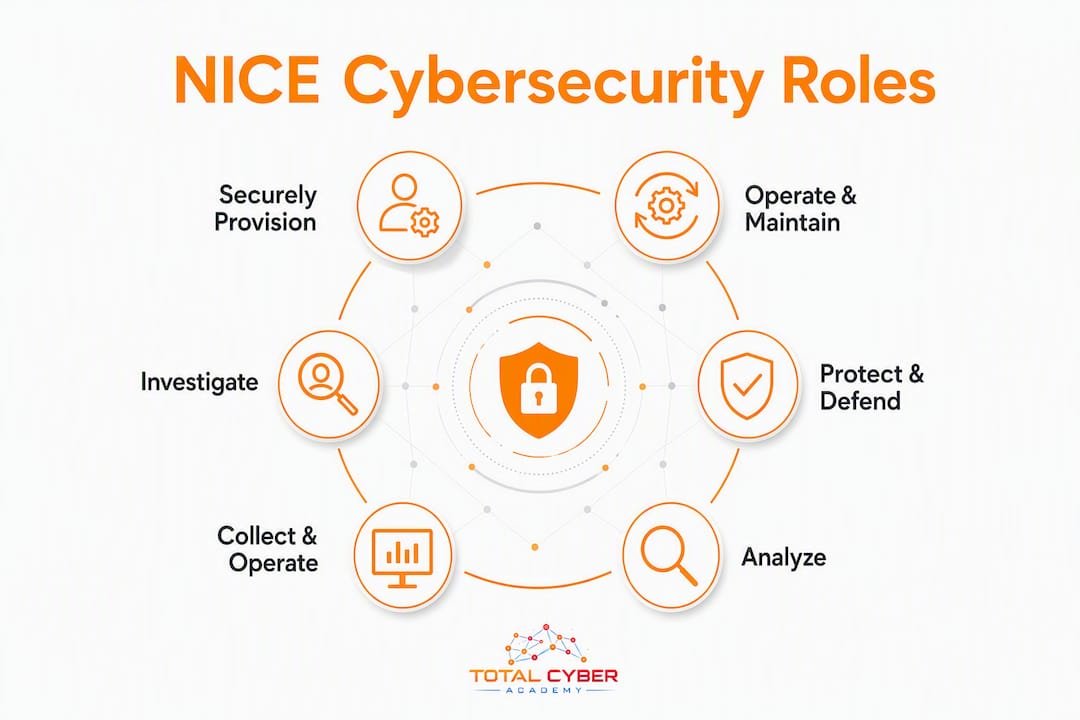
The NICE Framework (formally NIST SP 800-181) is a taxonomy, not a curriculum. It standardizes how cybersecurity work is described across public, private, and academic sectors, giving employers, educators, and learners a shared vocabulary. The Framework organizes work into seven high-level categories, each containing specialty areas and specific work roles, with every role defined by a set of tasks and corresponding KSAs.

The seven categories span the full operational lifecycle of cybersecurity work:
| Category | Typical role focus |
|---|---|
| Securely Provision | Design and build secure systems |
| Operate & Maintain | Keep infrastructure secure and running |
| Oversee & Govern | Policy, compliance, and risk management |
| Protect & Defend | Incident detection and network defense |
| Analyze | Threat intelligence and vulnerability analysis |
| Collect & Operate | Cyber operations and collection activities |
| Investigate | Digital forensics and incident response |
A “Vulnerability Assessment Analyst” in the Analyze category, for example, carries tasks such as conducting assessments of systems and networks, and KSAs covering knowledge of network protocols, skill in using vulnerability scanning tools, and the ability to interpret scan results. A “Cyber Defense Incident Responder” in Protect & Defend maps to tasks like analyzing malware and coordinating containment, with KSAs tied to intrusion detection and forensic analysis.
Pro Tip: Use the Framework as a diagnostic, not a syllabus. Pull the KSA list for your target work role, mark what you already know, and use the gaps to select specific hands-on training modules rather than enrolling in a broad survey course.
How do you find training through NICCS?
NICCS is the federal, searchable catalog for cybersecurity training, connecting learners with training providers, STEM programs, internships, scholarships, and competitions. Searching it effectively requires using its filters deliberately.

| Filter | What it controls | Practical use |
|---|---|---|
| Delivery method | Online, in-person, virtual instructor-led | Match to your schedule and learning style |
| Proficiency level | Beginner, intermediate, advanced | Avoid courses pitched above or below your current KSAs |
| Specialty area | Maps directly to NICE Framework categories | Narrow results to your target work role |
| Location | State or region | Relevant for in-person or hybrid programs |
Beyond the catalog, CISA Learning offers no-cost, on-demand courses covering a wide range of cybersecurity topics. Micro-challenges are particularly useful: they are short, hands-on exercises mapped to specific workforce roles, letting you experience the actual tasks of a role before spending money on a full training program. This diagnostic step reduces wasted training spend and focuses your attention on the KSAs employers actually require.
How does NICE mobilize community efforts?
NICE scales its impact through structured community mechanisms rather than operating as a purely federal program. The NICE Community Coordinating Council brings together representatives from government, industry, and academia to align priorities and share resources. Working groups within the council address specific challenges such as curriculum development, workforce metrics, and K-12 pipeline building.
CISA’s Cybersecurity Education & Career Development programs invest in K-12 outreach through CETAP, partnerships with organizations like CYBER.ORG, and train-the-trainer initiatives that equip educators to deliver cybersecurity content in classrooms that previously had none. Higher-education institutions can earn National Centers of Academic Excellence in Cybersecurity (NCAE-C) designations, signaling alignment with federal standards to students and employers alike.
NICE Career Week is an annual event that draws educators, employers, students, and workforce professionals together to share curriculum resources, explore career pathways, and coordinate hiring pipelines. Cooperative agreements and federal funding channels support community colleges and nonprofit partners in building local cybersecurity programs, particularly in underserved areas. For learners, these community structures mean that NICE-aligned training is increasingly available at the local level, not just through federal portals.
How can you use NICE to plan your cybersecurity career?
The Framework and NICCS tools work best when you follow a deliberate sequence rather than browsing at random.
- Pick a target work role. Use the Cyber Career Pathways tool on CISA’s site or browse NICE Framework categories to identify a role that matches your interests and the job market you want to enter.
- Run a gap analysis. Pull the full KSA list for that role. Mark the knowledge and skills you can already demonstrate, and flag the ones requiring hands-on practice or formal instruction.
- Choose training that closes specific gaps. Prioritize instructor-led labs and performance-based preparation over lecture-only courses. For roles in Protect & Defend or Investigate, certifications such as CompTIA Security+, EC-Council CEH, or ISC2 SSCP directly validate the KSAs employers screen for. Review the value of industry certifications before selecting a program.
- Test fit with no-cost resources first. Use NICCS micro-challenges and CISA Learning to confirm the role is the right target before committing to a paid program.
- Validate the program before enrolling. Look for explicit KSA mapping in the course description and confirm that lab time is included, not optional. Hands-on cybersecurity training is what separates job-ready candidates from those who can pass a multiple-choice exam but struggle in a live environment.
Pro Tip: Career changers should treat certifications as proof of competency, not just credentials. Employers hiring for NICE-aligned federal or contractor roles often screen resumes for CompTIA, EC-Council, or ISC2 credentials as a first filter, so pairing lab experience with a recognized cert shortens the hiring timeline considerably.
What is the legal basis for NICE?
15 U.S.C. 7443 directs the NIST Director to coordinate a national cybersecurity awareness and education program in consultation with federal agencies, educational institutions, and the private sector. This statutory mandate is what gives NICE its institutional permanence and ensures that federal workforce planning, grant funding, and agency hiring practices remain anchored to the Framework.
Practical implication for learners and employers: Federal agencies and contractors increasingly use NICE work role alignment as a baseline for position descriptions and hiring criteria. Aligning your skills and certifications to the Framework is not just academically useful — it directly improves your competitiveness for federal and federally-funded positions.
The statute also authorizes NIST to support formal cybersecurity education programs at all levels, from K-12 through graduate study, which is why NICE’s reach extends well beyond federal employment into community colleges, universities, and private training providers.
How Totalcyber aligns its courses to NICE roles
Totalcyber is a veteran-owned cybersecurity training organization with a formal partnership with (ISC)², and its programs are built around the KSA structures that NICE work roles require. The course-to-role mapping below shows how Totalcyber’s offerings connect to common Framework specialty areas.
| NICE specialty area | Totalcyber course focus | Primary certifications |
|---|---|---|
| Protect & Defend | Cybersecurity Engineering, network defense labs | CompTIA Security+, CySA+ |
| Analyze | Threat analysis, vulnerability assessment labs | CompTIA PenTest+, EC-Council CEH |
| Investigate | Incident response, digital forensics scenarios | EC-Council CHFI |
| Securely Provision | Cloud engineering, secure architecture | CompTIA Cloud+, ISC2 SSCP/CISSP |
| Operate & Maintain | IT operations, system administration | CompTIA A+, Network+ |
Every program includes instructor-led labs and performance-based assessments, which close the gap between knowing a KSA and demonstrating it under realistic conditions. Veterans benefit from dedicated support resources and scheduling flexibility designed around transition timelines. Totalcyber’s ISC2 partnership page details how the academy’s CISSP and SSCP prep programs align to the Oversee & Govern category of the Framework.
Key Takeaways
The NICE Framework is a career planning tool, not a training program; pairing it with hands-on, lab-based instruction and recognized certifications is the fastest path to a job-ready cybersecurity skill set.
| Point | Details |
|---|---|
| NICE is a taxonomy, not a curriculum | Use NIST SP 800-181 to identify target work roles and KSAs, then select training to close specific gaps. |
| NICCS is your first search stop | Filter by delivery method, proficiency level, and specialty area to find government-vetted training programs. |
| Test fit before paying | CISA micro-challenges and no-cost CISA Learning courses let you validate role fit before committing to premium training. |
| Certifications accelerate hiring | CompTIA, EC-Council, and ISC2 credentials map directly to NICE KSAs and serve as first-pass filters in federal and contractor hiring. |
| Totalcyber maps courses to NICE roles | Veteran-owned, ISC2-partnered programs cover Protect & Defend, Analyze, Investigate, and more with hands-on labs and cert prep. |
NICE alignment matters more than most learners realize
The cybersecurity workforce conversation tends to focus on the shortage of qualified professionals, but the more precise problem is a shortage of workers whose skills are verifiable in terms employers recognize. The NICE Framework addresses exactly that gap, yet most learners treat it as background reading rather than a planning instrument.
What practitioners consistently underestimate is how much the Framework’s KSA structure mirrors what hiring managers actually screen for. A job description for a federal SOC analyst and a NICE work role definition for a Cyber Defense Analyst are, in practice, nearly identical documents. Learners who map their training to those KSAs and validate them through lab-based certification programs enter interviews with a vocabulary and a skill set that aligns precisely with what the employer wrote in the posting.
The continuous learning mandate that CISA and NIST both emphasize is equally practical. Cybersecurity threats evolve faster than any single certification cycle, which means the learners who build recertification and ongoing lab practice into their career plans stay competitive longer than those who treat a single credential as a finish line. Continuous learning in IT is not a philosophical commitment; it is a career maintenance requirement.
Totalcyber’s NICE-aligned training programs
Totalcyber offers instructor-led and on-demand programs that map directly to NICE work roles across five specialty areas, covering everything from entry-level IT operations to advanced penetration testing and cloud engineering. Every course includes hands-on labs, interactive quizzes, and live mentoring, so you build demonstrable KSAs rather than passive knowledge.
Veterans receive dedicated scheduling support and transition-focused resources. CompTIA courses cover Security+, Network+, CySA+, and PenTest+, while EC-Council and ISC2 programs address the Analyze, Investigate, and Oversee & Govern categories of the Framework. Whether you are a career changer identifying your first NICE work role or an IT professional closing a specific KSA gap, Totalcyber’s programs give you a structured, lab-verified path to the credentials employers hire for. Review the full course catalog and check your training prerequisites to find the right starting point.
Useful sources
- NICE Framework on NICCS — Searchable taxonomy of work roles, KSAs, and tasks; the primary reference for role mapping and training alignment.
- NICE | NIST — NIST’s official NICE program page, including NIST SP 800-181 and Framework documentation.
- NICE Cybersecurity Workforce Framework | CISA — CISA’s implementation resources, employer guides, and the Cyber Career Pathways tool.
- Cybersecurity Education & Career Development | CISA — K-12 programs, NCAE-C designations, cooperative agreements, and educator resources.
- Cybersecurity Training & Exercises | CISA — CISA Learning (no-cost on-demand courses) and micro-challenges mapped to workforce roles.
- 15 U.S.C. 7443 (statutory text) — The federal statute directing NIST to coordinate the national cybersecurity education program.