
Personally identifiable information training for cybersecurity professionals is hands-on, role-focused instruction that teaches how to identify, protect, and manage personal data across system lifecycles using privacy-by-design, data minimization, and modern security architectures. If you are preparing for a privacy engineering, security engineering, or incident response role, here is what to prioritize:
- Core skills to build: data inventory and classification, encryption (TLS and application-level), access control and least privilege, DLP, tokenization, and incident response scoping
- Target certification: CDPSE (Certified Data Privacy Solutions Engineer) from ISACA, covering four technical domains and awarding 12 CPE credits upon completion
- Realistic timeline: 3 months of structured lab work and cert prep, followed by a few months of capstone or entry-level experience to reach job-ready status
- Governing standards: ISO/IEC 27001 Annex A 5.34, GDPR, and CCPA define the audit expectations your skills must satisfy
- Recommended training provider: Totalcyber delivers the hands-on labs, certification prep, and capstone projects that map directly to these requirements
Table of Contents
- What core technical skills do you need to protect PII?
- Which hands-on labs build real PII protection skills?
- Which certifications and job roles map to PII training?
- How do zero trust and supply-chain risk change PII protection?
- What do auditors expect from your PII policy and documentation?
- How do you evaluate and choose a PII-focused training program?
- How does Totalcyber prepare students for PII-focused cybersecurity roles?
- Key Takeaways
- The gap most PII training programs leave open
- Start your PII training with Totalcyber
- Useful sources and further reading
What core technical skills do you need to protect PII?
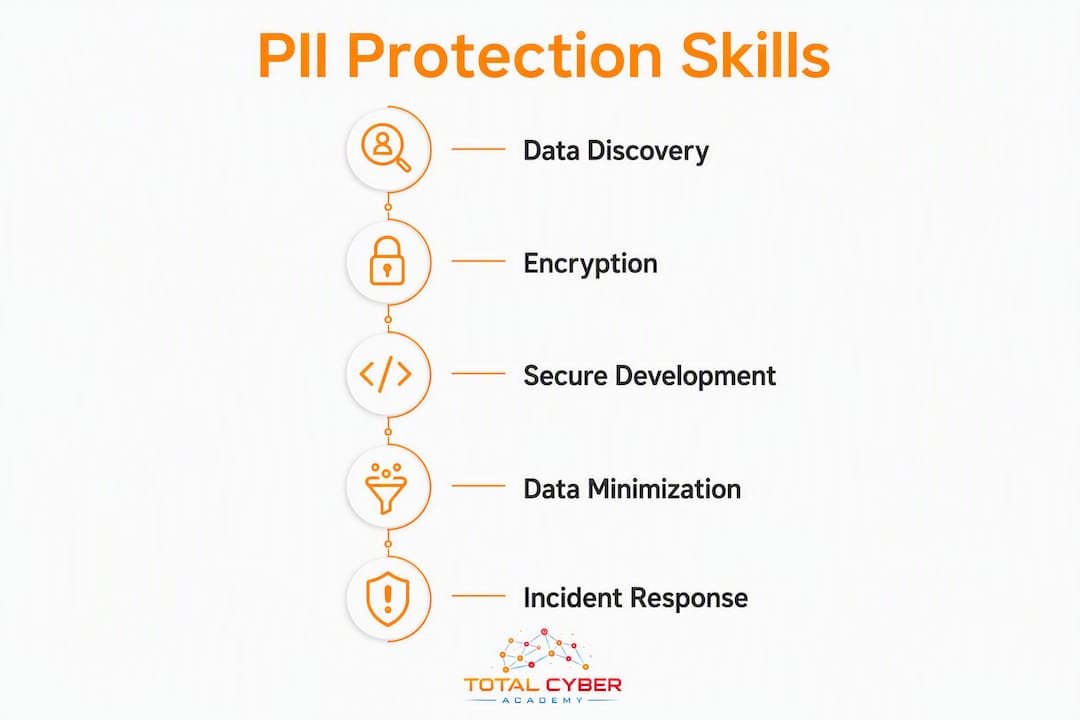
The skills hiring managers expect for PII-focused roles cluster around six technical areas: data discovery and classification, encryption, access control, data loss prevention, secure development, and incident response.
Data discovery and classification is the foundation. Before any control can be applied, you need to know where personal data lives, how it flows, and what sensitivity level it carries. Schema-level tagging, using markers like @pii, is operationally necessary because it drives automated redaction, data-subject-access-request (DSAR) exports, retention enforcement, and selective auditing. Without it, downstream systems cannot reliably apply the right controls.
Encryption covers two layers: transport security (TLS 1.2 or higher) and application-level encryption for data at rest. Access control builds on that with role-based access control (RBAC) and least-privilege principles, so only authorized personnel reach PII fields. DLP tools and logging pipelines then monitor for unauthorized movement or exposure.

Secure development means embedding privacy into the SDLC through DevSecOps practices, producing artifacts like Data Protection Impact Assessments (DPIAs) and secure-by-design reviews. Privacy engineering training that combines GDPR, CCPA, ISO 27701, and secure coding gives you the vocabulary and the deliverables employers expect.
Data minimization is one of the most effective controls and is frequently underweighted in early training. Storing a boolean for “over 18” instead of a full date of birth reduces exposed PII, shrinks retention complexity, and lowers breach impact. ISO/IEC 27001 Annex A 5.34 formalizes this expectation, requiring a topic-specific PII policy, a legal register, a PII inventory, appointed privacy roles, and role-specific training records.
Pro Tip: Tag PII at the schema level from day one of a project. A single @pii annotation on a database column lets your pipeline automatically apply redaction, enforce retention rules, and generate DSAR exports without manual intervention every time a request arrives.
Which hands-on labs build real PII protection skills?
The highest-impact labs to run, in order of foundational importance, include data inventory and tagging, applying the LINDDUN framework to identify privacy risks, data-flow mapping to trace PII, tokenization and masking of test datasets, and breach tabletop exercises. Success criteria should include completing relevant registers, documenting mitigations, verifying functional tokenization, and producing tabletop reports that assist in incident response planning.
A critical practice note: always use synthetic or anonymized data in lab environments. PII leaks commonly occur in logs, analytics pipelines, and non-production databases, which are less protected than primary datastores. Never seed production PII into a test environment, even temporarily.
Incident response training must emphasize precise scoping above speed. Rushing a public statement before confirming which fields and how many records were exposed typically worsens regulatory and reputational outcomes. Your tabletop should rehearse that discipline explicitly.
Which certifications and job roles map to PII training?
The most directly relevant certification for PII technical implementation is CDPSE. Complementary security certifications include CompTIA Security+ and ISC2 pathways, which build the underlying security engineering foundation.
| Certification | What it proves for PII work | Recommended audience | Continuing requirements |
|---|---|---|---|
| CDPSE | Technical privacy implementation across four domains: privacy governance, privacy architecture, data lifecycle, and advanced privacy engineering | Mid-level privacy or security engineers | —; training earns 12 CPE credits |
| CompTIA Security+ | Baseline security controls, access management, and incident response relevant to PII environments | Entry-level security practitioners | Renewal every 3 years via CEUs |
| ISC2 CISSP | Broad security architecture including data classification and lifecycle management | Senior security professionals | — |
The practical timeline works as follows. Spend an initial period on structured lab work covering data inventory, threat modeling, and encryption, while studying for CDPSE or Security+ concurrently. Schedule your certification exam at the end of that period. A subsequent period should focus on a capstone project that produces a ROPA, a DPIA, and a documented tabletop exercise. That artifact set is what moves a resume from “trained” to “job-ready” for privacy engineer, security engineer, and incident responder titles.
For study strategy, effective exam preparation pairs domain review with timed practice questions, so you build both conceptual fluency and exam-day pacing.
How do zero trust and supply-chain risk change PII protection?
Zero trust and supply-chain controls are now baseline for PII protection, not advanced options. The core principle: assume no implicit trust, apply microsegmentation, and continuously verify identity and access for every request touching personal data.
Zero trust architecture requires you to follow strong safeguards to protect sensitive PII in SaaS platforms:
- Microsegment PII environments so that a breach in one segment cannot traverse to another
- Enforce application-level encryption and manage keys separately from the data they protect
- Apply tokenization at API boundaries so downstream services never receive raw PII
- Monitor third-party telemetry continuously, since processors and analytics tools are frequent sources of unintentional exposure
Architecture principle: Microsegmentation and continuous identity verification are not optional hardening steps for PII domains. Every service that touches personal data should operate under the assumption that adjacent services are untrusted, and access should be re-verified at each boundary rather than inherited from a session.
Supply-chain risk deserves equal attention. Inventory every third-party processor, require contractual controls (data processing agreements, sub-processor clauses), and include vendor risk exercises in your lab work. Training that skips third-party telemetry monitoring leaves a significant gap, since copies and telemetry are a frequent source of unintentional PII exposure and are less protected than primary datastores.
What do auditors expect from your PII policy and documentation?
Auditors operating under ISO/IEC 27001 Annex A 5.34 expect six categories of evidence: a topic-specific PII policy, a legal register, a PII inventory or ROPA, appointed privacy responsibility, technical controls documentation, and role-specific training records.
A minimum-viable PII policy covers: scope and classification rules, handling procedures per lifecycle stage (collection, processing, storage, transfer, deletion), retention schedule, access rules, and a breach notification protocol with defined timelines.
| Policy element | Auditor artifact | Notes |
|---|---|---|
| PII classification rules | Data classification matrix | Must map sensitivity tiers to handling controls |
| Retention schedule | Automated deletion logs or policy doc | Tie retention rules to the PII inventory |
| Access control | RBAC configuration records | Show least-privilege enforcement |
| Breach notification protocol | Incident response plan + tabletop report | Include field-level scope and legal consultation step |
| Training records | Completion logs with assessment scores | Role-specific; technical staff need separate records from general staff |
| ROPA / PII inventory | Spreadsheet or GRC tool export | Must include processor names and legal basis |
Training records for technical staff are frequently the weakest link in audit evidence packages. Document completion dates, assessment scores, and the specific modules covered. A general “security awareness training completed” entry does not satisfy Annex A 5.34 for a privacy engineer role.
How do you evaluate and choose a PII-focused training program?
Choose programs that combine hands-on labs, role-specific curricula, CDPSE-aligned content, experienced instructors, and measurable capstone deliverables. A program that only covers regulatory theory without lab work will not produce job-ready practitioners.
Evaluation checklist:
- Does the program include a data inventory or ROPA lab with graded deliverables?
- Does the curriculum cover LINDDUN threat modeling and DevSecOps privacy integration?
- Are instructors credentialed practitioners with real-world privacy engineering or incident response experience?
- Does the program provide sandbox environments that persist long enough to complete a full capstone?
- Does the program map content to CDPSE domains or Security+ objectives explicitly?
Questions to ask during an enrollment call:
- “Can you show me a sample lab exercise for tokenization or data-flow mapping?”
- “What does the capstone project produce, and how is it graded?”
- “What is the instructor’s background in privacy engineering or incident response?”
- “Do students retain lab access after the course ends?”
- “What job titles do graduates typically pursue, and do you track placement outcomes?”
Programs that integrate privacy-by-design principles with secure development and DevSecOps deliver the most transferable skills. Regulatory theory alone does not prepare you to write a DPIA, configure a DLP rule, or lead a breach tabletop.
How does Totalcyber prepare students for PII-focused cybersecurity roles?
Totalcyber delivers hands-on labs, certification prep content across CompTIA, ISC2, and EC-Council pathways, and job-focused capstones that map directly to PII protection tasks. The academy’s ISC2 partnership and CompTIA tracks provide the certification scaffolding; the lab environments provide the practice.
Specific offerings relevant to PII work include:
- Instructor-led and self-paced modules covering security engineering, incident response, and privacy-by-design principles
- Lab sandboxes where students practice data inventory, access control configuration, and secure logging
- Capstone projects that produce a PII inventory and a documented incident tabletop exercise
- Policy and audit practice modules aligned to ISO/IEC 27001 Annex A 5.34 expectations
- Veteran support programs, including SkillBridge and GI Bill pathways, for transitioning service members
Key Takeaways
Effective personally identifiable information training for cybersecurity roles requires hands-on labs, schema-level data classification, CDPSE certification preparation, and audit-ready policy artifacts produced within a 3–6 month structured roadmap.
| Point | Details |
|---|---|
| Start with data inventory | Build a ROPA for a sample app and apply schema-level @pii tags before studying any other control. |
| Target CDPSE first | CDPSE covers four technical privacy domains and training earns 12 CPE credits toward the credential. |
| Run three core labs | Complete tokenization, LINDDUN threat modeling, and a breach tabletop to cover the highest-priority skill gaps. |
| Produce audit artifacts | Create a PII policy, retention schedule, and training records that satisfy ISO/IEC 27001 Annex A 5.34 expectations. |
| Train with Totalcyber | Totalcyber’s hands-on labs, ISC2 and CompTIA cert prep, and capstone projects map directly to PII-focused job roles. |
The gap most PII training programs leave open
Most programs teach privacy law well and technical controls adequately, but almost none train practitioners on the discipline of not acting during a breach. The instinct to communicate quickly is understandable, but incident response for PII requires confirming field-level scope and record counts before any public statement. Rushing that step typically worsens both regulatory and reputational outcomes.
The same gap appears in how programs treat data minimization. Storing a boolean instead of a full date of birth is not a minor optimization; it is a design decision that reduces breach impact, shrinks retention obligations, and simplifies audit evidence. Training that covers this as a footnote to GDPR compliance misses the point. It is an architectural discipline that should be practiced in labs from day one.
The programs worth your time are the ones that force you to produce artifacts under pressure: a ROPA with real classification decisions, a tabletop report that includes a legal consultation step, a DPIA that identifies mitigations. Theory you can read in a weekend. The artifact discipline takes months to build, and it is exactly what hiring managers check.
Start your PII training with Totalcyber
Totalcyber’s career-focused cybersecurity programs give you the lab environments, certification prep, and capstone deliverables to move from training to employment in a structured 3–6 month timeline. Veterans, career changers, and entry-level IT professionals get the same rigorous, hands-on curriculum that maps directly to privacy engineer and security engineer job requirements.
Two ways to get started: enroll in a self-paced cybersecurity program to begin lab work immediately, or review the beginner’s career guide to confirm which track fits your current skill level and certification goals. Both paths lead to the same outcome: job-ready skills, documented artifacts, and a certification roadmap you can execute.
Useful sources and further reading
The sources below are the authoritative references a PII-focused practitioner should read alongside any training program. Each one addresses a specific layer of the technical and regulatory knowledge you need.
| Source | Why it matters for your training |
|---|---|
| NIST Guide to Protecting the Confidentiality of PII | The foundational U.S. federal standard; defines PII categories, confidentiality impact levels, and training requirements for system access |
| FTC: Protecting Personal Information — A Guide for Business | Practical U.S. regulatory guidance on physical security, electronic controls, and training obligations for organizations handling PII |
| ISACA CDPSE Credential Page | Official exam outline, four domain descriptions, and CPE requirements for the primary technical privacy certification |
| ISO 27001 Control 5.34 — UpGuard | Detailed breakdown of Annex A 5.34 audit expectations: PII policy, ROPA, DPO appointment, encryption configs, and training records |
| SecurityScorecard: What Is PII? How to Protect PII | Zero trust architecture guidance and supply-chain risk controls applied specifically to PII protection |
| Safeguard.sh: PII Security and Compliance Guide | Practical engineering guide covering schema tagging, data minimization, breach scoping, and telemetry risks |
| Data Protection Institute: Privacy by Design for Developers | LINDDUN threat modeling methodology and privacy-by-design implementation for technical practitioners |
This article provides general information about cybersecurity training and PII protection practices. It is not legal or compliance advice. Confirm current regulatory requirements with a qualified privacy professional or the relevant primary source for your jurisdiction.
Recommended
- On-the-Job Training in IT: What You Need to Know – Total Cyber Academy!
- Identity and Access Management – The Future of IAM – Total Cyber Academy!
- Cybersecurity Training Explained: A Beginner’s Career Guide – Total Cyber Academy!
- Cybersecurity Job Interview Preparation Guide 2026 – Total Cyber Academy!