
Veterans, career changers, and entry-level IT professionals ready to enter cybersecurity have one clear first move: earn CompTIA Security+ through a hands-on, lab-based training program. Register for a free CISA Learning account today, map your current skills to the NICE Framework work role, and schedule your Security+ exam within 90 days. Totalcyber’s instructor-led courses are built specifically for this audience, combining lab environments, exam prep, and veteran-specific mentorship.
Immediate actions:
- Create a free CISA Learning account at niccs.cisa.gov and complete at least one NICE-aligned course module this week.
- Contact Totalcyber to review your veteran cybersecurity certification path and confirm whether GI Bill® or VR&E funding applies to your situation.
Key Takeaways
The single most effective move for veterans and career changers entering cybersecurity is earning CompTIA Security+ through a hands-on, lab-based program while verifying VR&E eligibility before spending GI Bill® credits.
| Point | Details |
|---|---|
| Start with Security+ | CompTIA Security+ satisfies DoD 8570/8140 IAT Level II and is the hiring threshold for most entry federal and contractor roles. |
| Use free federal resources first | CISA Learning, CyberSkills2Work, and CyberVetsUSA provide no-cost training mapped to NICE work roles. |
| Check VR&E before GI Bill® | VR&E funds prep courses and exam fees with no per-test cap; GI Bill® reimburses exam fees up to $2,000 and excludes prep courses. |
| Translate military language | Map your MOS/AFSC to NICE work roles using the NIST Cyber Career Map and rewrite resume bullets around civilian outcomes. |
| Totalcyber for structured training | Totalcyber offers veteran-owned, lab-based CompTIA, EC-Council, and ISC2 prep with SkillBridge and GI Bill® support. |
Table of Contents
- Who is this training for, and which career path fits you?
- Federal and free veteran training resources worth using
- What does a smart certification roadmap look like?
- How do you choose a training provider without getting burned?
- How veterans translate military experience into civilian cybersecurity roles
- Why hands-on labs and CTFs matter more than lecture hours
- How Totalcyber supports veterans and career changers
- Totalcyber: veteran-owned training built for this transition
- The credential-first approach is right, but most programs get the execution wrong
- Sources
Who is this training for, and which career path fits you?
Three realistic entry pathways exist, each with a different timeline and starting point.
-
Career changer / bootcamp route. You have no IT background but strong analytical or problem-solving skills. A focused 6–12 month plan combining Security+ study with hands-on labs can qualify you for SOC Analyst I or IT support roles. First credential: CompTIA Security+. First step: enroll in a structured, lab-based prep course.
-
Veteran leveraging federal benefits and SkillBridge. Your MOS or AFSC already maps to NICE work roles in network operations, intelligence analysis, or systems administration. Use your final 180 days of service for a SkillBridge cybersecurity program, confirm VR&E eligibility before spending GI Bill® credits, and target Security+ as your first civilian credential. Timeline: 3–6 months to first cert.
-
IT support to SOC analyst route. You already hold CompTIA A+ or Network+ and work a helpdesk role. The gap to close is security-specific knowledge and lab experience. Add Security+, then CySA+ within 12 months. First step: audit your current skills against the NICE Cyber Career Map maintained by NIST and identify the shortest path to a defensive security role.
Federal and free veteran training resources worth using
The VA and federal agencies have built a genuine ecosystem of no-cost training that most veterans underuse. Here is what each program provides and how to access it.
| Program | What it funds | Eligibility | How to access |
|---|---|---|---|
| CISA Learning (FedVTE replacement) | On-demand courses mapped to NICE work roles | Veterans, active duty, government employees | Register via niccs.cisa.gov using ID.me or Hire Our Heroes |
| CyberSkills2Work | Accelerated training + job placement support | Transitioning veterans and unemployed civilians | Apply through participating community colleges |
| CyberVetsUSA | Free cybersecurity training and mentorship | U.S. veterans | Register at cybervetsusa.org |
| VetSuccess Academy | SANS-affiliated training for veterans | Eligible veterans | Apply through SANS VetSuccess program page |
| NPower SkillBridge | Tech training during final 180 days of service | Active-duty transitioning service members | Coordinate with your unit’s SkillBridge coordinator |
| CyberCorps®: Scholarship for Service (SFS) | Full tuition + stipend at CAE-designated schools | Students at NSA/DHS CAE institutions | Apply through participating universities |
| NSA/DHS CAE Programs | Nationally designated academic programs | Students enrolling at CAE schools | Search the CAE school directory at niccs.cisa.gov |
Practical registration tips:
- CISA Learning requires identity verification through ID.me or a Hire Our Heroes account. Set this up before your separation date so access is immediate.
- SkillBridge approval takes 30–90 days. Submit your request at least four months before your end-of-service date.
- CyberCorps® SFS is competitive and requires enrollment at a designated CAE institution. Check the school list early if you plan to pursue a degree alongside training.
- Veteran cybersecurity workforce initiatives change eligibility rules periodically. Verify current requirements directly with each program before applying.
What does a smart certification roadmap look like?
Certifications drive hiring more than degrees at the entry and mid levels of cybersecurity. The sequence below reflects what employers actually screen for.
Security+ is the entry point for a reason: it satisfies DoD 8570/8140 IAT Level II requirements, which means federal contractors and agencies treat it as a hiring threshold, not just a preference. Veterans pursuing federal roles should earn Security+ before any other cert. CISSP requires five years of experience, but veterans can often use GI Bill® benefits to fund advanced cert training once they meet the experience threshold.
Exam prep checklist:
- Allocate a substantial number of study hours for Security+, split between reading, video instruction, and lab practice.
- Complete at least two full-length practice exams before your test date.
- Use lab environments (not just flashcards) to reinforce network scanning, access control, and incident response concepts.
- Schedule your exam date first. A fixed deadline prevents indefinite preparation.
Pro Tip: VR&E can fund exam fees and prep courses via Purchase Orders with no per-test cap, while GI Bill® testing reimbursements cover exam fees up to $2,000 and typically do not fund prep courses. Check VR&E eligibility before spending GI Bill® credits on certification prep.
How do you choose a training provider without getting burned?
The cybersecurity training market includes programs that charge premium prices for lecture-heavy content with no lab access. Avoid them.
Evaluation checklist — ask every provider these questions:
- Do students get hands-on lab access, or is training video-only?
- Are exam vouchers included, or sold separately at full price?
- What is the documented pass rate for the certification this course prepares for?
- Does the program offer instructor access or mentorship hours, or only recorded content?
- Is there a refund or retake policy if you fail the exam?
- Does the provider have documented experience working with GI Bill® or VR&E funding?
Red flags to walk away from:
- No hands-on lab environment at all.
- Vague placement claims (“most graduates find jobs”) with no documented outcomes.
- Accreditation language that implies degree-granting authority the provider does not hold.
- Fixed-price bundles with no itemized breakdown of what is included.
On funding: VR&E covers prep courses and exam fees through Purchase Orders, which means the VA pays the provider directly. GI Bill® reimburses exam fees up to $2,000 per test but does not fund prep courses. Confirm your eligibility with a Vocational Rehabilitation Counselor before selecting a provider, because the funding mechanism determines which providers you can use.
How veterans translate military experience into civilian cybersecurity roles
Veterans bring real operational strengths to cybersecurity: threat assessment, situational awareness, and disciplined incident response. The gap is language, not capability.
MOS/AFSC to civilian role translations:
- 25B (IT Specialist) → Network Security Analyst or Systems Administrator
- 35L (Counterintelligence Agent) → Threat Intelligence Analyst
- 17C (Cyber Operations Specialist) → SOC Analyst or Penetration Tester
- 3D0X2 (Cyber Systems Operations) → Security Engineer or Cloud Security Specialist
Resume language swap examples:
- Before: “Maintained SIPR and NIPR network infrastructure for a 500-person battalion.”
- After: “Administered classified and unclassified network environments supporting 500+ users, enforcing access controls and monitoring for unauthorized activity.”
In interviews, lead with outcomes and mission context rather than acronyms. “I reduced network downtime by 40% during a six-month deployment” communicates more to a civilian hiring manager than any MOS code. The NIST Cyber Career Map lets you cross-reference your military duties with NICE work roles and identify the exact civilian job titles your background supports.
Targeted hiring channels: VetSec (community Slack), CyberVetsUSA mentorship network, SkillBridge employer lists, and federal hiring fairs where a security clearance accelerates the process significantly. Use the military skills to IT career guide to build a targeted outreach message before attending.
Pro Tip: Send a short, specific LinkedIn message to a veteran already working in the role you want: “I’m transitioning from [MOS] and targeting SOC Analyst roles. Would you have 15 minutes to share what your hiring process looked like?” A direct, specific ask gets responses. A generic connection request does not.
Why hands-on labs and CTFs matter more than lecture hours
Employers screening entry-level candidates cannot verify what a candidate learned from a video course. They can verify what a candidate built, broke, and fixed in a lab. Hands-on cybersecurity training accelerates skill retention and produces portfolio evidence that lecture-only study cannot.
Lab quality checklist:
- Ephemeral VM snapshots that reset between exercises, preventing carryover errors.
- Scoring and metrics that show progress and identify weak areas.
- Realistic scenarios (phishing analysis, log review, vulnerability scanning) rather than abstract exercises.
- Guided walkthroughs for beginners, with unguided challenges for intermediate learners.
- Replayability so you can repeat a scenario until the technique is solid.
Capture the Flag competitions add a competitive dimension that employers notice. A beginner CTF path typically starts with web application challenges (SQL injection, XSS), moves to binary exploitation basics, and progresses to network forensics. Completing documented CTF challenges and including scores or placement results in a resume or LinkedIn profile gives hiring managers concrete evidence of practical ability.
Pro Tip: Screenshot your lab completion reports and CTF scoreboards. Attach them to job applications as a supplemental portfolio document. Most candidates submit only a resume. A one-page lab summary with documented outcomes stands out immediately.
How Totalcyber supports veterans and career changers
Totalcyber is a veteran-owned cybersecurity training organization that prepares students for CompTIA, EC-Council, and ISC2 certification exams through instructor-led and on-demand courses with integrated lab access. Programs cover cybersecurity engineering, penetration testing, IT operations, and cloud engineering.
What the programs include:
- Hands-on lab environments with realistic scenarios and guided walkthroughs.
- Live instructor access and mentorship sessions, not just recorded video.
- Exam preparation with practice exams and interactive quizzes.
- SkillBridge pathway support and GI Bill®/VR&E guidance for eligible veterans.
- Career prep support focused on placement outcomes, not just certification.
Totalcyber’s CompTIA course catalog includes Security+, CySA+, and related prep programs. The SkillBridge program page outlines how active-duty service members can use their final 180 days for structured cybersecurity training. Totalcyber’s team has competed and placed first at the CompTIA Partner Summit CTF, which reflects the practical, competition-tested approach embedded in the curriculum.
Pro Tip: Before enrolling anywhere, confirm your funding method with a VRC or education counselor. Totalcyber’s team can walk you through which courses qualify under GI Bill® or VR&E and what documentation you need to submit.
Totalcyber: veteran-owned training built for this transition
Veteran-owned and career-focused, Totalcyber delivers what most online platforms do not: live instructors, real lab environments, and a team that understands the military-to-civilian transition from the inside. Where self-paced video libraries leave you to figure out exam strategy and job placement alone, Totalcyber structures the entire path from first lab to first job offer.
The cybersecurity training programs at Totalcyber are available online and in person, with enrollment options for veterans using GI Bill®, VR&E, or SkillBridge. Review the course catalog, confirm your funding eligibility, and speak with an advisor about which certification track fits your background and timeline.
The credential-first approach is right, but most programs get the execution wrong
The conventional advice for veterans entering cybersecurity is sound in outline: earn Security+, get hands-on practice, leverage federal programs. Where most guidance falls short is in the execution layer. Veterans are told to “use their benefits” without being told that VR&E and GI Bill® fund fundamentally different things, and choosing the wrong one costs money and time. They are told to “get hands-on experience” without being told what a quality lab environment actually looks like versus a marketing claim.
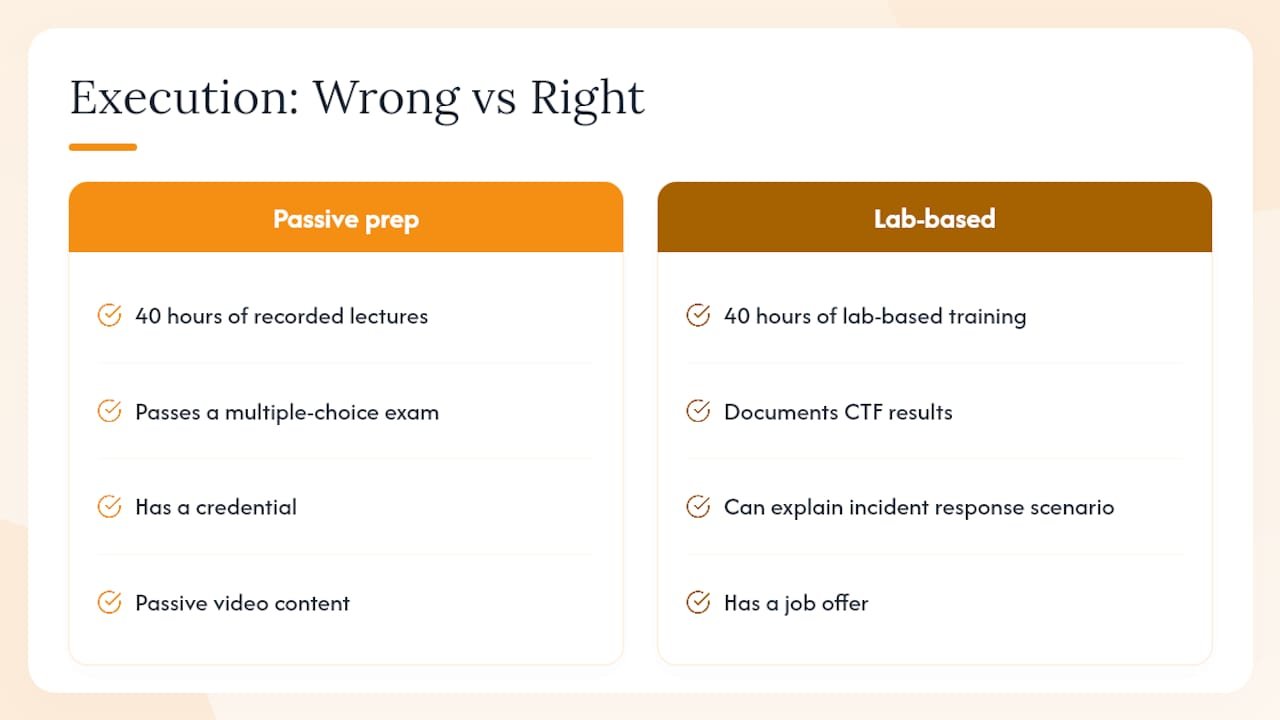
The deeper problem is that the cybersecurity training market is full of programs that sell certification prep but deliver passive video content. A veteran who completes 40 hours of recorded lectures and passes a multiple-choice exam has a credential. A veteran who completes 40 hours of lab-based training, documents CTF results, and can walk an interviewer through a real incident response scenario has a job offer. Those are not the same outcome, and the difference is entirely in how the training is structured.
Veterans already possess the discipline, threat awareness, and operational mindset that cybersecurity roles demand. The translation problem is real but solvable, and it is primarily a language and framing problem, not a skills gap. Pair that foundation with a Security±first cert roadmap, a lab-heavy training program, and a mentor who has made the same transition, and the path from service to SOC analyst is shorter than most people expect.
Sources
- Veterans are an obvious fit for cybersecurity, but tailored support ensures they succeed | CSO Online
- Cybersecurity training and education for veterans | NICCS (CISA)
- Veterans can take advantage in free cybersecurity training | U.S. Department of Veterans Affairs
- Veteran resources | NIST
- How to Switch Careers to Cybersecurity: A Complete Guide | Traecta
- Military to Cybersecurity: Complete Transition Guide for Veterans | Military Transition Toolkit
Recommended
- CompTIA vs. SANS Training for Veterans: Start Here – Total Cyber Academy!
- The Role of Military Skills in IT: A 2026 Career Guide – Total Cyber Academy!
- Veteran Cybersecurity Certification Study Guide 2026 – Total Cyber Academy!
- Cybersecurity Workforce Veteran Initiatives: 2026 Guide – Total Cyber Academy!