
The fastest practical route into a cloud career is to earn a foundational certification aligned to the specific entry role you want, then back it with guided hands-on practice for 4 to 12 weeks. This combination builds job-ready cloud literacy without wasted motion. Exam fees vary by vendor and region, and most credentials require recertification, so planning the sequence in advance matters as much as passing the first exam.
TL;DR:
- Foundational exams test concepts, while associate exams require console familiarity; CompTIA Cloud+ recommends two to three years of systems administration or networking experience.
- Choose vendor specific study when three of five local job postings name the same platform; otherwise, a vendor neutral credential preserves flexibility.
- Plan 4 to 12 weeks of study, including guided labs and at least two timed practice exams; review topics where scores fall below 70%.
- AWS offers 50% off your next certification exam after your first pass, so plan a second exam if you intend to follow its certification track.
- Pair your certification with a documented lab project, such as a deployed web app or storage setup, to show practical skills beyond exam knowledge.
Table of Contents
- 1. What Counts as an Entry-Level Cloud Certification?
- 2. Beginner-Friendly Certification Categories and the First Jobs They Unlock
- 3. Realistic Study Timeline, Exam Costs, and Testing Logistics
- 4. How to Pick Your First Certification: A Decision Checklist
- 5. Practical 8 to 12 Week Study Plan to Pass a Foundational Cloud Certification
- 6. How Total Cyber Academy Helps Beginners Prepare for Cloud Certifications
- 7. Author’s Perspective: Start Practical, Then Specialize
- How Total Cyber Academy Gets You Exam-Ready
- FAQ
- Sources
1. What Counts as an Entry-Level Cloud Certification?
Cloud certifications are not all built for the same audience, and confusing one tier with another is the most common mistake we see beginners make. A true foundational certification assumes no technical background at all. It tests whether you understand cloud concepts, billing models, and basic service categories, not whether you can configure infrastructure. An associate-level certification is a different animal: it assumes you have already spent time inside a cloud console, writing configurations or troubleshooting deployed resources.
The AWS Certified Cloud Practitioner is the clearest example of a genuinely beginner-friendly credential. Amazon’s own exam description states it validates foundational, high-level knowledge and is designed for candidates without an IT background, which makes it a sensible starting point for someone switching careers or entering the workforce for the first time.
Associate-level exams expect something closer to real experience. Google Cloud’s own guidance for the Associate Cloud Engineer exam recommends hands-on experience before attempting it, and it describes skills tied to deploying, monitoring, and managing applications rather than simply recognizing cloud terminology. Beginners who skip straight to this tier often find themselves memorizing answers instead of understanding the material, which rarely survives a scenario-based question.
Vendor-neutral credentials add another wrinkle. Industry guidance on CompTIA’s Cloud+ exam notes that while it is sometimes marketed as beginner-friendly, the certification actually recommends two to three years of systems administration or networking experience before candidates attempt it, which puts it closer to a mid-tier credential than a true starting point.
Here is how the three groups typically sort by audience:
- Non-technical staff and total beginners fit best with foundational exams that test vocabulary and concepts, not configuration skills.
- Early-career IT workers with a few months of helpdesk or support experience can usually handle foundational exams quickly and may be ready for associate-level study within a year.
- Hands-on operators who already manage servers, networks, or virtual machines are the intended audience for associate and professional tiers.
Before registering for any exam, build light confidence in a few prerequisite areas: basic Linux or Windows command-line navigation, an understanding of IP addressing and DNS, and familiarity with the idea of virtualization. None of this requires a separate certification first. A weekend of focused reading or a short lab session is usually enough to remove the biggest knowledge gaps.
2. Beginner-Friendly Certification Categories and the First Jobs They Unlock
Choosing a certification by job outcome, rather than by brand recognition, keeps the decision grounded. Each category below maps to a distinct set of entry titles and a logical next step once you pass.
- Foundational cloud literacy certifications cover billing models, shared responsibility, core service categories, and basic security concepts. These map to titles like cloud support associate, junior IT technician, or helpdesk analyst with cloud exposure. The sensible next step after passing is an associate-level exam from the same vendor, since the vocabulary and console familiarity carry over directly.
- Entry engineer or associate-track certifications test configuration, deployment, and troubleshooting inside a specific platform’s console. They suit candidates already comfortable with a command line who are targeting titles such as cloud engineer, systems administrator, or DevOps support technician. The logical follow-up is a role-based associate certification in networking, security, or data, depending on where the job market points.
- Cloud security fundamentals certifications focus on identity management, access controls, encryption basics, and compliance concepts specific to cloud environments. These fit candidates aiming at titles like cloud security analyst or security operations technician, and pair well with our beginner-focused security skills guide for readers who want to specialize early. The next step is typically a security-focused associate exam or a vendor-neutral credential like Security+.
- Data-focused fundamentals certifications introduce database types, basic analytics services, and storage tiers without requiring scripting skills. They map to titles like junior data analyst or BI support technician, and the next step is usually a data engineering associate exam once the candidate has written queries or built a small pipeline.
The decision between a vendor-neutral fundamentals path and a vendor-specific associate path comes down to how certain you already are about which cloud platform your target employer uses. Job listings in your region are the most reliable signal: if three out of five postings for the role you want mention a specific platform, start there. If listings are mixed or vague about platform, a vendor-neutral foundation keeps your options open while you decide. There is no prize for skipping the foundational tier. Hiring managers screening entry-level resumes are usually looking for evidence that you understand cloud concepts at all, not for a credential stack that outpaces your actual experience.
3. Realistic Study Timeline, Exam Costs, and Testing Logistics
Most learners starting from zero cloud knowledge can prepare for a foundational exam with several weeks of study, typically between one to three months depending on schedule and technical background. Cramming a foundational exam into a single weekend is possible for some, but it tends to produce shaky knowledge that will not survive a follow-up technical interview.
A gap worth knowing: AWS offers a 50% discount on your next certification exam once you pass your first one, which makes planning a two-exam sequence within the discount window financially worthwhile if you are committed to a specific vendor track.
Exam fees vary by vendor and by region, so confirm current pricing directly on the vendor’s own certification page before registering rather than relying on a figure from a blog or forum. AWS publishes its exam fee structure and recertification policies directly, including lower-cost renewal paths for some credentials, such as recertifying through a hands-on challenge rather than a full retake.
A few logistics decisions matter more than most beginners expect:
- Choose remote proctoring for convenience, since most vendors allow online testing with a webcam and ID check, though a quiet, enclosed space is required.
- Use a test center if your home setup is unreliable, since remote proctoring software can flag background noise or a cluttered desk as a violation.
- Register certifications under a personal account, never only a work account, because Microsoft’s own AZ-900 exam guidance warns that certification records are tied to your Microsoft Learn profile, and losing access to a work account can mean losing access to your certification record.
- Save your certificate and transcript locally immediately after passing, regardless of vendor, as a backup to the vendor portal.
Recertification windows typically run two to three years depending on the vendor and credential level, and many providers now offer lower-effort renewal paths such as short requalification activities instead of a full exam retake. Building this into your plan from day one avoids an unpleasant surprise two years into your first cloud role.
4. How to Pick Your First Certification: A Decision Checklist
Picking a first certification works best as a short series of yes-or-no questions rather than an open-ended search through every vendor’s catalog. Answer these in order:
- What job title are you actually targeting? Write down three real job postings for that title and note which cloud platform, if any, they mention repeatedly.
- What technical skills do you already have? Be honest about command-line comfort, networking basics, and whether you have ever touched a cloud console at all.
- What does the employer side of those postings expect? Scan the postings for whether they list a specific certification by name or simply mention “cloud experience” generically.
- What is your real study budget, in both hours and dollars? A 12-week timeline with 5 hours a week is very different from a 4-week sprint with 15 hours a week, and your answer should match your actual schedule, not an aspirational one.
- Does the certification you are considering match your current experience level, based on the vendor’s own recommended prerequisites, rather than its marketing description?
Running through job postings this way does double duty: it validates demand for the role and tells you which vendor ecosystem to study. If postings are split evenly across platforms, a vendor-neutral foundation keeps you flexible.
Pro Tip: Pair your fundamentals certification with a small hands-on lab or a one-page portfolio project, such as deploying a basic web app or configuring a storage bucket, since a certificate alone rarely distinguishes you from other entry-level applicants.
The checklist above also protects against a common trap: choosing a certification because it looks impressive rather than because it matches a job you can realistically get in the next six months. A foundational AWS, Azure, or Google Cloud credential paired with a documented lab exercise beats an associate-level certification earned through memorization without hands-on context.
5. Practical 8 to 12 Week Study Plan to Pass a Foundational Cloud Certification
A structured plan beats open-ended studying because it forces you to touch hands-on material early instead of only reading slides until exam week. Here is a sequence that works across AWS, Azure, or Google Cloud’s foundational exams with minor adjustments for platform-specific terminology.
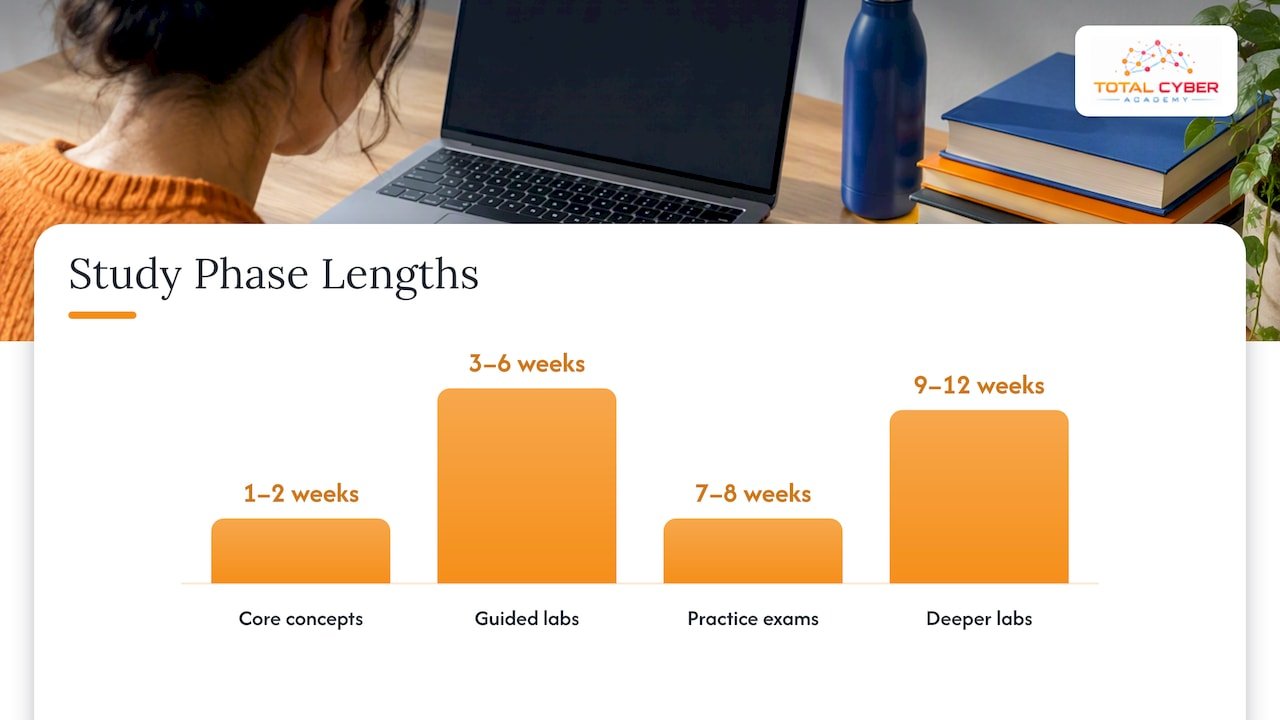
- Weeks 1 to 2: core concepts and vocabulary. Learn the shared responsibility model, basic billing structures, and the difference between compute, storage, and networking services. Spend time in the vendor’s free-tier console just clicking around, even without a specific task in mind.
- Weeks 3 to 6: platform fundamentals and guided labs. Work through structured labs covering identity and access management, basic storage configuration, and simple compute deployment. This is the phase where a structured 90-day plan can keep you from drifting between disconnected tutorials.
- Weeks 7 to 8: practice exams and targeted revision. Take at least two full-length practice exams under timed conditions, then spend any remaining study time only on the topics where you scored below 70%. This phase is where most candidates discover gaps that reading alone never surfaced.
- Weeks 9 to 12 (optional, for slower starts or working learners): deeper labs and a capstone project. Build one small project, such as a static website hosted on cloud storage with a basic content delivery setup, and document it in a short write-up you can show an interviewer.
Minimal portfolio projects do not need to be elaborate. A single deployed application, a documented troubleshooting exercise, or even a screenshot-backed walkthrough of a lab you completed gives an interviewer something concrete to ask about, which matters more at the entry level than an impressive-sounding project you cannot explain in detail.
The time before the test date gives you time to revisit weak areas without losing the momentum of having already committed to a test date. Readers targeting a security-adjacent first role can run this same structure alongside our career starter guide for cloud security skills to cover both tracks in parallel rather than sequentially.
6. How Total Cyber Academy Helps Beginners Prepare for Cloud Certifications
We built our training around the gap between passing an exam and actually being ready for the job that follows. Our CompTIA Cloud+ On-Demand Course walks beginners through cloud fundamentals with structured labs rather than slide decks alone, and our CompTIA Network+ (009) On-Demand Course covers the networking foundation that makes cloud concepts click faster for anyone starting from zero.
Live mentoring sets this approach apart from self-study. Students working through on-demand and instructor-led courses get access to real-time guidance from working cybersecurity and IT professionals, which matters most when a lab error does not match anything in a troubleshooting guide. The programs are designed with veterans and career changers in mind, offering flexible scheduling around work and family commitments rather than a one-size-fits-all cohort calendar.
The practical move for most beginners is combining the official vendor exam guide, which tells you exactly what will be tested, with structured lab time that builds the muscle memory a multiple-choice exam cannot teach on its own. Our Cloud Engineer Program bundles that lab work with mentorship and career guidance aimed at shortening the distance between certification and an actual job offer, which is the part most self-study paths leave entirely to chance.
7. Author’s Perspective: Start Practical, Then Specialize
The certification that gets beginners hired fastest is rarely the most advanced one they can pass. It is the foundational credential that matches a real job posting, backed by a small hands-on project that proves the knowledge is not just memorized. We see candidates chase associate-level exams before they have touched a console, and the interviews that follow expose the gap immediately.
The sequence that works is fundamentals first, then an associate or role-based credential once you have logged real hands-on hours, then specialization once you know which part of cloud work you actually enjoy. Hiring managers reward demonstrated competence over credential stacking almost every time.
— Alden
How Total Cyber Academy Gets You Exam-Ready
Picking the right first certification is only half the work. Studying for it with structured labs and real feedback is what actually gets you hired, and that is where our on-demand and instructor-led courses earn their place. Our CompTIA Cloud+ Live Course pairs guided instruction with hands-on practice, and we built our veteran-friendly scheduling and mentorship specifically for learners who cannot afford to waste study hours on the wrong material.
If you are ready to move from reading about cloud fundamentals to actually practicing them, visit our course catalog to compare on-demand and live options, or review our Cloud Engineer Program for a full pathway with mentorship built in.
FAQ
What Certifications Do You Need to Become a Cloud Engineer?
Most cloud engineers start with a foundational certification like AWS Certified Cloud Practitioner, then move to a platform-specific associate certification such as the Associate Cloud Engineer exam, which Google recommends pursuing with 6 or more months of hands-on experience. A vendor-neutral networking credential often rounds out the foundation before specializing further.
Is CCSP Entry Level?
No, CCSP is not an entry-level certification; it is designed for experienced security practitioners and generally requires several years of relevant work experience before candidates qualify to sit the exam. Beginners interested in cloud security should start with a foundational cloud certification and a vendor-neutral security credential instead.
Can I Learn Cloud in 3 Months?
You can realistically prepare for a foundational cloud certification exam in a 4 to 12 week window with consistent weekly study, which fits within a 3-month timeframe for most beginners. Full cloud engineering competency takes longer, but a foundational credential paired with a small hands-on project is an achievable 3-month goal.
Is OCI Certification Still Free?
Certification pricing and promotional offers change over time and vary by exam level and region, so confirm current fees directly on the vendor’s own certification page before assuming a past promotion still applies. Always check the official exam page for the most current pricing rather than relying on older guides.
Sources
Confirm fees, prerequisites, and exam outlines directly from vendor sources: the AWS Certified Cloud Practitioner page, Microsoft’s AZ-900 exam guide, and Google’s Associate Cloud Engineer certification page. For role demand and occupational outlook, see the Bureau of Labor Statistics and this industry overview of certification pathways.
- AWS Certified Cloud Practitioner
- Exam AZ-900: Microsoft Azure Fundamentals
- Associate Cloud Engineer | Google Cloud