
Freelance cybersecurity consulting means working as an independent contractor to deliver security services — penetration testing, vulnerability assessments, incident response, compliance guidance, and virtual CISO advisory — to multiple clients simultaneously, rather than as a full-time employee of a single organization. Clients range from small and mid-sized businesses (SMBs) and startups to nonprofits and enterprises that need specialized expertise on a project or retainer basis. According to Pangea, these engagements can be time-bound or extend into continuous support when both parties agree. In the U.S. market, freelance consultants bill hourly rates that vary widely by experience and role, with entry-level consultants charging lower rates and senior practitioners and virtual CISOs commanding higher rates, with rates varying significantly by scope, liability exposure, and industry. Salary confirms that compensation grows steeply with experience and that industry sector can shift pay by a meaningful margin.
Common freelance cybersecurity services include:
- Penetration testing (network, web application, social engineering)
- Vulnerability assessments and risk analysis
- Incident response and forensic support
- Virtual CISO (vCISO) advisory and program leadership
- Compliance and policy work (NIST, SOC 2, HIPAA, PCI DSS frameworks)
- Security awareness training and employee workshops
Key Takeaways
Freelance cybersecurity consulting is a viable, high-earning career path for practitioners with verified technical skills and strong communication habits — and a practical hiring solution for organizations that need specialized expertise without a full-time headcount commitment.
| Point | Details |
|---|---|
| Core services | Penetration testing, vulnerability assessments, incident response, vCISO advisory, and compliance work are the most common freelance service types. |
| U.S. rate ranges | Entry-level consultants typically bill —; senior and vCISO practitioners often reach — depending on scope and industry. |
| Contract essentials | Every engagement needs a signed SOW, NDA, rules of engagement, and liability/insurance terms before work begins. |
| Certification path | CompTIA Security+ is the recognized starting point; OSCP and CISSP mark mid and senior levels respectively. |
| Totalcyber training | Totalcyber’s hands-on, lab-based programs prepare students for the certifications and practical skills freelance consulting clients expect. |
Table of Contents
- What does a freelance cybersecurity consultant actually do?
- How do freelance cybersecurity engagements typically work?
- What do U.S. freelance cybersecurity consultants typically charge?
- What skills and certifications do clients expect?
- How do you hire a freelance cybersecurity consultant?
- How do you become a freelance cybersecurity consultant?
- When does freelance consulting make sense — and when doesn’t it?
- Totalcyber prepares you for a career in cybersecurity consulting
- Sources
What does a freelance cybersecurity consultant actually do?
Sophos describes the consultant’s core function as assessing exposures, developing policies and internal controls, conducting professional testing, and providing prioritized mitigation and program recommendations. That description covers a wide range of concrete deliverables, and understanding what clients actually receive from each service bucket matters whether you are hiring or building a practice.
Technical testing
A penetration test engagement typically delivers a written report with an executive summary, a technical findings section, proof-of-concept evidence (screenshots, logs, or code snippets), a CVSS-scored vulnerability list, and a prioritized remediation plan. A vulnerability assessment produces a similar artifact but without active exploitation — the consultant scans, validates, and ranks exposures rather than demonstrating how an attacker would chain them together.

Example: A regional healthcare clinic hires a freelance consultant for a one-week external penetration test. The deliverable is a 30-page report showing two critical findings (an exposed RDP port and an unpatched VPN appliance), a remediation timeline, and an executive summary the clinic’s board can read without a technical background.
Programmatic and compliance work
Security consulting blends engineering work with governance and workflow design. Good consultants combine hands-on testing with policy, process, and employee-facing controls, as Sophos notes. Deliverables here include written security policies, risk registers, control gap analyses, audit-ready documentation, and roadmaps for achieving a compliance framework like SOC 2 Type II or HIPAA.
Virtual CISO advisory
ISACA identifies the vCISO as a distinct and high-value consultant role: part-time executive advisory that packages program design, board-level reporting, and strategic security leadership for organizations that cannot justify a full-time CISO salary. A startup preparing for a Series B round, for instance, might retain a vCISO for 10 hours per month to manage vendor risk reviews, respond to investor security questionnaires, and chair a quarterly security committee.
Incident response and training
When a breach occurs, organizations need someone who can triage fast. Freelance incident responders analyze logs, contain affected systems, preserve forensic evidence, and produce a post-incident report with root-cause analysis. On the training side, consultants design and deliver phishing simulations, security awareness workshops, and tabletop exercises — deliverables that reduce human-factor risk across an organization’s workforce.
Security consulting is not a single job. It is a portfolio of disciplines — technical, advisory, and educational — that a skilled consultant selects from based on what a client’s threat model actually requires. The best engagements start with a clear risk conversation, not a service menu.
How do freelance cybersecurity engagements typically work?
Freelance cybersecurity engagements follow a few recognizable structures. Understanding each type helps both clients and consultants set realistic expectations before a contract is signed.
- Fixed-scope project — A defined deliverable (e.g., a penetration test or a SOC 2 gap assessment) with a set timeline and price. Most common for first engagements.
- Retainer / ongoing support — The client pays a monthly fee for a defined number of hours or services. Common for vCISO work, monthly vulnerability scanning, or policy maintenance.
- Emergency incident response — Unplanned, often billed at a premium hourly rate. Scope is defined as the incident unfolds.
- Short advisory calls or workshops — Hourly or half-day engagements for specific questions, architecture reviews, or team training sessions.
Contract essentials every engagement needs
Every freelance cybersecurity engagement should include the following in writing before work begins:
- Statement of Work (SOW): Scope, deliverables, timeline, and acceptance criteria
- Non-Disclosure Agreement (NDA): Mutual protection of client data and consultant methodology
- Liability and insurance clause: Errors and omissions (E&O) coverage and liability caps
- Data handling terms: How client data is stored, transmitted, and destroyed after the engagement
- Rules of engagement (for testing): Written authorization specifying target systems, testing windows, and out-of-scope assets
- Termination and change control: How either party exits the engagement and how scope changes are priced
Scope creep is a persistent risk in security projects. A penetration test that started as “external network only” can quickly expand to “and can you check our cloud environment too?” without a formal change order, that expansion is unpaid work.
Pro Tip: Build a one-page change-order template into every engagement from day one. When a client requests additional scope, respond with a brief written change order that names the new deliverable, the added cost, and the revised timeline. Clients who agree in writing rarely dispute the invoice.
What do U.S. freelance cybersecurity consultants typically charge?
Independent consultants are typically paid by negotiated terms — hourly, per-project, retainer, deposit, or milestone — and contract terms set invoice timing and conditions. The table below reflects general U.S. market rate bands based on experience level and role type.
Rate variance is real. Salary.com confirms that industry sector is a meaningful driver — healthcare, finance, and defense contractors typically pay more because of regulatory complexity and liability exposure.
Common billing models and payment practices include:
- Hourly billing: Tracked and invoiced weekly or biweekly; straightforward but requires clear time-logging
- Fixed-project pricing: One price for a defined deliverable; protects the client from overruns and rewards efficient consultants
- Monthly retainer: Predictable income for the consultant; predictable cost for the client; best for ongoing advisory
- Milestone payments: Tied to deliverable acceptance (e.g., 50% on kickoff, 50% on final report delivery)
- Deposits: Common for new client relationships — typically 25–50% upfront to cover initial work
Freelance consultants in the U.S. operate as independent contractors and receive 1099-NEC forms from clients who pay them $600 or more in a calendar year. Self-employment tax, quarterly estimated payments, and business expense tracking are all the consultant’s responsibility — not the client’s.
Pro Tip: Set payment terms at Net 15 rather than Net 30 for project-based work, and require a deposit before any testing begins. A signed SOW plus a deposit is the clearest signal that a client is serious and that the engagement is authorized.
What skills and certifications do clients expect?
The Bureau of Labor Statistics Occupational Outlook Handbook lists the core duties of information security analysts — planning security measures, monitoring for breaches, checking vulnerabilities, researching trends, and preparing reports — duties that map directly onto what freelance consultants deliver. Clients expect consultants to bring both technical depth and the communication skills to translate findings into business language.
Core technical skills
- Networking fundamentals (TCP/IP, DNS, firewalls, VPNs, routing)
- Operating system hardening (Windows Server, Linux)
- Penetration testing tools (Nmap, Metasploit, Burp Suite, Nessus)
- Cloud security (AWS, Azure, or GCP security controls and IAM)
- Log analysis and SIEM platforms (Splunk, Microsoft Sentinel)
- Incident response tooling and forensic methodology
- Scripting (Python or Bash for automation and custom tooling)
Certifications mapped to experience level
- Entry level: CompTIA Security+, CompTIA Network+, CompTIA CySA+
- Mid-level: Offensive Security Certified Professional (OSCP), EC-Council CEH, AWS/Azure security specialty certs
- Senior: CISSP (ISC2), CCSP (ISC2), GIAC certifications (GPEN, GWAPT)
- vCISO / advisory: CISSP plus demonstrated program leadership; some practitioners hold CISM (ISACA)
Soft skills matter as much as technical credentials in consulting. Clients pay for clear written reports, confident verbal briefings, and the ability to explain a critical finding to a non-technical executive without losing accuracy. The cybersecurity soft skills that employers and clients value most include written communication, structured problem-solving, and the ability to manage client expectations under pressure.
Pro Tip: Build a redacted portfolio of past deliverables — sanitized pentest report sections, anonymized risk registers, or sample policy documents — before pitching your first client. A tangible artifact of your methodology is more persuasive than a certification list alone. Lab-based demonstrations using platforms like Hack The Box or TryHackMe also give prospective clients a concrete signal of hands-on ability.
How do you hire a freelance cybersecurity consultant?
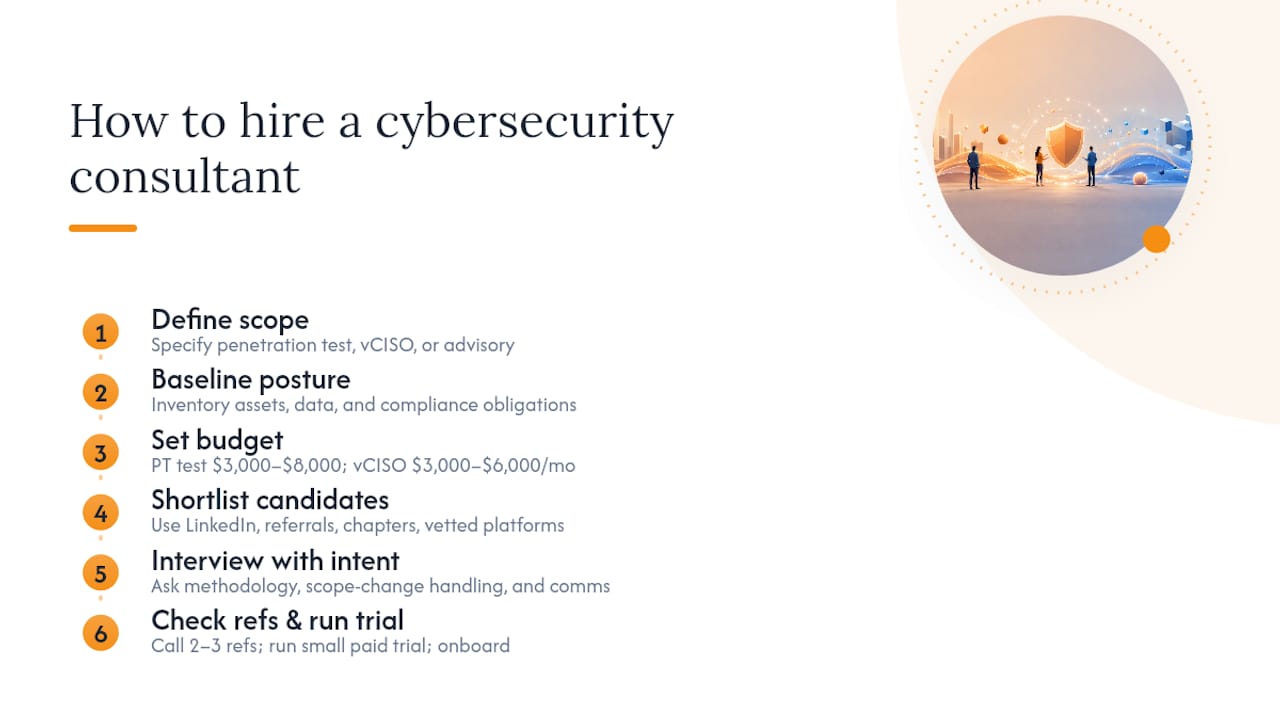
Hiring a freelance cybersecurity consultant follows a logical sequence. Skipping steps — especially scope definition and reference checks — is where most engagements go wrong.
Step 1: Define the scope. Identify what you need: a one-time penetration test, ongoing compliance support, or strategic advisory. A vague brief produces vague proposals.
Step 2: Baseline your current security posture. Know what assets exist, what data you handle, and what compliance obligations apply. This information shapes the SOW.
Step 3: Determine your budget. Use the rate bands above as a starting point. A fixed-scope external penetration test for an SMB typically runs $3,000–$8,000; a monthly vCISO retainer for a startup might run $3,000–$6,000 per month.
Step 4: Shortlist candidates. Use professional networks (LinkedIn, ISACA chapters, local ISSA chapters), referrals, or vetted freelance platforms. Review portfolios and ask for redacted sample deliverables.
Step 5: Interview with intent. Ask technical and advisory questions that reveal methodology, not just credentials.
Sample interview questions:
“Walk me through how you scope and price a penetration test for a client you’ve never worked with before.”
“How do you handle a situation where you find a critical vulnerability mid-engagement that falls outside the agreed scope?”
“What does your final report look like, and how do you present findings to a non-technical executive?”Strong candidates describe a structured methodology, reference specific tools and frameworks (PTES, OWASP, NIST), and demonstrate clear communication habits. Evasive answers about methodology or an inability to describe a past deliverable are red flags.
Step 6: Check references. Ask for two or three past clients and actually call them. Ask whether deliverables arrived on time, whether the consultant communicated proactively, and whether they would hire again.
Step 7: Run a small paid trial. A brief, scoped engagement — a single vulnerability scan with a written report, for example — reveals work quality before a larger commitment.
Red flags to watch for: no sample deliverables, guarantees of “zero vulnerabilities found,” evasive answers about liability coverage, no written authorization process for testing, and reluctance to sign an NDA before discussing your environment.
Onboarding checklist: Signed SOW, signed NDA, written rules of engagement (for testing), access provisioning log, kickoff call with defined points of contact, and a communication cadence agreement (weekly status updates, for example).
How do you become a freelance cybersecurity consultant?
The path from cybersecurity student to independent consultant is sequential. Skipping the foundation steps produces consultants who cannot defend their methodology under client scrutiny.
-
Build the technical foundation. Start with networking and operating system fundamentals before moving into security-specific content. The prerequisites checklist from Totalcyber identifies the baseline knowledge required before hands-on security training becomes productive.
-
Earn foundational certifications. CompTIA Security+ is the recognized entry point for the field. It validates core security concepts and is widely recognized by clients and employers alike. Totalcyber’s Security+ preparation resources cover exam objectives with hands-on labs and practice scenarios.
-
Complete hands-on lab training. Certifications alone do not build consulting credibility. Hands-on labs — simulated penetration tests, incident response scenarios, and cloud security exercises — produce the practical skills clients pay for. Totalcyber’s course catalog includes lab-based programs in cybersecurity engineering and penetration testing.
-
Build a redacted portfolio. Document lab work, capture-the-flag (CTF) write-ups, and any authorized assessments you complete during training. Sanitize any real client data and present findings in a professional report format. This portfolio is your primary sales tool for the first 12–18 months.
-
Find initial clients. Start with your existing network — former employers, colleagues, or local small businesses that need a basic security review. ISACA and ISSA chapter meetings, LinkedIn, and platforms like Upwork or Toptal can supplement direct outreach. Price your first engagements conservatively to build references.
-
Set contracts, pricing, and scale. Use the contract essentials outlined earlier for every engagement. As references accumulate and specialization deepens, raise rates and pursue retainer relationships that provide predictable monthly income.
Pro Tip: Your first pentest portfolio piece does not require a paying client. Complete a structured lab environment (such as a Hack The Box Pro Lab or an OSCP practice network), document your methodology in a professional report format, and include it as a redacted sample when pitching. Clients evaluate your thinking process as much as your findings.
For career changers and veterans, Totalcyber’s career changer roadmap maps the transition from non-technical backgrounds into cybersecurity roles, including consulting paths.
When does freelance consulting make sense — and when doesn’t it?
The conventional wisdom is that freelancing offers freedom and higher hourly rates than salaried roles. Both are true, but neither tells the full story of what the model actually demands.
Tradeoffs worth considering honestly:
- Flexibility vs. stability: You control your schedule, but income variability is real. A slow month with no signed contracts is not a vacation — it is a revenue gap you absorb personally.
- Income upside vs. business overhead: Senior freelancers can earn significantly more than salaried peers, but they also handle sales, invoicing, contract negotiation, tax planning, and professional liability insurance — tasks that a full-time employer absorbs.
- Deep specialization vs. breadth: Freelancing rewards specialists. A consultant known for healthcare penetration testing or OT/ICS security commands higher rates than a generalist. Full-time roles often provide broader exposure faster.
The practical sweet spot for freelancing is gap-filling: organizations hire consultants when internal staff lack the capacity or a specific expertise that is not worth hiring full-time. Many engagements start as time-boxed projects and convert to retainers when the organization recognizes ongoing need, as Sophos observes. That conversion from project to retainer is the most reliable path to stable freelance income.
When to prefer a retainer over one-off projects: Once you have completed one successful engagement with a client and they have recurring security needs (monthly vulnerability scanning, quarterly policy reviews, ongoing vCISO support), propose a retainer. A retainer at a slightly lower effective hourly rate than your project rate is usually worth it — predictable income reduces the time you spend on business development.
Totalcyber prepares you for a career in cybersecurity consulting
The skills that freelance cybersecurity consultants sell — penetration testing, vulnerability analysis, incident response, and security program design — are precisely what Totalcyber’s hands-on training programs build. Totalcyber is a veteran-owned cybersecurity training academy that prepares students for CompTIA, EC-Council, and ISC2 certification exams through instructor-led labs, real-world scenarios, and live mentoring, not passive video lectures.
For readers building toward a consulting career, the beginner’s career guide maps a clear path from foundational IT knowledge through certification and into job-ready skills. Veterans benefit from dedicated support resources and benefit-eligible enrollment options. Whether you are starting from zero or transitioning from an IT role, Totalcyber’s full course catalog gives you the structured, lab-based training that clients and employers recognize. Browse available programs and take the first concrete step toward a consulting-ready skill set.
Sources
The sources below provide authoritative context on cybersecurity consulting responsibilities, U.S. labor data, compensation benchmarks, and professional standards — useful whether you are evaluating the profession or preparing to hire.
What is a cybersecurity consultant? | Sophos covers the full scope of consultant responsibilities, from technical testing to policy development and prioritized mitigation recommendations.
Cybersecurity Consultant | ISACA outlines professional standards for the role, including the vCISO function and the advisory services that distinguish senior consultants from technical testers.
Information Security Analysts: Occupational Outlook Handbook | U.S. Bureau of Labor Statistics provides U.S. labor market context, including job duties that overlap with consulting work and demand projections for the broader field.
Cybersecurity Consultant Salary | Salary.com offers employer-reported compensation data broken down by experience level and industry sector — the most grounded starting point for rate benchmarking.
How do independent consultants get paid? | Umbrex explains U.S.-specific payment structures, invoicing terms, and contract conventions for independent consultants across industries.
What Is a Cybersecurity Consultant + How to Work as One | Pangea.ai describes the freelance model specifically, including how engagements are structured and how project work converts to retainer relationships.
- What is a cybersecurity consultant? | Sophos
- Cybersecurity Consultant | ISACA
- Pangea
- Information Security Analysts : Occupational Outlook Handbook | U.S. Bureau of Labor Statistics
- How do independent consultants get paid by their clients? | Umbrex
- Salary