
Get a vendor-neutral foundational security certification first, such as CompTIA Security+, because it’s the credential employers recognize regardless of what systems your future employer runs. It proves baseline knowledge without requiring prior experience. Hands-on prep, not just reading, is what actually shortens the distance between certification and a job offer, and programs like Total Cyber Academy build that practice into the process from day one.
TL;DR:
- The CompTIA Security+ certification is the most recognized vendor-neutral entry point, requiring little prior experience and about 8 to 12 weeks of preparation.
- The ISC2 Certified in Cybersecurity (CC) offers an accessible, lower-cost option with no prerequisites, suitable for complete beginners aiming for security support roles.
- Hands-on certifications like EC-Council CCT are ideal for learners who prefer practical, lab-based training, especially for roles like junior analysts or SOC support.
- The GIAC GSEC certification is more advanced, best suited for those with basic networking knowledge, and functions well as a follow-up to foundational certifications.
- Study time and costs vary based on background, with self-study taking longer and instructor-led courses accelerating readiness through labs, practice exams, and mentoring.
Table of Contents
- Which First Cybersecurity Certification Is Right for You?
- Who Should Get Which Certification First?
- How Do You Choose Your First Certification?
- How Long Does It Take to Prepare, and What Does It Cost?
- Why Hands-On Training Changes the Outcome
- Start Your First Certification Prep Today
- Where to Verify Exam and Career Details
- Sources
Which First Cybersecurity Certification Is Right for You?
Four credentials dominate the “what should I get first” conversation, and each one signals something slightly different to a hiring manager. None of them requires a college degree. All of them require you to actually learn the material, since the exams are built to filter out people who skimmed a study guide the night before.
CompTIA Security+ is the closest thing this industry has to a universal entry ticket. It’s vendor-neutral, meaning it doesn’t tie you to one company’s software or hardware. CompTIA positions Security+ as a baseline credential that maps directly to what employers expect from entry-level cybersecurity hires. The exam runs 90 questions in a mixed format of multiple choice and performance-based simulations, with a passing score of 750 on a 100 to 900 scale, delivered at a Pearson VUE testing center. Most beginners spend several weeks preparing. It rewards people who like a mix of theory (risk management, cryptography basics, network security concepts) and light hands-on scenario work.
ISC2 Certified in Cybersecurity (CC) is the newer option and arguably the lowest-friction entry point available. ISC2 designed the CC to require no prior work experience, which sets it apart from ISC2’s more advanced credentials like the CISSP. The exam covers five domains, including security principles, incident response, access controls, network security, and security operations. It’s a shorter, more affordable option than Security+ and functions as a stepping stone toward heavier ISC2 certifications later. If you’re testing the waters before committing serious money to training, this is where a lot of people start.
EC-Council Certified Cybersecurity Technician (CCT) leans harder into hands-on work than either of the above. EC-Council built the CCT around 85 labs, covering network defense, ethical hacking fundamentals, digital forensics basics, and incident handling. There’s no prerequisite, and the program is explicitly aimed at students and career changers who want proof they can actually do something, not just define terms on a multiple-choice test. If your learning style is “show me, don’t tell me,” CCT fits better than a pure knowledge exam.
GIAC Security Essentials (GSEC) sits a notch above the other three in difficulty. GIAC built GSEC to validate practitioner-level, hands-on security knowledge, and it’s delivered as a proctored exam through GIAC’s own testing process. It assumes you already understand basic networking and systems concepts, so it’s less common as a true first step for someone with zero technical background. It’s a strong second or third certification, or a first choice for someone coming from an adjacent IT role.
Here’s a quick side-by-side of how they stack up on the fundamentals:
- CompTIA Security+: no prerequisites, 90-question exam, roughly 8 to 12 weeks of prep, best general-purpose first cert.
- ISC2 CC: no prerequisites, five-domain exam, typically 4 to 8 weeks of prep, lowest cost of entry.
- EC-Council CCT: no prerequisites, lab-heavy curriculum with 85 hands-on exercises, best for kinesthetic learners.
- GIAC GSEC: some technical background helpful, proctored exam, practitioner-level depth, stronger as a follow-up cert.
None of these is objectively “the best.” They’re built for different starting points, and picking the wrong one for your background just adds friction you don’t need in year one.
Who Should Get Which Certification First?
Your background matters more than any ranking list. A certification is only as useful as the door it opens for your specific situation, and the four options above sort naturally into distinct profiles.
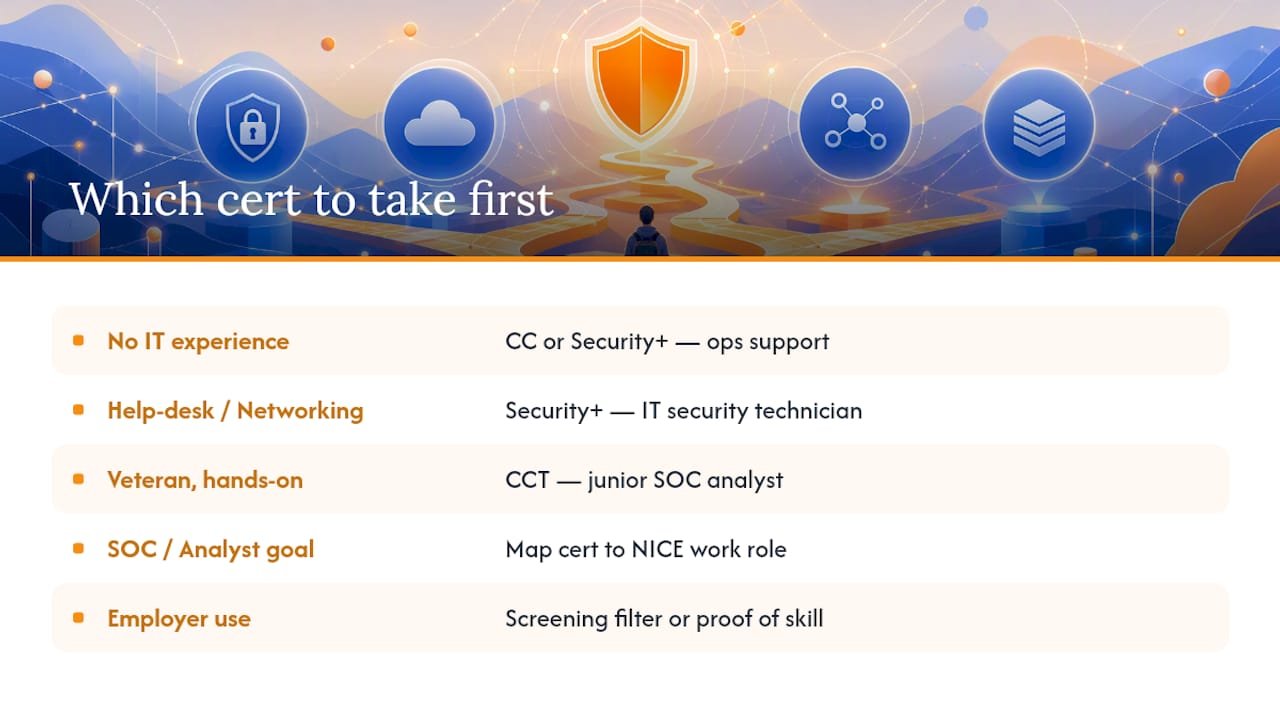
If you have zero IT experience, ISC2 CC or CompTIA Security+ are the realistic starting points. CC’s lack of prerequisites makes it especially forgiving for someone learning terminology for the first time, while Security+ demands a bit more but pays off with broader recognition. Someone in this category is typically aiming for a security operations support role or a junior help-desk position with security responsibilities layered on.
If you already have help-desk or networking experience, Security+ becomes the stronger default. You already understand ports, protocols, and basic troubleshooting, so the security-specific material builds on a foundation instead of starting from scratch. This path tends to lead toward IT security technician roles or a lateral move into a security-focused help-desk tier.
If you’re a veteran with hands-on technical training from your service, CCT often fits best because it rewards practical skill over textbook memorization, and its lab-based structure resembles the kind of scenario training military technical roles already use. This background frequently maps to junior SOC analyst openings, especially at organizations that actively recruit veterans for their discipline and clearance eligibility.
If your goal is a SOC or analyst-track role specifically, rather than a general technician position, employers increasingly reference frameworks like the NICE Framework when writing job descriptions, mapping specific certifications to specific work roles. Aligning your first cert to a named NICE work role makes your resume language match what applicant tracking systems and hiring managers are actually scanning for.
Employers use certifications two different ways during hiring. Sometimes it’s a screening filter, a box that has to be checked before your resume even reaches a human. Other times it’s proof of skill during the interview itself, something a technical interviewer will ask you to explain or apply on the spot. Know which situation you’re walking into, because a résumé-only certification and an interview-ready certification aren’t quite the same asset.
How Do You Choose Your First Certification?
Six questions will get you 90 percent of the way to a decision. Answer them honestly, and the right certification usually becomes obvious.
- What’s my current technical experience? Zero, some help-desk or networking background, or prior military technical training.
- What role am I aiming for first? A general technician position, a SOC analyst track, or something adjacent like compliance or IT audit.
- What do job postings in my target role actually list? Pull five real postings and note which certification comes up most often.
- How much prep time do I realistically have? Four hours a week is a different plan than twenty.
- What’s my budget for the exam and any training? Exam fees alone range widely, and training costs stack on top.
- Do I learn better through labs and simulations, or through structured reading and practice tests?
If your answers point toward “I need hands-on practice to actually retain this,” that preference should shape which training program you pick, not just which certification.
Before enrolling in any prep course, ask the program these questions:
- Does the course include live or on-demand lab access, not just slideshows?
- Are practice exams included, and how closely do they mirror the real test format?
- What are the instructors’ actual credentials and industry background?
- Is there job placement or resume support after certification?
- What’s the program’s typical student pass rate, and can they show it?
- Is the training self-paced, instructor-led, or a mix, and does that match how you learn?
- What happens if you don’t pass the exam on the first attempt?
- Is there a cost difference between the full program and an exam-voucher-only option?
Pro Tip: If you’re choosing between two certifications you’re equally interested in, pick the one more frequently named in real job postings for the role you want next, not the one with the flashier reputation online. Hiring managers filter resumes against the postings they wrote, not against forum opinions.
How Long Does It Take to Prepare, and What Does It Cost?
Exam fees for these four certifications generally fall in a comparable range, with training costs varying far more depending on the format you choose. Self-study using books and free practice questions costs the least but takes the longest and has the highest dropout rate. Instructor-led courses cost more but compress the timeline and add accountability. Bootcamp-style intensives sit at the top of the price range and are built for people who want to move fast.
Your background should set your timeline expectations:
- No prior IT experience: 12 to 24 weeks of steady study, roughly 5 to 8 hours a week.
- Some IT or help-desk experience: 6 to 12 weeks, since foundational networking concepts are already familiar.
- Accelerated bootcamp format: 4 to 8 weeks, with daily study blocks and instructor pacing.
A realistic 8 to 12 week plan for someone with light technical background looks something like this: weeks 1 through 3 cover core terminology and concepts through readings and short quizzes. Weeks 4 through 7 shift into hands-on labs and scenario practice, reinforcing concepts through application rather than memorization. Weeks 8 through 10 move into full-length practice exams under timed conditions. The final week or two is dedicated to reviewing weak domains and one final simulated exam to confirm readiness.
The payoff for sticking to a plan like this is real. The Bureau of Labor Statistics tracks strong long-term demand for information security analysts, a role that regularly lists entry certifications like Security+ as a preferred or required qualification. That demand doesn’t guarantee you a job, but it does mean the credential you’re studying for is aimed at a real, growing hiring category rather than a shrinking one.
Why Hands-On Training Changes the Outcome
Reading about firewalls and configuring one under a deadline are not the same skill, and hiring managers can tell the difference in an interview within about ninety seconds. That gap is the biggest thing conventional advice on certification choice tends to underplay. Most guides treat the decision as purely academic: pick the cert, buy the study guide, take the exam. The programs built around actual lab time, like CCT’s lab-based curriculum, consistently produce candidates who feel more comfortable being asked to do something rather than just define it.

Some cybersecurity training organizations build their prep programs around that same principle. Beginners preparing for CompTIA certifications or working through Certified Cybersecurity Technician training get access to practical labs, practice exams, and live mentoring rather than a static video library. That structure matters most for veterans and career changers, groups that some cybersecurity training organizations focus on serving, since technical confidence tends to come from repetition under realistic conditions, not from a second read-through of a textbook chapter.
Certification opens the door. What you can demonstrate once you’re through it is what keeps you employed.
— Alden
Start Your First Certification Prep Today
If you’ve decided a vendor-neutral foundation is your fastest path in, the next move is straightforward: start studying with material built around real exam conditions, not just a static outline. Total Cyber Academy’s beginner cybersecurity training guide walks through exactly what a first program covers and how the pieces fit together for someone with no prior background.
If Security+ is your target, test where you actually stand before committing to a full course. The CompTIA Security+ practice exam gives you a realistic read on your current knowledge gaps in under an hour, which is a faster gut-check than guessing based on how confident you feel after a chapter of reading. From there, enrolling in a structured program with lab access and instructor support is the most direct route from “studying” to “certified and job-ready.”
Where to Verify Exam and Career Details
- ISC2 Certified in Cybersecurity: official exam domains and requirements.
- EC-Council CCT: certification details and accreditation.
- GIAC GSEC: exam structure and prerequisites.
- NICE Framework, NICCS: workforce role mapping.
- BLS Occupational Outlook Handbook: job outlook data.
Sources
- Certified Cybersecurity Technician (CCT) — NICCS / EC-Council
- CC Certified in Cybersecurity Certification | ISC2
- GIAC Security Essentials (GSEC) | GIAC
- Cybersecurity certificates, certifications and degrees: how to choose | CompTIA Blog
- Information security analysts — Occupational Outlook Handbook | BLS