
Getting hired as a SOC analyst comes down to two things: proving you can operate a SIEM, read logs, and map behavior to the MITRE ATT&CK framework, and showing you can stay calm, triage fast, and document clearly under pressure. The next move is straightforward: pursue Security+ and CySA+ (or a vendor SIEM fundamentals badge), then build a homelab and document one to three real investigations before you apply anywhere.
TL;DR:
- Developing strong hands-on skills with SIEM platforms and writing detection queries is more valuable than certification alone, especially in real investigations.
- Building a home lab with log sources, network captures, and documented case studies demonstrates practical ability that outshines certifications for hiring decisions.
- Mastering incident documentation and clear communication, particularly translating technical details into business impact, is crucial for career advancement and trust.
- Prioritizing triage discipline and alert management helps prevent burnout, improve response speed, and makes you stand out as a reliable analyst.
- Combining structured, practical training with ongoing lab work and portfolio development accelerates the path from learning to being interview-ready.
Table of Contents
- Core Technical Skills Every SOC Analyst Needs
- The Soft Skills That Determine Who Gets Promoted
- Tools and Platforms Worth Practicing Before You Apply
- Certifications and a Realistic Learning Roadmap
- Building a Home Lab and an Investigations Portfolio
- Career Tiers and What It Takes to Move Up
- How Practical Training Accelerates Your Path to Hireable
- What Twenty Years in Classrooms Teaches You About Hiring
- Get Interview-Ready With Hands-On SOC Training
- Sources
- FAQ
Core Technical Skills Every SOC Analyst Needs
Certifications get your resume past the applicant tracking system. Skills get you through the interview and past your ninety-day review. The gap between the two is where most candidates fail, and it’s entirely fixable with focused practice.
SIEM fluency sits at the top of the list. You need to read an alert and understand what triggered it, then write a query in Splunk’s SPL or Microsoft Sentinel’s KQL to pull related events. Start simple: build one detection rule that fires when a user account logs in from two geographically distant locations within an hour. That single exercise teaches you field extraction, time correlation, and alert tuning all at once.
Log literacy is the skill nobody teaches well in bootcamps but every SOC job demands daily. Learn the Windows Event IDs that matter most for investigations: 4624 and 4625 for logon success and failure, 4688 for process creation, 4720 for account creation. Add Sysmon to your study list since it captures process trees and network connections that native Windows logging misses. On the Linux side, auditd tracks file access and privilege escalation attempts, which is usually where lateral movement investigations start.
Network traffic analysis rounds out the technical core. According to Vectra AI’s breakdown of the SOC analyst role, network analysis using tools like Zeek and Wireshark remains one of the essential competencies alongside SIEM and log analysis. Practice capturing traffic, following a TCP stream end to end, and spotting DNS anomalies like beaconing or tunneling. Wireshark’s own documentation and sample capture files give you realistic packets to dissect without needing your own malware traffic.
Endpoint detection and response tools add another layer. You don’t need to master a specific EDR platform, but you do need to read a process tree and recognize when a legitimate parent process (like explorer.exe) spawns something it shouldn’t (like powershell.exe with an encoded command). Learn basic containment steps too: isolating a host, killing a malicious process, and preserving artifacts before wiping anything.
MITRE ATT&CK ties all of it together. When you write up an investigation, don’t just say “suspicious email led to malware execution.” Say the email matches Phishing (T1566), and the follow-on activity maps to a specific execution or persistence technique. Hiring managers notice candidates who think in ATT&CK terms because it shows you understand attacker behavior, not just tool output.
In an interview, bring proof. Screenshots of your SIEM queries, a timeline you built from raw logs, and a short write-up connecting evidence to ATT&CK techniques will outperform a certification list every time.
The Soft Skills That Determine Who Gets Promoted
Technical chops get you in the door. Judgment and communication decide whether you stay, and whether anyone trusts you with harder cases.
Triage discipline is the first thing a Tier 1 analyst has to master. You’re deciding, often within minutes, whether an alert is a true positive worth escalating or noise that wastes another team’s time. That decision has to happen fast and it has to hold up under review, because SOC teams typically work against service level agreements that measure how quickly alerts get acknowledged and closed.
Documentation separates analysts who get promoted from analysts who plateau. A clean incident note lets the next shift pick up exactly where you left off, without re-running your queries or guessing at your reasoning. Note what data sources you checked, what you found, and what you concluded, even when the alert turns out to be nothing.
Communication matters just as much internally as externally. You’ll often need to explain a finding to someone in IT operations or a business unit leader who has never heard of a Golden Ticket attack. Translate the technical detail into business impact: what happened, what’s at risk, what needs to happen next.
Alert fatigue is real, and prioritization frameworks help you survive it. Ask three questions on every queue: what asset is affected, what’s the potential blast radius, and has this pattern shown up before. That habit alone will make you faster than analysts who treat every alert with equal weight.
- Keep a personal lab journal logging what you tried, what broke, and what you learned from each investigation.
- Ask a peer or mentor to review your incident write-ups the way a senior analyst would during a shift handoff.
- Practice explaining one technical finding per week to someone outside security, whether that’s a friend or a study group.
Pro Tip: Write your incident notes as if you’re handing the case to someone who knows nothing about it. If a stranger couldn’t follow your logic in under two minutes, rewrite it.
Tools and Platforms Worth Practicing Before You Apply
You don’t need to master every product on the market. You need to understand what each tool family does and be able to demonstrate that understanding hands-on.
- SIEM platforms. Spin up Splunk Free or a self-hosted ELK stack, ingest a sample log set, and write at least one working query plus one detection rule that actually fires. This is the single highest-value exercise on this list.
- EDR and XDR tools. Practice reading process execution chains and file creation events in a controlled lab. You’re training your eye to spot the difference between normal admin activity and something that looks like credential dumping.
- SOAR platforms. You don’t need to build automations yourself early on, but understand the boundary: SOAR should handle repetitive enrichment and low-risk containment for Tier 1, while anything ambiguous still needs a human decision.
- Network capture tools. Use tcpdump or Wireshark to capture a session and reconstruct a timeline of what happened, in what order, and from which host.
- Enrichment sources. Practice pulling a suspicious file hash or IP through VirusTotal and cross-checking domain registration data through WHOIS, then tie what you find back to a specific ATT&CK technique.
The goal isn’t tool worship. According to Vectra AI’s SOC analyst career guide, correlating multiple signals and writing tickets that let the next shift continue work without losing context matters more than which specific product sits on your resume.
Certifications and a Realistic Learning Roadmap
Sequence matters more than most study guides admit. If you’re new to networking concepts, start with Network+ before anything else, since SOC work is fundamentally about understanding traffic and connections. From there, CompTIA Security+ functions as the baseline credential that clears applicant tracking systems and proves foundational knowledge to recruiters who aren’t security specialists themselves.
CySA+ or EC-Council’s CSA come next, and they map far more directly to daily SOC responsibilities than Security+ does. A SOC analyst roadmap from CertQuests lays out a four-certification sequence, including Network+, Security+, CySA+, and a vendor SIEM cert, as a path that typically takes over a year when studied part-time alongside a full-time job or other coursework.
Vendor-specific credentials like Splunk Core or hands-on KQL training carry different weight than broad certs. Employers read Security+ as “this person understands security fundamentals.” They read a Splunk cert as “this person can operate our actual tools on day one.” Both signals matter, but they answer different questions for a hiring manager.
- Set a checkpoint before you apply anywhere: your homelab should be functional, with logs flowing and at least one query you can explain from memory.
- Don’t wait until every certification is finished to start building your lab. Run them in parallel.
- Treat each cert as proof of a knowledge domain, not an end goal. The lab work is what makes the cert credible.
Certifications alone rarely close the deal. Pairing a cert like CySA+ with documented lab proof is what actually beats an ATS filter and impresses the human who reads your application after it.
Building a Home Lab and an Investigations Portfolio
Most candidates lose offers not because they lack certifications, but because they can’t walk an interviewer through a real investigation step by step. A homelab with documented investigations is frequently what separates two similarly certified candidates.
Your lab doesn’t need to be expensive. A minimal setup includes Splunk Free or ELK for log aggregation, a Windows VM with Sysmon installed for detailed process logging, a Linux VM with auditd enabled, and a free-tier EDR demo or open-source alternative to practice endpoint visibility.
- Phishing triage. Simulate a phishing email, trace the payload, and document how you’d contain it and what indicators you’d block.
- Suspicious authentication investigation. Generate failed and successful login patterns across accounts, then investigate the anomaly and map it to a credential access technique.
- Lateral movement timeline. Chain two or three systems together and practice reconstructing how an attacker moved from initial access to a second host.
For each project, document your data sources, build a timeline, save your actual queries, capture evidence screenshots, and write a short verdict explaining what you’d do next. Anonymize anything sensitive, then publish the write-ups on GitHub or a simple portfolio site recruiters can review before you even walk into the interview.
Pro Tip: Treat every lab write-up like an incident report you’d hand to a real SOC lead. That habit alone will make your interview answers sound like experience instead of memorized theory.
Career Tiers and What It Takes to Move Up
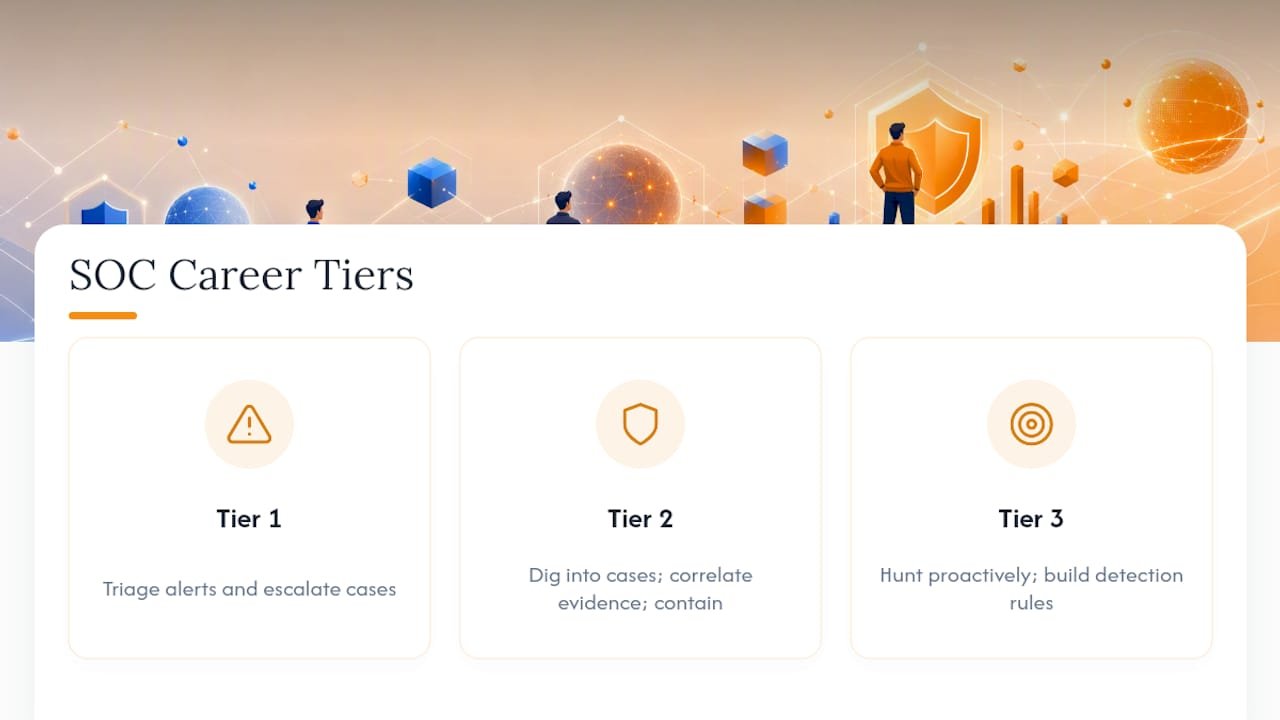
SOC careers run on tiers. Tier 1 analysts triage alerts and escalate what matters. Tier 2 analysts dig into escalated cases, correlate evidence across sources, and handle containment. Tier 3 analysts hunt proactively and build the detection rules that feed the tiers below them, according to the Vectra AI career guide.
Promotion readiness shows up in outputs, not tenure: writing your own detection rules, tuning existing alerts to reduce false positives, and running a hunt that someone else can reproduce. The Bureau of Labor Statistics tracks information security analyst roles as a growing occupational category, and AI-assisted triage is reshaping Tier 1 work by cutting alert volume while raising demand for analysts who can supervise automation and handle the ambiguous cases it can’t resolve.
How Practical Training Accelerates Your Path to Hireable
Self-study teaches concepts. Live instruction corrects mistakes in real time, and that difference shows up directly in the quality of your incident notes and query logic. A structured 12 to 18 week plan combining one certification track with 40 to 80 hours of hands-on labs and three documented investigations gives you both the credential and the proof hiring managers ask for.
There are training organizations that focus on instructor-led labs, live mentorship from working cybersecurity professionals, and certification prep that doesn’t stop at exam content. The practical move is simple. Pick one certification track, enroll in a lab-driven course, and walk away with three investigations you can defend in an interview.
What Twenty Years in Classrooms Teaches You About Hiring
The candidates who get hired fastest aren’t the ones with the most certifications on their resume. They’re the ones who can open a laptop in an interview and walk through a real investigation they built themselves, mistakes included. Employers hire judgment, not badges.
The conventional advice to “get certified first, then worry about experience” has the order backwards. Build the lab while you study for the cert, not after. That parallel track is what turns a stack of acronyms into a hireable skill set.
— Alden
Get Interview-Ready With Hands-On SOC Training
Some training providers offer a practical alternative to certification-only prep for readers who want proof, not just a badge, on their resume. The academy’s CompTIA CySA+ v3 On-Demand Course and EC-Council CSA On-Demand Course map directly to SOC Tier 1 and Tier 2 responsibilities, pairing exam prep with the hands-on labs that turn theory into a documented investigation you can defend in an interview.
Many courses include live mentorship from working cybersecurity professionals, providing real feedback on investigation write-ups instead of guesswork. Students leave with certification prep completed and portfolio-ready projects in hand, exactly the combination hiring managers say they can’t find. Browse the full course catalog and pick the track that matches the tier you’re aiming for.
Sources
- SOC analyst: roles, skills, salary, and career guide
- How AI is changing the SOC analyst role — Swimlane blog
- BLS: Information Security Analysts
- Wireshark
FAQ
What Exactly Does a SOC Analyst Do?
A SOC analyst monitors security alerts, investigates suspicious activity, and decides whether an incident needs escalation or containment. Day to day work spans reading SIEM alerts, analyzing logs, and documenting findings so other analysts can pick up the case.
What Are the Top Skills for a SOC Analyst?
The three that matter most are SIEM and log analysis, network traffic analysis, and clear incident documentation. Behind those sit triage discipline and calm communication under pressure, both of which industry career guides point to as differentiators between average and strong analysts.
Is Being a SOC Analyst Difficult?
The role is demanding because you’re often making fast decisions with incomplete information while alert volume stays high. It becomes far more manageable once you’ve built triage habits and a documented process for common investigation types, which is exactly what a homelab and portfolio project help you develop before your first day on the job.
Does a SOC Analyst Need to Know Coding?
Basic scripting in Python or PowerShell is increasingly valued for automating repetitive tasks like log parsing or enrichment lookups, though it isn’t always a strict requirement for entry-level roles. Query languages like Splunk’s SPL or Microsoft’s KQL matter more immediately, since you’ll use them daily to search logs and build detection rules.