
Take the AWS Certified Security – Specialty (SCS-C03) exam once you have several years of security experience and want to validate advanced AWS security skills. The exam suits practitioners with roughly 3 to 5 years in security work and at least 2 years securing AWS workloads, tested across six domains, scored on a scale of 100 to 1,000 with 750 as the passing mark.
TL;DR:
- AWS recommends 3 to 5 years of security experience and 2 years securing AWS, but those figures are guidance, not registration requirements.
- IAM, Infrastructure Security, and Data Protection together account for more than half the exam, so allocate extra lab time to these domains.
- A focused study plan lasting 8 to 12 weeks should prioritize practical lab work, with practice scores consistently at or above 80% before test day.
- Older exam materials may miss the separate Detection and Incident Response domains and the dedicated Security Foundations and Governance domain in the current guide.
Table of Contents
- Where Security Specialty sits in the AWS certification roadmap
- Who should take SCS-C03: prerequisites and a readiness checklist
- Exam structure: domains, weightings, format, and scoring (SCS-C03)
- How to prepare: a practical 8-12 week study plan using official resources and hands-on practice
- Scheduling and exam logistics: test delivery, technical and ID requirements, and results
- Logical next certifications to pursue before or after Security Specialty
- How hands-on, instructor-led courses complement official AWS prep
- Changes from SCS-C02 to SCS-C03: domain reorganizations and weight differences
- Typical career paths and job roles enabled by this certification
- Tips for hands-on practice environments and labs specific to AWS security scenarios
- Expected timeline from starting preparation to passing the exam
- Cost breakdown including exam fees and recommended training expenses
- A practitioner’s take on certification value
- Total Cyber Academy: a practical complement to your AWS study plan
- FAQ
- Sources
Where Security Specialty sits in the AWS certification roadmap
AWS organizes its certifications into four levels, and understanding that structure helps you avoid skipping steps that matter. Foundational credentials introduce cloud concepts to newcomers. Associate-level exams test practical ability to build and operate workloads. Professional certifications assess judgment across complex, multi-service environments. Specialty credentials, including Security Specialty, go deep into one domain rather than wide across many services.
The AWS certification roadmap typically maps candidates in two directions. Newer cloud professionals often start at Foundational or Associate and work upward before attempting a Specialty exam. Experienced security practitioners who already operate AWS environments daily sometimes move straight toward Security Specialty, using their job experience to substitute for a formal associate credential.
- Foundational level introduces cloud terminology and billing basics for people new to AWS.
- Associate level validates hands-on ability to design, deploy and troubleshoot standard workloads.
- Professional level tests judgment across large, multi-account, multi-service architectures.
- Specialty level, where Security Specialty lives, measures deep expertise in one technical area.
Being a Specialty credential signals that AWS expects more than textbook familiarity. It expects you to have configured encryption, built incident response playbooks and tuned detection tools in live or near-live environments.
Who should take SCS-C03: prerequisites and a readiness checklist
AWS recommends candidates bring the equivalent of 3 to 5 years of experience designing and implementing security solutions, along with at least 2 years of hands-on work securing AWS workloads. That guidance is not a hard gate. It describes the practical background most candidates need to pass comfortably rather than a formal requirement enforced at registration.
Before you commit to a test date, check whether your recent work already touches these areas:
- Managing multi-account governance using cloud migration and audit services with AWS Organizations and service control policies.
- Configuring KMS and CloudHSM for encryption key management and rotation.
- Reviewing CloudTrail logs and tuning GuardDuty findings for real incidents.
- Applying VPC security controls, including security groups, NACLs and flow logs.
- Designing IAM policies at scale across multiple accounts and roles.
Pro Tip: If you cannot recall a recent, specific task in each of those five areas, spend two to three weeks closing that gap with hands-on labs before scheduling your exam.
A quick readiness checklist helps here too: completed labs touching every domain, consistent scores of 80% or higher on practice questions, and at least one real-world task finished in the past few months in each major domain area.
Exam structure: domains, weightings, format, and scoring (SCS-C03)
The SCS-C03 exam guide defines six content domains, each weighted differently in the final score. Knowing these weightings before you build a study plan keeps your time aimed at the material that actually counts.
Identity and Access Management carries the single largest share, followed closely by Infrastructure Security and Data Protection. Together those three domains account for more than half the exam, which is worth remembering when you decide where to spend extra lab hours.
The exam itself mixes multiple-choice and multiple-response questions, with some items scored and others unscored for exam-maintenance purposes, though you cannot tell which is which during the test. Results come back as a scaled score between 100 and 1,000, with 750 needed to pass.
- The exam guide lists in-scope AWS services by domain, along with the specific tasks you should be able to perform on each.
- Services outside that list are considered out of scope, so chasing unrelated AWS features wastes study time.
- Official service documentation remains the primary reference for understanding how each in-scope service behaves under exam conditions.
How to prepare: a practical 8-12 week study plan using official resources and hands-on practice
An 8 to 12 week plan gives experienced practitioners enough time to close knowledge gaps without losing momentum. Spread the weeks across domains in proportion to their weighting, spending the most time on IAM, Infrastructure Security and Data Protection.
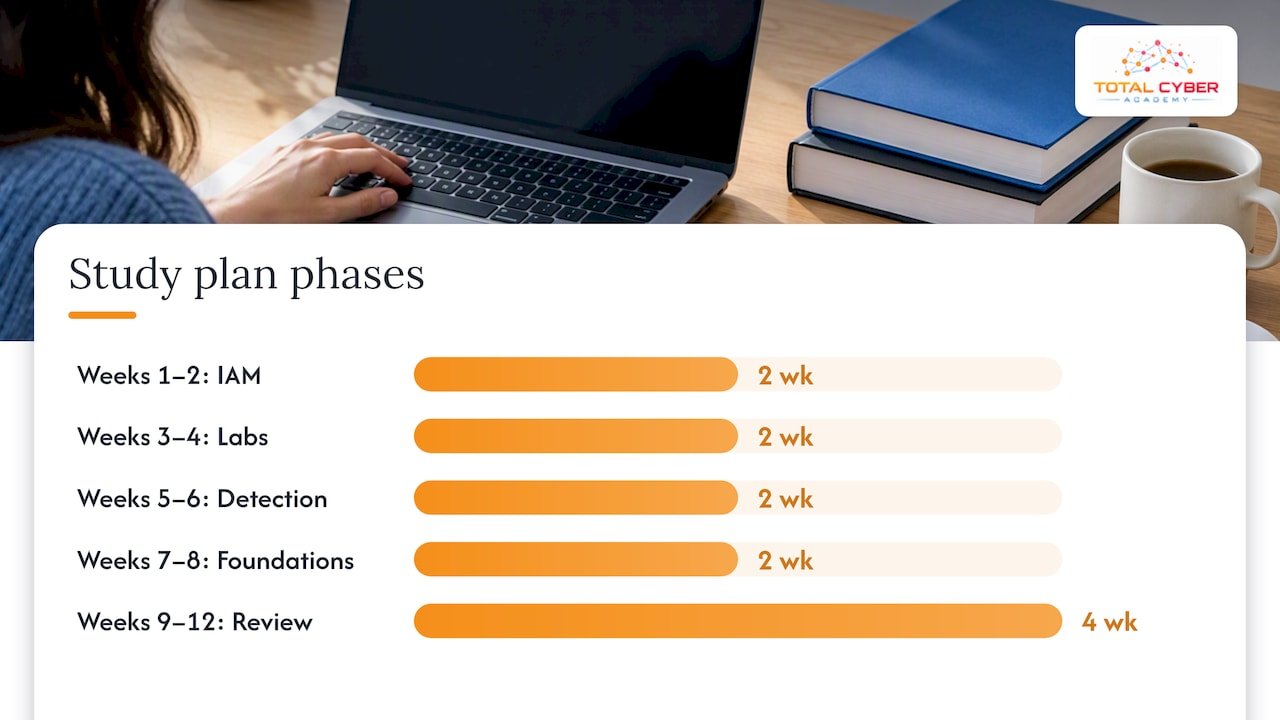
- Weeks 1 to 2: review the AWS Skill Builder Exam Prep Plan and read the Identity and Access Management task statements closely.
- Weeks 3 to 4: build lab environments covering multi-account governance, KMS key policies and VPC security controls.
- Weeks 5 to 6: work through Detection and Incident Response scenarios using GuardDuty, Security Hub and CloudTrail.
- Weeks 7 to 8: cover Security Foundations and Governance, then take a full-length practice exam.
- Weeks 9 to 12 (if needed): revisit weak domains, repeat labs, and retake practice exams until scores stabilize above 80%.
Pro Tip: Treat flashcards and timed practice quizzes as a diagnostic tool, not a study method on their own; use them to find which domain needs another round of hands-on work.
Hands-on labs matter more here than in many other AWS exams. Multi-account logging setups, KMS and CloudHSM key rotation tasks, GuardDuty and Security Hub configuration drills, and incident response playbook walkthroughs all mirror the scenario-based questions you will see. Live instruction helps most when you get stuck mid-lab, since a mentor can explain why a policy failed rather than leaving you to guess.
Scheduling and exam logistics: test delivery, technical and ID requirements, and results
You schedule the SCS-C03 exam through Pearson VUE, choosing between an in-person test center or online proctoring from your own space. Online proctoring demands a quiet room, a stable internet connection and a workspace free of notes, extra monitors or background noise.
Before test day, confirm these details:
- A government-issued photo ID that matches the name on your registration.
- A webcam and microphone that meet the proctoring software’s system requirements.
- A private, enclosed room if testing online, with no other people entering during the exam.
- Accommodations requested in advance if you need extended time or other adjustments.
Results appear as a scaled score shortly after you finish, with 750 as the line between pass and fail. A pass unlocks your digital badge and certification record; a fail comes with a domain-level score breakdown you can use to target your next study round.
Logical next certifications to pursue before or after Security Specialty
Many candidates hold AWS Certified Solutions Architect – Associate before attempting Security Specialty, though AWS does not require it. That associate credential builds the architectural vocabulary that makes security-specific questions easier to parse.
After earning Security Specialty, two paths tend to make sense depending on your career direction:
- DevOps Engineer – Professional suits practitioners moving toward automated, security-integrated deployment pipelines.
- Advanced Networking – Specialty suits those focused on network security architecture and hybrid connectivity.
Choose based on whether your next role leans toward DevSecOps workflows or deep network design work.
How hands-on, instructor-led courses complement official AWS prep
Official AWS materials explain concepts well, but applying them under mentorship often closes the last gap between knowing a service and troubleshooting it under pressure. Instructor feedback speeds up root cause analysis on multi-account policy conflicts and SIEM integration issues that self-study tends to leave unresolved.
- Live mentorship sessions let you walk through a failed lab step by step instead of guessing at the fix alone.
- Pairing exam-style questions with real lab scenarios reinforces how domain concepts show up in practice, not just in theory.
Changes from SCS-C02 to SCS-C03: domain reorganizations and weight differences
AWS periodically revises its exam guides as cloud security practices shift, and the move from SCS-C02 to SCS-C03 reorganized how domains are grouped. The older version split topics differently across its domain structure, while SCS-C03 separates Threat Detection and Incident Response into two distinct domains: Detection and Incident Response.
That separation matters for study planning because it changes how heavily each topic counts on its own. Under the newer structure, Detection and Incident Response are weighted and assessed independently rather than folded into a single combined category, which means a candidate studying from older SCS-C02 materials risks under-preparing for one of the two areas.
Security Foundations and Governance also appears as its own domain in SCS-C03, giving dedicated weight to governance, compliance and organizational security practices that previously sat alongside other topics. If you studied using older guides or practice questions, cross-check them against the current exam guide’s domain breakdown before relying on them, since a mismatch in domain structure can leave real gaps in your preparation even when the underlying AWS services have not changed much.
Typical career paths and job roles enabled by this certification
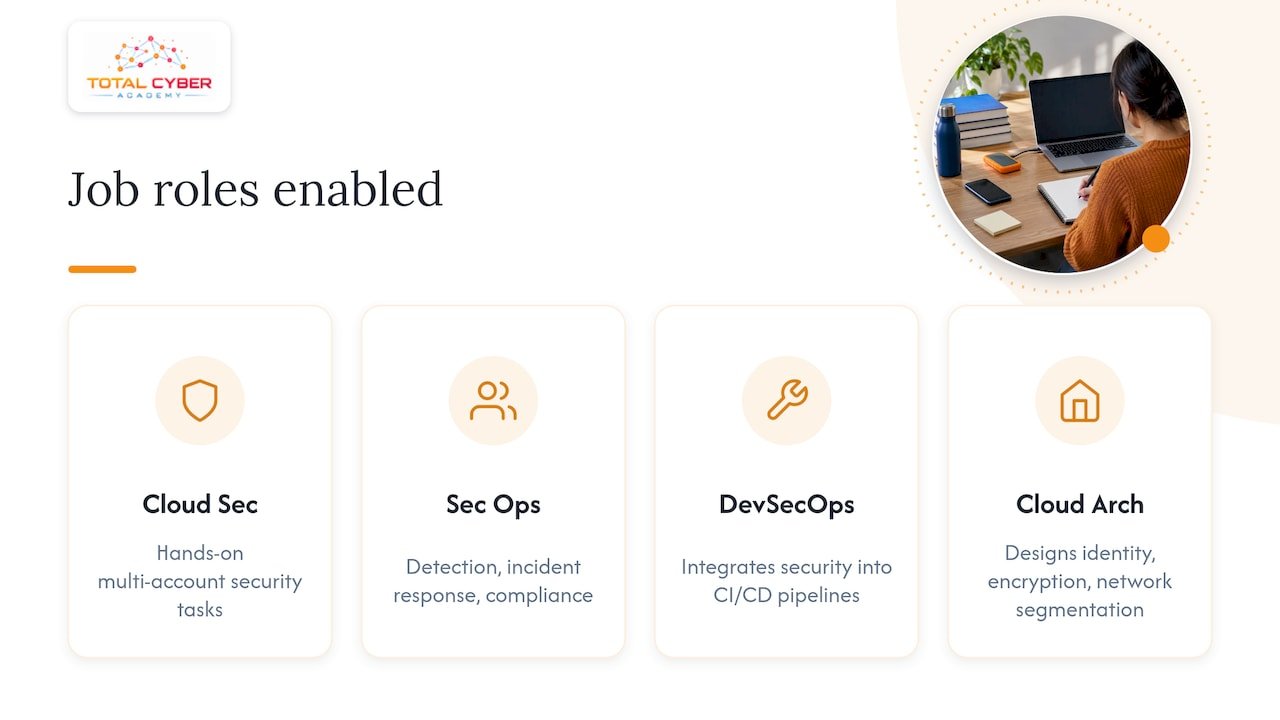
Security Specialty certification tends to open doors for roles that sit squarely between cloud engineering and security operations. Cloud security engineer positions often list the credential as a strong signal of hands-on readiness, since the exam’s scenario-based questions mirror the daily work of securing multi-account AWS environments.
Security operations analysts who work with detection tooling, incident response playbooks and compliance audits also benefit, particularly in organizations running mature AWS footprints with GuardDuty, Security Hub and CloudTrail already in place. The certification signals familiarity with those tools beyond a surface level.
DevSecOps engineers, who integrate security checks into deployment pipelines, frequently pursue this credential alongside DevOps-focused certifications to show they understand both the automation and the security side of the pipeline. Cloud architects responsible for designing secure-by-default infrastructure also use the certification to demonstrate depth in identity management, encryption and network segmentation, areas that account for more than half the exam’s weighting. Across all these roles, the common thread is direct, demonstrable experience with AWS-native security tooling rather than general security theory.
Tips for hands-on practice environments and labs specific to AWS security scenarios
Building your own sandbox environment beats passive reading for almost every domain on this exam. A multi-account setup using AWS Organizations, with separate accounts for logging, security tooling and workloads, mirrors real enterprise patterns and the scenario questions built around them.
Focus lab time on tasks you can repeat until they feel automatic: rotating KMS keys and reviewing CloudHSM configurations, writing IAM policies that scope permissions tightly across multiple accounts, and configuring GuardDuty findings to trigger automated remediation through Security Hub. Incident response playbook drills, where you simulate a compromised credential or an unexpected API call pattern and then walk through containment steps, map directly onto the Incident Response and Detection domains.
Keep a lab journal noting what broke and why, since the exam often tests judgment about why one configuration failed rather than simple recall. A sandbox account with a small monthly budget cap is usually enough to practice most of these scenarios without running up significant costs, as long as you remember to tear down resources after each session.
Expected timeline from starting preparation to passing the exam
Most experienced candidates who already work with AWS security tools report readiness within 8 to 12 weeks of focused study, assuming they dedicate several hours a week to labs and practice questions rather than reading alone. That timeline shortens for practitioners whose current job already touches most exam domains, and stretches longer for those coming from adjacent roles like general cloud administration without a strong security focus.
The biggest timeline variable tends to be hands-on practice, not reading time. Candidates who skip lab work and rely only on practice questions often need extra weeks to close gaps revealed once they hit domain-specific scenario questions. Mapping your study weeks to domain weightings, as outlined earlier, helps you avoid spending disproportionate time on lower-weighted material while under-preparing for IAM or Infrastructure Security.
Cost breakdown including exam fees and recommended training expenses
The SCS-C03 exam itself carries a standard AWS Specialty exam fee, which you pay directly through your Pearson VUE registration at the time of scheduling. Beyond the exam fee, most candidates budget for supplementary training, since official AWS documentation alone rarely covers every hands-on scenario the exam expects you to handle.
Training costs vary widely depending on format. Self-paced online courses tend to sit at the lower end, while live, instructor-led courses with mentorship and structured labs cost more but often reduce the number of study weeks needed. Practice exam bundles and lab-hosting costs for sandbox AWS accounts add a modest amount on top, though a tightly managed sandbox environment rarely runs up a significant bill if resources are torn down after each session.
A practitioner’s take on certification value
A certification badge opens a hiring conversation, but it rarely closes one. Hiring managers increasingly ask candidates to walk through a lab they built or a real incident they handled, so the credential works best paired with something concrete you can show.
Treat the exam as a checkpoint, not the goal. Choose your next certification based on the role you actually want next, and keep a portfolio of lab work that proves the skills the badge only implies.
— Alden
Total Cyber Academy: a practical complement to your AWS study plan
Official AWS materials cover the theory well, but closing the gap between reading about a service and troubleshooting it under pressure takes practice most self-study plans skip. We built our on-demand and live courses, hands-on labs and mentorship around exactly that gap, giving experienced practitioners structured lab time instead of another set of slides to read alone.
If you already work in security and want the kind of guided lab troubleshooting that speeds up readiness for exams like SCS-C03, our Cybersecurity Engineer Program pairs mentorship with scenario-based practice that maps directly onto cloud security skill-building. Explore our full course catalog to find the format that fits your schedule and current experience level.
FAQ
What is the AWS Certified Security – Specialty (SCS-C03) exam?
The SCS-C03 exam is a Specialty-level AWS certification that validates advanced skills in securing AWS workloads, covering six domains including IAM, Infrastructure Security and Data Protection. It uses scaled scoring from 100 to 1,000, with 750 required to pass.
What are the top cybersecurity certifications to consider?
The right certifications depend on your career direction, since cloud security, penetration testing and general security operations each favor different credentials. For AWS-focused security roles, Security Specialty (SCS-C03) stands out, while broader entry-level security roles often start with foundational certifications before specializing.
How do I find AWS certifications that match my experience?
The official AWS certification page lists every available credential by level, from Foundational through Specialty, along with target candidate descriptions. Reviewing the recommended experience section for each exam helps you match your background to the right starting point.
How hard is the AWS Certified Security – Specialty exam?
The exam is considered challenging even for experienced practitioners, since it expects 3 to 5 years of security experience and 2 or more years working hands-on with AWS. Candidates who combine official study materials with hands-on labs across all six domains tend to perform better than those relying on reading alone.
What training options help prepare for SCS-C03 beyond official AWS resources?
Hands-on, instructor-led courses that pair mentorship with lab-based practice can reinforce concepts that reading alone tends to leave abstract. Our live and on-demand courses are built around that kind of applied practice for practitioners working toward AWS-aligned security roles.