
A practical cloud security roadmap moves through four phases: foundations, platform skills, specialization, and operations. Start today with three actions: learn networking and Linux basics, commit to one cloud platform, and open a hands-on lab. Frameworks from NICE, CCSP, and CompTIA give this path structure and employer credibility.
TL;DR:
- A schedule for 90 days pairs 8–10 weekly hours of networking, Linux, and cloud study with a first lab project and Security+ or Cloud+ checkpoint.
- Reserve CCSP for advanced study after a year or two of practical cloud security work; Security+, Cloud+, or an associate credential should come first.
- Build three portfolio projects: a segmented, encrypted web application; centralized logging across at least two services; and infrastructure templates with automatic policy checks.
- Analyst and associate roles involve alert monitoring, triage of less severe incidents, and compliance documentation under supervision, making them suitable after foundation and platform practice.
Table of Contents
- A phase-based roadmap: crawl, walk, run
- Skills, certifications, and which roles they unlock
- Hands-on practice: labs, projects, and a portfolio that proves it
- A realistic study calendar: 90 days to 12 months
- Turning skills into a job application that gets a callback
- Why this roadmap holds up against established frameworks
- The communication skills that separate good engineers from hired ones
- Finding mentors and a community that accelerates your progress
- Job titles and descriptions worth targeting early
- Why compliance and governance frameworks belong in your roadmap
- Staying current once the roadmap gets you hired
- What I wish more beginners understood about this path
- Where Total Cyber Academy fits into this roadmap
- FAQ
- Sources
A phase-based roadmap: crawl, walk, run
We recommend treating cloud security as a staged skill build rather than a single course to finish. AWS prescriptive guidance describes a crawl-walk-run maturity model for implementing preventative, detective, proactive, and responsive controls, and that same structure works well for an individual learning plan.
Crawl (initial phase): build the fundamentals.
- Networking basics: subnets, routing, DNS, TCP/IP.
- Linux command line fluency and basic scripting in Python or Bash.
- Core cloud concepts: compute, storage, identity, and shared responsibility.
- Identity and access management (IAM) principles: least privilege, roles, policies.
By the end of this phase, you should be able to stand up a basic virtual machine, configure a security group, and explain why IAM misconfigurations cause most cloud breaches.
Walk (second phase): pick one cloud platform and go deeper.
- Implement preventative controls like network segmentation and encryption at rest.
- Set up detective controls: logging, alerting, and basic monitoring dashboards.
- Practice incident triage using platform-native tools.
- Document your first two portfolio projects.
Run (advanced phase): specialize and automate.
- Choose a lane: cloud security operations, cloud penetration testing, or secure DevOps.
- Build automation using infrastructure as code and policy enforcement.
- Learn SIEM and SOAR basics, then practice threat hunting on sample data.
- Prep for a certification checkpoint tied to your chosen specialty.
Treat each phase as a checkpoint, not a deadline. If crawl takes four months instead of three, that is fine as long as the fundamentals are solid before you add platform complexity.
Skills, certifications, and which roles they unlock
Certifications matter most when they map to a role you actually want, so sequence them with intention rather than collecting badges.
- Foundation: Security+ and Network+ establish core knowledge, paired with basic Linux and scripting skills.
- Platform: Cloud+ and an associate-level credential from your chosen cloud vendor validate hands-on platform skills once you have completed a few walk-phase projects.
- Advanced: CCSP signals readiness for senior cloud security roles. ISC2 documents six CCSP domains covering cloud concepts, data security, platform and infrastructure security, application security, operations, and legal and risk compliance, with experience expectations that make it a stronger fit after a year or two of hands-on work rather than a day-one exam.
One framework employers increasingly recognize is the NICE Framework, which defines work roles and maps them to tasks, knowledge, and skills rather than relying on job titles alone. Describing your abilities in NICE terms (for example, “securely provision” or “protect and defend”) on a resume signals that you understand how your skills translate into employer-recognized competency areas, not just certificate names.
Hands-on practice: labs, projects, and a portfolio that proves it
Certifications prove you studied. Projects prove you can build and defend something.
Minimum lab setup checklist:
- A free-tier account on your chosen cloud platform (AWS, Azure, or Google Cloud).
- A local virtual machine or container environment for Linux practice.
- A version control account to store your project code and documentation.
- Access to a structured lab platform or capture-the-flag (CTF) environment for guided practice.
Three portfolio projects worth building:
- Secure three-tier web app: deploy a basic application with network segmentation, IAM roles, and encrypted storage, then document the security decisions you made.
- Centralized logging pipeline: configure logging and alerting across two or more services, then simulate an incident and show your detection and response steps.
- Infrastructure as code with policy checks: write deployment templates that enforce security baselines automatically, catching misconfigurations before they reach production.
Document each project with a short write-up: the objective, the architecture, the specific controls you implemented, and what you would improve. That write-up becomes your interview talking point.
Pro Tip: Record a five-minute screen walkthrough of each project. Interviewers remember a demo far longer than a bullet point on a resume.
A realistic study calendar: 90 days to 12 months
A roadmap without a calendar tends to stall, so pair each phase with a time-boxed study plan.
- 90-day track: 8 to 10 hours per week covering networking, Linux, and one cloud platform’s core services, ending with your first lab project and a Security+ or Cloud+ study checkpoint.
- 6-month track: add IAM deep dives, logging and monitoring projects, and a platform-specific associate certification attempt.
- 12-month track: specialize in cloud security operations or secure DevOps, complete your third portfolio project, and target CCSP or an advanced vendor certification depending on your path.
Mix resource types rather than relying on one format: vendor documentation for accuracy, official exam outlines for structure, and on-demand or instructor-led courses for pacing and accountability. The NICE Framework resource center and the CCSP domain outline both work well as module-by-module syllabi, since they already break the subject into defined competency areas rather than leaving you to guess what to study next.
Turning skills into a job application that gets a callback
A portfolio only helps if it is framed for the reader skimming it in thirty seconds.
- Lead your portfolio with the business problem each project solved, not just the tools used.
- Phrase resume bullets around measurable outcomes: “reduced exposed ports from 12 to 2” reads stronger than “configured security groups.”
- Prepare for practical interview tasks: expect a take-home architecture review or a live troubleshooting scenario.
- Treat your first 90 days on the job as phase four of the roadmap: keep documenting, keep automating, and keep asking for feedback on your detection and response work.
You are ready to apply when you can explain, unprompted, why each control in your portfolio exists and what it prevents.
Why this roadmap holds up against established frameworks
This sequence is not improvised. It mirrors how major frameworks and vendors already define cloud security competency.
- The NICE Framework and its companion proficiency guidance map work roles to skill levels, which is exactly the crawl-walk-run progression this roadmap follows.
- CCSP’s six domains give the specialization phase a career-aligned syllabus rather than an arbitrary reading list.
- Microsoft’s Azure architecture guidance and AWS’s crawl-walk-run maturity model both describe the same staged control implementation this roadmap applies to individual learning.
The communication skills that separate good engineers from hired ones
Technical skill gets you shortlisted. Communication gets you hired and promoted.
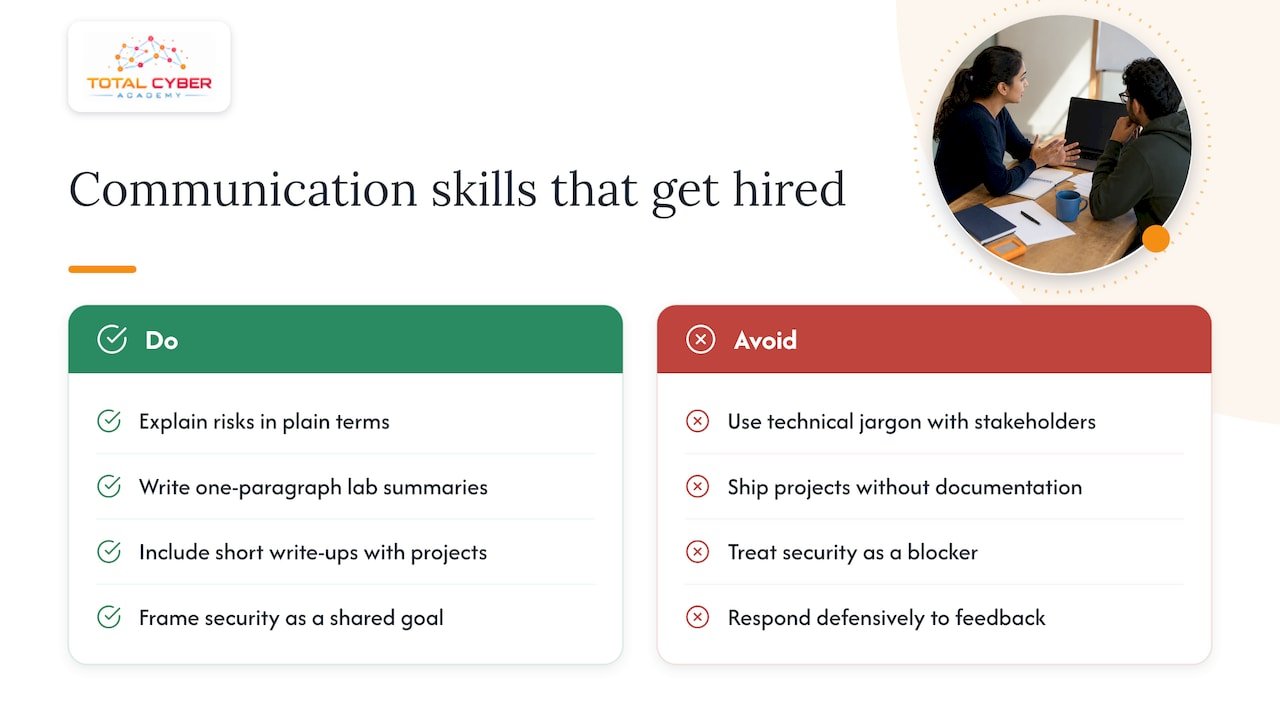
Cloud security work involves translating risk into language a finance team, a product manager, or an executive can act on. An engineer who can explain why an exposed storage bucket matters, in plain terms and within two minutes, is more valuable than one who can only describe the fix in jargon. Practice this by writing a one-paragraph summary after every lab project: what broke, why it mattered, and what you changed.
Written documentation matters just as much as verbal explanation. Incident reports, change requests, and architecture decisions all live in writing, and a security professional whose documentation is clear saves the next person hours of guesswork. Build this habit early: every portfolio project should include a short write-up, not just code.
Collaboration skills matter too, since cloud security rarely operates in isolation. You will work alongside developers, platform engineers, and compliance teams who each care about different outcomes. Framing a security requirement as a shared goal, rather than a blocker, tends to get faster buy-in than an enforcement-only posture.
Finally, practice giving and receiving feedback gracefully. Code reviews, architecture reviews, and security assessments all involve critique, and the ability to take a correction without defensiveness (and to deliver one without condescension) is a soft skill hiring managers specifically probe for in interviews.
Finding mentors and a community that accelerates your progress
Learning cloud security alone is slower than learning it alongside people already doing the work.
Start with online communities built around the platform you chose: vendor-specific forums, subreddits, and Discord servers tend to have active practitioners answering real configuration questions daily. Local or virtual chapters of established security organizations also host regular meetups where you can ask questions in person rather than typing them into a search bar.
Mentorship does not require a formal program to start. Commenting thoughtfully on a practitioner’s post, asking a specific technical question rather than a vague one, and following up with what you tried are often enough to start a real conversation. Many experienced engineers are happy to answer a focused question from someone who has clearly already attempted the problem.
Capture-the-flag competitions and hackathons double as both skill practice and networking events, since teammates and judges are often working security professionals. Treat every one of these events as a chance to collect a contact, not just a score.
Job titles and descriptions worth targeting early
Cloud security job titles vary by company size, so look past the title and read the actual responsibilities listed.
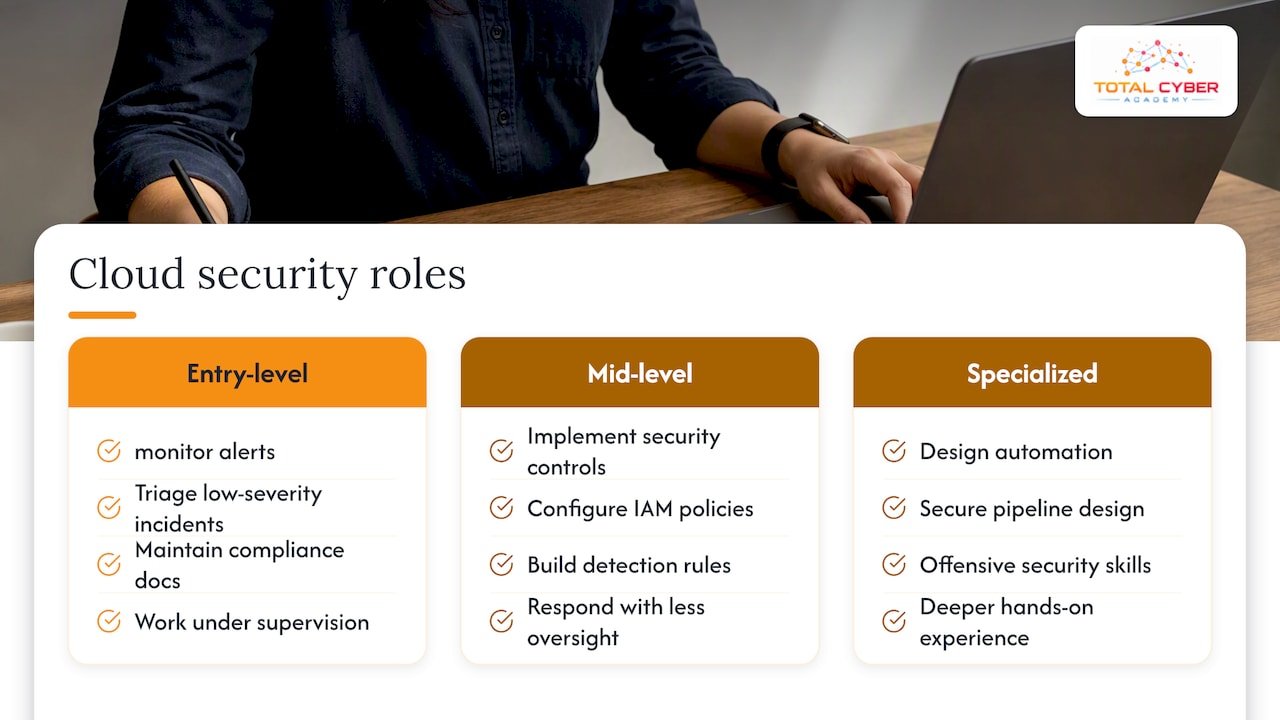
Entry-level roles often appear as cloud security analyst or associate cloud security engineer, and typically involve monitoring alerts, triaging low-severity incidents, and maintaining compliance documentation under supervision. These roles are a reasonable first target once you have completed your crawl and walk phases.
Mid-level roles, often titled cloud security engineer, usually expect hands-on experience implementing controls: configuring IAM policies, building detection rules, and responding to incidents with less oversight. This is where a completed portfolio and a platform associate certification carry real weight.
Specialized roles like cloud security architect, DevSecOps engineer, or cloud penetration tester require deeper experience and often a credential like CCSP or a platform professional-level certification. Job descriptions for these roles frequently list automation, secure pipeline design, or offensive security skills as requirements, which is why the run phase pushes toward a chosen specialty rather than staying generalist.
Why compliance and governance frameworks belong in your roadmap
Technical controls without governance context tend to drift, so understanding compliance frameworks is not optional overhead, it is part of the job.
Frameworks like NIST and CIS benchmarks give security teams a shared vocabulary for what “secure enough” means, and most employers expect new hires to at least recognize these references even before mastering them. Google Cloud’s security best practices catalog organizes its guidance by control areas that map directly to NIST 800-53, which is a useful way to see how a vendor-specific control ladders up to a broader compliance standard.
Governance also shapes day-to-day decisions: who can approve a new cloud resource, how access reviews happen, and how incidents get reported up the chain. A cloud security professional who understands these processes, not just the technical controls, becomes far more useful to a team managing audit requirements or client contracts that mandate specific compliance postures.
Treat one compliance framework as a study module in your walk phase. Read through a CIS benchmark for your chosen cloud platform and map two or three controls in your portfolio project directly to it. That exercise alone teaches you how auditors and security leaders think about risk.
Staying current once the roadmap gets you hired
The roadmap gets you to job-ready, but cloud security does not stay still once you arrive.
Cloud providers release new services and security features continuously, and attackers adapt just as fast. Build a habit of reading vendor security blogs and release notes monthly rather than waiting for a certification renewal cycle to force the update. Google Cloud’s AI and machine learning security guidance is one example of a fast-moving area worth tracking, since AI-related cloud risks are evolving quickly.
Set a recurring block of time, even just two hours a month, to review one new threat report, one new vendor feature, or one CVE relevant to your platform. Pair that with a lab exercise to reproduce or mitigate it when possible, since reading about a threat and reproducing its mechanics teach very different lessons.
Engineering teams managing infrastructure as code also face a quieter ongoing risk: policy drift and cloud waste that accumulate as environments scale. A partner resource on policy-as-code practices is a useful read once you reach the automation stage of the run phase, since enforcing policy automatically catches both security and cost problems before they become expensive to unwind.
What I wish more beginners understood about this path
Roadmap-hopping feels productive but rarely is. Switching plans every few weeks, or chasing certifications without building anything, leaves you with paper knowledge and no proof. Pick a lane, finish one project before starting the next, and build a weekly habit, even thirty focused minutes, since consistency compounds faster than intensity.
— Alden
Where Total Cyber Academy fits into this roadmap
We designed our training to follow a phased progression similar to this roadmap, offering hands-on labs, certification preparation, and live mentorship from cybersecurity professionals in addition to lecture content.
- Our Cloud Engineer Program is built for the walk and run phases, pairing platform fundamentals with real lab work.
- Our CompTIA Cloud+ On-Demand Course gives you a self-paced option to validate platform skills at your own schedule.
- Our Cybersecurity Engineer Program suits readers who want a broader foundation before specializing in cloud security specifically.
Visit our programs page to find the track that matches where you are on this roadmap right now.
FAQ
What are the 6 pillars of cloud security?
Definitions vary across frameworks, but a common version covers identity and access management, data protection, network security, workload and application security, monitoring and detection, and governance and compliance. CCSP’s six domains cover closely related ground: cloud concepts, data security, platform and infrastructure security, application security, operations, and legal and risk compliance.
Will AI replace cloud security engineer jobs?
AI tools are changing how detection, monitoring, and threat hunting get done. Vendor guidance points to AI-powered detection feeding SecOps workflows. The work is shifting toward higher-judgment tasks like architecture review and incident response rather than disappearing.
Is CCSP entry level?
No. CCSP is positioned as an advanced credential, with experience expectations tied to its six domains that assume hands-on cloud security work already completed. Most learners pursue Security+, Cloud+, or a platform associate certification first, then target CCSP once they have real project experience.
What are the 7 layers of security in Azure?
Microsoft’s architecture guidance describes a layered defense model mapping Zero Trust pillars to concrete controls across identity, network, infrastructure, and application layers rather than a fixed count of exactly seven. The Azure Architecture Center’s first-layer-of-defense guidance is the clearest starting reference for how these layers connect in practice.
Sources
- Getting Started with the NICE Framework | NIST
- Build the first layer of defense by using Azure security services – Azure Architecture Center | Microsoft Learn
- AWS Prescriptive Guidance – Implementing security controls on AWS
- CCSP Experience Requirements | (ISC)²