
Follow a three-stage certification roadmap — foundation → specialization → senior/leadership — and map each credential to a job title, realistic timeline, and verified experience threshold rather than vendor marketing. That single principle separates professionals who advance predictably from those who collect credentials without direction.
The three most common progressions look like this:
- Blue team / defensive: CompTIA Security+ → CompTIA CySA+ or ISC2 SSCP → CISSP or CISM
- Red team / offensive: CompTIA Security+ → EC-Council CEH or CompTIA PenTest+ → Offensive Security OSCP
- Cloud / infrastructure: AWS Cloud Practitioner → AWS Solutions Architect Associate → AWS Solutions Architect Professional or AWS Security Specialty
Quick timeline orientation: if you have 0 years of IT experience, start with a foundational cert (CompTIA A+, Network+, or AWS Cloud Practitioner) and plan 6–12 months to your first credential. With 1–3 years of experience, target an associate or entry-level security cert and expect 3–6 months of focused study. At 3+ years, you are ready for professional or specialty credentials, which typically require 4–6 months of preparation even for experienced practitioners.
The authoritative bodies governing these credentials include:
- CompTIA — vendor-neutral, widely recognized by U.S. employers and DoD
- ISC2 — CISSP and SSCP, the gold standard for security management roles
- AWS — cloud certification tiers with explicit experience requirements
- EC-Council — offensive and ethical hacking credentials (CEH, CPENT)
- Offensive Security — OSCP, the hands-on benchmark for penetration testers
Key Takeaways
A structured certification roadmap tied to job titles and verified experience thresholds is the most reliable path from entry-level IT to senior cybersecurity roles in the U.S. market.
| Point | Details |
|---|---|
| Three-stage progression | Foundation → specialization → senior/leadership maps to 0–2, 2–5, and 5+ years of experience. |
| Read candidate guides first | Official guides from ISACA, BCSP, and vendor portals contain exam-day rules that prevent avoidable failures. |
| Validate with job postings | Sample 20–30 postings for your target role before committing to a study plan; let employer demand drive cert selection. |
| Hands-on practice is required | Exam-only study produces narrow readiness; lab work and scenario practice are what employers verify in interviews. |
| Totalcyber for structured prep | Totalcyber’s veteran-owned, ISC2- and EC-Council-aligned programs map directly to roadmap stages for U.S. career changers and IT professionals. |
Table of Contents
- What does a certification roadmap look like at a glance?
- What do certification levels mean to employers?
- Which certification tracks match your career goals?
- How do you choose the right certification path for your situation?
- How should you prepare for a certification exam?
- Why hands-on training accelerates your certification success
- What should you check before and after exam day?
- One-page action plan you can follow this month
- What most certification advice gets wrong
- Totalcyber prepares you for every stage of this roadmap
- Sources
What does a certification roadmap look like at a glance?
The table below maps four experience levels to six major tracks. Use it to locate your current level, pick a track, and identify your next credential.
| Level | Networking | Cloud | Defensive Security | Offensive Security | GRC | DevSec / Platform |
|---|---|---|---|---|---|---|
| Foundational (entry level) | CompTIA Network+ | AWS Cloud Practitioner | CompTIA Security+ | CompTIA Security+ | CompTIA Security+ | Linux+ / AWS Cloud Practitioner |
| Associate / Entry (early career) | Cisco CCNA | AWS Solutions Architect Associate | CompTIA CySA+ / ISC2 SSCP | EC-Council CEH | CompTIA Security+ / ISACA CISA | Red Hat RHCSA |
| Professional / Specialized (mid-career) | Cisco CCNP | AWS Solutions Architect Professional | ISC2 CISSP / ISACA CISM | Offensive Security OSCP | ISACA CISM / ISACA CRISC | Red Hat OpenShift / RHCE |
| Leadership / Expert (senior level) | Cisco CCIE | AWS Security Specialty | ISC2 CISSP-ISSMP | CREST Technical Security Architecture | ISACA CGEIT / SABSA SCF | Red Hat Architect |
AWS defines Foundational, Associate, Professional, and Specialty levels with explicit experience thresholds: foundational requires no prior experience, associate recommends roughly one year of IT experience, and professional requires approximately two years of AWS-specific experience. Use those vendor-defined thresholds, not marketing copy, to set your expectations.
The CompTIA certification roadmap groups credentials by job title and career stage, making it a practical reference for no-degree paths that sequence from help desk to security analyst to advanced security roles.
Pro Tip: Choose vendor-specific certifications — Cisco, AWS, Red Hat — only after confirming that your target employer or your current team actually uses that vendor’s platform. A Cisco CCNP is highly valuable at a Cisco shop; it carries less weight at an AWS-native organization. Vendor-neutral certs like CompTIA and ISC2 credentials travel across employers without that constraint.
What do certification levels mean to employers?
Certification levels are not just marketing tiers. Employers, federal agencies, and DoD contracting officers read them as proxies for demonstrated experience, and the distinction matters when your resume lands in an applicant tracking system.
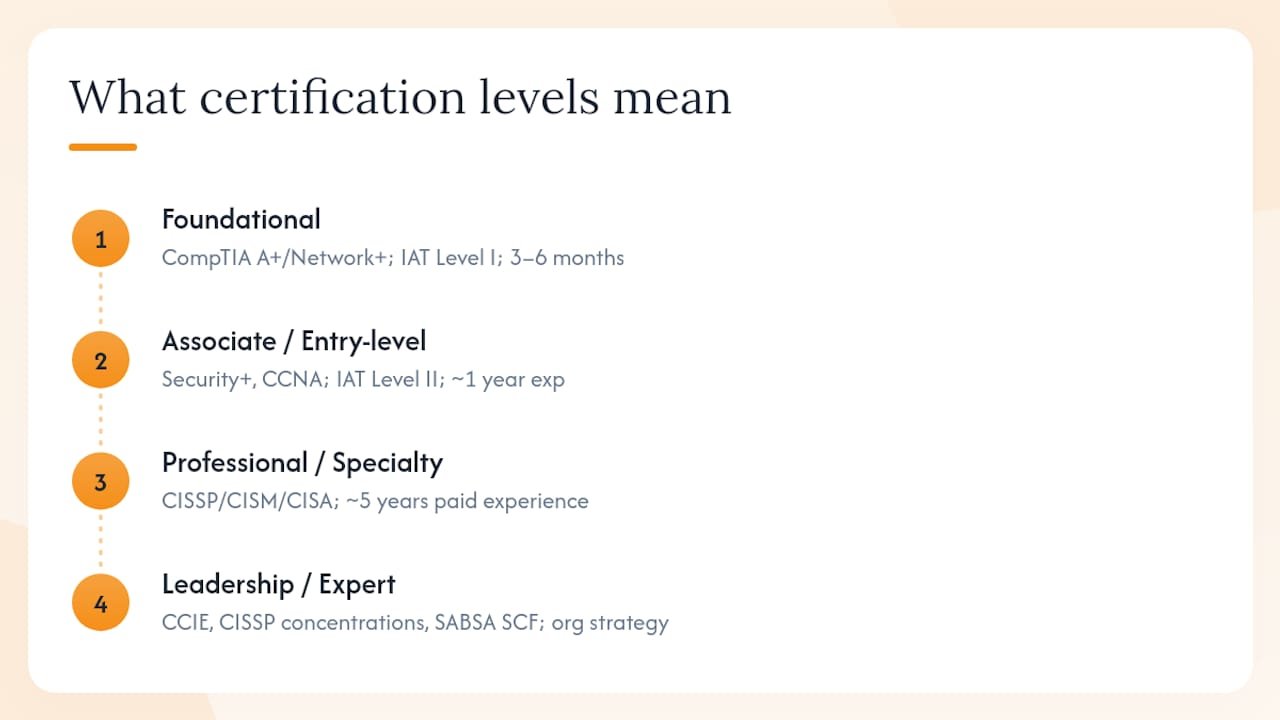
Foundational credentials signal baseline literacy. CompTIA A+ and Network+ appear on entry-level help desk and IT support postings, and they satisfy DoD 8140 (DoDM 8140.03) baseline requirements for certain IAT Level I roles. No prior IT experience is formally required, though self-study of 3–6 months is realistic.
Associate / Entry-level credentials — CompTIA Security+, Cisco CCNA, ISC2 SSCP — indicate that a candidate can operate independently in a defined technical role. CompTIA Security+ is among the frequently requested certifications on U.S. cybersecurity job postings and satisfies DoD 8140 IAT Level II requirements, making it a near-mandatory credential for federal contractors. Recommended experience at this level is generally considered to be at least one year of hands-on IT work.
Professional / Specialty credentials signal that a practitioner can architect, lead, or audit. CISSP requires a minimum of five years of paid work experience in two or more ISC2 domains before full certification is granted. ISACA’s CISM and CISA credentials carry similar experience requirements and are standard for governance, risk, and compliance roles.
Leadership / Expert credentials — CISSP concentrations, CCIE, SABSA SCF — are held by practitioners who set organizational security strategy. PMI credentials intersect here for professionals moving toward CISO or program management tracks, where project management credentials complement technical depth with governance fluency.
Pro Tip: Time your cert to the job application, not the other way around. Employers posting “Security+ required” will screen out candidates who lack it, even with equivalent skills. Aim to pass the exam before submitting applications for roles that list it as a requirement, not after.
Which certification tracks match your career goals?
Networking track
The networking path runs from CompTIA Network+ through Cisco CCNA (associate, 1–2 years experience recommended) to Cisco CCNP (professional, 3–5 years). Target roles include network administrator, network engineer, and infrastructure architect. Cisco credentials are vendor-specific, so confirm your employer’s environment before committing. DoD 8140 maps CCNA to IAT Level II in some role categories.
Cloud security track
Start with AWS Cloud Practitioner (no experience required), advance to AWS Solutions Architect Associate after roughly one year of cloud exposure, then pursue AWS Solutions Architect Professional or AWS Security Specialty at the two-year mark. The Red Hat software certification guide catalogs prerequisites for OpenShift, CNF, and RHEL certifications — consult it before planning any platform-specific credential. Target roles: cloud security engineer, DevSecOps engineer, cloud architect.
Defensive security track
- 0–1 year: CompTIA Security+ (vendor-neutral, DoD 8140 compliant, exam SY0-701, 90 questions, 90 minutes)
- 1–3 years: CompTIA CySA+ or ISC2 SSCP — both emphasize threat detection and incident response
- 3–5 years: ISC2 CISSP (requires five years of verified experience) or ISACA CISM for management-track defenders
- 5+ years: CISSP concentrations (ISSMP, ISSAP) for leadership and architecture roles
Target roles: SOC analyst, incident responder, security engineer, CISO.
Offensive security track
CompTIA PenTest+ and EC-Council CEH occupy similar territory at the associate level, but they differ in emphasis. PenTest+ is vendor-neutral and DoD 8140 mapped; CEH covers a broader methodology catalog and is recognized across federal and commercial employers. Offensive Security OSCP is the professional-level benchmark — it requires passing a 24-hour hands-on exam in a live environment, which is why practitioners with only exam-memorization backgrounds consistently struggle with it. Plan 3–6 months of dedicated lab practice before attempting OSCP. Target roles: penetration tester, red team operator, vulnerability researcher.
For architecture and assurance roles at the senior level, CREST technical security architecture credentials provide a structured examination pathway recognized in both commercial and government contexts.
GRC track
Governance, Risk, and Compliance credentials follow a distinct sequence: CompTIA Security+ establishes the technical baseline, ISACA CISA (Certified Information Systems Auditor) targets audit roles, ISACA CISM targets management, and ISACA CRISC or CGEIT targets risk and IT governance leadership. ISACA candidate guides contain the registration, scheduling, and retake rules for all ISACA credentials — read them before registering. Target roles: GRC analyst, IT auditor, risk manager, compliance officer.
DevSec / platform track
This track suits practitioners who work at the intersection of development and security. Start with Linux+ or AWS Cloud Practitioner, advance to Red Hat RHCSA, then pursue Red Hat OpenShift or RHCE credentials. Prerequisites and testing workflows for Red Hat platform certifications are explicit — consult the vendor documentation before planning your timeline.
How do you choose the right certification path for your situation?
A structured decision process prevents the most common mistake: choosing a certification because it sounds impressive rather than because it matches your next job target.
- Define your target role. Search 20–30 current U.S. job postings for the role you want. Note which certifications appear most frequently in the “required” and “preferred” sections. That list is your priority queue.
- Assess your current experience. Match your years of hands-on IT work to the level definitions above. If you have fewer than one year of experience, start foundational regardless of your academic background.
- Confirm your employer’s technology stack. Vendor-specific certs (Cisco, AWS, Red Hat) are most valuable when your employer uses that vendor’s products. Vendor-neutral certs (CompTIA, ISC2, ISACA) transfer across employers.
- Set a realistic budget. CompTIA exam vouchers typically run $239–$392. CISSP exam fees are higher. High-cost certs like OSCP ($1,499 for the standard package) are worth delaying until your employer offers sponsorship or reimbursement.
- Stack exams strategically. Passing Security+ before CySA+ is not just a convention — CySA+ exam objectives assume Security+ knowledge. Follow the prerequisite chain rather than skipping levels to save time.
- Set a target date. Register for the exam before you feel fully ready. A scheduled exam creates accountability that open-ended study rarely does.
Pro Tip: *Validate employer demand by sampling job postings on LinkedIn, USAJobs, and Indeed for your target role and metro area before committing to a study plan.
A useful external framework for mapping certifications to career steps is the individual development plan approach used by career development practitioners, which pairs credential targets with concrete job-market milestones.
How should you prepare for a certification exam?
Read the candidate guide first
Every major certification body publishes an exam candidate guide. These documents contain the authoritative rules on registration windows, remote proctoring technical requirements, acceptable ID, and retake policies. Practitioners consistently report that avoidable exam-day failures — failed remote proctor checks, ID rejections, missed scheduling windows — trace back to skipping this document. ISACA’s candidate guides and the BCSP complete guide both illustrate how detailed these requirements are: scheduling through Pearson VUE, recertification point accumulation over multi-year cycles, and extension procedures are all covered. Read the guide before you register, not the night before the exam.
Build a study schedule
Typical preparation windows by credential:
- CompTIA Security+: 6–8 weeks at 10–15 hours per week for candidates with one year of IT experience
- CISSP: 3–6 months at 15–20 hours per week; the breadth of eight domains demands sustained, structured review
- OSCP: 3–6 months of daily lab practice; the exam is a live 24-hour penetration test, so passive study is nearly useless
Use layered preparation resources
Effective preparation combines multiple resource types rather than relying on a single study guide. For IT certification exam study, the most effective approach layers:
- Official vendor study guides and exam objectives (always the authoritative source)
- Hands-on labs and virtual environments (TryHackMe, Hack The Box, AWS free-tier sandboxes)
- Practice exams timed to simulate real exam conditions
- Study groups, Discord communities, and mentorship channels where practitioners share recent exam experience
Salesforce’s certification guidance makes the point clearly: pairing formal training with practical experience produces certifications that reflect applied skills employers can verify, not rote memorization that fades within weeks of the exam.
Pro Tip: If your employer provides a sandbox environment or lab access, use it for cert study during off-hours. Practicing in a production-adjacent environment accelerates retention and reduces the cost of separate lab subscriptions.
Exam logistics to verify early
- Acceptable government-issued photo ID (name must match registration exactly)
- Remote proctoring system requirements (camera, microphone, browser, background)
- Scheduling window and cancellation/reschedule deadlines
- Retake waiting periods (CompTIA enforces a waiting period after a failed attempt)
- Recertification cycle and continuing education unit (CEU) requirements
Why hands-on training accelerates your certification success
Exam-only study produces a narrow kind of readiness. Practitioners who pass a certification through memorization alone frequently struggle in interviews and on the job because they cannot translate exam knowledge into live environments. Hands-on training closes that gap by forcing the application of concepts in real or simulated scenarios before the exam, not after.
Totalcyber is a veteran-owned cybersecurity training organization that maps its curriculum directly to the roadmap stages described in this article. Its programs cover:
- Foundational and associate levels: CompTIA A+, Network+, Security+ preparation with hands-on labs and instructor-led sessions
- Professional and specialty levels: ISC2 and EC-Council certification preparation, including CEH and penetration testing tracks
- Hands-on lab environments: Real-world scenarios that mirror exam objectives and job tasks simultaneously
Totalcyber has an official partnership with ISC2, which means its ISC2 preparation programs are aligned with the credentialing body’s own standards. For offensive security tracks, the EC-Council training programs at Totalcyber prepare candidates for CEH and related credentials through scenario-based instruction. Veterans, career changers, and entry-level professionals benefit from the mentoring and live instruction structure, which compresses the typical self-study timeline.
What should you check before and after exam day?
Pre-exam checklist
- Confirm eligibility requirements and submit any required experience documentation
- Register through the official vendor portal or authorized testing partner (Pearson VUE, Prometric)
- Read the full candidate guide — The Open Group’s POSIX certification guide illustrates how formal the process is, including conformance statements, test-suite agreements, and renewal cycles
- Verify acceptable ID types and that your name matches registration exactly
- Test remote proctoring software at least 48 hours before the exam
- Confirm the exam format: number of questions, time limit, question types (multiple choice, performance-based)
Post-exam and recertification checklist
- Save your score report immediately; some vendors provide it on-screen and do not re-send it
- Note your certification expiration date and recertification cycle (CompTIA: 3 years; CISSP: 3 years; CISM: 3 years)
- Understand your continuing education requirements: CompTIA uses CEUs, ISC2 uses CPE credits, ISACA uses CPE hours
- The BCSP recertification model — five-year cycles with accumulating recertification points — is representative of how most professional credentials handle ongoing maintenance
- Track professional development activities (training, conferences, publications) from day one; accumulating credits retroactively is harder than logging them as you go
One-page action plan you can follow this month
- Pick your track. Choose one of the six tracks (networking, cloud, defensive, offensive, GRC, DevSec) based on your target job title and current experience level.
- Sample job postings. Search 20 current U.S. postings for your target role and list the certifications that appear most often in the “required” section.
- Register for a foundational or entry-level cert. If you have fewer than one year of experience, register for CompTIA Security+ or Network+. If you have 1–3 years, target CySA+, CCNA, or AWS Solutions Architect Associate.
- Schedule lab time weekly. Block at least 5–10 hours per week for hands-on practice. Use free-tier cloud environments, virtual labs, or employer sandbox access.
- Join a study community and consult the official candidate guide. Discord servers, Reddit communities (r/CompTIA, r/netsec), and mentorship channels accelerate preparation. Then check the Totalcyber course catalog if you need guided instruction with expert mentoring.
What most certification advice gets wrong
The conventional guidance on certification planning has one persistent flaw: it treats credentials as the destination rather than the evidence. Career forums are full of practitioners who passed CISSP before they had the five years of verified experience required for full certification, or who earned OSCP without the lab hours to back it up in a live interview. The credential arrived; the competence did not.
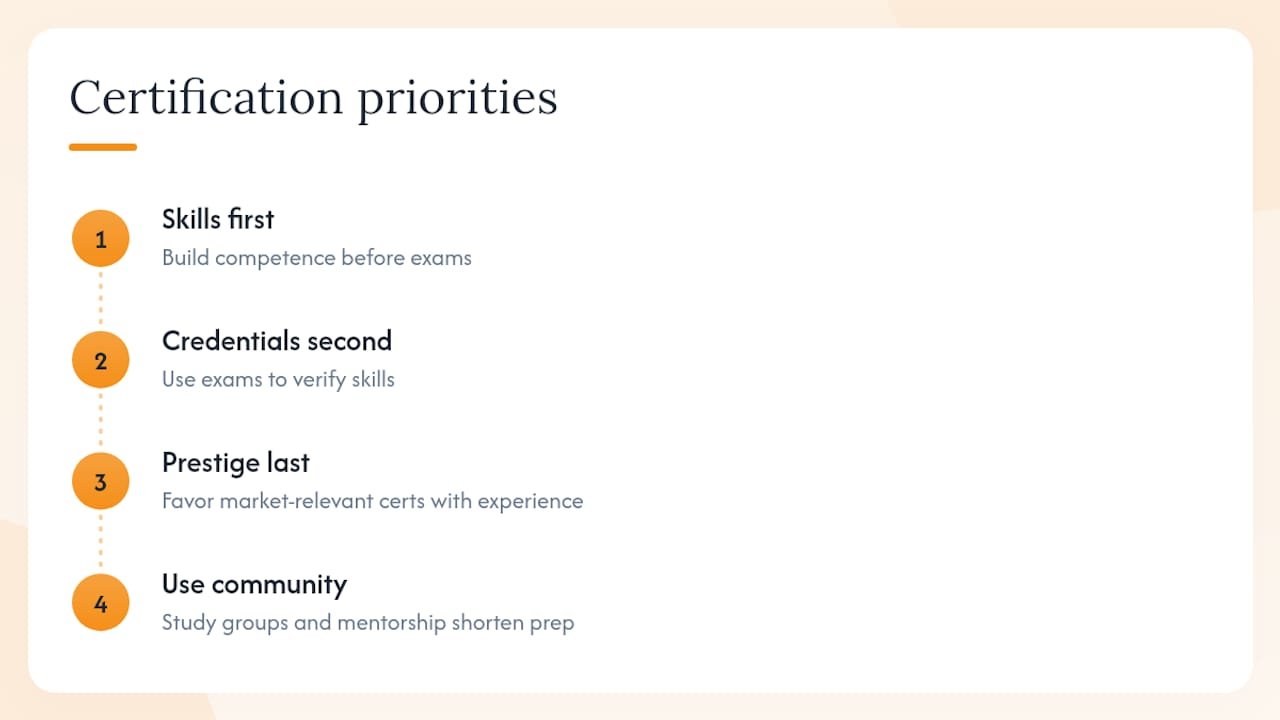
The more useful frame is to treat certifications as checkpoints that confirm skills you have already built, not as the mechanism for building them. That reordering changes how you prepare. You study to master the domain, and the exam becomes the verification step. Practitioners who approach it this way tend to pass on the first attempt and can actually perform the job the cert describes.
There is also a persistent overemphasis on prestige credentials at the expense of market-relevant ones. CISSP is genuinely valuable, but a Security+ held by a practitioner with two years of SOC experience will open more doors at the entry-to-mid level than a CISSP held by someone who crammed for it without the experience base. Employers read both the credential and the resume context around it.
The third underrated factor is community. Study groups, mentorship channels, and peer networks consistently shorten preparation timelines and surface exam-relevant insights that no study guide captures. The cybersecurity career resources available through peer networks and career platforms are often more current than published guides, because practitioners share recent exam experience in real time.
Prioritize skills first, credentials second, and prestige last. That sequence produces a career that compounds.
Totalcyber prepares you for every stage of this roadmap
Skipping from a study guide to an exam without hands-on practice is where most candidates lose time and money. Totalcyber’s veteran-owned training programs are built specifically to close that gap — with instructor-led sessions, live labs, and mentoring that map directly to CompTIA, ISC2, and EC-Council certification objectives.
Whether you are starting with Security+ or advancing toward CISSP or CEH, Totalcyber’s curriculum follows the same three-stage progression this article describes. The ISC2 partnership means ISC2 preparation programs meet credentialing-body standards. The EC-Council track prepares offensive security candidates with scenario-based instruction rather than passive memorization. Veterans, career changers, and entry-level professionals get the same expert instruction and mentoring support.
Check the cybersecurity training programs at Totalcyber to find the course that matches your current level and target credential, and start your first module this week.
Sources
Recommended
- Career Changer Cybersecurity Success Roadmap: 2026 Guide – Total Cyber Academy!
- CompTIA Courses by Total Cyber Academy – Total Cyber Academy!
- Cybersecurity Training Explained: A Beginner’s Career Guide – Total Cyber Academy!
- Resume Building for Cybersecurity: A 2026 Career Guide – Total Cyber Academy!