
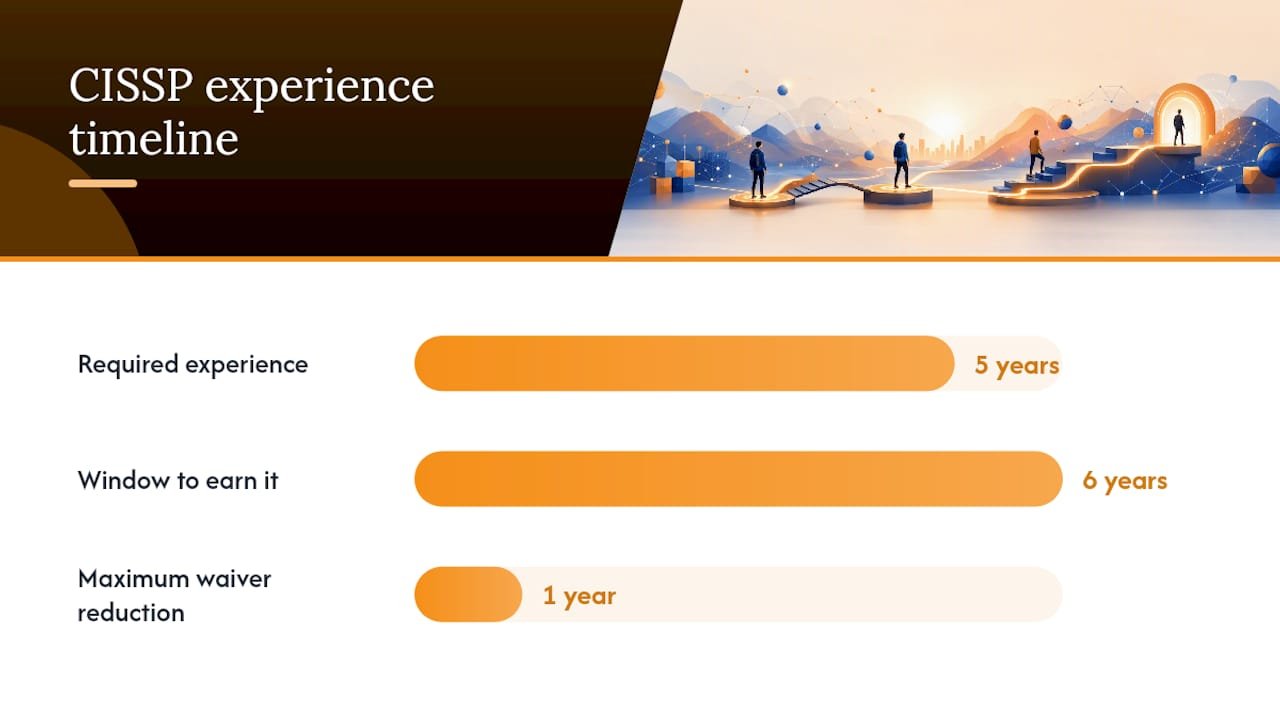
Yes, you can sit the CISSP exam without the five years of qualifying professional experience ISC2 normally requires. Pass it, and you earn Associate of (ISC)² status rather than full CISSP certification, which starts a six-year clock to gather and verify the experience you’re missing.
That timeline is workable, but only if you plan for it from the day you pass. Here’s the roadmap:
- Study for and pass the CISSP exam on the standard eight-domain format.
- Receive Associate of (ISC)² status immediately upon passing.
- Spend up to six years accumulating and documenting qualifying work experience.
- Secure endorsement from an active ISC2-certified professional once you’ve met the requirement.
- Convert to full CISSP after ISC2 verifies your submitted experience.
Pro Tip: Start a running log of your job duties the moment you pass the exam. Waiting until year four to reconstruct two years of work history is how candidates lose months to paperwork.
Key Takeaways
Passing the CISSP exam without experience grants Associate of (ISC)² status, and converting to full certification requires documented experience, endorsement, and ongoing CPEs within a six-year window.
| Point | Details |
|---|---|
| You can sit the exam now | Five years of experience is not required to take or pass the CISSP exam itself. |
| Associate status starts a clock | Passing gives you six years to earn and verify five years of qualifying experience. |
| One waiver, not stackable | A qualifying degree or approved certification like Security+ or SSCP cuts one year, but only one waiver applies. |
| Document everything from day one | Track dates, supervisors, and domain-mapped tasks for every role, internship, or project. |
| Structured training builds your paper trail | Programs like Total Cyber Academy’s hands-on labs produce the documentable, verifiable experience endorsers expect. |
Table of Contents
- Can You Get CISSP Without Experience? Understanding Associate Status
- Do You Need Five Years of Experience for CISSP, or Can It Be Waived?
- What Counts as Qualifying Experience if You Have None Yet?
- How Do You Study for CISSP Before You Have the Experience?
- Where Total Cyber Academy Fits Into Your Path to Full CISSP
- Frequently Asked Questions
- Sources
Can You Get CISSP Without Experience? Understanding Associate Status
Associate of (ISC)² is the credential ISC2 grants when you pass the CISSP exam but haven’t yet logged the required qualifying, full-time work in the field. It shows up on your ISC2 certification record and on LinkedIn as a distinct, legitimate designation, not a consolation prize. Employers recognize it as proof you’ve mastered the exam content; they just know you’re still building the resume to match.
The clock ISC2 gives you is generous but firm: six years from your exam pass date to accumulate five cumulative years of qualifying experience across at least two of the eight CISSP domains. Qualifying experience generally means paid, full-time security work, though internships and part-time roles can sometimes count on a prorated basis.
Converting to full CISSP requires:
- Endorsement from an active, ISC2-certified professional who can attest to your experience (ISC2 itself can endorse you if you don’t know anyone certified).
- Verification, where ISC2 audits your submitted work history against domain requirements.
- Continuing Professional Education (CPE) credits, which both Associates and full members must earn annually to stay current.
- A different Annual Maintenance Fee (AMF) structure. Associates typically pay a reduced AMF compared to fully certified members, a gap that closes once you convert.
Do You Need Five Years of Experience for CISSP, or Can It Be Waived?
The baseline rule is several cumulative years of relevant full-time, paid work experience in at least two of the eight CISSP domains. But ISC2 allows a limited waiver if you hold a qualifying four-year college degree or an approved certification reducing the requirement accordingly.
The commonly approved waiver certifications include:
- CompTIA Security+
- CompTIA CySA+
- SSCP (Systems Security Certified Practitioner)
That list isn’t fixed. ISC2 periodically updates which credentials qualify, and its own insights on experience-waiver changes make clear the approved roster shifts over time. Never assume a certification qualifies just because a study guide or forum thread says so. Check ISC2’s current list directly before you build a strategy around it.
Two rules trip people up. First, waivers aren’t stackable. Holding both Security+ and a relevant degree still only knocks one year off your total, not two. Second, part-time work, internships, and structured project work can sometimes count toward your five years, but only if you document them properly: dates, supervisor contact, and a clear description of tasks tied to specific domains. Vague resume bullets won’t survive ISC2’s verification process.
What Counts as Qualifying Experience if You Have None Yet?
Passing the exam is the easy part for a lot of candidates. Turning six years into documented, verifiable experience is where the real work happens. Here’s a sequence that actually moves the needle:
- Take a role that touches security directly. SOC analyst, security operations center support, network administrator with security duties, or IT support roles with access-control and incident-response responsibilities all typically qualify. Map your daily tasks to CISSP domains like Security Operations or Identity and Access Management as you go, not retroactively.
- Document non-traditional experience with the same rigor as a full-time job. Internships, volunteer security work for nonprofits, contract projects, and capstone engagements from a training program can count, but only with paperwork: start and end dates, a named supervisor or point of contact, and a task list mapped to specific domains.
- Negotiate security work into your current role. If you’re in general IT, ask to own patch management, log review, or access audits. Even a few hours a week of documented security duties builds your case over time.
- Build demonstrable projects you can point to. Draft an incident response playbook for a fictional company, write a security policy for a home lab, or contribute to an open-source security tool. These won’t replace paid experience, but they strengthen your case during endorsement and give you concrete talking points in interviews.
- Use bridging certifications strategically. If you haven’t already claimed a waiver, earning Security+ or SSCP during this window can shave a year off your remaining requirement while also giving you hands-on lab exposure that’s useful on its own.
A structured cybersecurity role guide can help you identify which entry-level titles are most likely to generate qualifying experience fastest, since job titles alone don’t guarantee CISSP-eligible duties. Total Cyber Academy’s own guide to building practical cybersecurity experience walks through how to structure volunteer and project work so it holds up under ISC2 verification.
How Do You Study for CISSP Before You Have the Experience?
Studying for CISSP without a security job behind you means leaning harder on structured resources, since you can’t fall back on years of instinct built from daily work. The exam covers eight domains, from Security and Risk Management to Software Development Security, delivered through the Computerized Adaptive Testing format for English-language exams, meaning the questions adjust in difficulty based on your answers.
A study sequence that works for most beginners:
- Start with a foundational course like Security+ if you’re new to security concepts entirely. It builds vocabulary the CISSP exam assumes you already have.
- Move into domain-focused, hands-on labs. Reading about access control models is one thing; configuring them is what makes the concept stick.
- Work through official ISC2 study materials domain by domain, not randomly.
- Finish with timed, full-length practice exams to build stamina for the real test’s scenario-based questions.
Once you pass, list “Associate of (ISC)²” on your resume and LinkedIn exactly as ISC2 names it. Recruiters searching for CISSP-track candidates do look for it, and it signals you’ve cleared the hardest technical hurdle even before you’ve hit the experience mark.
A realistic study timeline for most candidates involves several months of consistent study, depending on prior IT exposure. Before exam day, confirm your Pearson VUE registration, bring two forms of ID, and expect roughly three hours in the testing center. Total Cyber Academy’s guide to studying for IT certification exams and test-taking strategies cover pacing techniques specific to scenario-based exams like CISSP.
A candid take on timelines and what actually shortens them
Most candidates who pass CISSP without prior security experience underestimate how long the conversion to full certification takes, not because the six-year window is tight, but because documentation habits form late. The Associates who convert fastest treat their first entry-level security role like a paper trail from day one: task logs, supervisor sign-offs, domain mapping. Course completions look good on a resume, but endorsers and ISC2 verification care about verifiable specifics. Hands-on training programs shorten the real bottleneck, which isn’t passing the exam. It’s producing evidence an endorser can stand behind.
Where Total Cyber Academy Fits Into Your Path to Full CISSP
Passing the exam is one milestone. Building the documented experience ISC2 wants for endorsement is the longer game, and it’s where structured training pays off more than generic study guides ever will.
Total Cyber Academy’s programs are built around hands-on labs and instructor mentorship rather than passive video lectures, which matters when you need portfolio work an endorser can actually verify. The ISC2 on-demand CISSP course maps directly to the eight exam domains, while broader offerings like cloud security fundamentals give you the kind of domain-specific practice that turns into real resume line items. Because Total Cyber Academy is veteran-owned and built specifically for career changers and beginners, the labs are designed to produce documentable, task-level work, not just certificates. If you’re starting from zero experience and need a clear sequence from exam prep to job-ready portfolio, the beginner’s career guide is the right place to map out your next course and start building the experience your Associate status is waiting on.
Frequently Asked Questions
Can you take the CISSP exam without prior experience?
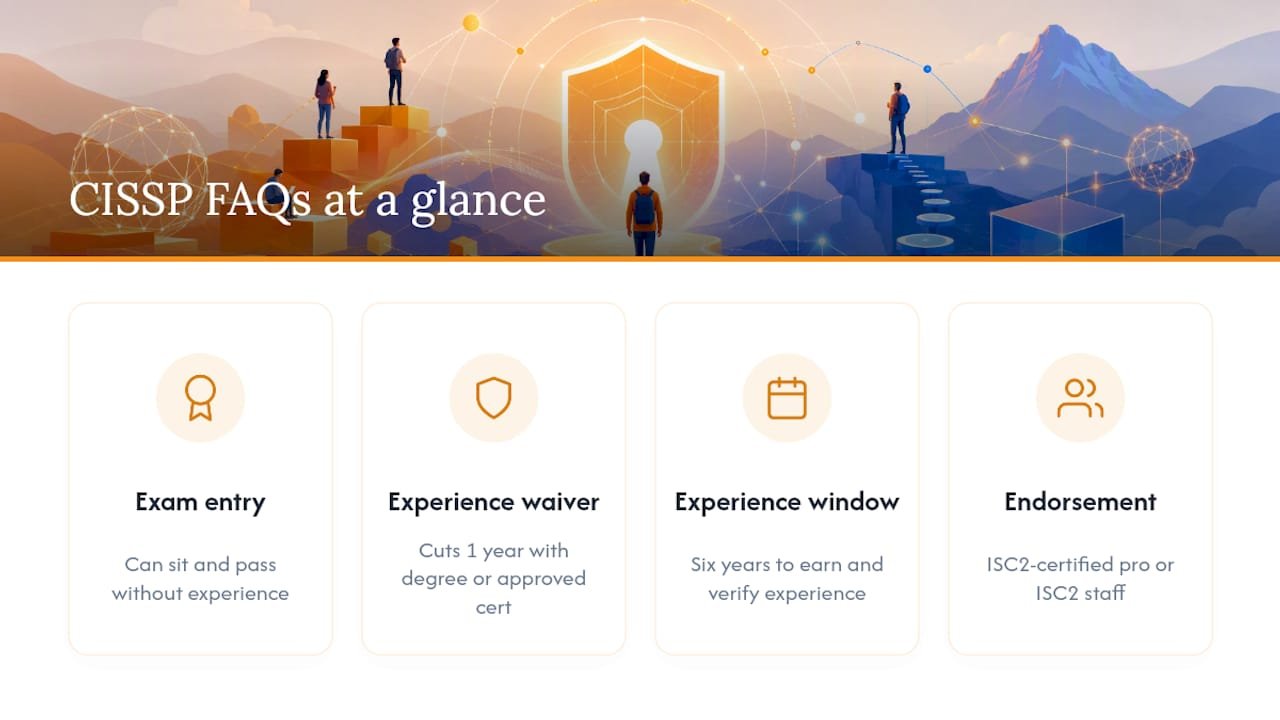
Yes. ISC2 lets you sit and pass the CISSP exam without meeting the five-year experience requirement upfront. Passing grants Associate of (ISC)² status instead of full certification.
What is the CISSP experience waiver, and how do you qualify?
The waiver deducts one year from the five-year requirement if you hold a qualifying four-year degree or an approved certification such as CompTIA Security+, CompTIA CySA+, or SSCP. Only one waiver applies per candidate, and ISC2’s approved list changes periodically, so verify it directly on ISC2’s site before planning around it.
How long can you stay an Associate of (ISC)² before losing the credential?
You have six years from your exam pass date to accumulate and verify the required experience. If you don’t meet the requirement within that window, you’ll need to retake the exam to restart the process.
Does Associate of (ISC)² status help you get entry-level cybersecurity jobs?
It can. Many hiring managers recognize it as proof you’ve mastered the CISSP body of knowledge, even without the work history yet. It’s worth listing explicitly on resumes and LinkedIn rather than omitting it or calling yourself “CISSP certified” prematurely.
Who can endorse you for full CISSP certification?
An active, ISC2-certified professional in good standing can endorse your application. If you don’t know one, ISC2 offers an alternative endorsement process directly through its own staff.
Sources
- Experience Needed for the ISC2 CISSP Certification