
A cybersecurity bootcamp is worth it for career changers, veterans, and IT professionals who commit to a program with audited outcomes, real lab hours, and certification alignment. It is not worth it for anyone who cannot dedicate consistent weekly hours to labs and job applications. The math depends almost entirely on program quality and your own follow-through. Self-study or a degree may serve you better if either condition is missing.
TL;DR:
- A cybersecurity bootcamp is most valuable for career changers, veterans, and IT professionals who can dedicate consistent hours to hands-on labs and job applications.
- Programs should provide documented lab hours, clear skill mapping to frameworks, and certification prep aligned with industry standards like CompTIA Security+.
- Real-world portfolio projects, industry certifications, and employer partnerships significantly increase the likelihood of employment after graduation.
- Budget considerations include certification exams, cloud lab subscriptions, opportunity costs, and job search time, with a typical ROI achievable within eight months of employment.
- Careful evaluation of program outcomes, instructor credentials, and curriculum transparency is essential before enrollment to avoid ineffective or misleading offerings.
Table of Contents
- What A Cybersecurity Bootcamp Worth It Actually Teaches You
- Costs, Timeline, And Realistic ROI Math
- Who Benefits Most From A Bootcamp (And Who Should Look Elsewhere)
- How To Evaluate A Cybersecurity Bootcamp Before You Enroll
- Alternatives Worth Considering: Degrees, Self-Study, And Targeted Certifications
- Turning Your Bootcamp Into A Job: What To Do After Graduation
- What A Well-Designed Program Actually Looks Like In Practice
- When I’d Recommend A Bootcamp, And When I Wouldn’t
- Ready To Start? What Total Cyber Academy Offers Career Changers And Veterans
- Sources
What A Cybersecurity Bootcamp Worth It Actually Teaches You
The question “cybersecurity bootcamp worth it” only makes sense once you know what a program is supposed to deliver. A serious curriculum does not hand you a stack of slides and a certificate. It builds specific, testable skills that a hiring manager can verify in an interview, and it maps those skills to frameworks employers already use to describe open roles, like the NICE Cybersecurity Workforce Framework.
A well-built program covers a defined set of technical domains rather than a scattershot list of buzzwords. Expect coursework in:
- Networking fundamentals: subnetting, firewalls, VPNs, and traffic analysis with tools like Wireshark
- Operating systems: Windows and Linux administration, command-line proficiency, and log locations
- SIEM platforms: alert triage and log correlation using tools like Splunk or a similar security information and event management system
- Incident response: containment, evidence preservation, and post-incident reporting
- Vulnerability assessment: scanning with tools like Nessus and interpreting results against a risk framework
- Penetration testing basics: reconnaissance, exploitation, and reporting for those tracking toward offensive security roles
Lab quality separates a strong program from a marketing brochure. Passive video lectures teach you vocabulary; they do not teach you how to respond when a SIEM dashboard lights up at 2 a.m. Look for labs built around simulated breach scenarios, packet capture exercises, and cloud environments you configure yourself rather than click through. CISA’s workforce development guidance consistently emphasizes hands-on experience over textbook familiarity, and hiring managers echo that in practice. Employers frequently value demonstrable skills, like a documented log-analysis project or a written incident report, over a resume that lists tools without evidence you used them, according to CyberSeek’s pathway research.
Portfolio evidence is what turns a certificate into a job offer. A finished capstone project, a GitHub repository with your scripts, or a write-up of a simulated ransomware response gives an interviewer something concrete to ask about. That’s a fundamentally different conversation than reciting definitions.
Certification alignment matters just as much. CompTIA Security+ shows up in a large share of entry-level cybersecurity job postings, making it close to a baseline requirement rather than a differentiator. Quality bootcamps build their curriculum around it and often include the exam voucher in tuition, along with practice exams that mirror the real test format. Some programs extend into EC-Council or ISC2 tracks for students aiming at penetration testing or governance roles. If a program cannot tell you exactly which certification exams its curriculum maps to, that is worth noting before you enroll.
Costs, Timeline, And Realistic ROI Math
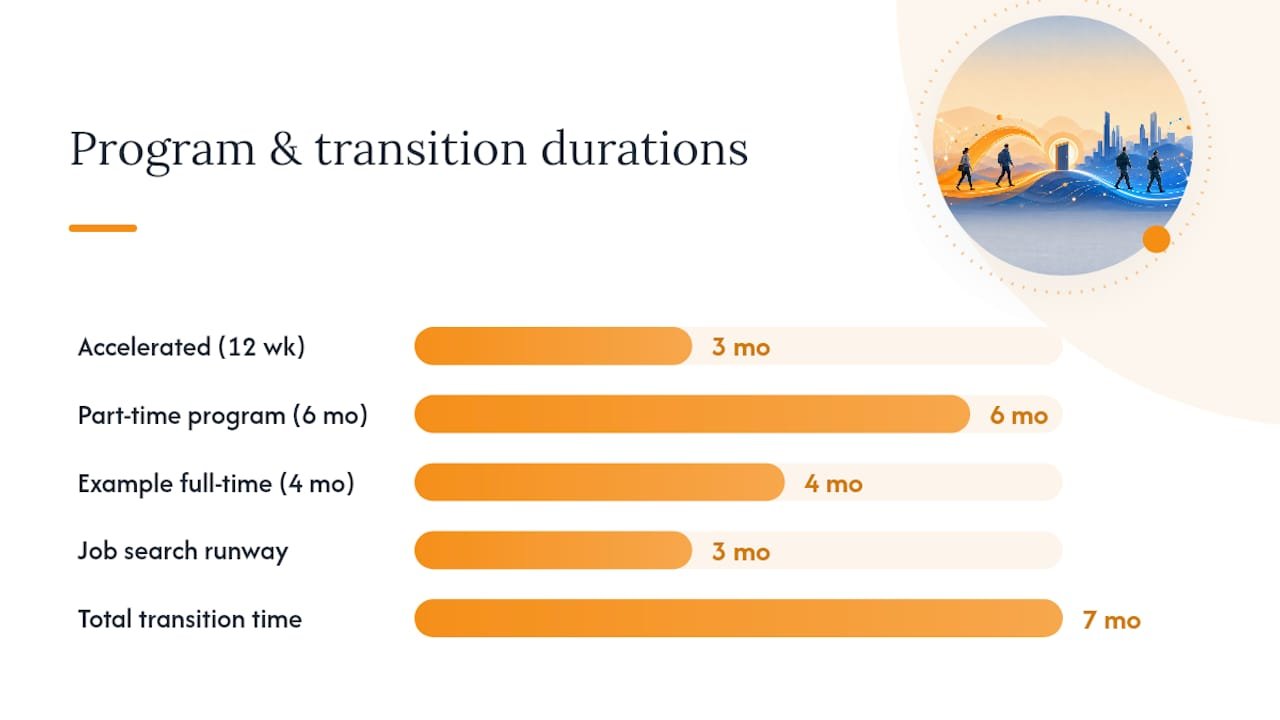
Tuition for cybersecurity bootcamps varies widely, with self-paced formats generally costing a few thousand dollars and more intensive, instructor-led programs costing more. Timelines range from twelve weeks for accelerated formats to six months for part-time programs that let you keep working while you train.
Sticker price is never the full cost. Budget for these additions:
- Certification exam fees, often $200 to $400 per attempt if not bundled into tuition
- Cloud lab subscriptions for platforms like AWS or Azure, which can run $50 to $150 monthly if not included
- Opportunity cost, meaning lost income if you reduce work hours during an intensive program
- Job search runway, the weeks or months between graduation and your first offer where income may be lower or absent
A conservative ROI example: Say a program costs $12,000 and takes four months full-time. Assume three additional months of job searching before landing an entry-level security analyst role at $65,000, up from a prior job paying $45,000. That’s a $20,000 annual salary gain. Even after subtracting tuition and roughly seven months of transition time, the breakeven point lands under eight months post-hire. If the raise is smaller or the job search runs longer, breakeven stretches accordingly. This is why researching realistic entry-level salary bands before enrolling matters more than trusting a glossy outcomes page.
The demand side of this math is genuinely favorable. Employment for information security analysts is projected to grow about 29% over the next decade, much faster than the average occupation. That growth doesn’t guarantee any individual a job, but it does mean the roles a quality bootcamp targets aren’t disappearing.
Financing options matter more here than in most consumer purchases, because a wrong choice compounds the debt-to-outcome ratio. Common paths include:
- Interest-free payment plans spread across the program length
- Income share agreements (ISAs), where you pay a percentage of post-graduation salary instead of upfront tuition, though these deserve careful reading of the repayment terms
- VA education benefits and the VET TEC program for eligible veterans, which can cover tuition without touching GI Bill benefits
- Employer tuition assistance for IT professionals already working in adjacent roles
- Scholarships offered directly by training providers for veterans or underrepresented groups in the field
Who Benefits Most From A Bootcamp (And Who Should Look Elsewhere)
Three archetypes consistently get strong outcomes from bootcamp training. IT professionals already working in help desk, network administration, or systems roles bring foundational knowledge that lets them focus purely on security-specific skills rather than starting from zero. Career changers with genuine aptitude for troubleshooting and pattern recognition, even without a technical background, tend to do well if they’ve shown that aptitude in a prior role, like a systems-minded operations job. Veterans with a security clearance or a technical military occupational specialty often move fastest, since employers actively seek clearance holders and the discipline of structured training environments maps well onto military training culture.
Bootcamps deliver the best return for learners who either arrive with some technical foundation or can commit full-time to the program and the job search that follows; they consistently underdeliver for passive learners who treat the coursework as background noise, according to research on bootcamp outcomes.
Certain profiles should think twice before enrolling:
- Anyone without 15 to 20 hours weekly to dedicate to labs, homework, and later, job applications
- People targeting roles that legally require a specific degree, such as certain government positions with statutory education requirements regardless of skill
- Those expecting a guaranteed six-figure offer within weeks, which sets up disappointment against realistic entry-level timelines
- Learners who have not tested their own interest in the material through even a free introductory course first
Prior experience compresses timelines significantly. Someone coming from network administration might land a security analyst role within two months of graduating. Someone starting with zero technical background typically needs three to six months of active job searching, more portfolio work, and often a lateral move into a help desk or SOC tier-1 role before landing the security title they actually wanted. Total Cyber Academy’s prerequisites checklist is a useful gut check before you commit tuition money to find out the hard way.
How To Evaluate A Cybersecurity Bootcamp Before You Enroll
Marketing pages are designed to make every program sound identical: hands-on, career-focused, industry-aligned. The differences that matter show up in specifics a sales rep either can or cannot produce on request.
Run every program through this checklist before signing anything:
- Audited or CIRR-aligned outcomes. Ask whether placement rates are self-reported or verified by a third party. The Council on Integrity in Results Reporting sets a standard specifically so prospective students can compare programs on equal footing, and its published outcomes data shows a meaningful gap between audited numbers and unverified marketing claims.
- Documented lab hours, not just “hands-on” language. Ask for the actual hour count and whether labs are simulated environments or live systems you configure from scratch.
- Named employer relationships. A program with real hiring partners should be able to name a handful, not gesture vaguely at “our network.”
- Instructor credentials. Ask whether instructors currently work or have recently worked in the field, versus teaching full-time with no recent operational experience.
- Certification prep built in, including whether exam vouchers are bundled into tuition or sold separately.
- Refund and placement support policies in writing, not verbal assurances during a sales call.
When you’re on a call with an admissions rep, ask these questions directly: “Can you send me your CIRR-audited outcomes report?” “Can you name three employers who have hired your graduates in the last year?” “Can I see a sample syllabus and sit in on a demo lab session?” A program confident in its own quality answers these without hesitation.
Pro Tip: Ask for the syllabus before you ask about price. A program that stalls on curriculum details but moves fast to close the sale is telling you something about its priorities.
Watch for red flags during the sales process: pressure to enroll within 24 hours, refusal to provide a written refund policy, outcomes numbers that include part-time or unrelated job placements, and vague answers about instructor background. None of these individually disqualifies a program, but two or more together are a real warning sign.
Alternatives Worth Considering: Degrees, Self-Study, And Targeted Certifications
A four-year cybersecurity or computer science degree suits people targeting research roles, regulated government positions requiring specific credentials, or long-term leadership tracks where the broader theoretical foundation pays off over a career, not just a first job. The tradeoff is time and cost: two to four years and tens of thousands of dollars against a bootcamp’s months and thousands.
Self-study paired with targeted certifications is genuinely cost-effective for a specific type of learner:
- Highly disciplined self-starters who don’t need external structure to stay on schedule
- People already working in IT who can study part-time while applying skills on the job
- Anyone testing interest in the field before committing bootcamp-level money
A self-paced training path combined with Security+ certification can get a motivated learner to entry-level readiness for a fraction of instructor-led tuition, provided they have the discipline to actually finish it.
Hybrid strategies often work best in practice: start with a low-cost self-study certification to confirm genuine interest, then move into an intensive instructor-led program once you know the field is right for you. That sequencing avoids paying premium tuition to discover the material doesn’t hold your attention.
Turning Your Bootcamp Into A Job: What To Do After Graduation
Graduation is the midpoint, not the finish line. What you do in the following ninety days determines whether your tuition was a good investment or a sunk cost.
- Build three to four portfolio projects with real artifacts. A packet capture analysis, a documented incident response simulation, a home lab network diagram, and a vulnerability assessment report give interviewers concrete material to question you on.
- Earn at least one industry certification and display it prominently on LinkedIn and your resume. Security+ remains the most requested baseline for entry-level roles.
- Network deliberately rather than applying blindly. Attend local security meetups, engage in relevant online communities, and reach out to people in roles you want before you need something from them.
- Apply broadly and tailor each resume to the specific job posting’s language, mirroring the terminology from the listing rather than relying on a generic template. Resume strategies built for cybersecurity roles differ from generic resume advice in meaningful ways.
- Prepare interview demos, meaning a five-minute walkthrough of one lab project you can deliver confidently without notes.
- Maintain a home lab after graduation. Skills atrophy fast in this field, and continued practice signals genuine commitment to employers who ask what you’ve built since finishing the program.
Pro Tip: Treat your job search like a part-time job itself. Block calendar time for applications and networking the same way you blocked time for coursework. Graduates who stop “studying” the day they finish the program lose momentum fast.
Programs that embed real client work or internship-style projects into the curriculum measurably improve how much confidence employers place in graduates, based on outcomes reported by established bootcamp providers. If your program offers this option, take it even if it extends your timeline slightly.
What A Well-Designed Program Actually Looks Like In Practice
Total Cyber Academy is a veteran-owned training organization built specifically around the checklist above rather than around marketing copy that sounds good on a landing page. The programs cover cybersecurity engineering, penetration testing, IT operations, and cloud engineering, with instructor-led and on-demand formats depending on how a student needs to structure their time.
The hands-on lab work maps directly to the skills employers actually test for: log analysis, incident response, and vulnerability assessment rather than passive video consumption. Certification preparation covers CompTIA, EC-Council, and ISC2 tracks, with courses structured around the exam objectives students will actually face. Veteran support is built into the program design rather than bolted on as an afterthought, reflecting the fact that the organization itself is veteran-owned.
Career-focused training means the curriculum is built backward from job requirements rather than forward from whatever content happens to be easy to produce. That’s the same standard the evaluation checklist asks you to apply to any program you’re considering, and it’s worth holding every option, including this one, to that same bar before enrolling.
When I’d Recommend A Bootcamp, And When I Wouldn’t
Bootcamps earn their tuition when the program is verifiably rigorous and the student treats it like a job, not a hobby. If you’re an IT professional adding security specialization, enroll with confidence. If you’re a veteran with a technical background and access to VET TEC funding, the math favors you strongly. If you’re a total career changer without a tested aptitude for troubleshooting or the ability to commit fifteen-plus hours weekly, spend a month with free introductory material first, then decide. Whatever path you’re leaning toward, run it through the evaluation checklist before you sign anything.
— Alden
Ready To Start? What Total Cyber Academy Offers Career Changers And Veterans
Total Cyber Academy gives you a direct route into cybersecurity without the guesswork of piecing together scattered tutorials or gambling tuition on a program that can’t show its work. Where generic self-study leaves you guessing which skills matter and degree programs demand years you may not have, Total Cyber Academy builds its curriculum around real certification objectives and hands-on labs from day one, with veteran support baked into the program rather than added as an afterthought.
The programs cover cybersecurity engineering, penetration testing, IT operations, and cloud engineering, backed by live mentoring and practice exams that mirror what you’ll face on test day. If you’re ready to see how the curriculum lines up with the entry-level roles you’re targeting, start with the beginner’s career guide to map out which track fits your background and timeline.
Sources
- Information security analysts – Occupational Outlook Handbook | BLS
- NICE Cybersecurity Workforce Framework | NICCS / CISA
- CIRR — Council on Integrity in Results Reporting
- CyberSeek
- CompTIA