
A hiring-ready cybersecurity resume targets one role, such as SOC analyst or penetration tester, shows hands-on results with measurable outcomes, and uses the exact keywords and certifications the posting asks for. Anchor it in trusted vocabulary: BLS data on the occupation, NIST and NICE Framework language for skills, and CareerOneStop resume guidance for format.
TL;DR:
- Scan 10 to 15 postings for recurring phrases, use standard section headings and a single column, then test the file in plain text.
- With little paid experience, place education and certifications near the top, and lead with labs or projects that produce linked reports, rules, or dashboards.
- Treat certifications as supporting evidence, not a substitute for experience; label pending exams as scheduled and pair credentials with projects that demonstrate applied skills.
- Keep entry level resumes to one page, use two only when experience warrants it, and submit a PDF unless the application requests DOCX.
Table of Contents
- What goes on a cybersecurity resume, and in what order?
- Three annotated cybersecurity resume examples you can adapt
- How do you write accomplishment bullets for cybersecurity roles?
- Which skills belong on a cybersecurity resume?
- Which certifications should entry-level candidates list?
- How do you get past ATS screens?
- Formatting, length, and a final checklist before you submit
- Where can you find resume templates and build a portfolio?
- Why trust this guidance on cybersecurity resumes?
- Why proof beats polish on an entry-level security resume
- Need hands-on proof to put on your resume?
- FAQ
- Sources
What goes on a cybersecurity resume, and in what order?
Think of your resume as a map for two readers: an applicant tracking system (ATS) that scans for keywords, and a human who spends seconds deciding whether to keep reading. CareerOneStop advises placing your minimum qualifications near the top and keeping the layout simple. For most cybersecurity candidates, the order below works.
- Contact and headline: Name, city and state, phone, professional e-mail, LinkedIn, and a portfolio or GitHub link. Skip your full street address, photo, age, and references. Add a headline that names the target role, such as “Entry-Level SOC Analyst | Security+ | Splunk, Wireshark.”
- Professional summary: Two lines at most. Name the role, your strongest proof, and two or three keywords from the posting. Example: “Help-desk technician moving into SOC work, with completed incident-response labs and Security+ certification. Experienced in Splunk triage and phishing analysis.”
- Technical skills: Group by category: networking, endpoints and operating systems, cloud, security tools, and scripting. Grouping helps a recruiter scan in seconds and helps the ATS match terms.
- Certifications: Place them directly under the summary or skills when they are the strongest qualification you have. Mark exams you have not passed yet as “in progress.”
- Education and training: Lead with this section when you have little paid experience. Lead with work experience once you have relevant job history, and move education below it.
- Work experience: Put the most relevant role first. Reframe IT or help-desk duties in security language: password resets and lockouts become identity and access management, patching becomes vulnerability remediation, and ticket escalation becomes incident handling. Describe only what you actually did.
- Projects and portfolio: Link each project to a GitHub page, write-up, or lab report. Add one line on the objective, the tools, your role, and the outcome.
BLS notes that a bachelor’s degree is typical for information security analysts, yet some workers enter with a high school diploma plus relevant training and certifications. That makes hands-on projects and certification prep worth showing prominently, rather than apologizing for a missing degree.
Three annotated cybersecurity resume examples you can adapt
Each sample below is a condensed excerpt, not a full resume. The annotations explain why each line works, so you can copy the logic instead of the wording. All names, tools, and numbers are illustrative placeholders; replace them with your real work.
BLS reports a median pay of $129,180 per year for information security analysts, with projected employment growth of 21% from 2025 to 2035. Strong demand is real, but it does not mean employers lower their bar for resume quality.
-
Headline: It names one role and the exact tools, which is what both the ATS and the recruiter look for first.
-
Projects first: With no job history, labs carry the proof. Counts like “12 alerts” make the work concrete.
-
Certification wording: “Exam scheduled” is honest and still earns keyword credit.
-
Portfolio link: Each project points to a write-up the reader can open in one click.
-
Translated duties: “Patch failures” and “triaged phishing tickets” use the same words a vulnerability or incident-response posting uses.
-
Metrics: Numbers show scale. Only include figures you can defend in an interview.
-
Tool names: SCCM and Nessus tell a reader what you have touched, not just what you studied.
-
Honest framing: The headline says “transitioning,” which sets accurate expectations.
-
Alert handling: Volume per shift and escalation quality show you can work a queue.
-
Framework vocabulary: Mentioning MITRE ATT&CK signals shared language with the security team.
-
Outputs: “Timelines, affected hosts, and containment steps” name what you produced, not just what you did.
-
Portfolio link: Link a sanitized sample incident report or detection-rule write-up.
How do you write accomplishment bullets for cybersecurity roles?
Use a compressed STAR method: situation, action, result, squeezed into one line. Start with a strong verb, name the tool, and finish with an outcome. NIST job-seeker guidance recommends short action-verb statements with metrics and linking to work samples such as GitHub or a blog.
- Find the situation. What was the problem, system, or lab scenario? Keep it to a few words.
- State your action. Use a verb like “investigated,” “configured,” “remediated,” or “documented,” and name the tool.
- Add the result. A count, a percentage, a time saved, or a deliverable. If you have no number, name the output, such as “a written incident report.”
Before and after:
- Before: “Responsible for resetting user passwords and unlocking accounts.”
- After: “Resolved 80+ account lockouts monthly in Active Directory, enforcing identity verification steps before each reset.”
- Before: “Installed Windows updates on company computers.”
- After: “Deployed monthly patches to 200 endpoints with SCCM, closing 35 critical vulnerabilities flagged by Nessus.”
Three templates to adapt:
- “[Verb] [number] [item] using [tool], resulting in [outcome].”
- “Investigated [type of alert] in [tool]; documented [finding] and escalated to [team or role].”
- “Built [lab or project] with [tools] to practice [skill]; published [deliverable] at [link].”
Pro Tip: Always name the tool and the concrete output, such as a report, rule, or dashboard, but never inflate a number. Interviewers will ask you to walk through every bullet.
Which skills belong on a cybersecurity resume?
A focused list of relevant keywords beats a long dump of every tool you have opened once. Pull terms from your target posting and group them so a recruiter can scan quickly. The CareerOneStop occupation profile for information security analysts is a good vocabulary source: it lists activities such as monitoring networks for breaches, installing firewalls, testing systems, performing risk assessments, and documenting procedures.
- Networking: TCP/IP, DNS, VPN, firewalls, packet analysis with Wireshark
- Endpoints and operating systems: Windows, Linux, Active Directory, endpoint detection and response
- Cloud: AWS or Azure security basics, identity and access management
- SIEM and security tools: Splunk, Nessus, CrowdStrike, Nmap
- Scripting and automation: Python, PowerShell, Bash
- Domain skills: Incident response, vulnerability assessment, threat hunting, risk assessment, compliance documentation
- Soft skills: Analytical thinking, written communication, attention to detail, problem solving. Evidence them inside bullets (“wrote incident reports for non-technical managers”) instead of listing adjectives.
Only list a skill you can discuss in detail. If a tool appears in your skills section, it should also appear, or be easy to justify, somewhere in your projects or experience.
Which certifications should entry-level candidates list?
For early-career roles, hiring managers commonly see Security+, Network+, CySA+, and CEH. Where each one belongs depends on how much job history you have.
- Placement: With limited experience, put certifications near the top, under your summary. With strong experience, move them below work history.
- Format: “CompTIA Security+, earned [month and year].” Use the full name once, then the abbreviation.
- In progress: Write “CompTIA CySA+, exam scheduled [month and year].” Never imply you are certified before you pass.
- Hands-on training: List completed lab courses or capture-the-flag placements under Education or Projects, with the platform name, dates, and one line on what you did.
- Beginner path: Our guide to first cybersecurity certifications and an 8 to 12 week plan lays out a sensible order.
One honest caveat: a certification strengthens a resume, but it rarely replaces measurable experience. BLS notes that training and certifications help some workers enter the occupation, while employers commonly expect related experience or a degree. Pair every credential with a project or bullet that proves you can use it. Also remember that “entry-level” is not standardized: one career center points out that (ISC)2 may define it as under 12 months of experience while other sources use 1 to 2 years, so read each posting’s actual requirements.
How do you get past ATS screens?
An ATS parses your resume into text and compares it with the posting. Your goal is to be readable by the software and persuasive to the person behind it.
- Collect keywords. CareerOneStop recommends scanning 10 to 15 postings for your target title and noting phrases that repeat, such as “incident response,” “SIEM,” or “vulnerability management.”
- Build a role keyword set. Keep a short list of exact phrases, with tool names and certification names spelled as the postings spell them.
- Use standard headings. “Skills,” “Experience,” “Education,” and “Certifications” parse reliably. Creative labels often confuse the software.
- Keep formatting plain. Avoid images, icons, text boxes, columns, and tables in the resume body. Use a clean single column.
- Weave keywords naturally. Place them in your summary, skills, and bullets where they describe real work. Repeating a term excessively does not help and reads badly.
- Verify. Paste your resume into a plain-text editor or a free ATS checker. If the order scrambles or characters disappear, simplify the layout.
- Make one version per role. NIST advises tailoring separate resumes for different role types, such as SOC analyst and penetration tester.
Formatting, length, and a final checklist before you submit
Keep it to one page for most entry-level candidates. Go to two pages only when your experience justifies it; CareerOneStop suggests 1 to 2 pages. Use a readable font at 10 to 12 points, consistent spacing, and enough white space for a quick scan.
- Save as a PDF unless the application system asks for DOCX.
- Name the file clearly: “FirstName-LastName-SOC-Analyst-Resume.pdf.”
- Confirm your contact details, e-mail, and phone number are accurate.
- Compare your keywords against the posting one last time.
- Open every portfolio link in a private browser window to confirm it works.
- Proofread for typos, then read it aloud once.
- Remove photos, graphics, and decorative elements.
- Add a cover letter when the posting requests one, or when you need to explain a career change in a few honest sentences.
| Checkpoint | Standard |
|---|---|
| Length | 1 page entry-level, 2 pages with deeper experience |
| File type | PDF unless DOCX is requested |
| Summary | Concise, naming role, proof, and keywords |
| Skills list | Targeted keywords |
| Links | Tested portfolio and GitHub URLs |
Where can you find resume templates and build a portfolio?
Choose simple, single-column, ATS-friendly templates. Skip visually heavy designs with sidebars, skill bars, and icons; they look polished to people but often scramble in software.
For each portfolio project, give a reader the full picture quickly:
- Context: The scenario or problem you were solving.
- Objective: What you set out to prove or build.
- Tools used: Specific names, such as Splunk, Nmap, or pfSense.
- Your role: Especially important for team labs or capture-the-flag events.
- Outcome: A finding, a report, or a measurable result.
- Next step: Our resume-building guide for cybersecurity has templates and sample pages you can adapt, and our guide to entry-level cybersecurity jobs helps you choose a first target role.
Write each project README so a recruiter can understand it quickly.
Why trust this guidance on cybersecurity resumes?
We teach cybersecurity at Total Cyber Academy, a veteran-owned training organization built around hands-on labs, instructor support, and certification prep. Our students are beginners, career changers, veterans, and IT professionals, so we see the same resume problem repeatedly: people have done real work but describe it in vague terms.
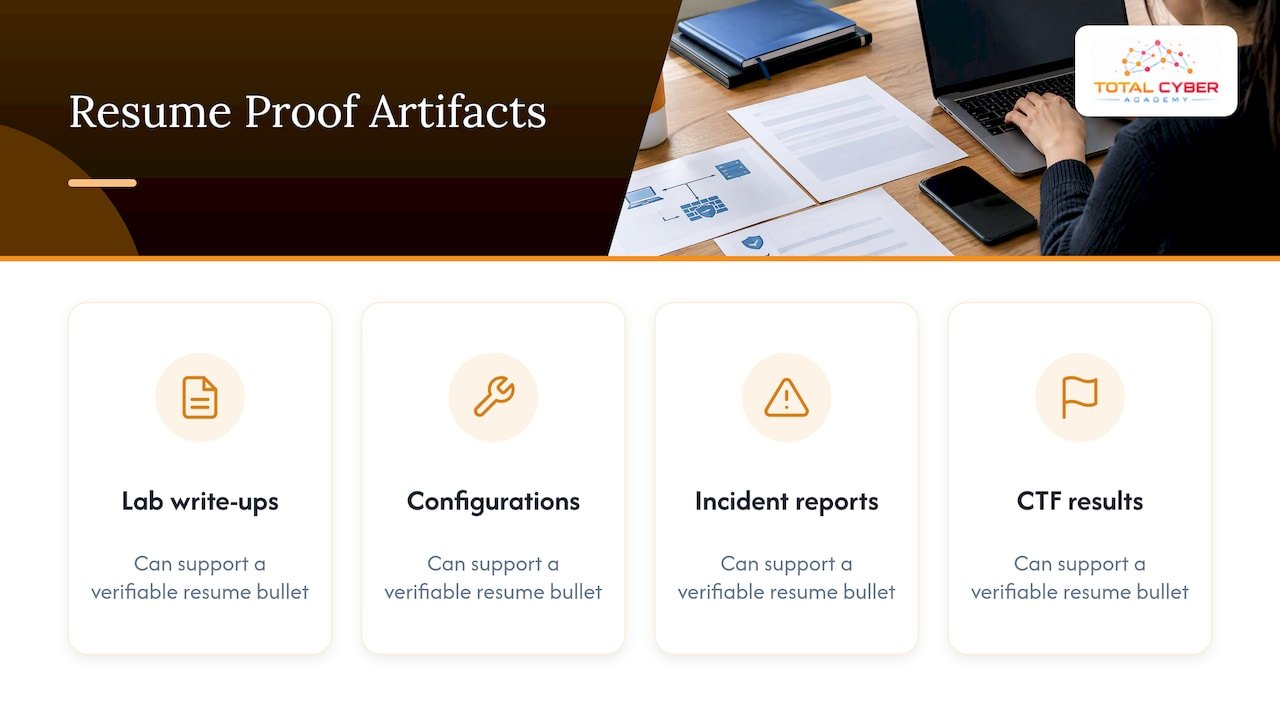
What recruiters commonly look for is evidence. Hands-on training produces exactly that: lab write-ups, documented configurations, incident reports, and capture-the-flag results that can sit in a portfolio and support a bullet point. Our approach is to turn each lab into something a hiring manager can verify, using the vocabulary from sources like NIST’s NICE Framework materials and the BLS occupation data.
If you want deeper help after reading this, our resume-building guide for cybersecurity walks through templates and examples, and our beginner’s career guide explains how training maps to roles.
Why proof beats polish on an entry-level security resume
Most resume advice obsesses over layout, fonts, and buzzwords. Those matter far less than people think. The thing that separates candidates is whether a stranger can verify that you did the work.
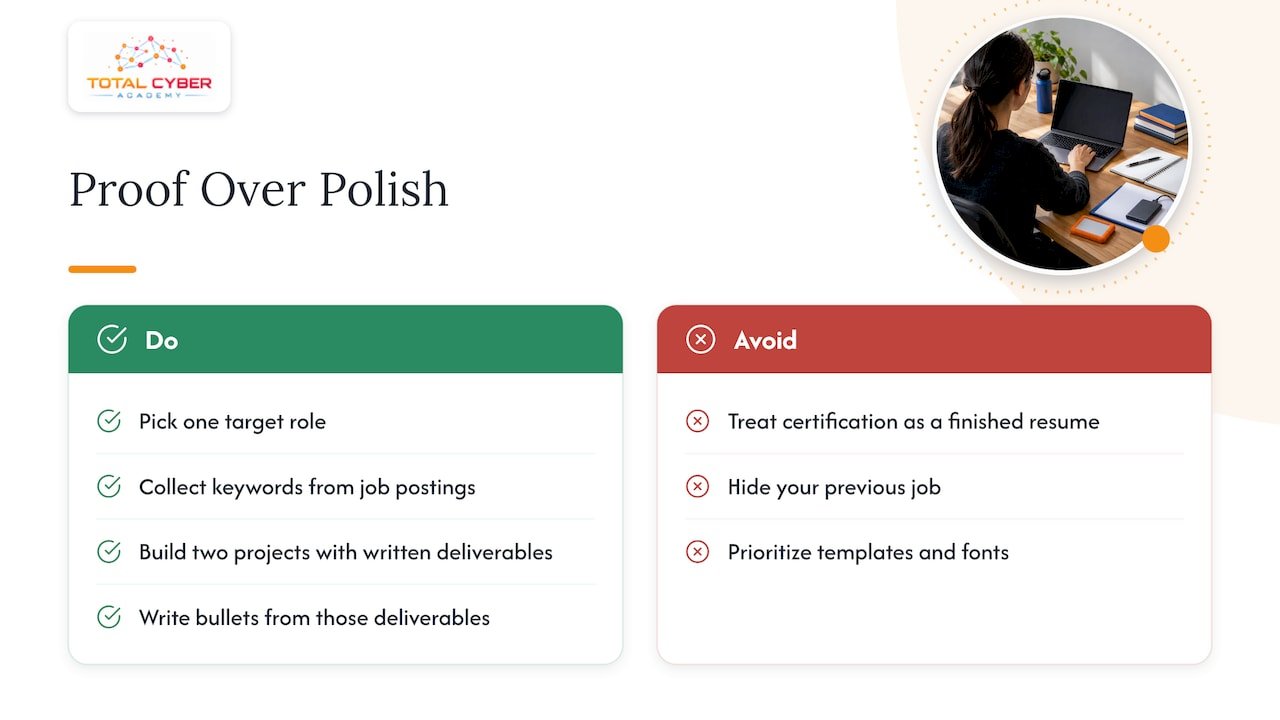
Conventional advice falls short in two places. It tells beginners to “get certified” as if a credential were a finished resume, and it tells career changers to hide their old job. Both miss the point. A certification shows you studied; a linked lab report shows you can operate. And your help-desk years are not a liability, they are evidence of handling tickets, access problems, and users under pressure, which security teams value once you translate it honestly.
If you have limited time, do this first: pick one target role, collect keywords from a handful of postings, and build two portfolio projects that each produce a written deliverable. Then write bullets from those deliverables. Everything else, including template choice and font, is secondary polish. Overrated: long skills lists. Underrated: one clear, linked incident write-up.
— Alden
Need hands-on proof to put on your resume?
If you want structured practice that produces portfolio-ready work, we built Total Cyber Academy for exactly that. It is one route to resume-ready skills, not a required step; plenty of people build projects on their own.
Here is what we offer:
- Certification prep: On-demand and live courses for CompTIA and EC-Council exams, including Security+, CySA+, Network+, and CEH, in our course catalog.
- Career programs: Our Cybersecurity Engineer, Penetration Tester, and IT Operations Specialist programs combine labs, instruction, and mentoring from active professionals; see the program pages.
- Veteran and career-changer support: Flexible options and live tutoring designed for people moving into the field.
- Portfolio-ready work: Labs and scenarios that give you real tools, outputs, and results to describe in your bullets.
Browse the Total Cyber Academy courses to find the one that matches your target role, or review the prerequisites checklist first to plan your starting point.
FAQ
What cybersecurity skills should I include on my resume?
List skills that match your target posting, grouped by networking, endpoints, cloud, security tools, and scripting. Add domain skills such as incident response and vulnerability assessment, and prove each one inside a project or bullet.
What do L1, L2, and L3 mean in cybersecurity?
They are common tiers in security operations. L1 analysts triage and escalate alerts, L2 analysts investigate confirmed incidents in depth, and L3 specialists handle advanced threats, hunting, and detection engineering. Titles vary by employer, so check each posting.
What is a good short summary for a resume?
Use two lines: name your target role, state your strongest proof, and include two or three posting keywords. For example, “Help-desk technician moving into SOC work, with Security+ and completed incident-response labs in Splunk.”
How long should a cybersecurity resume be?
Keep it to one page for most entry-level candidates and two pages at most, in line with CareerOneStop guidance of 1 to 2 pages. Cut anything that does not support the role you are targeting.
Sources
- Information Security Analysts : Occupational Outlook Handbook: : U.S. Bureau of Labor Statistics
- Resumes | CareerOneStop
- Employer Project for MTM
- Careers