
Cybersecurity training is defined as the systematic education of individuals to recognize, prevent, and respond to digital threats targeting computer systems, networks, and data. Human error causes over 60% of breaches, and the average cost of a data breach now sits near $4.88 million. Those two facts alone explain why security awareness training has become a serious career field, not just a compliance checkbox. The security awareness training market is projected to reach $10 billion by 2027, signaling strong and sustained demand for skilled professionals. Whether you are exploring a career change or building foundational knowledge, understanding this field is the first step.
What is cybersecurity training and what types are available?
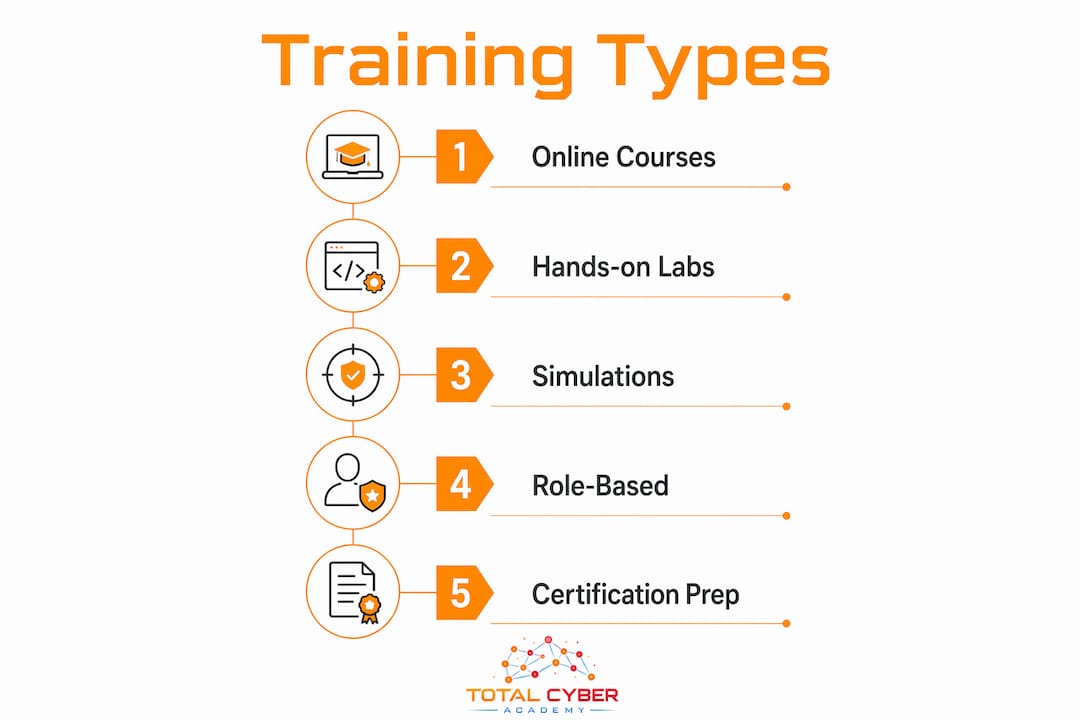
Cybersecurity training, also called security awareness training in organizational contexts, covers a wide range of formats. Each format serves a different learning goal, and the best programs combine more than one approach.
The three primary delivery methods are:
- Traditional e-learning: Structured online modules that learners complete at their own pace. These work well for foundational concepts like password hygiene, data classification, and recognizing phishing emails. The drawback is passive engagement. Learners click through slides without applying knowledge under pressure.
- Instructor-led live sessions: Real-time classes with an expert who can answer questions, adjust explanations, and respond to the group’s skill level. This format builds deeper understanding and allows for discussion of real-world scenarios. Totalcyber uses this model to give students direct access to experienced practitioners.
- Simulation-based training: Simulations like phishing tests provide the strongest behavioral reinforcement of any training format. A simulated phishing email sent to an employee, followed immediately by corrective feedback, creates a memory tied to a real emotional response. That response sticks far longer than a slide deck.
Pro Tip: If you are evaluating a cybersecurity training program, check whether it includes hands-on labs or simulations. Programs that only deliver video content will not prepare you for real threat scenarios.
The most effective programs blend all three formats. Foundational knowledge comes from structured modules, depth comes from live instruction, and behavioral change comes from simulation and practice under realistic conditions.
How does role-based training improve cybersecurity outcomes?
Generic annual training fails because it treats a software developer, an HR manager, and a C-suite executive as if they face identical threats. They do not. Role-based, behavior-focused training produces better retention and relevance than one-size-fits-all approaches.

Consider the difference in threat exposure. A developer needs to understand secure coding practices, SQL injection, and dependency vulnerabilities. An executive is more likely to be targeted by spear-phishing or business email compromise. HR staff handle sensitive personal data and face social engineering attacks designed to extract employee records. Training that addresses each role’s specific risk profile produces measurable behavior change.
Just-in-time learning takes this further. Just-in-time learning triggered by risky user behavior produces better retention than scheduled annual reviews. When a user clicks a simulated phishing link, the system delivers a short, targeted lesson at that exact moment. The timing matters. The lesson arrives when the user is most receptive because they just made the mistake.
Attackers rarely exploit obvious technical flaws. They target human psychology, using urgency, authority, and fear to manipulate behavior. Training that ignores social engineering leaves the most exploited attack surface completely undefended.
This insight from University of Luxembourg SnT research on cybersecurity reframes what effective training must cover. Technical controls matter, but the human layer requires equal attention. Programs that incorporate social engineering scenarios, pretexting simulations, and multi-factor authentication adoption exercises address the full threat picture.
- Phishing reporting drills that reward employees for flagging suspicious emails
- MFA adoption campaigns tied to role-specific risk briefings
- Tabletop exercises simulating ransomware incidents for IT and leadership teams
- Secure coding workshops for development teams using real vulnerability examples
What certifications and career paths exist in cybersecurity?
A cybersecurity certification is a credential issued by a recognized body that validates specific technical skills or knowledge domains. Certifications serve two functions: they signal competence to employers, and they structure a learner’s path through complex material.
Entry-level credentials worth pursuing
CompTIA Network+ and Security+ are the most widely recognized entry-level credentials in the field. Network+ establishes foundational networking knowledge, which is a prerequisite for understanding how attacks propagate across systems. Security+ builds on that foundation with threat detection, risk management, and cryptography. Totalcyber offers dedicated CompTIA certification prep covering both credentials with hands-on labs and practice exams.
Intermediate and advanced pathways
After earning entry-level credentials, professionals typically pursue one of three tracks:
- Security operations: Credentials like EC-Council’s Certified Ethical Hacker (CEH) or ISC2’s SSCP prepare analysts for threat monitoring, incident response, and vulnerability assessment roles.
- Penetration testing: Advanced certifications validate the ability to simulate attacks against systems with authorization. This track requires strong networking and scripting fundamentals before certification study begins.
- Cloud security: Vendor-neutral credentials address security architecture across multi-cloud environments. These are increasingly sought as organizations migrate infrastructure off premises.
MIT xPRO’s 24-week Professional Certificate in Cybersecurity covers network security, cryptography, and penetration testing in a structured sequence. That curriculum mirrors the progression most hiring managers expect: networking fundamentals first, then threat analysis, then applied offensive and defensive techniques.
Certifications function as a hiring filter. Many federal agencies and defense contractors require specific credentials before considering candidates. Earning CompTIA Security+ before applying to government-adjacent roles is not optional in many cases. It is a baseline requirement. Totalcyber’s EC-Council training programs and ISC2 certification tracks prepare students for these exact credential requirements.
| Certification | Level | Primary Focus |
|---|---|---|
| CompTIA Network+ | Entry | Networking fundamentals |
| CompTIA Security+ | Entry | Threat detection, risk management |
| EC-Council CEH | Intermediate | Ethical hacking, penetration testing |
| ISC2 SSCP | Intermediate | Security operations, access controls |
| ISC2 CISSP | Advanced | Security architecture, management |
What are the real benefits and challenges of cybersecurity training?
Cybersecurity training reduces organizational risk by improving decision-making at every level of an organization. Better decisions mean fewer successful phishing attacks, fewer misconfigured systems, and faster incident recognition. For individuals, training translates directly into career mobility and higher earning potential in a field with persistent talent shortages.
The core benefits include:
- Reduced susceptibility to social engineering and phishing attacks
- Faster threat recognition and incident reporting
- Stronger data protection practices across teams
- Compliance with frameworks like NIST, ISO 27001, and CMMC
- Career advancement through validated, credential-backed skills
The challenges are equally real. Training fatigue sets in when employees receive repetitive, low-quality content that feels disconnected from their daily work. Annual slide decks that cover the same material year after year produce diminishing returns. Effective cybersecurity training uses short lessons, role-specific content, simulations, and metrics rather than annual check-the-box approaches. That shift requires organizational commitment, not just a software subscription.
Leadership culture determines whether training sticks. When executives treat security as a shared responsibility and participate visibly in training programs, employees follow. When security training is delegated entirely to IT and treated as an HR compliance task, engagement collapses. Metrics like phishing click rates, incident reporting frequency, and time-to-report provide concrete feedback on whether training is producing behavior change.
Pro Tip: Track your phishing simulation click rate over three months. A declining rate is the clearest evidence that training is working. A flat or rising rate signals that content needs to change.
Key Takeaways
Cybersecurity training is the most direct defense against human error, which remains the leading cause of data breaches and the primary target of modern attackers.
| Point | Details |
|---|---|
| Human error drives most breaches | Over 60% of breaches involve human error, making training the highest-impact control available. |
| Simulation outperforms passive learning | Phishing simulations and hands-on labs produce stronger behavioral change than video-only courses. |
| Role-based content improves retention | Training tailored to job function is more relevant and produces measurable behavior change. |
| Certifications validate and accelerate careers | CompTIA Security+ and Network+ are baseline credentials for most entry-level cybersecurity roles. |
| Culture sustains training impact | Leadership participation and ongoing reinforcement determine whether training changes behavior long-term. |
Why most cybersecurity training misses the point
Most training programs focus on what to do and almost none of them focus on why attackers succeed. That gap is where breaches happen.
I have seen technically proficient IT professionals fall for spear-phishing emails because the message exploited urgency and authority, two psychological triggers that bypass rational evaluation. No amount of policy documentation prevents that. Only repeated exposure to realistic scenarios, combined with immediate feedback, builds the instinct to pause and verify.
The professionals who advance fastest in this field are not the ones who memorized the most frameworks. They are the ones who understand how attackers think. Attackers exploit human psychology rather than technical flaws in the majority of successful intrusions. That means your training must include social engineering scenarios, not just firewall configuration exercises.
Certifications matter, but treat them as milestones, not destinations. CompTIA Security+ gets you in the door. What keeps you employed and advancing is the habit of continuous learning, staying current with threat intelligence, and practicing skills in environments that simulate real conditions. Veterans entering the field through programs like Totalcyber’s cybersecurity workforce initiatives bring operational discipline that accelerates this habit formation. That is a genuine competitive advantage.
Start with networking fundamentals. Build toward a Security+ credential. Then choose a specialization based on where your curiosity takes you, whether that is penetration testing, cloud security, or incident response. The field rewards people who stay curious and keep building.
— Alden
Totalcyber’s training programs for serious career starters
Totalcyber is a veteran-owned cybersecurity training organization built for people who are serious about entering or advancing in the field. Its programs cover everything from foundational IT concepts to advanced certification preparation, with hands-on labs, expert instruction, and real-world scenarios at every level.
Whether you are preparing for CompTIA Security+, pursuing EC-Council credentials, or exploring your first cybersecurity course, Totalcyber’s full course catalog has a structured path for you. The programs are designed for beginners, career changers, veterans, and working IT professionals who need flexible, career-focused training. Explore Totalcyber’s training programs and find the credential path that fits your goals.
FAQ
What is cybersecurity training in simple terms?
Cybersecurity training is structured education that teaches individuals to recognize and respond to digital threats. It covers topics like phishing, password security, network defense, and incident response.
How do I start cybersecurity training with no experience?
Start with foundational credentials like CompTIA Network+ to build networking knowledge, then progress to CompTIA Security+ for core security concepts. Totalcyber offers beginner-friendly programs that require no prior IT experience.
What is a cybersecurity certification and why does it matter?
A cybersecurity certification is a credential from a recognized body that validates specific technical skills. Employers use certifications like CompTIA Security+ as a baseline hiring filter for entry-level and mid-level roles.
How long does it take to complete cybersecurity training programs?
Entry-level certification programs typically take 3–6 months of focused study. Advanced programs like MIT xPRO’s Professional Certificate run 24 weeks with a structured curriculum covering network security, cryptography, and penetration testing.
What is the difference between cybersecurity awareness training and professional certification training?
Cybersecurity awareness training targets general employees and focuses on recognizing threats like phishing and social engineering. Professional certification training prepares individuals for technical roles and validates skills through industry-recognized exams.