
A cybersecurity portfolio is a structured collection of documented projects, certifications, and technical work that proves you can do the job before you get hired. Cybersecurity portfolio building step by step is not just a career tip. It is the difference between a resume that gets ignored and one that gets a callback. Hiring managers use portfolios to verify that candidates can think critically when faced with ambiguous, real-world data. A certification alone does not show that. Your portfolio does. Standards like the NIST Cybersecurity Framework and credentials like CompTIA Security+, CEH, and OSCP give your work credibility. Totalcyber exists to help you build exactly that kind of proof.
What are the essential components of a cybersecurity portfolio?
A strong portfolio is not a dump of screenshots and cert logos. It is a curated case for your hire. Every element should answer one question for the recruiter: can this person actually do the work?
These are the components that belong in every portfolio:
- Professional summary. Two to three sentences stating your specialization, career goals, and what makes you worth hiring. Think of it as your elevator pitch in writing.
- Skills and tools list. Name the platforms, programming languages, and security tools you know. Examples include Wireshark, Metasploit, Python, Splunk, and AWS. Be specific.
- Project entries. Each project gets its own write-up. Employers value detailed write-ups that explain the problem, methodology, tools used, and lessons learned. That documentation shows technical depth and communication skill together.
- Certifications with context. Certifications like Security+, CEH, and OSCP carry more weight when you explain what you learned and how you applied it. A bare list of acronyms tells the recruiter nothing.
- Code repositories. Link to your GitHub profile. Recruiters check it. Clean, commented code with a clear README signals professionalism.
- Technical writing or blog posts. A short write-up explaining how you analyzed a phishing sample or configured a firewall rule shows you can communicate findings. That skill is critical in any security role.
| Portfolio element | What it proves |
|---|---|
| Professional summary | Career focus and communication ability |
| Skills and tools list | Technical breadth and platform familiarity |
| Project write-ups | Hands-on problem-solving and documentation |
| Certifications with context | Validated knowledge applied to real scenarios |
| GitHub repositories | Code quality and version control habits |
| Technical blog posts | Written communication and analytical thinking |
How do you choose and develop cybersecurity projects to showcase?
Projects are the heart of your portfolio. Theory tells a recruiter what you studied. Projects tell them what you can do. The goal is to pick work that simulates real security scenarios, not toy exercises.
Here is a practical process for developing portfolio-grade projects:
- Start with beginner-friendly project types. CTF challenges, malware analysis reports, intrusion detection scripts, and cloud security audits are all solid starting points. They cover a broad skill set and are accessible without enterprise access. Totalcyber’s overview of CTF competitions is a good place to understand how to get started.
- Use virtual labs for safe practice. Virtual labs and structured modules provide zero-risk environments for hands-on learning. Practicing in realistic simulated systems is especially valuable when you are building your first projects without a real employer network to work on.
- Build toward a capstone project. A portfolio-grade capstone project typically requires 4–8 weeks and simulates realistic end-to-end security scenarios. An AWS SOC/SOAR pipeline is one strong example. It demonstrates mastery in threat detection, incident response, and threat intelligence sharing all in one project.
- Document every step. Write up the problem you were solving, the methodology you followed, the tools you used, and what you learned. Include screenshots and code snippets where relevant.
- Simulate real-world thinking. Do not just describe what you did. Explain why you made each decision. Recruiters want to see how you think under pressure, not just what commands you ran.
Pro Tip: Pick one project that covers the full attack lifecycle: reconnaissance, exploitation, detection, and response. That single project shows more range than five shallow exercises.
What tools and platforms support building and hosting your portfolio?

You do not need to be a web developer to have a professional portfolio online. The right tools make setup fast and the result looks credible.
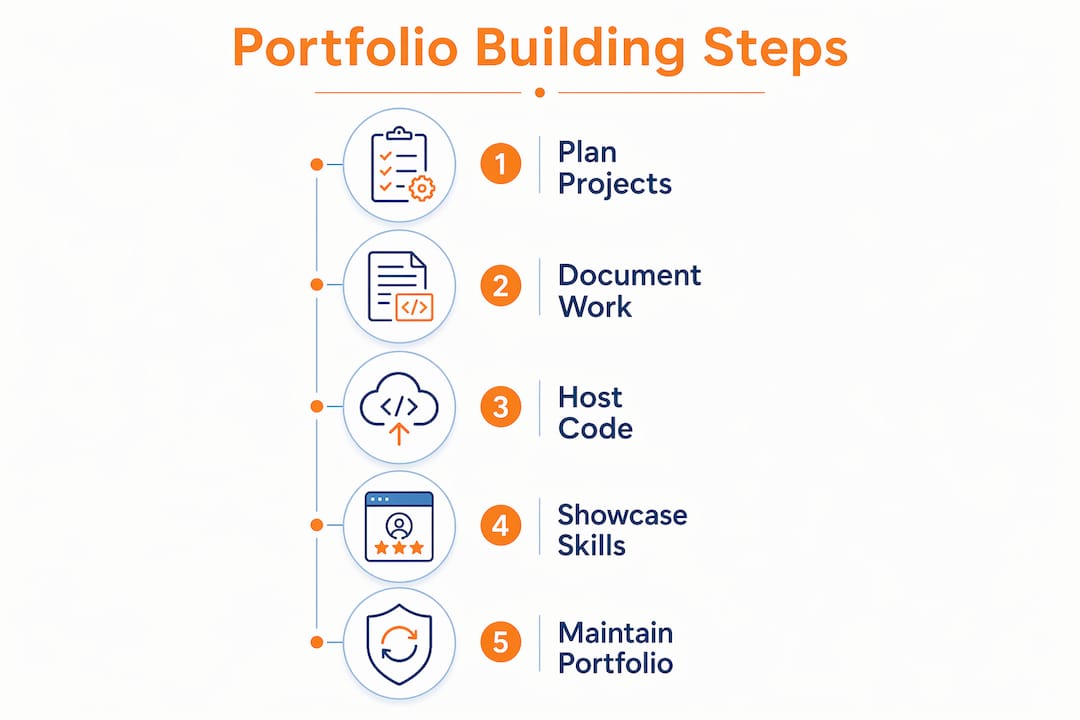
GitHub is the foundation. It hosts your code, shows your commit history, and doubles as a portfolio page with a pinned repositories section. Every cybersecurity professional should have an active GitHub profile. Learn more about AWS for cloud projects to understand how to build and document cloud security work that lives in your repositories.
For the portfolio website itself, open-source tools remove the technical barrier. The Hacker Portfolio Generator lets you launch a hacker-style portfolio site with effects and animations, hosted for free on GitHub Pages. No web development experience required.
| Tool or platform | Purpose | Cost |
|---|---|---|
| GitHub | Code hosting and portfolio display | Free |
| GitHub Pages | Static website hosting | Free |
| Hacker Portfolio Generator | Portfolio site template for security professionals | Free |
| AWS Free Tier | Cloud project implementation and demos | Free tier available |
| Notion or Obsidian | Project documentation and write-up drafting | Free |
Beyond hosting, your documentation quality matters as much as the project itself. Write clearly. Use headers, numbered steps, and labeled screenshots in every project write-up. Documentation quality showcases communication skills, which are critical for cybersecurity roles but often overlooked by candidates focused only on technical output.
How do you present and maintain your portfolio for maximum impact?
Building the portfolio is only half the work. How you present it determines whether a recruiter spends 30 seconds or 10 minutes on your work.
A professional portfolio needs a strong landing page that immediately communicates who you are, your specialties, and why someone should keep reading. That first impression is what holds a recruiter’s attention long enough to reach your projects.
Follow these practices to maximize your portfolio’s impact:
- Organize projects by skill or chronologically. Group related work together. A recruiter hiring for a cloud security role should find your AWS projects immediately, not buried after five unrelated entries.
- Link everything. Your portfolio should connect to your LinkedIn profile, GitHub, and any published write-ups. Linking to professional profiles increases visibility and employer trust. Make navigation obvious.
- Include contact information. A recruiter who likes your work should not have to search for your email. Put it on the landing page.
- Update after every new project or certification. A portfolio with a last-updated date from two years ago signals stagnation. Pair your resume preparation with portfolio updates so both stay current.
- Avoid common mistakes. Do not include unfinished projects. Do not list tools you cannot explain. Do not use jargon without context. Every entry should be something you can defend in a technical interview.
Pro Tip: Ask a peer or mentor to navigate your portfolio cold, without any explanation from you. If they cannot find your best project in under 60 seconds, reorganize.
Key Takeaways
A cybersecurity portfolio built on documented, real-world projects and clear communication skills is the most direct path from training to employment.
| Point | Details |
|---|---|
| Portfolio over resume alone | Hiring managers verify critical thinking through portfolios, not just credentials. |
| Document every project | Write-ups covering problem, methodology, tools, and lessons learned prove both technical and communication skills. |
| Start with accessible projects | CTF challenges, malware analysis, and cloud security audits build a broad skill set from day one. |
| Use free hosting tools | GitHub Pages and the Hacker Portfolio Generator make professional hosting accessible at no cost. |
| Keep it current | Update your portfolio with every new project and certification to signal active growth to recruiters. |
What I have learned watching hundreds of portfolios succeed and fail
Most candidates treat the portfolio as an afterthought. They finish a course, earn a cert, and then scramble to put something together before an interview. That approach shows. The portfolios that actually get people hired are built in parallel with learning, not after it.
The biggest mistake I see is confusing activity with evidence. A long list of tools you have touched is not a portfolio. A single, well-documented project where you identified a real vulnerability, explained your methodology, and described what you would do differently next time. That is a portfolio. It shows a recruiter that you think like a practitioner, not a student.
Certifications matter. Security+ and CEH open doors. But a recruiter who sees a cert and a documented AWS SOC/SOAR incident response project will always choose the candidate who has both over the one who has only the cert. The project is proof. The cert is context.
One more thing. Your portfolio is not finished. It is a living document. The best security professionals I know update theirs every few months, adding new write-ups, refining old ones, and removing work that no longer reflects their current skill level. Treat it the way you treat your skills. Keep sharpening.
— Alden
Build your cybersecurity career with Totalcyber
Totalcyber is a veteran-owned training organization built specifically for people who want to move from learning to working in cybersecurity. The cybersecurity courses at Totalcyber combine hands-on labs, expert instruction, and real-world scenarios that give you the project material your portfolio needs.
Whether you are preparing for CompTIA Security+, building your first cloud security project, or looking to sharpen skills for a career change, Totalcyber’s certification prep programs give you structured, practical training that translates directly into portfolio-ready work. You do not have to figure this out alone. The guidance, the labs, and the community are already there.
FAQ
What is a cybersecurity portfolio?
A cybersecurity portfolio is a documented collection of projects, certifications, and technical write-ups that demonstrates your practical skills to employers. It proves you can apply security knowledge to real scenarios, not just pass exams.
What projects should beginners include in a cybersecurity portfolio?
Beginners should start with CTF challenge write-ups, malware analysis reports, intrusion detection scripts, and cloud security audits. These project types cover a broad skill set and are achievable without enterprise access.
How long does it take to build a portfolio-grade capstone project?
A portfolio-grade capstone project typically requires 4–8 weeks and simulates realistic end-to-end security scenarios such as an AWS SOC/SOAR pipeline covering threat detection and incident response.
Where should I host my cybersecurity portfolio?
GitHub Pages is the most practical free option. The Hacker Portfolio Generator creates a professional hacker-style site hosted on GitHub Pages without requiring web development skills.
How do certifications fit into a cybersecurity portfolio?
Certifications like Security+, CEH, and OSCP strengthen a portfolio when presented with context explaining what you learned and how you applied it. A bare list of acronyms adds little value compared to a cert paired with a related project.
Recommended
- To-Do Lists – Total Cyber Academy!
- CSF 2.0 Reflecting on the Crucial Introduction of Governance – Total Cyber Academy!
- Best Practices for Backing Up Your Files – Total Cyber Academy!
- Total Cyber Places 1st in CompTIA Partner Summit CTF – Total Cyber Academy!