
The certifications that satisfy DoD cybersecurity requirements fall into four role groups: IAT, IAM, IASAE, and CSSP. The most frequently cited approved baseline credentials are CompTIA A+, Network+, and Security+, plus (ISC)² CISSP, ISACA CISM, EC-Council CEH, GIAC GSEC, and Cisco CCNA. DoDM 8140.03 is now the governing DoD policy, but many active contracts and statements of work still cite the older 8570 baseline lists by name, so both frameworks matter in practice.
- IAT (technical), IAM (management), IASAE (systems architecture), and CSSP (specialized cyber defense) are the four role families.
- CompTIA Security+, CISSP, CISM, and CEH show up most often across the qualification matrix.
- 8140 organizes qualifications by work role using the DoD Cyber Workforce Framework, not by the old cert checklist alone.
Pro Tip: Before you enroll in an exam, find out your exact DoD Cyber Workforce Framework (DCWF) work role code. That single number determines which certification actually counts, not the job title on your badge.
Your immediate next step: confirm your assigned work role with your Component Cyber Workforce Manager and cross check it against the official qualification matrix before you spend money on an exam voucher.
Key Takeaways
Compliance with DoD cybersecurity certification rules requires matching your exact DCWF work role to the current 8140 qualification matrix, not just picking a cert from the old 8570 list.
| Point | Details |
|---|---|
| Confirm your work role first | Identify your DCWF code before choosing any certification to avoid wasted exam fees. |
| 8140 governs policy, 8570 lingers in contracts | Check both the current matrix and any SOW language citing older 8570 baseline certs. |
| Higher-level certs don’t auto-substitute | Get written confirmation from your Cyber Workforce Manager before assuming cross-level acceptance. |
| Track renewal deadlines separately | Provider CEU cycles and DoD’s foundational and residential qualification windows run on different clocks. |
| Train with role-mapped prep | Total Cyber Academy offers CompTIA, ISC2, and EC-Council prep aligned to specific DoD work roles. |
Where to Verify Official DoD Certification Role Mappings
- DoD CIO’s Cyber Workforce pages publish the current qualification matrix and program guidance.
- Archived 8570 baseline charts preserve legacy cert-to-role mappings still cited in older contracts.
- Confirm your specific work role with your Component Cyber Workforce Manager before finalizing any exam choice.
Table of Contents
- Who Actually Has to Comply With DoD 8570 Certifications?
- Did DoD 8140 Replace DoD 8570 Certification Requirements?
- Which Certifications Are Approved for Each DoD Role Group?
- Does a Higher-Level Certification Cover a Lower-Level Role?
- How Do You Get Certified and Documented for DoD Compliance?
- What Are the Recertification and Continuing Education Requirements?
- How Much Do Component Requirements Vary From the Baseline?
- Practical Compliance Tips Practitioners Wish They’d Known Sooner
- Get Exam Ready for the Certifications DoD Actually Requires
- Frequently Asked Questions
- Sources
Who Actually Has to Comply With DoD 8570 Certifications?
The compliance requirement covers three groups: DoD civilians, active military, and contractor personnel who hold assigned information assurance or cyber duties. If your job function touches network defense, system administration with elevated privileges, or cyber risk management on a DoD network, you’re in scope regardless of your employer’s name on your paycheck.
- DoD civilians in IT, cyber, or systems roles with privileged access.
- Military personnel assigned to cyber, IT, or IA duty positions.
- Contractors and subcontractors performing IA/cyber functions under a DoD contract.
Edge cases trip people up constantly. Foreign nationals working in cleared positions, embedded contractors rotating between commands, and anyone holding privileged or root access often face additional scrutiny, and individual Components are free to layer on stricter rules than the DoD-wide baseline.
“Covered IA/cyber duties” generally means any role where you configure, defend, monitor, or administer DoD information systems, not just roles with “cybersecurity” in the title. A help desk technician with domain admin rights can qualify just as easily as a SOC analyst.
Did DoD 8140 Replace DoD 8570 Certification Requirements?
Yes. DoDM 8140.03 superseded DoD 8570 as the governing policy, shifting the qualification logic from a fixed certification list to the DoD Cyber Workforce Framework and a detailed per-work-role qualification matrix. That change sounds bureaucratic, but it has a real consequence for you: contracts written years ago, and plenty being written today, still reference the 8570 baseline certs by name because SOW language lags behind policy updates.
- 8140 maps certifications and training to specific DCWF work roles rather than broad IAT/IAM tiers alone.
- Contract language citing “DoD 8570 compliant” certifications remains legally binding even under 8140 policy.
- DoD CIO’s Cyber Workforce pages host the current qualification matrix and program guidance.
Treat the qualification matrix, not a blog post or training vendor’s chart, as the final word on what your specific work role requires.
Which Certifications Are Approved for Each DoD Role Group?
Certification requirements vary by both role group and experience level, and the mapping below reflects the most commonly cited baseline options across IAT, IAM, IASAE, and CSSP positions. Archived reproductions of the 8570 baseline chart remain the most detailed public reference for contract teams still bidding against 8570-language SOWs.
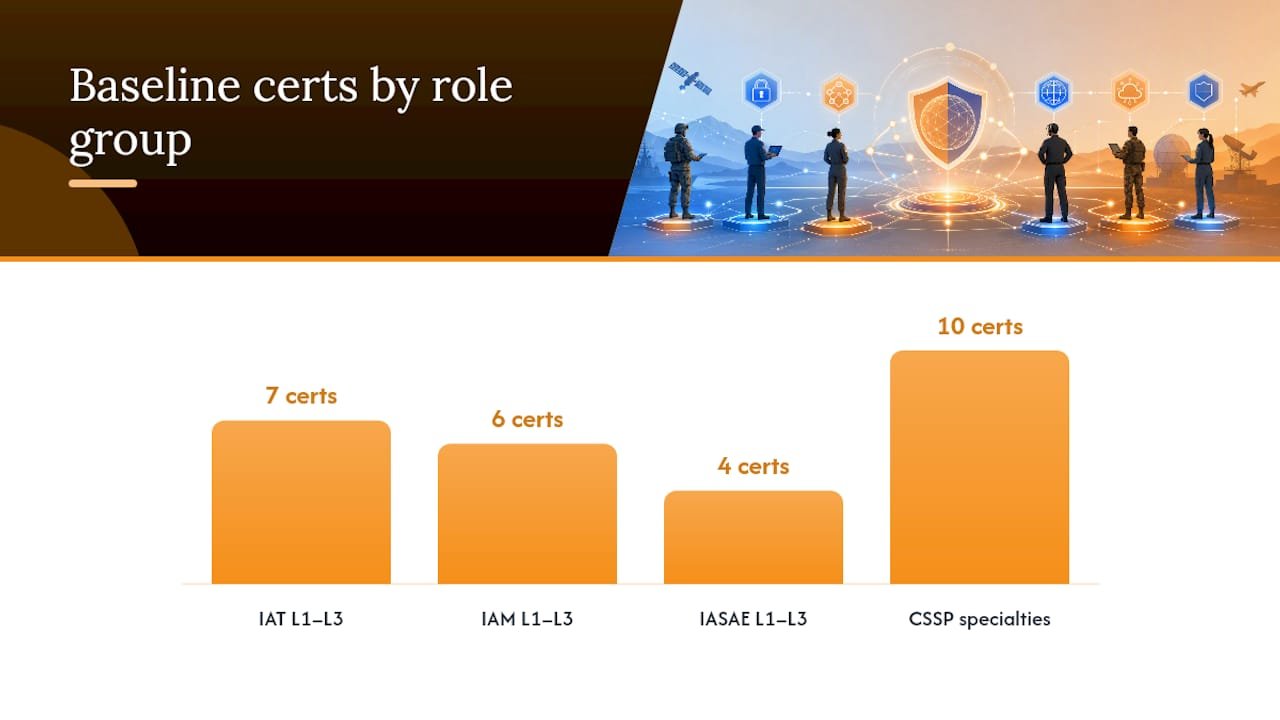
IAT (technical) levels I through III typically draw from CompTIA’s stack. Level I commonly accepts CompTIA A+ or Network+. Level II usually requires CompTIA Security+, SSCP, or a Cisco CCNA Security credential. Level III steps up to CompTIA CASP+ or CISSP, since technical leads at this tier need architecture-level judgment, not just configuration skill.
IAM (management) levels I through III lean toward governance-focused credentials. Level I often accepts Security+ CE or the (ISC)² CAP. Level II typically wants CASP+, CISM, or CISSP. Level III, reserved for senior IA managers overseeing entire programs, generally requires CISM, CISSP, or EC-Council’s CCISO for candidates managing enterprise-wide risk posture.
IASAE (systems architecture and engineering) levels I through III target the people designing secure systems from the ground up. Level I and II commonly recognize CASP+ or CISSP. Level III, the most senior architecture tier, usually calls for CISSP with an appropriate concentration, CSSLP for secure software architects, or CCISO for those bridging architecture and executive risk decisions.
CSSP specialties cover the operational cyber defense mission set, and the certs map to the specific job function rather than a generic level:
- Analyst: CompTIA CySA+, GIAC GCIA, or EC-Council CEH.
- Incident responder: GIAC GCIH or GCFA.
- Auditor: ISACA CISA.
- Infrastructure support: GIAC GSEC or CompTIA Security+.
- Manager: CISM or CCISO.
Notice the provider spread across this whole matrix: (ISC)² owns the CISSP, CAP, and SSCP lane; CompTIA covers the entry and mid-tier technical baseline; ISACA anchors governance and audit; GIAC dominates hands-on defensive specialties; EC-Council brings CEH and CCISO; and Cisco’s CCNA still shows up in technical infrastructure roles. Knowing which body issues which cert helps you plan renewal cycles, since each provider runs its own continuing education program.
Does a Higher-Level Certification Cover a Lower-Level Role?
Often, yes, but it’s not automatic. A CISSP frequently satisfies IAM II or IASAE II requirements and can sometimes substitute for a lower-level qualification when a Component allows cross-level acceptance. CISM works similarly for management-track roles below its normal tier.
- CISSP commonly clears IAM II/III and IASAE II/III baseline requirements in one exam.
- Cross-level substitution depends on your Component’s own policy, not a DoD-wide guarantee.
Pro Tip: Never assume a senior certification “auto-qualifies” you for a junior role. Get written confirmation from your hiring manager or Cyber Workforce Manager before you skip a required exam.
How Do You Get Certified and Documented for DoD Compliance?
Getting certified is only half the job. DoD compliance also requires that your credential gets recorded in the right personnel system, or it doesn’t count for anything on paper.
- Identify your assigned DCWF work role and confirm which certification satisfies it using the qualification matrix.
- Enroll in structured training or self-study prep matched to that specific exam.
- Schedule the exam through the certifying body and pass it.
- Submit proof of certification to your Component Cyber Workforce Manager or Information Assurance Manager, along with any required forms, such as DD Form 2875 for privileged access positions.
- Maintain currency through the provider’s renewal program so your qualification stays valid.
Pro Tip: Keep every renewal receipt and CEU/CET completion certificate in one folder. When a contract audit or CAC renewal comes up, you don’t want to be hunting for proof you completed continuing education three years ago.
What Are the Recertification and Continuing Education Requirements?
Recertification models differ by provider, but none of the major DoD-recognized credentials are “good for life.” Security+ requires renewal through CompTIA’s Continuing Education program roughly every three years. CISSP and CISM both run on Continuing Professional Education cycles managed by (ISC)² and ISACA, respectively. GIAC certifications typically require CPE submission and renewal within four years.
- Track CEUs/CPEs continuously rather than scrambling before a deadline.
- Retake requirements apply if you let a certification lapse past its grace period.
- Mismatched role mapping, holding a valid cert that no longer matches your current work role, is a common and avoidable compliance gap.
The DoD 8140 qualification matrix sets its own clock on top of provider renewal cycles: foundational qualifications are generally expected within nine months of assignment, and residential qualifications within twelve months. Miss that window and you may need a waiver just to keep working in your assigned role.
How Much Do Component Requirements Vary From the Baseline?
Baseline certification lists are a floor, not a ceiling. Individual Components, and even specific hiring managers or contracting officer’s representatives (CORs), routinely add requirements the DoD-wide matrix doesn’t mandate. Under 8140, Computing Environment and Operating System certificates aren’t universally required, but a given command can still insist on them for a specific position, according to the 8140 matrix SOP.
- Check your position’s assigned DCWF code before assuming a generic role mapping applies.
- Consult your Component Cyber Workforce Manager or COR directly rather than relying on a training vendor’s chart.
- Read the contract SOW and any DFARS clauses closely. Old 8570-era language can still be legally binding even under current 8140 policy.
Pro Tip: If a contract’s SOW names an 8570 certification the 8140 matrix doesn’t explicitly require anymore, don’t assume it’s outdated. Get the COR’s written confirmation before you switch qualification paths.
Practical Compliance Tips Practitioners Wish They’d Known Sooner
Keep both the archived 8570 baseline chart and the current 8140 qualification matrix on hand when bidding contracts or onboarding new hires; you’ll need to reference either one depending on which document governs your specific task order. If a contract explicitly names an 8570 certification, document that it satisfies the SOW, and get written sign off from the COR before switching to an 8140-based qualification path. Build your cert renewal timeline backward from assignment dates so you never land in the gap between a foundational deadline and an exam slot.
Pro Tip: Practitioners who preserve both frameworks side by side avoid the single most common compliance headache: discovering mid-contract that the SOW cites a certification the current matrix no longer lists by that exact name.
Why Mapping Certs to Roles Matters More Than Chasing Alphabet Soup
Career mobility inside DoD cyber roles rewards precision, not volume. A CISSP earns you almost nothing if it doesn’t match your assigned DCWF work role, while a well-matched Security+ can open a door a mismatched senior cert never will. Treat the qualification matrix as the final arbiter, and use focused exam prep, not scattershot certification collecting, to move up.
Get Exam Ready for the Certifications DoD Actually Requires
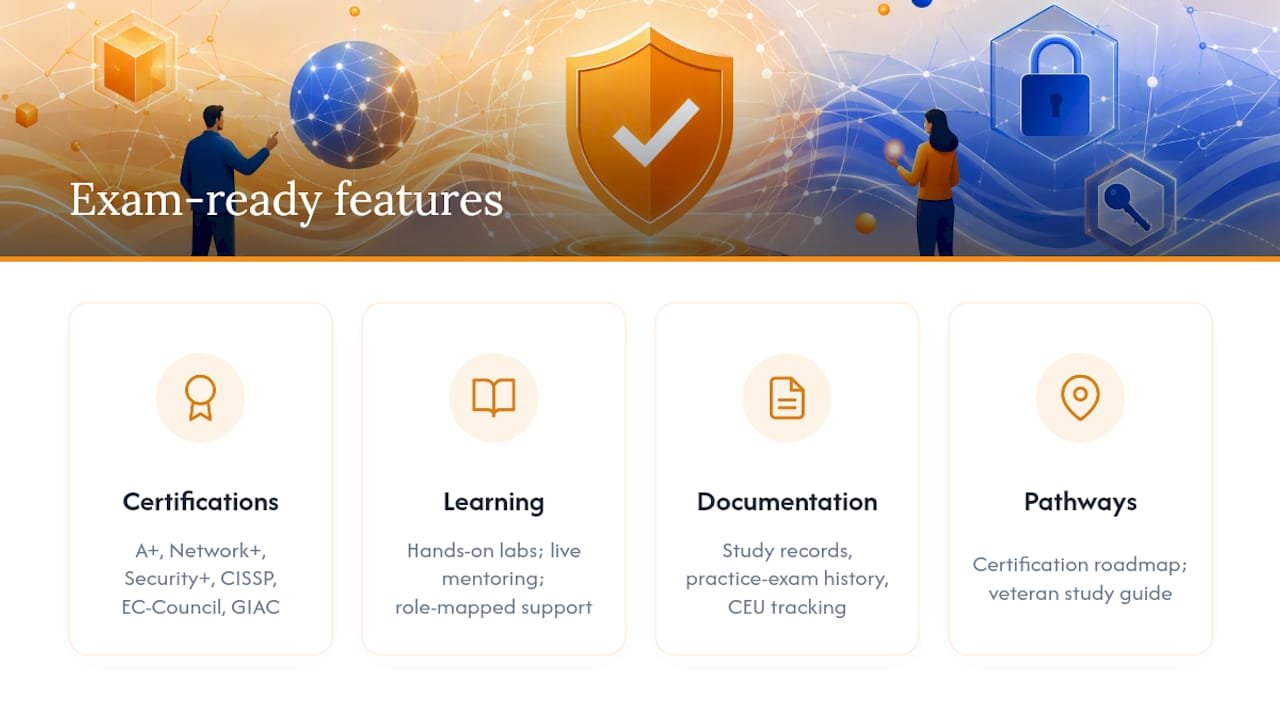
Total Cyber Academy builds its training around the exact certifications that show up across the DoD role matrix: CompTIA A+, Network+, and Security+, (ISC)² CISSP prep, EC-Council pathways, and GIAC-aligned skill building for CSSP specialties. You get hands-on labs instead of slide decks, live mentoring instead of a self-paced video queue you abandon after week two, and instructor support that maps directly to the work role you’re trying to qualify for.

Documentation matters as much as the exam itself, and Total Cyber Academy’s programs are built to leave you with the study records, practice exam history, and CEU tracking you’ll need when your Cyber Workforce Manager asks for proof. Whether you’re starting from an entry-level CompTIA course or moving into ISC2 certification prep for a CISSP-level role, the path is structured around the same DCWF logic this guide just walked through. Veterans transitioning into cyber roles get additional support through a dedicated study guide built around military experience translating into civilian and contractor cyber positions.
Check the certification roadmap to match your target DoD work role to the right training track, then start your exam prep today.
Frequently Asked Questions
Is DoD 8570 still active, or has it been fully replaced?
DoDM 8140.03 is the current governing policy, but 8570 baseline certification lists still appear in active contract language, so both frameworks remain relevant depending on which document governs your task order.
Which certification is best for an entry-level DoD IT role?
CompTIA A+ or Network+ typically satisfies IAT Level I requirements, and Security+ covers most IAT Level II and IAM Level I positions.
Does CISSP qualify for every senior DoD cyber role?
CISSP commonly satisfies IAM II/III and IASAE II/III baseline requirements, but Component-specific rules can still require additional credentials for certain work roles.
What happens if my certification lapses?
A lapsed certification generally means you fall out of compliance for your assigned role until you retake the exam or complete the provider’s reinstatement process, so track renewal deadlines closely.
Where can I find the authoritative DoD certification list?
The DoD 8140 qualification matrix published through DoD CIO is the current official source for role-to-certification mapping.
Sources
- DoD 8140 CYBER WORKFORCE QUALIFICATION PROGRAM (CWQP)
- Cyber Workforce Development – DoD CIO – Department of Defense
- DoD Approved 8570 Baseline Certifications by Role and Level – LegalClarity
- DoD 8140 Certification Requirements | JAKSecurity