
The most common examples of cloud security job roles include cloud security engineer, cloud security architect, SOC analyst, detection engineer, incident responder, penetration tester, DevSecOps engineer, IAM engineer, GRC/compliance analyst, and cloud security auditor. These positions span hands-on technical work, strategic design, offensive testing, and regulatory assurance. Frameworks like NIST and standards bodies like ISC2 (which governs CISSP and CCSP) define the competency benchmarks most employers reference when hiring for these roles. Totalcyber’s training programs are built around exactly these positions.
At a glance:
- Cloud Security Engineer — builds and maintains security controls on AWS, Azure, or GCP
- Cloud Security Architect — designs the overall security posture and governance model
- SOC Analyst — monitors alerts, triages incidents, and operates SIEM platforms like Splunk
- Detection Engineer — writes detection logic and tunes alerting pipelines
- Incident Responder — leads cloud-native IR investigations and forensics
- Penetration Tester / Red Team — simulates adversary attacks against cloud environments
- DevSecOps Engineer — integrates security into CI/CD pipelines using tools like Terraform and Kubernetes
- IAM Engineer — governs identity, access policies, and privilege management
- GRC / Compliance Analyst — maps controls to NIST, ISO 27001, and CSA STAR frameworks
- Cloud Security Auditor — validates that controls meet regulatory and contractual requirements
Table of Contents
- What each cloud security role actually does day to day
- How cloud security careers typically progress from entry to senior
- How to break into cloud security: a practical 6-step plan for beginners
- Where cloud security roles are hired in the U.S. and how to find them
- Estimated U.S. salary bands and what drives pay in cloud security
- Skills, tools, and certifications employers expect for cloud security roles
- Key Takeaways
- Why hands-on training is what actually gets beginners hired
- Totalcyber gives you a structured path into cloud security
- Authoritative sources and next reads
What each cloud security role actually does day to day
Understanding the difference between these cloud security positions requires more than a job title. Microsoft’s Cloud Adoption Framework organizes cloud security responsibilities across infrastructure, IAM, data security, posture management, and security architecture — a useful lens for seeing how roles divide in practice.
| Role | Seniority Entry Point | Core Daily Tasks | Key Tools | Top Certifications |
|---|---|---|---|---|
| Cloud Security Engineer | Mid | Build IAM policies, automate guardrails, review CI/CD pipelines | Terraform, AWS Security Hub, Kubernetes | AWS Security Specialty, CompTIA Security+ |
| Cloud Security Architect | Senior (5+ yrs) | Design reference architectures, threat model new services, advise engineering | CSPM/CNAPP platforms, Azure Defender | CISSP, CCSP |
| SOC Analyst | Entry (1–3 yrs) | Triage alerts, investigate logs, escalate incidents | Splunk, Microsoft Sentinel, SIEM dashboards | CompTIA Security+, CySA+ |
| Detection Engineer | Mid | Write detection rules, tune false positives, build alerting pipelines | Splunk, Elastic, SIEM query languages | GCIA, AWS/Azure certs |
| Incident Responder | Mid | Lead IR investigations, contain cloud breaches, document findings | Cloud-native forensics tools, SIEM | GCFE, GCIR |
| Penetration Tester | Mid–Senior | Simulate attacks on cloud configs, report findings, retest remediations | Burp Suite, cloud-native attack tools | OSCP, AWS Security Specialty |
| DevSecOps Engineer | Mid (2–4 yrs) | Embed security checks in pipelines, manage IaC security, automate policy | Terraform, Kubernetes, GitHub Actions | AWS DevOps Pro, CompTIA Security+ |
| IAM Engineer | Mid (2–4 yrs) | Manage identity providers, enforce least-privilege, audit access logs | Azure AD, AWS IAM, Okta | CISSP, Azure Identity certs |
| GRC Analyst | Entry–Mid | Map controls to frameworks, write policies, support audits | GRC platforms, spreadsheets, CSPM reports | CISA, CCSP |
| Cloud Security Auditor | Mid–Senior | Validate control effectiveness, produce audit reports, advise remediation | CSPM/CNAPP, audit management tools | CISA, CISSP |
Real-world job descriptions reinforce this picture. Stripe’s cloud security engineer listing specifies designing security infrastructure, building IAM controls, and automating guardrails as core responsibilities. At the senior end, Vercel’s cloud security engineer role adds threat modeling, Kubernetes security, Terraform/CDK proficiency, and certifications like CISSP and OSCP as expected qualifications.
One practical note: Wiz’s cloud careers guidance points out that organizations frequently combine responsibilities across roles. A cloud security engineer at a startup may also handle basic incident response and compliance tasks that a large enterprise would split across three specialists. Platform fluency on AWS, Microsoft Azure, or Google Cloud Platform matters more than matching an exact job title.
How cloud security careers typically progress from entry to senior
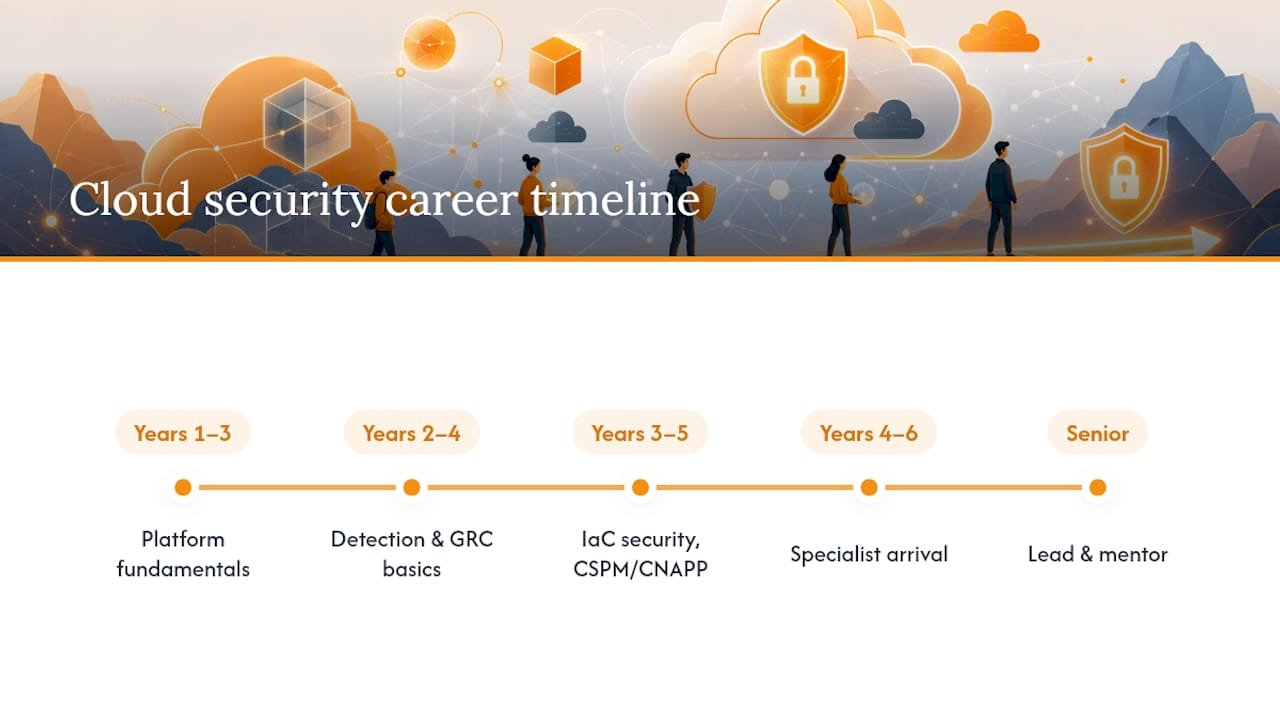
Most practitioners do not start in a cloud-specific role. AWS Training’s career trajectory research maps a flexible roadmap from entry SOC analyst positions into advanced cloud-specialist tracks, and CSOH’s career map identifies five primary specialty branches: Cloud Security Engineering, Detection Engineering, Cloud Incident Response, AppSec/CNAPP, and GRC. Specialists typically arrive in those branches around years 4–6 after starting in adjacent roles.
Engineering track: Entry through a cloud engineer, sysadmin, or DevOps role. Years 1–3 build platform fundamentals (AWS/Azure/GCP), scripting, and basic security controls. Years 3–5 add IaC security, CSPM/CNAPP tooling, and threat modeling. Senior engineers lead architecture decisions and mentor junior staff.
Detection and IR track: Entry through a SOC analyst role operating a SIEM like Splunk. Years 2–4 shift toward writing detection logic and handling cloud-native incidents. Senior practitioners design detection programs and lead major IR engagements.
GRC and assurance track: Entry through compliance or IT audit work. Years 2–4 build framework knowledge (NIST CSF, ISO 27001, CSA STAR) and cloud control mapping. Senior GRC professionals own audit programs and advise executive stakeholders.
Choosing a track based on personal strengths accelerates progression significantly. Hands-on cloud security engineering suits professionals who prefer daily configuration and automation work, while cloud security architecture fits those drawn to strategic design and governance. Forcing a mismatch between role type and working style is one of the most common reasons early-career professionals stall.
Pro Tip: Earning CompTIA Security+ before your first SOC role and then adding an AWS or Azure security specialty cert during years 2–3 is one of the fastest documented paths to a cloud-specific title. The cert signals platform intent to hiring managers before your resume shows dedicated cloud experience.
How to break into cloud security: a practical 6-step plan for beginners
Technology.org’s career overview recommends aligning your entry path with your strengths. The six steps below reflect that principle and the cloud security skills guide Totalcyber publishes for beginners.
-
Learn cloud fundamentals — Start with AWS Cloud Practitioner or Microsoft Azure Fundamentals free study materials. Understand shared responsibility models, IAM basics, and core services before touching security tooling.
-
Get hands-on with labs — Free tiers on AWS, Azure, and GCP let you build real environments. Platforms offering guided cloud security labs accelerate this faster than reading alone.
-
Specialize with a role-focused cert or course. After 12–18 months of experience, target a specialty: AWS Security Specialty, Azure Security Engineer Associate, CCSP, or OSCP depending on your track. Totalcyber’s beginner career guide maps these cert choices to specific role outcomes.
Pro Tip: Capture the Flag competitions are one of the fastest ways to build demonstrable offensive and defensive skills before your first job. A documented CTF portfolio entry often outweighs a generic resume bullet.
Where cloud security roles are hired in the U.S. and how to find them
Cloud security positions appear across a wider range of employers than most beginners expect. Understanding which employer type hires which role helps you target your search more precisely.
- Cloud providers (AWS, Azure, GCP) — hire detection engineers, security architects, and IAM specialists at scale; competition is high but compensation is top-tier.
For job searching, use title variants: “cloud security engineer,” “cloud security analyst,” “DevSecOps engineer,” “SRE security,” and “security engineer cloud” all surface different postings on LinkedIn and Indeed. Remote roles are common in this field, though government and finance positions often require on-site or hybrid arrangements. For cloud security best practices at smaller organizations, startup-stage employers have distinct hiring needs worth understanding before you apply.
Networking accelerates hiring. ISC2 local chapters, DEF CON and BSides conferences, and GitHub/CTF communities all produce direct referrals. A polished LinkedIn profile with lab projects listed is a consistent differentiator at the entry level. Totalcyber’s career prep course covers resume positioning and interview readiness specifically for cybersecurity roles.
Estimated U.S. salary bands and what drives pay in cloud security
Salary estimates for cloud security roles vary by source, employer, and geography, so treat these as directional bands rather than guarantees.
The factors that move compensation most significantly:
- Cloud platform depth — Demonstrated AWS, Azure, or GCP security specialty skills command a premium over general security knowledge.
Total compensation at cloud-native companies typically includes equity, annual bonuses, and training stipends, which can add meaningfully to base salary. Salary figures vary widely based on individual qualifications, employer, and market conditions; verify current ranges through primary sources like the Bureau of Labor Statistics or employer-specific data.
Cloud security roles consistently rank among the highest-compensated positions in the broader cybersecurity field, driven by the combination of platform-specific expertise and the critical nature of protecting cloud infrastructure.
Skills, tools, and certifications employers expect for cloud security roles
Platform fluency on AWS, Microsoft Azure, or Google Cloud Platform is the foundation. Employers hiring for cloud security positions expect candidates to understand the native security services on at least one platform before evaluating any other qualification.
| Role Category | Core Technical Skills | Recommended Certifications | Representative Tools |
|---|---|---|---|
| Engineering / DevSecOps | IaC security, CI/CD hardening, container security | CompTIA Security+, AWS Security Specialty | Terraform, Kubernetes, GitHub Actions |
| Detection / IR | SIEM query writing, log analysis, cloud forensics | GCIA, GCIR, CySA+ | Splunk, Microsoft Sentinel, CSPM platforms |
| Offensive / Red Team | Cloud attack techniques, privilege escalation, recon | OSCP, AWS Security Specialty | Cloud-native attack tools, Burp Suite |
| Architecture / Posture | Threat modeling, CSPM/CNAPP, zero-trust design | CISSP, CCSP | CSPM/CNAPP platforms, Azure Defender |
| GRC / Compliance | Framework mapping, policy writing, audit support | CISA, CCSP | GRC platforms, CSPM reporting |
Beyond the table, a few skills deserve specific attention. CSPM and CNAPP concepts are increasingly central to cloud security engineering and architecture roles, as they automate posture visibility across multi-cloud environments. The shared security responsibility model that governs how cloud providers and customers divide security duties is foundational knowledge for every role in this field.
Soft skills matter more than most job descriptions admit. Clear written communication is critical for GRC analysts producing audit reports and for incident responders writing post-mortems. Risk management thinking separates engineers who build controls from those who build the right controls. Problem-solving under pressure is the defining competency for detection and IR roles.
Key Takeaways
Cloud security careers most often begin in SOC analyst or cloud operations roles, with specialization into engineering, detection, or GRC tracks typically occurring around years 4–6.
| Point | Details |
|---|---|
| Entry path is usually SOC or cloud ops | Most practitioners start in adjacent roles before moving into dedicated cloud security positions. |
| Specialization takes 4–6 years | CSOH’s career map places most specialists in their chosen branch after 4–6 years of foundational experience. |
| Certifications signal role intent | CompTIA Security+ for entry, platform security specialties for mid-level, CISSP/CCSP for senior, OSCP for offensive tracks. |
| Platform fluency outweighs title matching | AWS, Azure, and GCP security skills matter more than memorizing exact job titles when applying. |
| Totalcyber accelerates the entry path | Totalcyber’s beginner training programs map hands-on labs and cert prep directly to the roles listed above. |
Why hands-on training is what actually gets beginners hired
The conventional wisdom says certifications open doors. That is partially true, but the practitioners who move fastest from entry-level to a dedicated cloud security title are almost always the ones who combined certification study with hands-on lab work from the start.
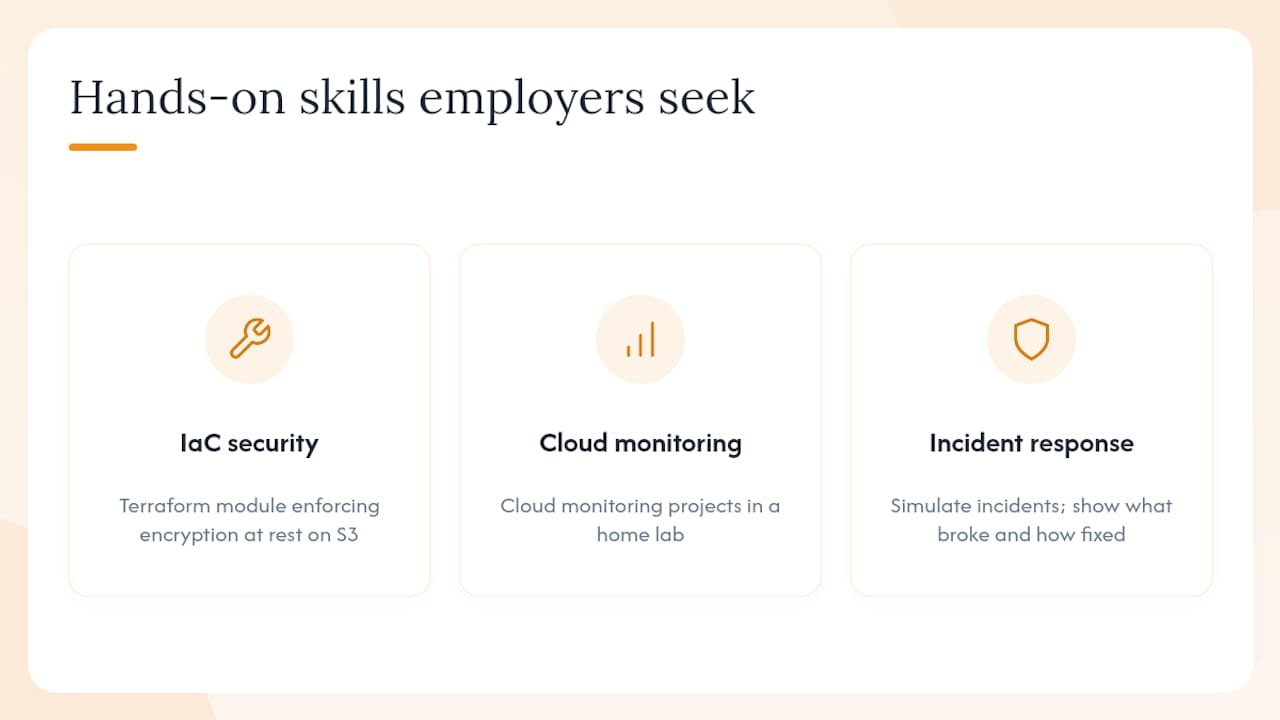
The reason is straightforward: cloud security is operationally specific. Knowing that Terraform manages infrastructure as code is different from having written a Terraform module that enforces encryption at rest across an S3 bucket. Hiring managers at cloud-native companies, in particular, screen for that operational specificity in interviews. A candidate who can describe a real lab scenario, including what broke and how they fixed it, consistently outperforms one who can only recite framework definitions.
IaC security, cloud monitoring configuration, and incident response simulations are the three skill areas that appear most consistently in entry and mid-level cloud security job descriptions. Building documented projects in all three, even in a home lab environment, creates a portfolio that compensates for limited professional experience.
Totalcyber gives you a structured path into cloud security
Certification prep alone leaves a gap between what you know and what employers need to see. Totalcyber fills that gap with hands-on, instructor-led training that maps directly to the cloud security roles covered in this article, from CompTIA Security+ for SOC entry to advanced cloud engineering and penetration testing programs.
Totalcyber is veteran-owned and built specifically for beginners, career changers, and IT professionals who need practical skills, not just exam memorization. Programs include live mentoring, real-world lab scenarios, and certification preparation for CompTIA, ISC2, and EC-Council credentials. If you are ready to match your training to a specific role, review the beginner’s career guide to identify which program fits your target position and timeline.
Authoritative sources and next reads
The following sources informed this article and are worth reading directly for deeper context on specific roles and career paths.
- Navigating your way into cloud security: Skills, roles, and career trajectories | AWS Training and Certification Blog
- Teams and roles — Microsoft cloud adoption framework
- What Does a Cloud Security Career Actually Look Like? — Technology Org
- Cloud Security Careers — Cloud Careers | Wiz
- Cloud Security Careers — Cloud Security Office Hours
- Cloud Security Engineer job listing — Stripe
- Job Application for Security Engineer, Cloud at Vercel
- Cybersecurity Training Explained: A Beginner’s Career Guide – Total Cyber Academy!
The most useful next step depends on where you are in your career. If you have no IT background, start with the AWS Cloud Practitioner free materials and CompTIA Security+ study. If you already work in IT or a SOC role, the CSOH career map and the Wiz Academy role descriptions will help you identify which specialty branch fits your current skills and interests.