
A penetration test finds and proves exploitable vulnerabilities inside a defined scope. A red team assessment tries to accomplish a specific adversary objective, undetected, to measure whether your security operations center can catch a real attack. Choose based on maturity: run pen tests to close known gaps, then graduate to red teaming once your detection and response program is mature enough to be tested. Most organizations run several pen tests before their first full red team.
TL;DR:
- Penetration tests focus on identifying and prioritizing vulnerabilities within a specific scope, typically lasting one to three weeks.
- Red team assessments emulate adversary tactics by targeting an objective through stealth, social engineering, and physical testing over four to twelve weeks or longer.
- Organizations should start with pen tests to close known gaps before advancing to red teaming once their detection and response capabilities are mature enough to be tested.
- Red teams emphasize attack narrative, dwell time, and detection metrics mapped against ATT&CK, unlike pen tests which produce vulnerability lists and remediation steps.
- Regular staffing, clear scope, and defined rules of engagement are crucial, with pen tests suitable for foundational maturity and red teams best for organizations with active security operations.
Table of Contents
- Pen Test vs Red Team: What a Penetration Test Actually Is
- What Is a Red Team Assessment?
- Key Differences: Pen Test vs Red Team Side by Side
- When to Choose a Pen Test vs a Red Team
- Deliverables and Metrics: What a Good Report Actually Contains
- How Pen Tests and Red Teams Fit Into a Security Program
- Costs, Team Composition, and Resourcing
- Common Misconceptions About Pen Tests and Red Teams
- How to Prepare: Scoping, Rules of Engagement, and Safety
- How Total Cyber Academy Training Maps to These Skills
- Publisher Perspective: A Practical Recommendation
- Build These Skills Before You Outsource Them
- Sources
Pen Test vs Red Team: What a Penetration Test Actually Is
A penetration test is a scoped, authorized attempt to identify and exploit vulnerabilities in a specific system, application, or network segment. The objective is coverage: find as many exploitable weaknesses as possible within the agreed boundary and hand engineering teams a prioritized fix list. NIST SP 800-115 remains the standard technical reference for how these engagements should be scoped, executed, and documented, from planning through evidence collection.
Pen tests come in a handful of common flavors, each targeting a different attack surface:
- Web application testing — probes for injection flaws, broken authentication, and logic errors in customer-facing software.
- Network testing — internal or external, looking for misconfigurations, unpatched services, and lateral movement paths.
- Cloud testing — reviews identity permissions, storage exposure, and misconfigured services across AWS, Azure, or Google Cloud.
- API testing — checks authorization and rate-limiting flaws often missed by traditional web scanners.
The process follows a predictable arc: scoping and rules of engagement, active assessment, proof-of-concept exploitation to validate real risk, then a remediation verification pass once fixes ship. Most pen tests run one to three weeks depending on scope size. Reports typically include a vulnerability list with CVSS severity ratings, exploitation proof, and step-by-step remediation guidance that maps cleanly to a ticketing system.
Compliance is often the trigger. PCI DSS requires regular penetration testing for organizations that handle card data, and auditors expect exactly this kind of deliverable as evidence. If you are building the underlying skill set yourself, Total Cyber Academy’s Penetration Tester program walks through the same methodology professional testers use in the field.
What Is a Red Team Assessment?
Red teaming is objective-driven adversary emulation. Instead of enumerating every possible flaw, a red team picks a goal, such as accessing a customer database or forging a wire transfer approval, and tries to get there the way a real attacker would, using whatever combination of techniques works. NIST’s own glossary defines red teaming specifically as an activity that emulates adversary behavior and tactics to evaluate security posture, not just find bugs.
That difference in framing changes everything about how the engagement runs:
- Full kill-chain scope — reconnaissance, initial access, privilege escalation, lateral movement, and objective completion, often over several weeks or months.
- Social engineering and physical testing — phishing campaigns, phone-based pretexting, and attempts to walk into a facility are frequently in scope, since real adversaries use them too.
- Minimal notification — usually only a small “white cell” inside the organization knows the test is happening, which is the entire point: you are testing whether the people who don’t know can catch it.
- Stealth over speed — testers deliberately move slowly to avoid tripping alerts, mirroring how a patient nation-state or ransomware crew actually behaves.
Red team reports look different from pen test reports too. Rather than a long vulnerability backlog, the deliverable is narrative-led: what path did the team take, what did the security operations center catch, and how long did detection take. Findings usually get mapped against MITRE ATT&CK, the industry standard framework for cataloging adversary techniques, so the security team can see exactly which tactics slipped past their SIEM and EDR tooling. The core metrics that matter here are dwell time and time-to-detect, not a raw count of vulnerabilities found.
Key Differences: Pen Test vs Red Team Side by Side
Once you strip away the marketing language, the two engagements separate cleanly across a handful of practical dimensions that actually affect what you’re buying.
| Dimension | Penetration test | Red team assessment |
|---|---|---|
| Primary objective | Find and validate exploitable vulnerabilities | Achieve a defined adversary goal undetected |
| Scope | Asset scoped (a system, app, or network segment) | Objective scoped (whatever it takes to reach the goal) |
| Typical timeline | One to three weeks | Four to twelve weeks, sometimes longer |
| Stealth/notification model | Known to IT staff, often scheduled in advance | Covert, known only to a small white cell |
| People/process coverage | Rarely includes social engineering or physical access | Frequently includes phishing, pretexting, and physical intrusion |
| Deliverable type | Vulnerability list with CVSS scores and PoCs | Attack narrative with ATT&CK mapping and detection metrics |
| Best-for maturity level | Foundational to intermediate programs | Organizations with an active, tested SOC/IR function |
The takeaway table below distills what actually changes your buying decision.
| If you need… | Choose |
|---|---|
| A prioritized fix list for engineering | Pen test |
| Proof your SOC catches a real intrusion | Red team |
| Evidence for a compliance audit | Pen test |
| A test of incident response speed | Red team |
| Coverage across dozens of systems quickly | Pen test |
| A realistic simulation of a targeted attacker | Red team |
Practitioners at OffSec frame it the same way: pen tests are asset-scoped vulnerability exercises, red teams are objective-driven simulations that test whether your people and tools notice an attack in progress. Neither replaces the other. They answer different questions.
When to Choose a Pen Test vs a Red Team
The decision comes down to maturity and the specific question you’re trying to answer, not budget alone.
- Foundational programs (no dedicated SOC, few prior tests) — run a pen test first. You almost certainly have exploitable gaps a red team would find in the first hour, which wastes an expensive engagement on low-hanging fruit.
- Compliance-driven organizations — PCI DSS, SOC 2, and similar frameworks expect penetration test evidence on a recurring cycle. Run those regardless of maturity.
- Mature programs with an active SOC and incident response team — this is where a red team engagement adds real value, because there’s something worth testing: detection and response, not just prevention.
- Organizations that have run three or more clean pen tests — consider layering in a red team to validate that fixed vulnerabilities translate into actual detection capability.
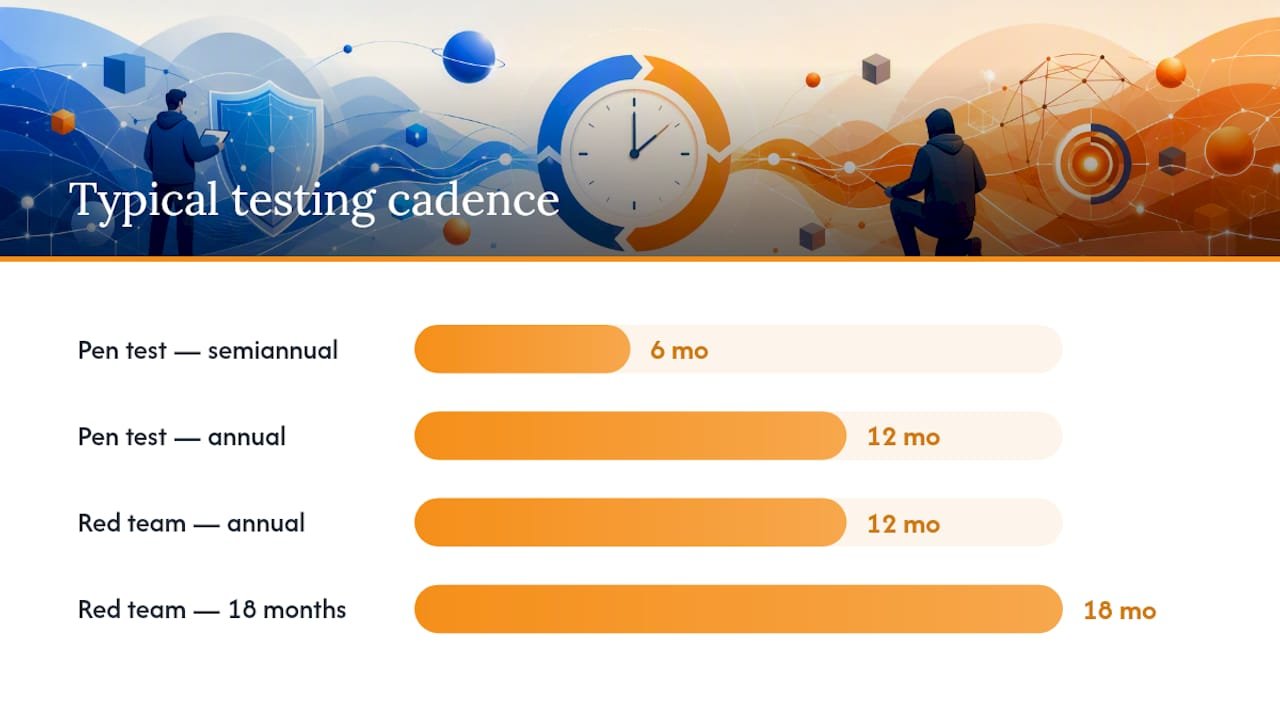
Cadence matters as much as sequence. Annual or semiannual pen tests are common; red teams typically run once a year or once every eighteen months given their cost and planning overhead.
Pro Tip: If you can’t say who on your team would notice a red team attack in progress, you’re not ready for one yet. That gap is exactly what a pen test and a maturity assessment should close first.
Deliverables and Metrics: What a Good Report Actually Contains
A pen test report earns its keep through specifics: a vulnerability list, exploitation proof-of-concept, CVSS or custom severity scoring, and remediation steps engineers can act on directly.
A red team report earns its keep through narrative and measurement: the attack path taken, which controls held and which failed, and hard detection metrics like dwell time and time-to-detect mapped against ATT&CK.
- Demand both the raw findings and the “so what”: a vulnerability with no business impact statement is noise.
- A red team report with no dwell-time or detection data is really just an expensive pen test wearing a costume.
How Pen Tests and Red Teams Fit Into a Security Program
Neither engagement works well as a one-off. The strongest programs sequence them deliberately.
- Run regular pen tests (quarterly or annually) to close known, exploitable gaps in priority systems.
- Layer in purple teaming or breach-and-attack simulation between heavy engagements to keep detection rules tuned continuously rather than testing them once a year.
- Run a red team assessment once your incident response team is staffed and rehearsed enough to have something worth testing.
- Feed every finding, from both engagement types, into a prioritized remediation backlog and update detection rules based on what got missed.
This sequencing mirrors what practitioners at IOActive recommend: frequent pen tests, periodic red teams, and continuous purple teaming in between to keep the gap from reopening.
Costs, Team Composition, and Resourcing
Budget and staffing expectations differ substantially between the two engagement types, and that difference should shape your procurement conversation from the start.
- Pen tests scale with scope size and typically run shorter engagements with one or two testers.
- Red teams require a small, senior team with social engineering, physical, and offensive tooling expertise, plus weeks of planning before execution even starts.
- Internal stakeholder time matters more for red teams: legal, HR, and facilities often need advance briefing even when the SOC itself stays in the dark.
- Staffing either function internally requires genuinely senior offensive security talent; the cybersecurity salary guide from NueCareer gives a useful sense of what that expertise costs to hire versus train.
Common Misconceptions About Pen Tests and Red Teams
The most expensive mistake is running a red team when a pen test was the right tool. You’ll get a narrow attack narrative instead of the broad vulnerability coverage you actually needed, and you’ll pay red team rates for it.

Clear rules of engagement and documented legal clearance matter just as much as methodology. A report that shows a red team “won” without measuring how long detection took, or without mapping techniques to ATT&CK, gives you a story but no data you can act on.
Pro Tip: If a vendor’s red team proposal doesn’t mention how they’ll measure your detection time, ask them directly. A red team without measurable detection data isn’t testing your SOC, it’s just testing your luck.
How to Prepare: Scoping, Rules of Engagement, and Safety
Getting real value from either engagement starts well before testers touch a keyboard.
- Define the objective and success criteria in writing before scoping conversations begin.
- Set formal rules of engagement (RoE) covering systems, techniques, and timing, following the structure NIST SP 800-115 lays out for evidence collection and scope boundaries.
- Loop in legal and privacy stakeholders early, especially for anything touching customer data or physical premises.
- Confirm escalation contacts, testing windows, and a rollback plan before day one.
- Schedule remediation verification or acceptance testing after the engagement closes, not just a report handoff.
Cloud environments carry an extra wrinkle: providers like AWS and Azure require authorization before testing, and FedRAMP-authorized services have their own documentation requirements you’ll need to satisfy first.
How Total Cyber Academy Training Maps to These Skills
Understanding pen testing and red teaming from the inside changes how you scope, evaluate, and act on either engagement, whether you’re hiring testers or becoming one.
- CompTIA PenTest+ preparation covers the same scoping and exploitation methodology described in NIST SP 800-115.
- Social engineering coursework builds the pretexting and phishing skills that show up directly in red team engagements.
- Hands-on labs modeled on real SOC workflows build the detection and response muscle that determines whether a red team finds anything worth reporting, and our practical cybersecurity experience guide breaks down how that lab time translates into job-ready skill.
- Total Cyber Academy is veteran-owned and operates as a Pearson VUE testing center, so certification prep connects directly to the exam you’ll actually sit for.
Publisher Perspective: A Practical Recommendation
The maturity-first argument isn’t a hedge, it’s the actual answer. Organizations that skip straight to red teaming before their SOC can detect a phishing email are paying premium rates to learn something a $2,000 pen test would have told them for free. Train the detection muscle first, run pen tests to close the obvious gaps, and save red teaming for when you have something real to test.
— Alden
Build These Skills Before You Outsource Them
Hiring a red team before your team knows what “normal” traffic looks like is like hiring a stunt driver before anyone on staff has a license. Total Cyber Academy’s approach is different from handing this entirely to an outside vendor: our hands-on labs and instructor-led courses build the same detection, response, and offensive skills these engagements test, so your team gets sharper with every course instead of waiting for an annual report to tell them what they missed.

Whether you’re a SOC analyst who wants to understand what a red team is actually probing for, or a career changer aiming to become the person running these engagements, our cybersecurity training overview breaks down which certification path fits your goal. Check the prerequisites checklist and see which program starts you closer to running your first assessment.
Sources
- NIST SP 800-115: Technical Guide to Information Security Testing and Assessment
- MITRE ATT&CK
- PCI Security Standards Council
- Red Teaming vs Pentesting: What’s the Difference? — OffSec
- Red team vs penetration testing key differences — IOActive