
Hands-on cybersecurity training is an immersive, experiential learning method where learners actively practice defensive and offensive security skills inside simulated IT environments. Rather than absorbing theory through lectures or reading materials, participants work directly with real tools, realistic network configurations, and live attack scenarios in controlled sandboxes. Critical skills developed through this approach include incident response, penetration testing, and digital forensics — all executed without exposing actual production systems to risk. Totalcyber’s Total Cyber Academy is built on this exact model, placing practical skill development at the center of every program it offers.
Key capabilities developed through this training method:
- Executing full incident response workflows under simulated breach conditions
- Conducting penetration testing using industry-standard tools like Metasploit and Wireshark
- Performing digital forensics analysis and reconstructing attack timelines
- Detecting and mitigating cloud misconfigurations in simulated cloud environments
- Practicing red team and blue team exercises in realistic network scenarios
What methods and environments does hands-on cybersecurity training use?
Hands-on training platforms generally fall into three categories: physical labs, simulation labs, and cloud-based virtual labs. Each serves a distinct purpose depending on the learner’s access, budget, and training objectives.
Physical labs offer direct interaction with real hardware and network equipment, which is valuable but expensive and location-dependent. Simulation labs use digital representations of systems and scenarios, giving learners structured practice without requiring physical infrastructure. Cloud-based virtual labs operate entirely through web browsers, eliminating the need for local hardware or software installations, and are increasingly favored because they offer anywhere-anytime access, reduce infrastructure costs, and allow rapid deployment of realistic network configurations.
Common training formats across these environments include:
- Cyber ranges: Live, adversarial environments where teams practice attack and defense in real time
- Gamified learning: Capture-the-flag competitions and scored challenges that build engagement alongside skill
- Role-playing simulations: Scenario-based exercises where learners take on specific roles such as incident responder or threat analyst
- Guided lab exercises: Step-by-step walkthroughs using tools like Burp Suite, Wireshark, and Metasploit
Totalcyber integrates virtual labs and simulated real-world scenarios throughout its curriculum, giving learners access to realistic environments regardless of their physical location.
Why hands-on training outperforms passive learning
The retention gap between active and passive learning is stark. Active learning improves knowledge retention up to 75%, compared to just 5% from passive lectures, according to research from the National Training Laboratories. Cybersecurity concepts that appear abstract in a textbook become concrete and durable when applied under realistic conditions.
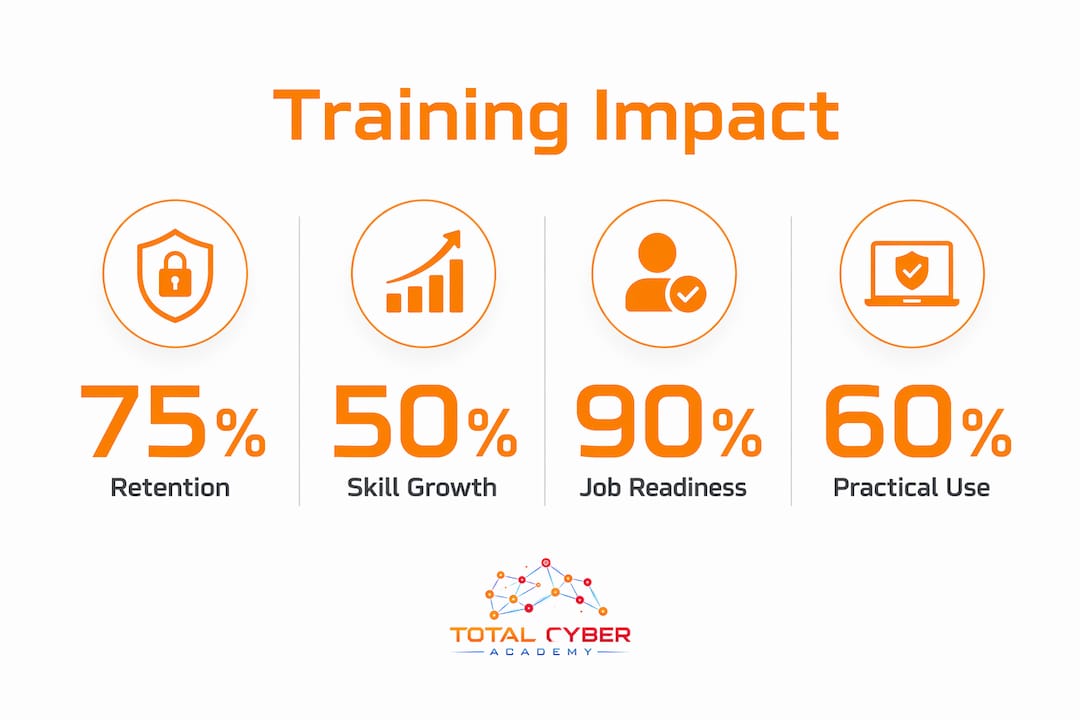
Beyond retention, practical training builds genuine skill readiness. Learners who practice incident response, ethical hacking, and forensic analysis in controlled environments develop the procedural fluency needed to perform under pressure in real roles. Organizations that invest in hands-on training for their teams also report a stronger security posture, reduced onboarding time for new hires, and better compliance with security frameworks.
The cybersecurity skills gap makes this training model urgent, not optional. Candidates who can demonstrate hands-on competency in a lab environment hold a measurable advantage in a competitive hiring market.
Real-world applications: what hands-on lab exercises actually look like
Hands-on labs translate directly into the workflows cybersecurity professionals execute on the job. Three exercise types appear consistently across effective programs:
- Incident response simulations: Learners detect a simulated breach, analyze logs, perform memory forensics, and reconstruct the attack timeline from initial access to exfiltration.
- Penetration testing exercises: Participants exploit known vulnerabilities in isolated target systems, practicing the full ethical hacking methodology from reconnaissance through post-exploitation reporting.
- Digital forensics labs: Learners recover deleted files, analyze disk images, and trace attacker activity through system artifacts, skills directly applicable to roles in incident response and law enforcement support.
Procedural mastery develops when learners execute full workflow cycles and manage failure conditions, not just complete scripted tasks. A learner who has misconfigured an access control policy in a lab and then diagnosed the resulting breach is far better prepared than one who has only read about the concept. This is especially relevant for beginners, career changers, and veterans transitioning into cybersecurity roles, all of whom benefit from structured exposure to realistic failure scenarios before entering the workforce.
Certifications tied to hands-on competency, including CompTIA Security+, CompTIA Network+, and Certified Ethical Hacker (CEH), carry more weight with employers when candidates can demonstrate that their preparation included actual lab work, not just exam drilling. Totalcyber’s programs are designed to support both certification preparation and the practical skill development that makes those credentials credible.

Pro Tip: Map your lab exercises to the NIST Cybersecurity Framework 2.0 and OWASP guidelines as you practice. Doing so helps you articulate your skills in the language hiring managers and compliance teams actually use, which strengthens both your resume and your interview performance.
What research and expert consensus say about immersive cybersecurity labs
The evidence base for hands-on training is well established. SEI research shows that realistic, tailored cyber training labs improve retention and enable quicker adaptation to evolving attacker techniques. The Software Engineering Institute developed its Skilling Continuation Labs in partnership with CISA specifically because federal cybersecurity professionals required training that mirrored actual threat conditions, not idealized procedures.
High operational fidelity is what separates effective labs from scripted exercises. Labs that simulate network latency, misconfigurations, and dependency failures better prepare learners for the complexity they will encounter in professional environments. A lab judged by how much content it covers, rather than by how realistically it replicates operational conditions, consistently underdelivers on skill transfer.

The safe failure principle is equally critical. Isolated sandbox environments allow learners to make the errors that are inevitable in real incident response, misconfiguring a firewall rule, missing an indicator of compromise, or failing to contain lateral movement, and then diagnose and recover from those errors without consequence. That iterative process builds the troubleshooting instinct that no lecture or certification exam can replicate. Cyber training must also evolve with attacker tradecraft; institutions like SEI advocate for dynamically updated labs that mirror current threat techniques rather than static curricula that age quickly.
Totalcyber’s curriculum reflects these principles directly, combining expert instruction with research-backed lab design to prepare learners for the realities of the 2026 threat environment.
Totalcyber Academy: career-ready training built on real lab experience
Candidates who complete lecture-only programs often struggle to perform in technical interviews or on the job. Totalcyber closes that gap by delivering career-focused cybersecurity training built around hands-on labs, expert instructors, and industry-recognized certification preparation.
Totalcyber is a veteran-owned organization, and its programs are designed for beginners, career changers, veterans, and IT professionals who need practical skills, not just credentials. Every course integrates simulated real-world scenarios, giving learners direct experience with the tools and workflows employers expect from day one. The result is shorter onboarding time, stronger interview performance, and a clearer path from training to employment.
Ready to build skills that hold up in a real environment? Explore Totalcyber’s full course catalog and find the program that fits your career goals.
Key Takeaways
Hands-on cybersecurity training delivers measurably better skill retention and job readiness than passive learning methods, making it the standard for serious career preparation.
| Point | Details |
|---|---|
| Retention advantage | Active learning produces up to 75% retention compared to just 5% from passive lectures. |
| Workforce demand | There is a significant global shortage of cybersecurity professionals, with employers prioritizing practical skills. |
| Lab types | Physical, simulation, and cloud-based virtual labs each serve distinct training needs. |
| Operational fidelity | Effective labs replicate network complexity and failure conditions, not just scripted tasks. |
| Totalcyber | Total Cyber Academy delivers hands-on, lab-based training with expert instruction and certification preparation for beginners, veterans, and career changers. |
Recommended
- Cyber Workforce Development: What It Means in 2026 – Total Cyber Academy!
- Top 6 DSDT.com Alternatives for Cybersecurity Training 2026 – Total Cyber Academy!
- Cybersecurity Training Explained: A Beginner’s Career Guide – Total Cyber Academy!
- Self-Paced Cybersecurity Training: A Beginner’s Guide – Total Cyber Academy!