
Security awareness training is an ongoing program that teaches employees to recognize cybersecurity threats, change their behavior, and apply specific skills to protect organizational data. NIST defines it as two complementary components: awareness, which focuses attention and reinforces attitudes, and training, which builds the job-specific skills and competencies needed for secure performance. For anyone pursuing a cybersecurity career, understanding this distinction is not optional — hiring managers expect it, and regulatory frameworks like PCI DSS and GDPR require organizations to demonstrate it.
Here is what that means in practice for career-focused learners:
- Awareness shifts mindset: employees recognize that their actions carry security consequences.
- Training builds capability: employees can execute specific tasks, such as identifying a phishing email or following an incident reporting procedure.
- Career relevance: certification pathways including CompTIA Security+ and (ISC)² SSCP test knowledge of awareness program design, not just technical controls.
Pro Tip: When evaluating any security awareness program, look for three features: phishing simulations, role-based modules, and measurable behavior metrics. A course that offers only video lectures and a completion certificate is unlikely to satisfy employer expectations or certification objectives.
Table of Contents
- What does an effective security awareness program actually contain?
- Why security awareness training matters for your career and your organization
- How awareness training differs from technical training and security education
- How to design and run a security awareness program that actually works
- Which metrics actually tell you whether a program is working?
- Common pitfalls that undermine security awareness programs
- How to build and document security awareness skills for a cybersecurity career
- Key Takeaways
- The gap between compliance and genuine security culture
- Useful sources and further reading
What does an effective security awareness program actually contain?
A well-designed program is not a single annual video. NIST SP 800-12 describes awareness programs as setting the stage for training, improving accountability, and following a defined lifecycle. In practice, that lifecycle produces several distinct content types and delivery formats.
Standard program components:
- Awareness campaigns: posters, newsletters, and intranet alerts that keep security top of mind between formal training events.
- Microlearning modules: short (3–5 minute) focused lessons on a single threat type, delivered monthly or after a simulated incident.
- Role-based training: developers receive secure coding guidance; finance staff receive business email compromise (BEC) scenarios; managers receive data governance and escalation procedures.
- Phishing simulations: controlled, tracked exercises that measure real click behavior and feed remediation workflows.
- Incident reporting drills: structured practice for recognizing and escalating a suspected breach within a defined time window.
- Policies and playbooks: written procedures employees reference when they encounter an ambiguous situation.
- Executive briefings: condensed risk summaries for leadership, focused on business impact rather than technical detail.
Modern programs combine simulated attacks, microlearning, and behavioral reinforcement to build measurable threat resistance rather than theoretical knowledge alone.
| Delivery Format | Best Used For | Frequency |
|---|---|---|
| Microlearning modules | Ongoing reinforcement, new threat topics | Monthly |
| Phishing simulations | Behavioral measurement and remediation | Monthly or bi-monthly |
| Instructor-led sessions | Deep-dive role-based skills | Quarterly |
| Awareness campaigns | Culture building, policy reminders | Continuous |
| Hands-on labs | Technical skill development | Per course milestone |

Pro Tip: Immersive formats, including AR and VR simulation environments, are increasingly used in enterprise programs to replicate realistic threat scenarios. Familiarity with these formats gives you a practical edge when discussing program design in interviews.
Why security awareness training matters for your career and your organization
Human behavior remains the most exploited attack surface in cybersecurity. Social engineering, phishing, and business email compromise succeed not because technical controls fail, but because people act without verifying. Aberdeen Group’s analysis found that security awareness training reduces phishing risk by a median of approximately 50%, with a median return on investment that can significantly exceed the training cost.
For entry-level practitioners, the career implications are direct:
- Employers in compliance-heavy sectors (healthcare, finance, government) expect new hires to understand awareness program structure from day one.
- Security operations center (SOC) analysts, IT support staff, and compliance analysts are frequently asked to assist with phishing simulation campaigns, user reporting triage, and policy communication.
- Demonstrating awareness literacy in an interview signals that you understand the human layer of defense, not just firewalls and endpoint tools.
Statistic: Aberdeen Group estimates that for a 1,000-user organization, the annualized business impact of phishing attacks can be very high before awareness training, and training generally helps reduce this impact.
The practical takeaway for learners: organizations invest in awareness programs because the financial exposure from untrained users is quantifiable and significant. Knowing how to design, run, and measure such a program makes you a more credible candidate at every level.
How awareness training differs from technical training and security education
These three terms are often used interchangeably, but they describe distinct outcomes. Confusing them leads learners to choose the wrong coursework for their target role.
- Awareness produces attitude and attention change. An employee who completes an awareness campaign understands why security matters and feels accountable for their actions. The output is behavioral, not technical.
- Training produces job-specific skills and competencies. A developer who completes secure coding training can identify an SQL injection vulnerability in their own code. The output is operational.
- Education produces deep domain expertise. A security professional who earns a CISSP or a graduate degree in information assurance can design enterprise security architectures. The output is strategic and analytical.
NIST SP 800-50 frames this as a lifecycle: awareness creates motivation, training builds job-specific skills, and education builds the expertise security professionals need for advanced roles.
For career planning, the combination you pursue depends on your target role. A SOC analyst needs technical training and hands-on labs alongside awareness literacy. A compliance analyst needs awareness program design knowledge and policy writing skills. An IT support technician needs both awareness and role-based hands-on cybersecurity training to handle user-reported incidents effectively.
How to design and run a security awareness program that actually works
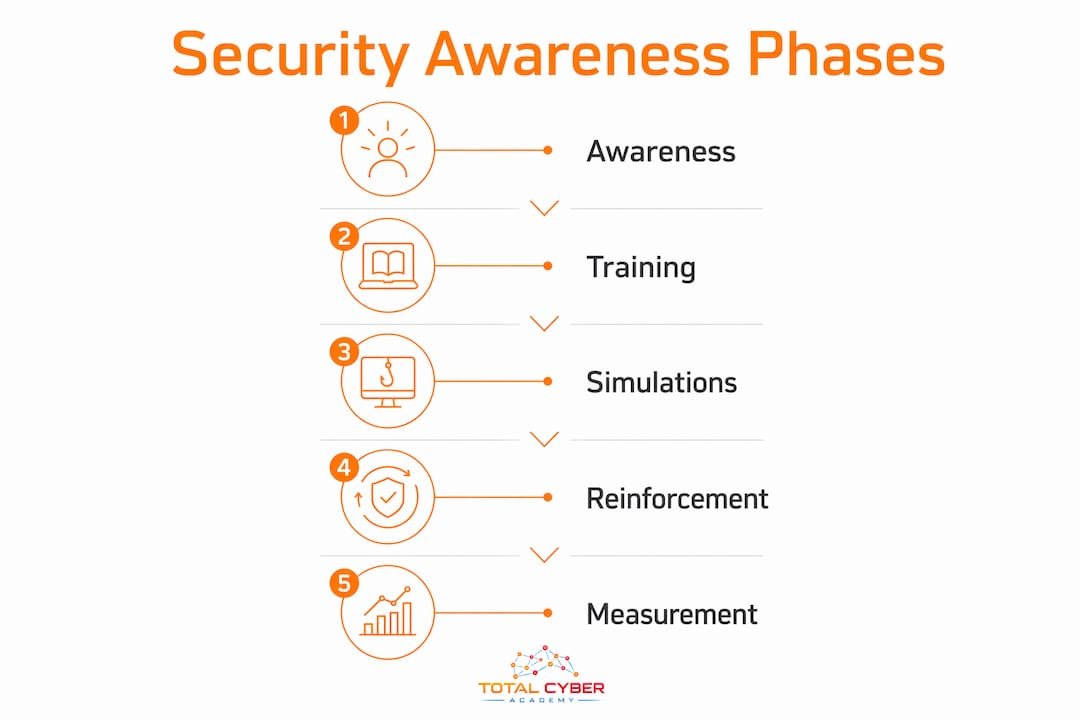
Effective programs are continuous and adaptive, not a single annual event. NIST SP 800-50 prescribes a four-phase lifecycle: design, develop, implement, and evaluate. Here is how that translates into a practical timeline.
| Phase | Timeline | Key Activities |
|---|---|---|
| Design and launch | Months 1–3 | Audience assessment, objective setting, baseline phishing simulation, policy review |
| Initial rollout | Months 2–4 | Foundational awareness modules, role-based training tracks, reporting workflow setup |
| Ongoing reinforcement | Months 4–12 | Monthly phishing simulations, quarterly microlearning, executive briefings |
| Evaluation | Quarterly | Click-rate trending, reporting rate, knowledge-check scores, risk score review |
Program design checklist for learners evaluating a course or workplace program:
- Does the program include phishing simulations with tracked results?
- Are modules tailored by role, not delivered identically to all staff?
- Is there a defined incident reporting workflow employees practice?
- Does the program publish behavioral metrics, not just completion rates?
- Is content updated to reflect current threat intelligence?
- Are remediation paths triggered automatically for users who fail simulations?
- Does the program include a documented evaluation cadence?
Pro Tip: You do not need employer access to practice these skills. Set up a personal lab, run free phishing simulation tools against test accounts, and document your click-rate improvement over 60 days. That documented improvement is a concrete resume bullet. The prerequisites checklist at Totalcyber can help you confirm you have the right foundation before starting.
Which metrics actually tell you whether a program is working?
Completion rates alone are insufficient for measuring program effectiveness. An employee can finish every module and still click a phishing link the following week. Organizations that track behavioral metrics get a far more accurate picture of actual risk reduction.
Key metrics and how to interpret them:
- Phishing simulation click rate: the percentage of users who click a simulated malicious link. A declining rate over successive campaigns indicates genuine behavior change.
- Reporting rate: the percentage of users who report a suspicious email rather than ignoring or deleting it. A rising reporting rate signals growing security culture, not just compliance.
- Time-to-report: how quickly users escalate a suspected incident. Faster reporting reduces dwell time and limits breach scope.
- Knowledge-check scores: pre/post assessment results that measure whether training content transferred. Useful for identifying knowledge gaps by role or department.
- Remediation completion rate: the percentage of users who complete targeted follow-up training after failing a simulation. Low rates indicate friction in the remediation workflow.
Statistic: Aberdeen Group’s analysis found that many organizations train users only at hiring or infrequently, which is insufficient to produce sustained behavior change.
Mature programs aim to reduce phishing click rates and increase reporting rates significantly over time through continuous simulation. Learners who can articulate these targets in an interview demonstrate measurement literacy that most entry-level candidates lack.
Common pitfalls that undermine security awareness programs
Most program failures trace back to a small set of predictable mistakes. Recognizing them makes you a more credible practitioner and a sharper evaluator of employer programs.
- Treating training as a one-time annual event. A single yearly session produces short-term recall, not lasting behavior change. Corrective action: schedule monthly simulations and quarterly microlearning refreshers.
- Fear-based messaging without actionable steps. Telling employees they are the weakest link without giving them a clear reporting procedure increases anxiety but not security. NIST SP 800-12 warns that awareness without accountability structures can backfire. Corrective action: pair every threat message with a specific, workflow-integrated response step.
- Measuring only completion rates. A 100% completion rate with a 30% phishing click rate is a failing program. Corrective action: track behavioral metrics from the first simulation.
- Ignoring role and language differences. A phishing scenario relevant to a finance team is irrelevant to a warehouse worker. Corrective action: segment training by job function and, where applicable, by language.
- Friction in the reporting workflow. If reporting a suspicious email takes more than two clicks, most users will not bother. Corrective action: integrate a one-click reporting button into the email client.
Pro Tip: Turn pitfall awareness into a demonstrable skill. When you review a job posting that mentions “security awareness program management,” prepare one specific example of how you would measure behavioral change rather than completion. That specificity separates candidates who understand the field from those who have only read about it. Reviewing employer-valued soft skills alongside technical knowledge strengthens that case further.
How to build and document security awareness skills for a cybersecurity career
Career readiness in this domain is demonstrated through measurable outcomes, not just course certificates. The following path moves you from foundational awareness to job-ready evidence.
Suggested learning path:
- Complete foundational awareness modules covering phishing, social engineering, password hygiene, and data handling.
- Progress to role-based training aligned with your target job function (SOC analyst, compliance analyst, IT support).
- Practice phishing simulations in a personal lab environment and track your click-rate improvement over 60 days.
- Complete hands-on labs covering incident reporting, log review, and basic threat triage.
- Pursue certification prep: CompTIA Security+ covers awareness program concepts directly; (ISC)² entry-level credentials reinforce governance and risk framing. Totalcyber’s partnership with (ISC)² aligns its curriculum with these credential requirements.
- Document results: lab screenshots, simulation improvement data, and incident response examples become LinkedIn-ready bullet points.
How to present this experience:
- Frame simulation results as quantified improvements (“Reduced personal phishing click rate from 40% to 0% over 8 weeks of lab practice”).
- Reference specific reporting workflows you practiced, not just that you “completed training.”
- List certifications with their issuing body and exam number, not just the credential name.
Totalcyber’s career-focused cybersecurity training is built around exactly this kind of documented, employer-verifiable skill development, with self-paced labs and certification prep that map directly to entry-level job requirements.
Key Takeaways
Security awareness training combines NIST-defined awareness and training components into an ongoing, measurable program that reduces human-layer risk and builds the career-relevant skills hiring managers expect.
| Point | Details |
|---|---|
| NIST two-part definition | Awareness shifts attitudes; training builds job-specific skills — both are required for an effective program. |
| Ongoing over one-time | Continuous simulations and microlearning produce sustained behavior change; annual-only programs do not. |
| Behavioral metrics matter | Track phishing click rate, reporting rate, and time-to-report — not just module completion. |
| Career documentation | Quantified simulation results and lab evidence are stronger resume proof points than completion certificates. |
| Role-based design | Effective programs segment content by job function; generic delivery reduces relevance and retention. |
The gap between compliance and genuine security culture
Most organizations implement security awareness training because a regulation requires it. PCI DSS, HIPAA, and GDPR all mandate some form of employee security education, and that mandate drives purchasing decisions. The result is a market flooded with checkbox-style courses that satisfy an auditor but do nothing measurable for actual risk.
The more interesting question for career-minded learners is not whether a program exists, but whether it produces behavior change you can point to. An employer who asks “have you worked with security awareness programs?” is really asking whether you understand the difference between a compliant program and an effective one. That distinction shows up in how you talk about metrics, how you describe simulation design, and whether you can name a specific reporting workflow you have practiced.
The learners who stand out are those who treat awareness training as a skill domain, not a box to check. They run simulations in personal labs, document their improvement, and can explain why a 90% completion rate with a 25% click rate represents a program failure. That level of specificity is rare at the entry level, and it is exactly what separates a candidate who has studied cybersecurity from one who is ready to practice it.
Useful sources and further reading
The following sources informed this article and provide authoritative guidance for learners who want to go deeper.
- NIST Glossary: Awareness Training — The primary definitional source for the awareness vs. training distinction used throughout this article.
- NIST SP 800-12, Chapter 13 — Covers awareness program lifecycle, methods, and the relationship between awareness, accountability, and organizational mission.
- NIST SP 800-50 — The foundational guide for building an IT security awareness and training program, including the design-develop-implement-evaluate lifecycle.
- PMC: Moving Beyond “Check-the-Box” Compliance — Peer-reviewed analysis on why behavioral metrics outperform completion rates as program effectiveness measures.
- Proofpoint: Security Awareness Training Reference — Industry practitioner guidance on ongoing, adaptive program design and the failure modes of annual-only approaches.
- Totalcyber: Cybersecurity Training Career Guide — Career-focused overview of certification pathways, hands-on practice formats, and how awareness training fits into a broader cybersecurity education plan.
- Totalcyber: Course Catalog and Self-Paced Labs — Entry point for learners ready to begin structured, certification-aligned training with hands-on lab components.
Recommended
- Cybersecurity Training Explained: A Beginner’s Career Guide – Total Cyber Academy!
- Self-Paced Cybersecurity Training: A Beginner’s Guide – Total Cyber Academy!
- Career Changer Cybersecurity Success Roadmap: 2026 Guide – Total Cyber Academy!
- Cybersecurity Workforce Veteran Initiatives: 2026 Guide – Total Cyber Academy!