
The cybersecurity skills gap is the mismatch between the capabilities organizations need to defend against modern threats and the skills their current or available workforce actually has. This is not simply a headcount problem. 60% of organizations identify the skills gap as a greater problem than raw hiring shortages, and 27% have suffered breaches directly caused by workforce capability deficits. If you are exploring a career in cybersecurity or trying to grow in one, understanding the cybersecurity talent gap is the first step toward positioning yourself on the right side of it.
What is the cybersecurity skills gap and how big is it?
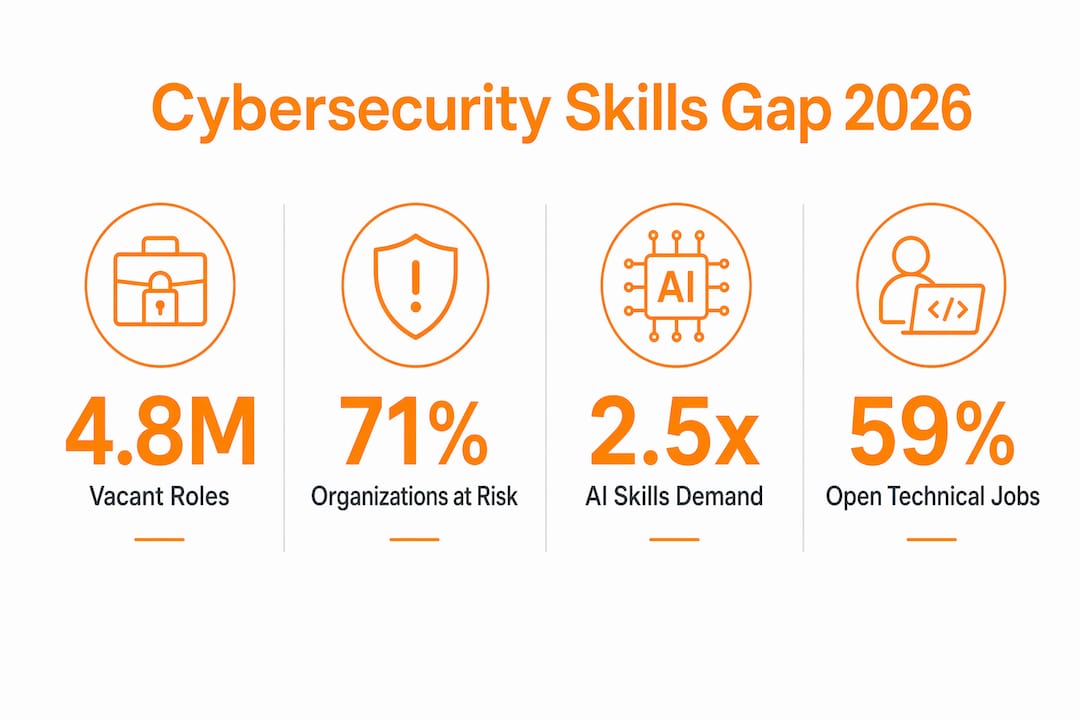
The scale of the problem is significant. An estimated 4.8 million cybersecurity roles sit vacant globally in early 2026, a 19% increase year over year. That number reflects not just unfilled positions but a structural mismatch between what organizations need and what the available talent pool delivers.
71% of organizations report that the cybersecurity skills shortage poses a direct risk to their operations. That means delayed incident response, slower security projects, and teams stretched too thin to stay ahead of threats. The gap is not theoretical. It shows up in real breaches and real business losses.

Several forces are driving this growth. Digital transformation has expanded the attack surface faster than training programs can respond. Regulatory requirements like CMMC, GDPR, and HIPAA compliance demand specialized knowledge that takes time to develop. AI is also reshaping the field faster than most curricula can track. The result is a workforce that is perpetually one step behind the threat environment it is supposed to defend.
Key organizational risks from the talent gap
- Operational vulnerability: Understaffed teams miss alerts and delay responses.
- Project slowdowns: Security reviews and compliance work stall without qualified staff.
- Burnout: Overloaded professionals make more errors, compounding risk.
- Retention loss: Skilled professionals leave when workloads become unsustainable.
| Risk category | Impact |
|---|---|
| Breach exposure | 27% of organizations report breaches tied to skill deficits |
| Operational disruption | 71% say the gap directly threatens operations |
| Workforce vacancy | 4.8 million unfilled roles globally in 2026 |
| Year-over-year growth | 19% increase in open positions from 2025 |
What skills define the current cybersecurity workforce shortage?
The cybersecurity workforce challenges of 2026 go well beyond knowing how to configure a firewall. 59% of open cybersecurity roles demand a hybrid of technical and strategic business skills. Only 40% of the current workforce fits that profile. That gap between demand and supply is where careers stall and organizations suffer.
On the technical side, the skills most in demand include cloud security architecture, threat intelligence analysis, penetration testing, and identity and access management. These are not entry-level competencies. They require hands-on practice, not just classroom exposure. 83% of cybersecurity roles require hands-on experience, including 75% of junior roles. A certification alone does not close that gap.
The strategic side is just as important and often more overlooked. New roles increasingly require professionals to communicate risk to executives, align security programs with business goals, and collaborate across departments. Professionals who lack communication skills often experience stalled career progression despite strong technical ability. The field rewards people who can translate a technical threat into a business decision.
Soft skills that matter most for career progression include:
- Risk communication: Explaining threats clearly to non-technical leadership.
- Collaboration: Working across IT, legal, and operations teams.
- Critical thinking: Prioritizing threats when everything feels urgent.
- Adaptability: Keeping pace with a field that changes every quarter.
Demand for AI-related cybersecurity skills has increased 2.5 times since 2020, but workforce capabilities lag well behind. That lag is one of the clearest signals of where the next wave of career opportunity sits.
Pro Tip: Build your communication skills alongside your technical ones. Practice explaining a vulnerability or risk scenario to someone outside IT. If they understand it, you are ready for a leadership track.
How is AI changing the cybersecurity skills gap?
AI is doing two things at once. It is making experienced cybersecurity professionals more effective, and it is making the path to experience harder for newcomers. AI automates many entry-level tasks like alert monitoring and log triage, which used to be how junior professionals built their instincts. When those tasks disappear, so does the traditional apprenticeship model.
AI’s automation of routine tasks requires new approaches to give junior professionals practical experience. Training programs that rely on simulated environments, live labs, and real-world scenarios are filling that void. You can explore how immersive training technologies are changing how professionals build hands-on skills without waiting for a breach to learn from.
“AI just rewrote the skills list. The question is no longer whether you can monitor alerts. It is whether you can interpret what AI flags, challenge its conclusions, and act with judgment.” — SANS Institute, 2026
AI also creates new risks when employees use it without proper training. Unprepared professionals who rely on AI tools without understanding their limitations can introduce new vulnerabilities. This makes AI literacy a core competency, not an optional add-on.
The opportunities AI creates are real, though. Professionals who understand how to work with AI-assisted threat detection, automate repetitive security workflows, and evaluate AI-generated outputs are in high demand. The skills needed for cybersecurity jobs in 2026 include knowing how to use AI responsibly, not just knowing how to code or configure systems.
What strategies can close the cybersecurity skills gap?
The most effective approach to closing the cybersecurity talent gap is investing in the people you already have. Industry leaders emphasize the shift from a hiring crisis to a skills crisis, recommending upskilling existing teams rather than expanding headcount alone. Hiring more people into a broken development model does not fix the underlying problem.
Organizations historically prioritized tools over talent development, but current challenges require fundamental workforce model redesigns focused on career growth and retention. That means creating clear promotion paths, funding continuous learning, and recognizing that a cybersecurity professional’s skills have a shelf life measured in months, not years.
For individuals, the path forward is structured and achievable:
- Earn a foundational certification. CompTIA Security+, (ISC)² CC, or CompTIA CySA+ establish baseline credibility and open doors to entry-level roles.
- Build hands-on experience. Use labs, capture-the-flag competitions, and simulation environments to develop practical skills before you need them on the job.
- Develop your communication skills. Practice writing security reports and presenting risk summaries. This separates technical professionals from leaders.
- Pursue AI literacy. Take structured training on how AI tools work in security operations so you can use them with judgment, not just convenience.
- Commit to continuous learning. The cybersecurity workforce report from ISC2 consistently shows that professionals who invest in ongoing education advance faster and earn more.
There is a disconnect between cybersecurity education curriculums that focus on technical domains and the industry’s growing need for human and organizational security skills. The best training programs close that gap by combining technical labs with real-world decision-making scenarios.
Pro Tip: Do not wait until you feel fully ready to apply for roles. Hiring managers in cybersecurity consistently say they value demonstrated learning momentum over a perfect resume.
| Approach | Best for |
|---|---|
| Certification programs | Building foundational credibility quickly |
| Hands-on lab environments | Developing practical, job-ready skills |
| Internal upskilling programs | Retaining and advancing existing staff |
| AI literacy training | Preparing for next-generation security operations |
Key Takeaways
The cybersecurity skills gap is a capability crisis, not a headcount crisis, and closing it requires deliberate investment in both technical depth and strategic communication skills.
| Point | Details |
|---|---|
| Skills gap definition | The gap is a capability mismatch, not just a shortage of people in the field. |
| Scale of the problem | 4.8 million vacant roles globally with a 19% year-over-year increase in 2026. |
| Hybrid skill demand | 59% of roles require both technical and business skills, but only 40% of workers qualify. |
| AI’s dual role | AI automates entry-level tasks while creating new demand for AI literacy and judgment. |
| Best response strategy | Upskilling existing professionals and building hands-on experience closes the gap faster than hiring alone. |
The skills gap is an open door, if you walk through it prepared
I have watched a lot of people approach cybersecurity careers the wrong way. They chase certifications without building real skills. They focus entirely on technical depth and ignore how to talk to a CFO about risk. They wait for the perfect moment to start, and the field moves on without them.
Here is what I actually believe: the cybersecurity skills gap is the best career opportunity most people are not taking seriously enough. The demand is real, the roles are well-compensated, and the field genuinely needs people who can think, communicate, and adapt. You do not need to be a genius. You need to be consistent.
The professionals who are thriving right now are not necessarily the most technically advanced. They are the ones who combined solid technical training with the ability to explain what they found and why it matters. They also embraced AI as a tool to work with, not a threat to their relevance.
If you are a student or a career changer reading this, the gap is not a barrier. It is a signal. The industry is telling you exactly what it needs. Your job is to show up with those skills. Start with a structured program, build real experience through labs and simulations, and never stop learning. The cybersecurity skills gap will not close itself, but your career can grow directly because of it.
— Alden
Totalcyber’s training programs are built for this moment
The cybersecurity workforce needs professionals who combine technical skill with real judgment. Totalcyber builds exactly that.
At Total Cyber Academy, every course is designed around the skills employers are actually hiring for in 2026. That means hands-on labs, expert instruction, and certification preparation aligned with credentials like CompTIA Security+ and (ISC)² CC. Whether you are starting from zero or advancing an existing IT career, Totalcyber’s programs meet you where you are. Veterans, career changers, and working professionals all find a path here. If you are serious about entering or advancing in cybersecurity, explore the full course catalog and take the next step with training that leads to real jobs.
FAQ
What is the cybersecurity skills gap in simple terms?
The cybersecurity skills gap is the difference between the security capabilities organizations need and what their workforce can actually deliver. It is a quality problem, not just a quantity problem.
How many cybersecurity jobs are currently unfilled?
An estimated 4.8 million cybersecurity roles are vacant globally as of early 2026, representing a 19% increase from the previous year according to the Fortinet 2026 Cybersecurity Skills Gap Report.
What skills are most in demand for cybersecurity jobs?
Employers seek a hybrid of technical skills like cloud security and threat analysis combined with strategic skills like risk communication and business alignment. AI literacy is also a fast-growing requirement.
How does AI affect entry-level cybersecurity careers?
AI automates many tasks that junior professionals traditionally used to build experience, such as alert monitoring and log review. This makes structured lab-based training and simulation environments more important than ever for newcomers.
How can I start closing my own cybersecurity skills gap?
Earn a recognized certification like CompTIA Security+, build hands-on experience through labs and simulations, and develop your ability to communicate risk clearly. Continuous learning in IT is not optional in this field. It is the job.
Recommended
- The Cybersecurity Skills Gap – Total Cyber Academy!
- 2022 ISC2 Cybersecurity Workforce Report – Total Cyber Academy!
- The Dark Web in 2024 – Total Cyber Academy!
- Data Literacy in Today’s Job Market – Total Cyber Academy!
Interested in learning more? Take a look at our courses.