
A professional cybersecurity community is a human-centric network where practitioners, analysts, and security leaders collaborate to share threat intelligence, mentor peers, and accelerate career development. These networks range from large open forums to closed, invitation-only groups, and they serve as the primary infrastructure for knowledge transfer in a field that moves faster than any textbook can. Major global communities host over 700 leaders, and certification bodies like EC-Council represent over 400,000 professionals worldwide. That scale reflects how central community membership has become to professional growth in cybersecurity. For aspiring professionals, understanding what these communities offer and how to engage with them is not optional. It is the difference between a career that stalls and one that compounds.
What is a professional cybersecurity community and how does it work?
A professional cybersecurity community is a specialized network for knowledge exchange where members share threat intelligence, peer support, and career resources in either open or closed forums. The industry term for the most structured versions of these groups is “professional security association,” though the broader category includes informal networks, online forums, and certification-linked communities. Both terms describe the same core function: organized collaboration among people who work in or are entering the cybersecurity field.
These communities exist at multiple levels. Entry-level forums welcome students and career changers. Mid-tier groups focus on specific domains like cloud security, incident response, or governance, risk, and compliance. Senior-level groups, such as CISO communities hosted by organizations like ECSO, restrict membership to experienced executives. Each tier serves a distinct purpose, but all share the same foundation: practitioners helping practitioners.
The importance of professional cybersecurity groups extends beyond career networking. These communities generate real-time threat intelligence that no vendor report can replicate. When a new attack vector surfaces, community members who have seen it in production share indicators of compromise, detection logic, and remediation steps within hours. That speed is the core value proposition.

What activities and formats define community engagement?
Cybersecurity communities use a wide range of formats to keep members engaged and learning. The most common include:
- Meetups and local chapters: In-person events hosted by groups like OWASP or ISACA chapters where members discuss current threats, share research, and build relationships.
- Capture the Flag competitions: Structured hacking challenges where participants solve security puzzles under time pressure. CTF competitions build technical skills while creating a shared competitive experience that bonds participants.
- Slack and Discord channels: Real-time messaging platforms where members ask questions, share job leads, and post threat intelligence. These channels operate around the clock across time zones.
- LinkedIn groups: Professional networking spaces where members post research, comment on industry news, and connect with hiring managers.
- Conferences and virtual summits: Events like DEF CON, Black Hat, and regional BSides conferences where communities gather for talks, workshops, and hallway conversations that often produce more value than the formal sessions.
Engagement through structured activities provides mentorship, job referrals, and technical insights that traditional coursework cannot replicate. A textbook teaches you what a SQL injection is. A community member who ran incident response on a live breach tells you what the attacker actually did next.
Pro Tip: Join one active Slack or Discord community before you finish your first certification. Lurk for two weeks to understand the culture, then introduce yourself with a specific question. Vague introductions get ignored; specific questions get answers.
What are the primary benefits of joining a cybersecurity community?
The career benefits of cybersecurity communities are measurable and significant. Structured community members show 32% lower attrition rates compared to professionals who work in isolation. Lower attrition means longer careers, more accumulated expertise, and greater earning potential over time.
The specific benefits fall into three categories:
- Career acceleration: Members gain access to job boards, employer partnerships, scholarships, and conference invitations. Many high-value roles circulate within closed community groups before they appear on public job boards.
- Mentorship and sponsorship: Experienced professionals actively mentor newer members in most well-run communities. Sponsorship, where a senior member advocates for you in hiring conversations, is a direct product of strong community relationships.
- Emotional resilience: Cybersecurity is a high-pressure field. Communities function as pressure valves for professionals facing accountability demands, incident stress, and the psychological weight of defending critical systems.
“CISO communities act as an invaluable support system amidst high-pressure roles, mitigating stress and providing a safe outlet for discussing complex professional issues confidentially. The ability to speak openly with peers who face identical pressures is something no internal HR program can replicate.”
The positive psychology benefits of peer support are well documented in professional contexts. Cybersecurity communities apply those principles directly to one of the most stressful technical careers in existence. Professionals who feel supported perform better, stay in the field longer, and contribute more to the communities that supported them.
How do professionals join and contribute effectively?
Joining a cybersecurity community requires less than most aspiring professionals expect. The cost barrier is low. Foundational networks like OWASP charge $0 for basic membership, while advanced groups like ISACA and ISC2 charge annual dues for exclusive benefits. The real investment is time and contribution.
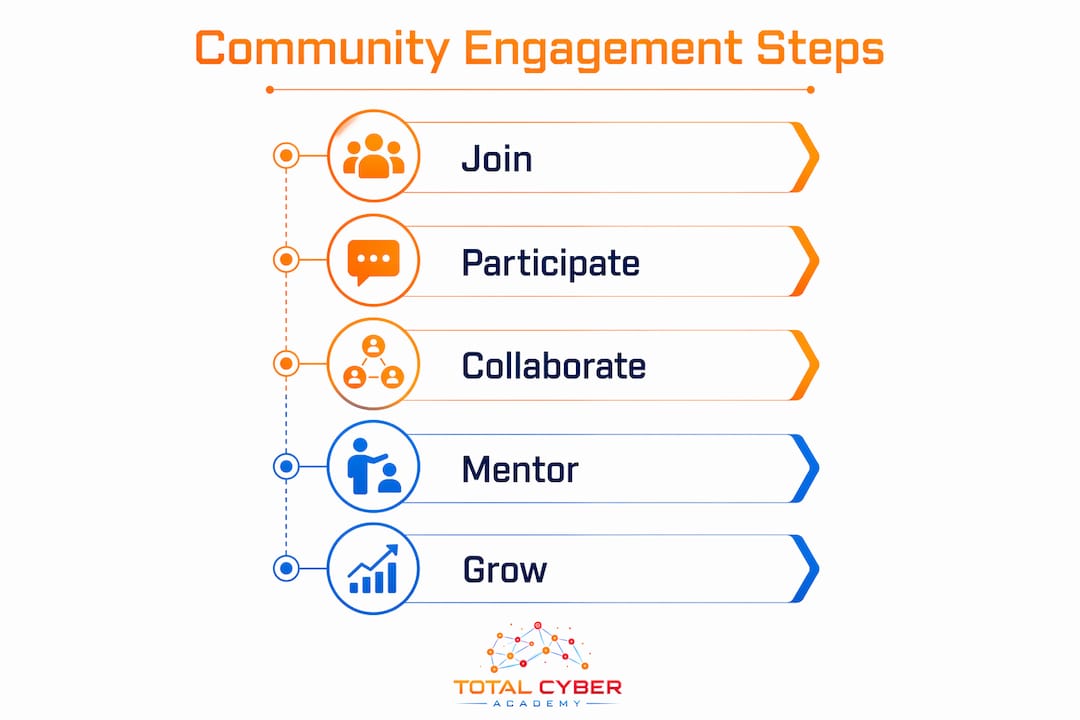
The process for joining and building a reputation follows a clear sequence:
- Choose the right entry point. Start with open communities aligned to your current skill level. OWASP suits application security beginners. ISC2 suits those pursuing the CISSP. CompTIA-aligned communities suit those working toward Security+ or Network+.
- Complete your profile before engaging. A complete LinkedIn profile with certifications, projects, and a clear career goal signals that you are a serious participant, not a passive consumer.
- Contribute before you ask. Answer questions you know the answer to. Share articles you found useful. Comment on others’ posts with specific observations. Reciprocity governs community engagement; members who give first gain access to inner circles faster.
- Pursue speaking and research opportunities. Presenting at a local chapter meeting or contributing to a community research project signals expertise and builds reputation faster than any credential alone.
- Build a portfolio from community work. Document CTF solutions, research contributions, and mentoring activities. A cybersecurity portfolio built from real community participation is more compelling to employers than a list of certifications.
Pro Tip: Target invitation-only groups by first becoming visible in their public-facing channels. Closed groups monitor open forums for contributors worth inviting. Consistent, high-quality participation in open spaces is the most reliable path to closed-group access.
What governance and confidentiality protocols protect community trust?
Trust is the operating system of any professional cybersecurity community. Without it, members will not share real incident data, vendor failures, or honest assessments of security tools. Two governance mechanisms make that trust possible.
| Protocol | Definition | Application in Cybersecurity Communities |
|---|---|---|
| Chatham House Rule | Information shared in a meeting may be used, but the identity of the speaker may not be disclosed. | Allows CISOs to discuss breach details and vendor failures without public attribution. |
| Code of Conduct | A written set of behavioral standards all members agree to follow. | Prevents harassment, protects confidential disclosures, and sets expectations for respectful engagement. |
| Non-Disclosure Norms | Informal or formal agreements not to share specific information outside the group. | Enables frank discussion of sensitive incidents in closed forums. |
| Sub-community Structure | Division of a large community into focused topic groups. | Allows members to engage at the right depth without information overload. |
Large communities exceed Dunbar’s number of 150 members yet remain effective through dynamic management via Slack, WhatsApp, and similar platforms. That finding is counterintuitive. Most research on human social networks suggests groups lose cohesion above 150 members. Cybersecurity communities solve this by fragmenting into sub-communities organized around specific topics, roles, or regions.
Professional communities operating under non-disclosure norms and codes of conduct create the conditions for honest discussion that formal industry reports cannot. A CISO who experienced a ransomware attack will not publish the details publicly. They will share them with trusted peers under the Chatham House Rule. That information is more valuable than any threat intelligence feed.
Key Takeaways
A professional cybersecurity community is the single most effective structure for accelerating career growth, building resilience, and accessing real-time threat intelligence that no formal training program can replicate.
| Point | Details |
|---|---|
| Core definition | A professional cybersecurity community is a structured network for knowledge exchange, peer support, and career development. |
| Retention impact | Structured community members show 32% lower attrition rates than isolated professionals. |
| Cost to join | Most foundational communities like OWASP charge nothing; advanced groups like ISACA and ISC2 charge annual dues. |
| Contribution drives access | Active contributors gain access to invitation-only groups and unadvertised job opportunities faster than passive members. |
| Governance enables trust | Protocols like the Chatham House Rule allow honest discussion of sensitive incidents without public attribution. |
Why community is the career infrastructure most professionals overlook
I have watched professionals spend thousands of dollars on certifications and then sit in isolation wondering why their career is not moving. The credential is not the problem. The absence of community is.
The professionals who advance fastest are not always the most technically skilled. They are the ones who show up consistently in the right communities, ask sharp questions, and give back before they need anything. I have seen a well-placed introduction in a closed CISO forum produce a job offer that never appeared on any public board. That is not luck. That is the direct return on consistent community investment.
For newcomers, the instinct is to wait until you feel qualified enough to participate. That instinct is wrong. Communities value curiosity and effort as much as expertise. The person who asks a well-framed question about a topic they are learning contributes more to a community than the expert who never shows up. Start where you are. Contribute what you have. The access and opportunities follow from that discipline, not from waiting.
— Alden
How Totalcyber prepares you to engage with professional communities
Totalcyber builds the skills that professional cybersecurity communities respect. Through hands-on labs, certification preparation courses, and real-world scenarios, Totalcyber equips beginners, career changers, and veterans with the technical foundation needed to contribute meaningfully from day one.
Totalcyber’s training programs are designed by practitioners who understand what community members actually value: verified skills, practical experience, and the ability to solve real problems. The academy’s ISC2 partnership connects students directly to one of the largest professional cybersecurity networks in the world. Visit Total Cyber Academy to find the course that positions you to enter and contribute to professional cybersecurity communities with confidence.
FAQ
What is a professional cybersecurity community?
A professional cybersecurity community is a structured network where practitioners share threat intelligence, mentorship, and career resources in open or closed forums. Major global communities host hundreds of leaders, and certification bodies like EC-Council represent over 400,000 professionals worldwide.
How do I join a cybersecurity network as a beginner?
Start with free, open communities like OWASP or ISC2’s entry-level forums, complete your professional profile, and contribute answers or resources before making requests. Consistent participation in open forums is the most reliable path to invitation-only groups.
What should I expect in cybersecurity forums?
Expect real-time discussions of current threats, job postings, mentorship offers, and technical Q&A. Well-governed forums operate under codes of conduct that maintain professional standards and protect sensitive disclosures.
What is the Chatham House Rule in cybersecurity communities?
The Chatham House Rule allows members to use information shared in a meeting without disclosing the identity of the speaker. Closed CISO groups apply this rule to enable honest discussion of breach details and vendor failures.
Do professional cybersecurity groups cost money to join?
Most foundational communities like OWASP charge nothing for basic membership. Advanced groups like ISACA and ISC2 charge annual dues that unlock exclusive benefits including job boards, conferences, and leadership programs.