
Resume building for cybersecurity is the process of crafting a targeted document that signals your technical expertise, certifications, and measurable achievements to both hiring managers and automated screening systems. Unlike a general resume, a cybersecurity CV format must demonstrate hands-on tool familiarity, role-specific skills, and concrete outcomes. Hiring managers prioritize resumes that show actual technical ability over generic summaries. Getting this right is the difference between passing an applicant tracking system (ATS) and being filtered out before a human ever reads your name. This guide covers the structure, content, and strategy you need to build a resume that earns interviews in 2026.
What is resume building for cybersecurity, and why does it matter?
Resume building for cybersecurity is a deliberate, technical writing process. It is not simply listing jobs. The goal is to produce a document that communicates your security knowledge, tool proficiency, and professional impact in a format that both ATS software and recruiters can evaluate quickly.
Hiring managers prioritize resumes that demonstrate actual hands-on technical ability rather than generic summaries or soft skills. That means your resume must speak the language of the role, using terms like SIEM, network protocols, and scripting languages rather than phrases like “team player” or “strong communicator.”

A cybersecurity resume also functions as a signal of your thought process. Recruiters use it to assess whether you understand the tools, methodologies, and threat models relevant to the position. A well-structured resume tells that story in under 10 seconds of scanning.
What are the key sections and formats used in cybersecurity resumes?
The reverse-chronological format is the preferred structure for cybersecurity resumes. It places your most recent and relevant experience at the top, which is exactly where recruiters look first. Functional or combination formats can work for career changers, but they are less familiar to hiring managers and can raise questions about gaps.
Every cybersecurity resume should include these core sections:
- Contact information: Full name, professional email, phone number, LinkedIn URL, and optionally a GitHub or portfolio link
- Professional summary: Two to three sentences stating your role, core technical focus, and career level
- Technical skills: Grouped by category such as SIEM tools, scripting languages, network protocols, and cloud platforms
- Work experience: Reverse-chronological job history with outcome-focused bullet points
- Education: Degrees, relevant coursework, and graduation dates
- Certifications: Credentials like CompTIA Security+, CISSP, CEH, or OSCP listed with dates
A clean, ATS-friendly layout uses simple section headers, standard fonts, and no columns or text boxes. Graphics and tables confuse ATS parsers and cause your resume to be misread or rejected before a recruiter sees it.
Pro Tip: Save your resume as a .docx or plain PDF. Fancy design files often fail ATS parsing entirely.
How to select and showcase cybersecurity skills and certifications effectively
The skills section is the fastest-read part of your resume. Recruiters scan it in seconds to determine whether you match the role. Organizing skills by category such as SIEM tools, network protocols, scripting languages, and cloud platforms gives recruiters an immediate picture of your technical range.
Separate technical skills from soft skills. Technical groupings carry far more weight in cybersecurity hiring. A skills section might look like this:
- SIEM & monitoring: Splunk, IBM QRadar, Microsoft Sentinel
- Scripting & automation: Python, Bash, PowerShell
- Network security: TCP/IP, firewalls, IDS/IPS, VPN
- Cloud security: AWS Security Hub, Azure Defender, IAM policies
- Frameworks & standards: NIST CSF, MITRE ATT&CK, ISO 27001
Certifications carry significant weight in cybersecurity hiring. High-value credentials like CISSP, CEH, OSCP, CompTIA Security+, and AWS Security Specialty should appear near the top of your resume, aligned with the requirements of the specific role. You can learn more about certification value and how to present credentials effectively before you apply.
Do not list certifications you cannot support with experience or knowledge. A recruiter who asks about a credential you barely touched will notice immediately.
Pro Tip: Mirror the exact certification names and acronyms from the job posting. ATS systems match keywords precisely, and “Sec+” may not match “CompTIA Security+” in the system.
How to present professional experience and achievements in cybersecurity resumes
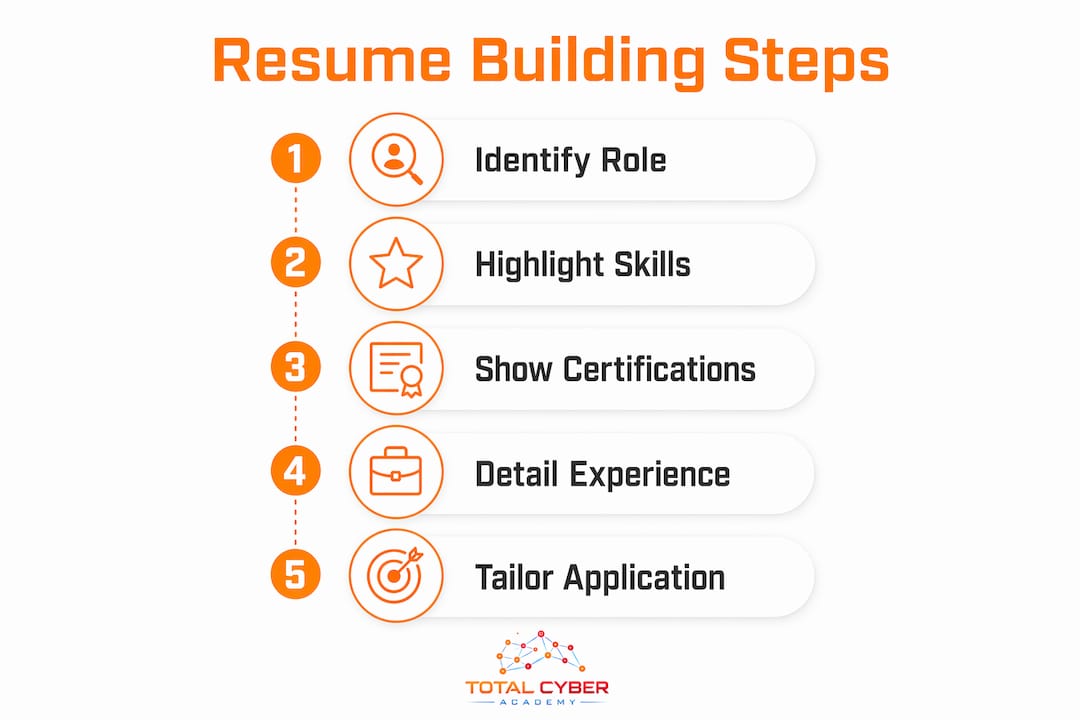
Work experience is the core of any cybersecurity resume. The structure of each bullet point determines whether a recruiter sees a capable professional or a vague job description. The most effective format follows this pattern: action verb, plus tool or method, plus measurable outcome.
Quantifying achievements with numbers and percentages shows your actual impact. Examples include “reduced security incidents by 40%” or “led a team of 10 analysts during a critical incident response.” Numbers give recruiters a concrete sense of scale and responsibility.
Follow these rules when writing experience bullets:
- Lead with a strong action verb: Detected, deployed, automated, investigated, remediated, configured
- Name the tool or method: Specify Splunk, Wireshark, Nessus, or the framework you used
- State the outcome: Reduction in alerts, time saved, vulnerabilities patched, compliance achieved
- Limit bullet count: Cap recent roles at six bullets and older roles at three to four bullets to keep the resume focused
- Cut vague language: Remove phrases like “responsible for” or “helped with” and replace them with direct ownership verbs
Tailoring your resume for each specific role significantly increases your interview rate. Using one version for every application reduces effectiveness because different roles prioritize different tools, frameworks, and responsibilities. A SOC analyst role values incident response and SIEM experience. A penetration testing role values scripting, exploitation frameworks, and reporting.
Pro Tip: Copy the job description into a text document and highlight every technical skill, tool, and certification mentioned. Then check your resume against that list before you submit.
What additional resume components help candidates stand out in cybersecurity?
Beyond the core sections, several optional components can separate your resume from the competition. These additions matter most for candidates with limited formal work experience, such as recent graduates or career changers.
Portfolios, GitHub links, awards, and personal projects are persuasive evidence of real-world capability. A GitHub repository showing a Python-based network scanner or a write-up from a Capture the Flag (CTF) competition tells a recruiter more than a bullet point ever could. Totalcyber offers a detailed portfolio building guide for candidates who want to build this component systematically.
Additional components worth including:
- Personal projects: Home labs, CTF write-ups, vulnerability research, or open-source contributions
- Awards and recognition: Academic honors, competition placements, or employer recognition
- Publications and presentations: Blog posts, conference talks, or technical write-ups on security topics
- LinkedIn profile: A complete, keyword-rich profile that mirrors your resume and extends your professional presence
Career changers and veterans should address employment gaps directly in a brief summary statement rather than leaving recruiters to guess. Framing military service or prior industry experience in terms of transferable security skills, such as risk assessment, operational security, or incident command, converts perceived gaps into relevant context.
A matching cover letter reinforces your resume’s narrative. Keep it to three short paragraphs: why this role, why your background fits, and one specific technical achievement that proves it.
Key Takeaways
A cybersecurity resume is a technical document, not a general work history. Every section must demonstrate tool familiarity, measurable outcomes, and alignment with the specific role you are targeting.
| Point | Details |
|---|---|
| Use reverse-chronological format | Place your most recent and relevant experience first for recruiter and ATS readability. |
| Group skills by technical category | Organize tools like SIEM, scripting, and cloud platforms into clear categories for fast recruiter scanning. |
| Quantify every achievement | Use numbers, percentages, and team sizes to show the real impact of your work. |
| Tailor each application | Customize skills, tools, and certifications to match the specific job description before submitting. |
| Add portfolio and project links | GitHub repositories and CTF write-ups provide concrete proof of hands-on ability. |
Why most cybersecurity resumes fail before a recruiter reads them
I have reviewed hundreds of cybersecurity resumes over the years, and the same problem appears repeatedly. Candidates treat the resume as a record of where they worked rather than a proof of what they can do. Those are two very different documents.
The resumes that get interviews are specific. They name the tools. They show the numbers. They match the language of the job posting with precision. The resumes that get ignored are full of phrases like “assisted with security operations” or “familiar with various tools.” Vague language signals vague thinking to a recruiter.
The other mistake I see constantly is padding. Candidates list every certification they have ever heard of, including ones they studied briefly or never used in a real environment. Recruiters notice when a credential appears on a resume but disappears entirely from the work experience section. That inconsistency raises more questions than it answers.
My honest advice: treat your resume as a living document. Update it after every project, certification, and incident response. The candidates who prepare for interviews with the same discipline they apply to their resume are the ones who get hired. Continuous refinement is not optional in this field. The threat environment changes, the tools change, and your resume needs to reflect that.
— Alden
How Totalcyber helps you build a resume-ready skill set
Totalcyber was built specifically to close the gap between cybersecurity education and employment. The programs develop the hands-on technical skills that belong in the experience and skills sections of a strong resume.
Courses at Totalcyber cover certification preparation for CompTIA Security+, CISSP, CEH, and other credentials that hiring managers look for by name. The training includes real-world labs, practical scenarios, and career guidance designed to produce resume-ready professionals. Whether you are entering cybersecurity for the first time or advancing from an IT background, the beginner’s career guide is the right starting point. You can also browse the full course catalog to find the program that matches your current level and target role.
FAQ
What is resume building for cybersecurity?
Resume building for cybersecurity is the process of creating a targeted document that highlights your technical skills, certifications, and measurable achievements for cybersecurity roles. It differs from a general resume by emphasizing tool proficiency, security frameworks, and outcome-driven work history.
What format works best for a cybersecurity resume?
The reverse-chronological format is the most effective for cybersecurity resumes because it places your most recent and relevant experience first, which is what hiring managers and ATS systems expect.
Which certifications should I include on a cybersecurity resume?
Certifications like CISSP, CEH, OSCP, CompTIA Security+, and AWS Security Specialty carry the most weight. Place them near the top of your resume and align them with the specific requirements of each job posting.
How do I write strong bullet points for a cybersecurity resume?
Each bullet point should follow the structure: action verb, plus tool or method, plus measurable outcome. For example, “Deployed Splunk SIEM across 500 endpoints, reducing mean detection time by 35%.”
Should I tailor my cybersecurity resume for every job?
Yes. Customizing your resume for each role to highlight the most relevant tools, certifications, and methodologies significantly increases your chances of passing ATS screening and earning an interview.