
Security clearance cybersecurity jobs are widely available across the United States, but you cannot apply for the clearance itself. An employer must extend a conditional offer and sponsor your investigation before any agency will process your paperwork. Once that happens, you need a clearance tier that matches the role, usually Secret, Top Secret, or TS/SCI, and a certification that satisfies DoD 8140 baseline requirements for your work role.
Two moves accelerate everything else. First, stop applying through general job boards and start working cleared-specific channels like Cybersecjobs and ClearanceJobs, where postings already assume you either hold or can obtain a clearance. Second, earn a baseline credential, CompTIA Security+ is the most common entry point, before you start applying, since many contracts require it within six months of assignment anyway.
- Target employers who sponsor clearances rather than searching for “clearance jobs” you can apply to directly.
- Get Security+ or an equivalent baseline cert in progress now.
- Watch for TS/SCI and polygraph requirements in listings; they signal longer timelines and stricter vetting.
Pro Tip: Sponsorship almost always follows the offer, not the other way around. Spend your energy building a resume that earns the offer, and let the clearance process follow naturally.
Key Takeaways
Cleared cybersecurity hiring rewards candidates who pair a baseline certification with cleared-specific job search channels, since sponsorship follows qualification, not the other way around.
| Point | Details |
|---|---|
| Sponsorship comes first | Employers initiate the clearance process after a conditional offer, not before. |
| Match cert to clearance | DoD 8140 baseline certs like Security+ are often expected within six months of hire. |
| Use cleared-specific channels | Boards like CyberSecJobs.com and cleared career fairs outperform general job sites. |
| Disclosure beats concealment | Adjudicators weigh honesty on the SF-86 far more favorably than a hidden issue. |
| Reinvestigation is ongoing | Secret clearances renew roughly every 10 years, Top Secret every 5, with continuous evaluation in between. |
Ready to close the gap between where you are and a cleared cybersecurity offer? Total Cyber Academy’s beginner training pathway walks you through the foundational skills, certification prep, and hands-on labs that cleared employers actually screen for, with dedicated guidance for veterans using TAP, SkillBridge, or GI Bill benefits to fund the transition.
Table of Contents
- Understanding Clearance Levels, Investigations, and Reinvestigation Timelines
- Common Cleared Cybersecurity Job Titles and Duties
- Certification Requirements Under DoD 8140
- Building a Job Search Plan Around Sponsorship and Clearance
- What Raises Red Flags and How Adjudicators Weigh Them
- Training Pathways That Get You Ready Faster
- How a Clearance Shapes Your Daily Work and Mobility
- Reinvestigation and Continuous Evaluation Explained
- Government Roles vs. Contractor Roles: Where Clearance Fits Differently
- The Playbook That Actually Shortens Time-to-Hire
- Sources
Understanding Clearance Levels, Investigations, and Reinvestigation Timelines
A Secret clearance grants access to information that could cause serious damage to national security if disclosed, and it typically follows a National Agency Check with Local Agency and Credit Checks (NACLC). Top Secret and TS/SCI clearances protect more sensitive material and require a Single Scope Background Investigation (SSBI), a deeper look into finances, foreign contacts, and personal history. Some TS/SCI roles, especially inside the intelligence community, also require a polygraph exam covering drug use, foreign contacts, and past security violations.
Timelines vary widely by agency and workload. An interim clearance can sometimes let you start work within weeks, while a final adjudication for a Top Secret clearance can stretch past a year in busier periods.
Clearances don’t last forever without checkups.
- Secret clearances are reinvestigated roughly every 10 years.
- Top Secret clearances are reinvestigated roughly every 5 years.
- Some agencies now use continuous evaluation instead of, or alongside, periodic reinvestigation, which changes how often your file actually gets a fresh look.
That reinvestigation cadence matters for career planning. A Top Secret holder faces scrutiny twice as often as a Secret holder, which means keeping your finances, associations, and records clean isn’t a one-time task before hire. It’s an ongoing condition of employment.
Common Cleared Cybersecurity Job Titles and Duties
Cleared postings tend to cluster around a handful of recognizable titles, each with its own daily rhythm.
- SOC analyst: Monitors network alerts, triages incidents, and escalates threats in real time, often on rotating shifts.
- Incident responder: Investigates confirmed breaches, contains damage, and documents root cause for after-action reports.
- Vulnerability analyst: Runs scans, prioritizes patching, and tracks remediation against compliance deadlines.
- ISSO/ISSM: Owns system accreditation, maintains Risk Management Framework (RMF) documentation, and answers to auditors.
- Security engineer: Builds and hardens infrastructure, often with hands-on cloud or network engineering work.
Entry-level SOC roles often accept candidates with a baseline cert and one to two years of IT experience, while ISSO and security engineering roles usually expect three or more years plus RMF or NIST exposure. A real-world example: one GDIT ISSO posting requires TS/SCI with polygraph, an IA certification, and direct RMF experience, which is a fairly typical bundle for that level.
Pay varies by clearance tier, location, and contract, but cleared cybersecurity salary data generally shows SOC analyst roles starting in the mid five figures, with ISSO and senior engineering roles climbing well into six figures once TS/SCI and specialized certs are in play. Onsite presence at a customer facility is common, especially for polygraph-required work, so remote flexibility is the exception, not the rule.
Certification Requirements Under DoD 8140
DoD 8140 replaced the older 8570 directive and standardized how the Department of Defense qualifies cyber workers. Instead of a flat list of approved certs, it maps baseline certifications to specific work roles and proficiency levels, and it expects training programs to cover the core knowledge, skills, and abilities tied to that role.
A practical sequence for someone starting from scratch looks like this:
- CompTIA Security+ — the near-universal baseline cert for entry-level cleared roles.
- CySA+ or GSEC — a mid-tier step for analysts moving into SOC or vulnerability work.
- CISSP — required or preferred for ISSO/ISSM and senior security roles.
- CISM — useful if you’re heading toward governance or risk management rather than hands-on technical work.
Many DoD and contractor positions won’t demand every cert on day one. It’s common for organizations to give new hires roughly six months to earn an approved baseline certification after they’re assigned to a role, which means you can sometimes get hired on potential and finish the paperwork later.
Pro Tip: Don’t wait for a job offer to start studying. Walking into an interview with Security+ already in hand, rather than “in progress,” puts you ahead of candidates who are still gambling on that six-month grace period.
Building a Job Search Plan Around Sponsorship and Clearance
Clearance sponsorship isn’t something you request. It’s something an employer initiates after extending a conditional offer, at which point you complete the SF-86 form and the background investigation begins. Your entire job search should be built around getting to that offer stage faster.
- Build profiles on cleared-specific boards like CyberSecJobs.com and ClearanceJobs, where recruiters actively search for candidates by clearance status.
- Attend cleared career fairs, which draw contractors and agencies specifically looking to fill cleared requisitions quickly.
- If you’re a veteran, route through the Transition Assistance Program (TAP), SkillBridge, or GI Bill benefits to fund training and get warm introductions to cleared employers.
- Connect directly with recruiters who specialize in cleared placements; many work exclusively with candidates who already hold or previously held a clearance.
- Diversify your search across multiple job platform types rather than relying on a single board.
Once you clear the offer stage, expect a document-heavy sprint: former addresses, references, financial history, and foreign contacts all get compiled into your SF-86. Gather this information before you apply, not after, since scrambling for ten years of address history mid-process is a common reason investigations stall. Some roles grant an interim clearance within weeks so you can start working while the full investigation continues in the background, though interim approval is never guaranteed and depends on the sensitivity of the position.
What Raises Red Flags and How Adjudicators Weigh Them
Adjudicators evaluate every case using the whole-person concept, meaning a single past mistake rarely sinks a clearance on its own. What matters more is the full pattern: financial stability, criminal history, drug involvement, foreign contacts, and personal conduct all get weighed together.
- Financial issues: Unpaid debt or bankruptcy raises concern, but a documented payment plan often resolves it.
- Criminal record: Older, isolated offenses are viewed differently than recent or repeated conduct.
- Drug use: Federal guidelines still treat marijuana as a disqualifying factor regardless of state legalization, and recent use is the bigger concern.
- Foreign influence: Close ties to relatives or contacts in certain countries require disclosure and context, not automatic denial.
The single biggest mistake candidates make is hiding something on the SF-86. Adjudicators consistently treat honest disclosure of a problem as far less damaging than getting caught concealing it.
Pro Tip: If you have a complex financial or legal history, get a documented repayment plan in place before you submit your SF-86, and consider a consultation with a clearance attorney if the issue involves foreign contacts or a criminal record.
Training Pathways That Get You Ready Faster
The fastest route into a cleared cybersecurity role starts with foundational IT knowledge, moves into Security+, and then layers in hands-on labs before you specialize. Total Cyber Academy built its programs around exactly that sequence, because employers hiring for cleared roles want proof you can operate systems, not just pass a multiple-choice exam.
A realistic timeline for a career changer:
- Foundational IT concepts and troubleshooting (4 to 8 weeks)
- Security+ exam prep and certification (6 to 10 weeks)
- Hands-on labs simulating SOC and incident response scenarios (ongoing, parallel to job search)
- Role-specific certification (CySA+, CISSP, or CISM depending on target role)
Veterans have a real head start here. Familiarity with classified environments and military security culture translates directly, and TAP and SkillBridge programs can fund the transition without draining savings. Total Cyber Academy also maps GI Bill benefits to specific training tracks, and its interview preparation guide covers the kinds of technical and behavioral questions cleared employers actually ask.
| Point | Details |
|---|---|
| Start with foundations | Build core IT skills before attempting Security+; skipping this step slows certification progress. |
| Use veteran funding | GI Bill and SkillBridge can cover training costs while you prepare for cleared roles. |
| Train hands-on | Labs that simulate SOC and incident response work matter more to employers than exam scores alone. |
How a Clearance Shapes Your Daily Work and Mobility
Holding a clearance changes more than your paycheck. It changes where you can work, how easily you can move between jobs, and how much of your personal life stays under quiet review.

Job mobility narrows in one specific way: transferring your clearance between employers is usually straightforward, since the clearance belongs to you and the government, not the company. But transferring between clearance levels or agencies with different adjudication standards can trigger a fresh review, especially for TS/SCI or polygraph-required roles. Travel is the other major constraint. Cleared employees, particularly those with TS/SCI, are often required to report foreign travel in advance and sometimes face restrictions on travel to specific countries altogether. Spontaneous international trips become a lot less spontaneous once you’re cleared.
Daily work life also shifts. Many cleared roles require onsite presence at a government facility or contractor SCIF (Sensitive Compartmented Information Facility), which limits remote work options compared to commercial cybersecurity jobs. You may also need to disclose changes in personal circumstances, marriage, new foreign contacts, financial changes, as part of ongoing reporting obligations tied to your clearance. None of this is meant to sound alarming. It’s simply the tradeoff for the access and pay premium that comes with cleared work, and most professionals adjust to it within the first year.
Reinvestigation and Continuous Evaluation Explained
Reinvestigation used to be the only mechanism for catching problems after initial clearance approval, but continuous evaluation has changed that. Under continuous evaluation, agencies run automated checks against financial, criminal, and other databases on an ongoing basis rather than waiting for the scheduled reinvestigation date.
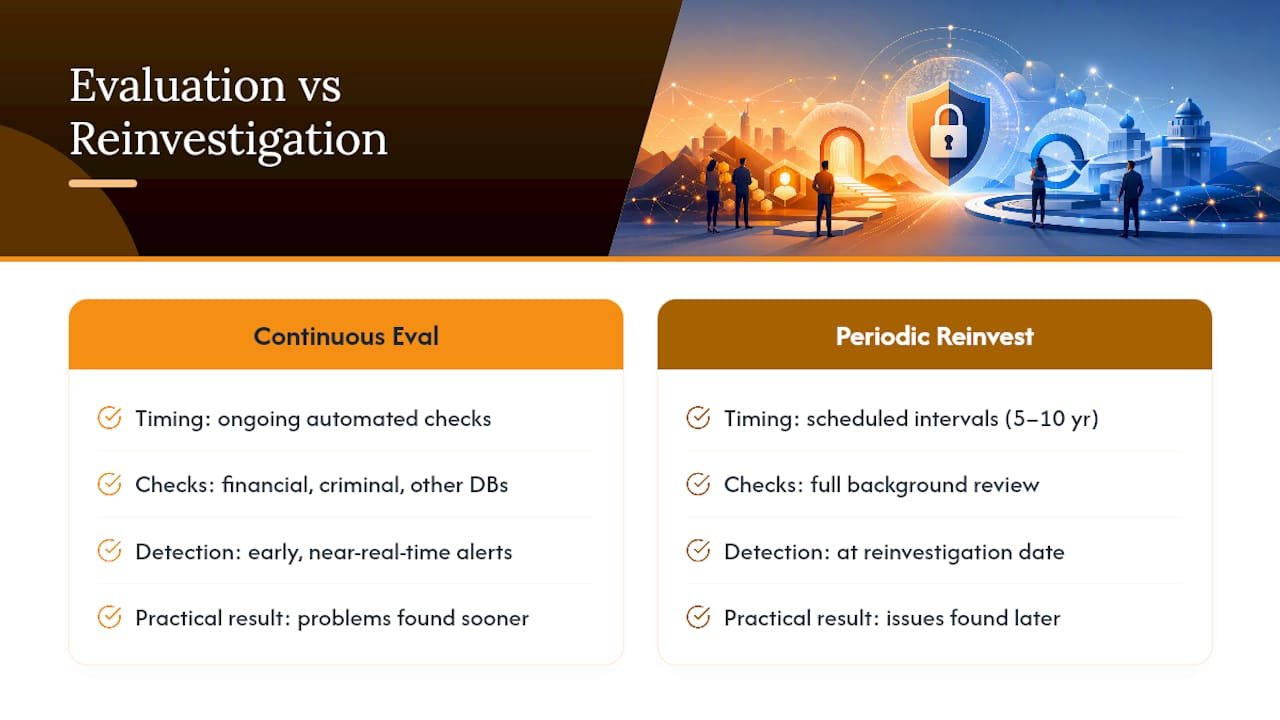
This matters practically because it means a financial problem or legal issue can surface and trigger a review well before your 10-year Secret or 5-year Top Secret reinvestigation is due. It’s not designed to catch people off guard. It’s designed to catch problems early, before they compound.
For working professionals, the practical takeaway is simple: treat your financial and legal record as if it’s being reviewed constantly, because in many cases it effectively is. Keep debts current, disclose major life changes promptly through your security officer, and don’t assume that because your reinvestigation date is years away, your file is dormant. Some agencies still rely primarily on periodic reinvestigation rather than continuous evaluation, so the exact cadence depends on which agency or contractor sponsors your clearance. Either way, the underlying standard doesn’t change: maintain the same financial and personal conduct that got you cleared in the first place.
Government Roles vs. Contractor Roles: Where Clearance Fits Differently
The clearance requirement is identical whether you work directly for a federal agency or for a contractor supporting that agency. What differs is how the role, pay, and career trajectory play out around that clearance.
Government cybersecurity positions, the kind posted on USAjobs, tend to offer more job security, a defined pay scale under the General Schedule, and a slower but more predictable promotion path. Contractor positions, often with firms supporting DoD or intelligence agencies, generally pay more for the same clearance tier and offer faster movement between projects, but with less job security tied to contract cycles. A contract ending can mean a layoff even if your performance was strong.
Contractors also tend to specialize more narrowly. A contractor ISSO might work a single system for years, deeply embedded in one program, while a government cybersecurity employee often rotates across systems or offices as part of broader career development. Clearance transferability works similarly in both paths, though contractors moving between companies on the same contract sometimes retain clearance continuity more smoothly than those making a bigger jump between agencies. For career changers weighing the choice, contractor roles usually offer a faster entry point and higher starting pay, while government roles offer more stability and a clearer long-term ladder.
The Playbook That Actually Shortens Time-to-Hire
Most advice on cleared cybersecurity careers treats certification and clearance as separate tracks. That’s backward. The candidates who move fastest treat DoD 8140 baseline certification as the entry ticket to sponsorship, not a formality to handle after the offer.
The conventional wisdom, “get cleared first, then worry about skills,” has it exactly wrong, because you can’t get cleared without a sponsor, and sponsors don’t chase unqualified candidates. Security+ in hand, before you apply, changes how recruiters read your resume entirely.
Veterans routinely underestimate their own advantage here. Familiarity with classified handling and military security culture is worth more than most civilian applicants realize, yet plenty of transitioning service members spend months on generic job boards instead of cleared-specific channels where that background is instantly recognized.
If you take one thing from this, prioritize the certification and the right search channel over everything else. The clearance will follow the offer. It always does.
— Alden
Sources
- Military
- DoDM 8140.03 — Cyberspace Workforce Qualification and Management Program
- Security clearance process | U.S. Intelligence Community careers