Passing the CHFI exam comes down to one discipline: mapping every study hour to the official exam blueprint, then reinforcing that reading with hands-on lab work that mirrors real forensic tasks. Start today by downloading the CHFI Candidate Handbook and the blueprint, or enrolling in an authorized course if you need structure. Most candidates who study consistently reach exam readiness in 8 to 12 weeks.
TL;DR:
- Study time should be allocated based on the domain weights listed in the official exam blueprint, with heavier topics like forensic procedures receiving more hours.
- Focus equally on building practical skills through labs and understanding procedural concepts to succeed in scenario-based questions rather than just memorizing facts or tool syntax.
- Use the candidate handbook to clarify eligibility and logistics before studying, and prioritize reading the blueprint to map objectives to your study plan.
- Practice with timed, scenario-based questions and full-length exams to improve comprehension, pacing, and the ability to recognize relevant procedural clues under exam conditions.
- Reinforce learning through instructor-led labs, hands-on workflows, and building experience via real or simulated forensic scenarios, especially if transitioning from related IT, security, or law enforcement roles.
Table of Contents
- What Does the CHFI Study Guide Need to Cover?
- Where Should You Start: The Official CHFI Study Materials
- How Do You Build a 90-Day CHFI Study Plan?
- What Tools and Labs Should You Practice With?
- What Are the CHFI Exam Logistics and Requirements?
- How Should You Structure CHFI Practice Tests?
- How Total Cyber Academy Maps Its Training to CHFI Prep
- What Do Candidates Misunderstand About the CHFI Exam?
- Should You Prioritize Theory or Hands-On Labs?
- How Do You Gain Practical Forensic Experience?
- What Real-World Cases Does CHFI Knowledge Apply To?
- Instructor-Led Training, Self-Study, or a Short Bootcamp?
- Ready to Turn This Study Plan Into a Pass
- Sources
What Does the CHFI Study Guide Need to Cover?
A real CHFI study guide is not a stack of flashcards. It is a domain-by-domain breakdown of exactly what EC-Council tests, weighted by how many questions each area actually earns on exam day. The CHFI exam blueprint lists the domains, their objective statements, and how coverage is distributed across the 150-question exam. Treat that document as your syllabus, not a reference you skim once.
The blueprint organizes CHFI knowledge into distinct domains, each with its own weight toward your final score. Here is what candidates need to master in each:
- Forensic science and investigation fundamentals — the legal framework, investigator roles, and the principles that govern how evidence gets collected without contaminating a case.
- Digital evidence and data acquisition — how to identify, preserve, and image digital evidence across storage media without altering the original source.
- Procedures and methodology — the step-by-step forensic process, from first response at a scene to final report submission, including chain of custody documentation.
- Operating system forensics — Windows, Linux, and Mac artifact analysis: registry hives, log files, file system metadata, and deleted data recovery.
- Memory and network forensics — volatile memory capture, network packet analysis, and reconstructing attacker activity from traffic logs.
- Tools, systems, and programs — the actual forensic suites and command-line utilities EC-Council expects you to recognize and apply correctly.
Each domain carries its own portion of the total 150 questions, and the blueprint spells out those weights explicitly. That weighting is important for guiding your study calendar allocation. Spending three weeks on OS forensics while skimming procedures and methodology in a single afternoon is how otherwise well-prepared candidates fail by a handful of points.
Converting weight into hours is simple arithmetic once you know your total study budget. If you have planned 100 hours of study across your prep window, a domain weighted at 25% earns 25 hours. A domain weighted at 10% earns 10. This sounds obvious written out, but almost no one does it. Most candidates study whatever topic feels most interesting that day, which usually means malware analysis and memory forensics get overstudied while procedural and legal topics get shortchanged, even though those procedural questions show up constantly in scenario-based prompts.
Pro Tip: Print the blueprint’s domain table and write your planned hours next to each domain before you open a single textbook. Seeing the numbers on paper stops the natural drift toward your favorite topic.
The blueprint also tells you something subtler: which domains lean conceptual versus which lean procedural. Forensic science and investigation questions tend to test judgment and legal reasoning. Tools and OS forensics questions tend to test recognition, specifically whether you know what a given command, log entry, or artifact actually means. That distinction should shape how you study each domain, a point the next section builds on directly.
Where Should You Start: The Official CHFI Study Materials
Three documents anchor every serious CHFI exam preparation plan, and reading them out of order wastes time. Start with the handbook, move to the blueprint, then use the study guide book for depth.
The CHFI Candidate Handbook is the rulebook, not a study text. It documents eligibility requirements, the official application process, exam policies, retake and extension rules, and the ECE renewal policy. It also confirms the exam is proctored and points candidates to its own Appendix A for the exam blueprint. Read this first, because it answers the logistical questions that otherwise derail candidates mid-preparation, like whether you qualify for the self-study route or need an authorized training center.
The CHFI Exam Blueprint is your content map. It lists domain objectives as specific, testable learning outcomes rather than vague topic labels. Where the handbook tells you the rules, the blueprint tells you what to actually know. Read each objective statement and ask yourself honestly whether you could explain it to a colleague. If you cannot, that objective goes on your weak-area list.
The Official CHFI Study Guide (Exam 312-49) book is the deep-dive resource. It is built to cover exam objectives comprehensively and functions as the canonical CHFI study guide many training programs reference. Use it after you have read the blueprint, not before. Reading it cold, without knowing which sections map to which weighted domains, means you will spend equal time on high-yield and low-yield material.
A few notes on how to use each resource efficiently:
- Highlight every objective statement in the blueprint that uses action verbs like “identify,” “analyze,” or “recover.” Those verbs tell you the exam wants applied knowledge, not memorized definitions.
- Cross-reference each study guide chapter against its matching blueprint domain before reading, so you know its weight before you invest the time.
- Keep the handbook open during registration. Eligibility and voucher rules change between handbook versions, and studying from an outdated one creates confusion later.
CHFI’s exam development also follows ISO/ANAB accreditation-aligned processes, which is worth knowing simply because it explains why the exam feels rigorously scenario-based rather than trivia-based. The questions are built to a quality standard, and that standard rewards applied understanding over rote recall.
How Do You Build a 90-Day CHFI Study Plan?
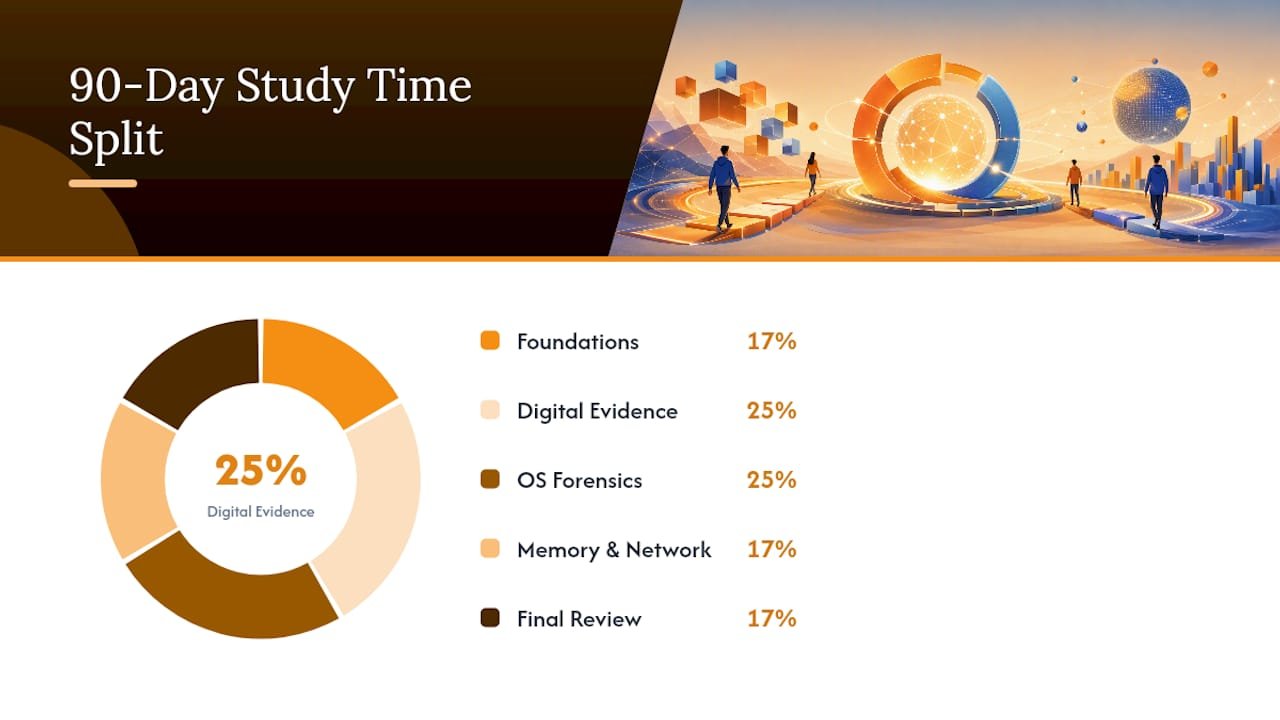
Most candidates who prepare consistently reach exam readiness within an 8 to 12 week window, and a 90-day plan gives you enough runway to cover every domain twice: once for learning, once for review. Here is a structure that ties directly to the blueprint’s weighting instead of treating every week the same.
- Weeks 1 to 2: Foundations and legal framework. Read the handbook fully, then move into forensic science and investigation fundamentals. Build your understanding of chain of custody, evidence admissibility, and investigator ethics before touching a single tool.
- Weeks 3 to 5: Digital evidence and procedures/methodology. These domains carry heavy scenario-question weight, so budget extra hours here. Pair reading with your first lab exercises: acquiring a forensic image and documenting the process step by step.
- Weeks 6 to 8: Operating system forensics. Split time evenly across Windows, Linux, and Mac artifact analysis. This is typically the densest domain in terms of tool-specific detail, so expect these weeks to feel the slowest.
- Weeks 9 to 10: Memory and network forensics. Run live capture exercises alongside your reading. Static reading about memory forensics without actually pulling a memory dump rarely sticks.
- Week 11: Tools, systems, and programs, plus your first full-length practice exam. By this point you should recognize tool output on sight. The practice exam here is diagnostic, not a pass/fail gate.
- Week 12: Targeted review based on practice-exam results, plus a second full-length timed exam in the final days.
Daily routines matter more than marathon weekend sessions. A workable weekday rhythm looks like 45 minutes of reading, 45 minutes of lab time, and 15 minutes of flashcard review for terminology and tool names. Weekends should shift toward longer lab blocks, 90 minutes to two hours, because forensic workflows like imaging and timeline reconstruction don’t compress well into short sessions.
Schedule your first full-length practice exam around week 9, once you’ve covered most domains at least once. Treat the score as a map of your weak points, not a verdict on your readiness. Schedule a second full-length exam in the final week, under strict timed conditions, and compare the two scores. A flat or declining score on a domain you already reviewed usually means you’re memorizing facts instead of understanding the underlying process, which is worth catching before exam day rather than after.
Pro Tip: Take your practice exams at the same time of day you’ll sit the real exam. Cognitive fatigue at hour three of a four-hour exam is real, and you want to know how your focus holds up before it counts.
The final two weeks deserve their own checklist, since this is where candidates either lock in their gains or burn out chasing new material:
- Stop introducing new topics. Review only.
- Redo every practice question you got wrong, and write a one-sentence explanation of why the correct answer is correct.
- Run through your lab notes once, focusing on command syntax and tool output you might have forgotten.
- Confirm your exam logistics: proctoring method, ID requirements, and testing center or remote setup, at least three days ahead.
- Sleep on a normal schedule the two nights before the exam. A rested memory outperforms a crammed one on scenario-based questions.
A companion resource on how to study for IT certification exams covers general pacing and retention techniques that apply directly to this kind of domain-weighted schedule.
What Tools and Labs Should You Practice With?
CHFI tests whether you can execute a forensic workflow, not just describe one, so your lab time needs to touch the same tool categories the exam draws from.
Build practice around these categories:
- Disk imaging and file system forensics — practice acquiring bit-for-bit images and analyzing file system artifacts using Autopsy, a free open-source platform built on The Sleuth Kit.
- Memory forensics — capture and analyze RAM dumps with Volatility to identify running processes, injected code, and network connections a suspect system held at capture time.
- Network forensics — use Wireshark to reconstruct sessions from packet captures and identify exfiltration or command-and-control traffic patterns.
- Automation and scripting — pytsk3, the Python binding for The Sleuth Kit, lets you script repetitive disk-image tasks, which is useful both for exam-style scenario practice and for real casework speed later.
- Mobile and cloud artifacts — even a basic familiarity with how mobile backups and cloud storage logs preserve metadata will help with scenario questions that touch modern evidence sources.
A low-cost home lab does not require expensive hardware. A single virtual machine running a forensic-focused Linux distribution, plus a handful of sample disk images you create yourself, covers most of what you need. A useful recurring exercise: create a small test image on a spare drive or virtual disk, plant a few deleted files and browser artifacts on it intentionally, then run the full workflow, image the drive, recover deleted files, extract OS and browser artifacts, build an event timeline, and write a short forensics report with proper chain-of-custody notes. Repeating that sequence with slight variations builds the muscle memory the exam’s scenario questions actually test.
Pro Tip: Time yourself on the full image-to-report workflow once a week. Knowing the steps is different from executing them under a clock, and the CHFI exam rewards candidates who can move efficiently through a scenario.
One caveat that deserves stating plainly: only run these exercises against data you own or environments built specifically for practice, such as a personal virtual machine or a sanctioned lab image. Never capture or analyze traffic, memory, or files from a network or device you do not have explicit authorization to test. Building a home lab on a budget is straightforward, and it keeps your practice both legal and repeatable.
What Are the CHFI Exam Logistics and Requirements?
The CHFI exam, version 312-49, runs 150 multiple-choice questions across four hours. You can sit it through Pearson VUE test centers, EC-Council’s own exam centers, or a remote proctoring option, depending on availability in your region.
Eligibility runs through two paths. If you complete official EC-Council training, you’re automatically eligible to schedule the exam. If you choose self-study instead, the candidate handbook requires documented experience in the field, generally two years, along with a completed eligibility application and a non-refundable application fee. That fee and the exact experience documentation required can change between handbook versions, so verify the current requirement before you apply rather than assuming last year’s terms still hold.
Key logistics to plan around:
- Voucher purchase: exam vouchers are typically purchased through EC-Council or an authorized training provider, and they carry an expiration window, so buy one only once you have a realistic exam date in mind.
- Retake policy: if you don’t pass, the handbook outlines a waiting period and retake fee structure before you can reattempt.
- Certificate delivery: digital certification and badge delivery typically follows within a defined period after a passing score is confirmed, though exact timelines are best confirmed directly with EC-Council at the time of your exam.
- Proctoring requirements: remote proctoring requires a stable webcam setup, a clear desk, and government-issued photo ID, so test your setup the day before if you’re not testing at a physical center.
Certification maintenance follows a fixed cycle. CHFI stays valid for three years, and renewal requires earning 120 ECE credits within that window through activities like continuing training, conference attendance, or published work in the field. Track ECE credits as you go rather than scrambling in year three. It’s a much smaller task spread across three years than compressed into a final scramble.
How Should You Structure CHFI Practice Tests?
CHFI questions lean heavily on scenario framing. Instead of asking “What does the FAT32 file system store?” the exam is more likely to describe an investigation, hand you a partial set of artifacts, and ask what your next forensic step should be. Reading comprehension matters as much as domain knowledge here, because the correct answer often hinges on a detail buried in the second sentence of the scenario, not the question itself.
Structure your practice sessions to mirror that reality:
- Run timed, sectioned drills first. Pull 20 to 30 questions from a single domain and time yourself at roughly 1.6 minutes per question, matching the real exam’s pace across 150 questions in four hours.
- Review every question afterward, right and wrong. For each one, write a single sentence explaining why the correct answer is correct and why the other three are not. This catches the near-miss questions where you guessed right for the wrong reason.
- Escalate to full-length, unsectioned exams in weeks 9 through 12, simulating real exam conditions with no domain hints and no pauses.
- Log your wrong answers by domain, not by individual question, so your review time in the final weeks targets patterns rather than isolated facts.
On exam day, budget your time in blocks rather than question by question. If you’re at question 40 and past the one-hour mark, you’re behind pace, flag questions you’re unsure about and move on rather than burning ten minutes on one scenario. Most CHFI exams allow you to mark and revisit questions, so use that feature deliberately: a first pass for anything you know cold, a second pass for anything requiring real thought.
Pro Tip: When a question describes a scenario you don’t immediately recognize, look for the procedural clue rather than the technical one. CHFI often rewards the answer that follows correct forensic methodology even when you’re unsure of the specific tool or artifact involved.
The most common mistake candidates make isn’t a knowledge gap, it’s over-trusting first instinct on scenario questions and skipping the second read-through of the prompt. A close second is neglecting procedures and methodology because it feels less technically exciting than memory or network forensics, then losing points on exactly the kind of question that domain’s weighting guarantees will appear. A structured exam strategy resource can help you build these habits before test day rather than discovering them mid-exam.
How Total Cyber Academy Maps Its Training to CHFI Prep
Alden, who covers certification strategy for Total Cyber Academy, built this guide around the same principle the academy applies to its own course design: study time only counts if it maps to the exam’s actual weighting, not to whatever topic feels most engaging that week.
The academy is built around hands-on labs rather than lecture-only formats, which matters specifically for a forensics certification where the exam tests applied workflow knowledge. The academy’s Cyber Forensics training covers digital evidence handling, OS artifact analysis, and investigative methodology, the same domains the CHFI blueprint weights most heavily. Students working through that material get lab reps on the exact image-to-report workflow this guide recommends practicing weekly.
For candidates who want vendor-aligned exam preparation beyond CHFI specifically, the academy’s EC-Council CEH on-demand course demonstrates the same lab-first approach applied to a related EC-Council credential, useful context if you’re mapping out a broader certification path rather than a single exam.
The most effective combination pairs official EC-Council materials, the handbook, blueprint, and study guide book, with structured lab access and instructor feedback on where your practice workflows fall short. Reading alone tells you what a forensic process should look like. Guided lab practice tells you where your own execution breaks down, which is exactly the gap between passing and failing on scenario-heavy exams like this one.
What Do Candidates Misunderstand About the CHFI Exam?
The most common misconception is that CHFI tests tool memorization. It doesn’t, not primarily. It tests whether you understand the forensic process well enough to know which tool or step applies to a given scenario. Candidates who cram tool syntax without understanding the underlying methodology often stall on questions that describe a situation and ask for the correct next action.
A second pitfall: treating legal and procedural topics as filler. Chain of custody, evidence admissibility, and investigator conduct show up constantly in scenario questions, precisely because real forensic work lives or dies on procedural correctness. Skipping ahead to the more technical domains and shortchanging this material is a common reason otherwise well-prepared candidates come up short.
A third: assuming OS forensics means memorizing file paths. The exam cares more about what an artifact tells you about user or system activity than the exact registry key location. Understanding what a piece of evidence means matters more than reciting where it lives.
Finally, many candidates underestimate how much reading comprehension affects their score. A scenario question can hinge on a single qualifying phrase, “after the drive was already mounted,” for example, that changes the correct answer entirely. Slow down on scenario questions rather than pattern-matching to the first familiar keyword you spot.
Should You Prioritize Theory or Hands-On Labs?
Neither extreme works. Reading the blueprint and study guide without lab time leaves you able to describe a forensic process but unable to execute it under exam-scenario pressure. Jumping straight into tools without the conceptual framework leaves you clicking buttons without understanding why a given step preserves evidence integrity, which is exactly what scenario questions probe.
The more reliable approach alternates the two deliberately. Read a domain’s blueprint objectives first, then immediately run a lab exercise that exercises those objectives before moving to the next domain. If you just read about disk imaging, image a test drive that same day. The concept sticks harder when your hands have just done the thing your eyes read about.

A useful gut check: after finishing a topic, ask whether you could walk a colleague through the process step by step, including what could go wrong and why. If you can only describe the “what” and not the “why it matters procedurally,” you’re still leaning too theoretical. If you can execute the tool steps but can’t explain what the output means for a case, you’re leaning too hands-on. Balanced preparation shows up as being able to do both at once.
How Do You Gain Practical Forensic Experience?
Beyond structured labs, real experience comes from three sources: workplace exposure, deliberate practice, and community involvement.
If your current role touches IT support, security operations, or incident response, volunteer for any task that involves log review, evidence preservation, or incident documentation. Even peripheral exposure to a real investigation teaches procedural discipline no textbook fully captures.
If you don’t have that workplace access yet, build it yourself through consistent home lab practice using the image-to-report workflow described earlier, repeated with new scenarios each time rather than the same drill on loop. Capture-the-flag competitions with a forensics track, and community platforms built around digital forensics challenges, offer structured scenarios that mimic exam-style reasoning without requiring a job in the field first.
Finally, consider a structured, instructor-led path if self-directed practice feels directionless. Guided lab environments compress the trial-and-error most self-taught candidates go through, and instructor feedback catches procedural mistakes, like documentation gaps, that are easy to miss when you’re grading your own work.
What Real-World Cases Does CHFI Knowledge Apply To?
CHFI’s domains map directly onto real investigative work: corporate insider-threat cases where an employee’s device needs imaging and timeline reconstruction, incident response engagements where memory forensics reveals an active intrusion, and law enforcement cases where mobile and cloud artifacts establish a timeline of activity.
The chain-of-custody discipline the exam tests exists because real cases get thrown out over documentation gaps, not technical failures. An investigator who images a drive perfectly but fails to log who handled it and when can watch that evidence become inadmissible. That’s why procedural questions carry real weight on the exam. They reflect what actually determines whether forensic work holds up outside a lab.
Network forensics skills apply directly to breach investigations, where reconstructing a packet capture can be the difference between identifying the entry point and guessing at it. Memory forensics matters most in active-incident scenarios, where a live system holds evidence a powered-down image never will. Every domain on the blueprint traces back to a scenario forensic investigators face routinely, which is exactly why the exam frames so many questions as scenarios rather than definitions.
Instructor-Led Training, Self-Study, or a Short Bootcamp?
Novices and career changers with limited hands-on background generally do better with instructor-led training. Guided labs catch procedural mistakes early, and the structure prevents the common trap of over-studying interesting domains while under-studying procedural ones.
Experienced IT or security practitioners with real investigative exposure can often succeed with self-study, provided they still meet the handbook’s eligibility path, typically two years of documented experience plus an approved application. Self-study saves cost but demands more discipline in tracking blueprint weightings honestly rather than defaulting to comfortable topics.
Veterans transitioning from military IT or intelligence roles often sit in between: strong procedural instincts from structured environments, but sometimes a gap in civilian forensic tooling. A hybrid approach, self-paced reading paired with instructor-led lab time, closes that gap efficiently.
If you’re unsure which route fits, default to the hybrid model. Read the blueprint and handbook independently, then use guided labs to validate your hands-on execution before committing to an exam date.
— Alden
Ready to Turn This Study Plan Into a Pass
You’ve got the blueprint, the roadmap, and the tool list. What most self-study candidates lack is lab access with someone checking their work before exam day, not more reading material. The training is built around exactly that gap: hands-on, instructor-led forensic labs that map to the CHFI domains covered in this guide, paired with practice-exam access and direct feedback on your scenario-question reasoning.
Enrolling gives you structured lab time on the same image-to-report workflow this guide recommends practicing weekly, instructor guidance when your evidence-handling steps go sideways, and test-taking strategy sessions built for scenario-heavy exams like CHFI’s. Veterans and career changers make up much of the student base, and the cyber forensics program is designed specifically to bridge classroom concepts with the applied skills this exam actually tests.
Start by exploring the full course catalog to see current cyber forensics offerings and enrollment options that fit your timeline and budget.
Sources
Bookmark these before you build your study calendar:
Read the handbook first, plan your hours against the blueprint second, and let the study guide fill in the depth once you know exactly where your time needs to go.