
The strongest path through penetration testing certifications runs from eJPT or CompTIA PenTest+ for beginners, through GPEN or CEH for working analysts, up to OSCP or PNPT for practitioners chasing senior red team roles. Every certification on that path earns its reputation through a hands-on, performance-based exam, not a multiple-choice test bank. Start where your current skills sit, not where your ambition does.
TL;DR:
- Entry-level certifications like eJPT and PenTest+ focus on practical, hands-on exams that simulate real-world penetration testing tasks, making them suitable for beginners.
- Higher certifications such as GPEN, CEH, and OSCP target intermediate to advanced practitioners, emphasizing structured methodology, live network exploitation, and report writing.
- Choosing the right certification depends on your current skill level, role focus, and the exam format, with hands-on tests being more valuable for practical roles like red team or consulting.
- Building a study plan around lab hours, real-world practice, and mentoring accelerates competency and better prepares candidates for certification exams.
- Certifications require ongoing renewal or skill maintenance, with most emphasizing continuous hands-on practice over solely accruing credentials.
Table of Contents
- Penetration Testing Certifications Ranked by Exam Rigor and Career Fit
- How to Choose the Right Certification for Your Situation
- Building a Study Plan That Matches the Exam Format
- Why Hands-On Instructor-Led Training Closes the Gap
- What the Certification Race Gets Wrong
- Start Building Job-Ready Skills, Not Just a Certificate Pile
- Sources
- FAQ
Penetration Testing Certifications Ranked by Exam Rigor and Career Fit
Not every certification tests the same thing, and employers know the difference. A multiple-choice exam confirms you can recognize the right answer among four options. A practical exam confirms you can break into a machine, document what you did, and explain why it matters. Practitioners consistently favor certifications with hands-on exam components because they simulate the actual job rather than testing recall. Here is how the six most-referenced certifications in the field stack up.
1. eLearnSecurity Junior Penetration Tester (eJPT)
The eJPT is the on-ramp most instructors point beginners toward, and for good reason. The exam is fully practical: you work through a simulated network and answer scenario questions based on what you actually find, not what you memorized. There are no formal prerequisites, which makes it the rare entry certification that does not assume prior IT experience. Expect a modest cost and an exam window measured in days rather than a single grueling session. Employers rarely list eJPT as a hard requirement, but they read it as proof a candidate has touched real tools, not just read about them. Take this one the moment you have basic networking and Linux command line comfort, before you invest in anything pricier.
2. CompTIA PenTest+ (V3)
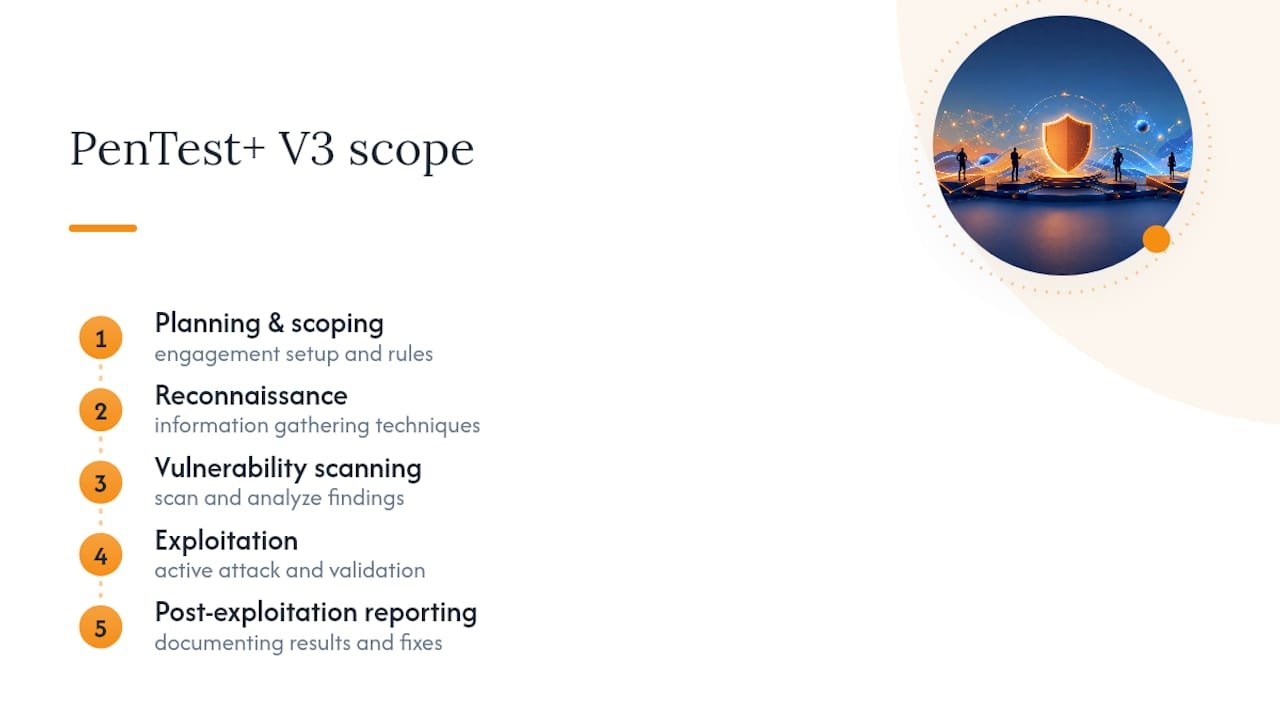
PenTest+ sits squarely between entry-level and intermediate, and its scope has grown with each version. The current V3 exam objectives span the full engagement lifecycle: planning and scoping, reconnaissance, vulnerability scanning, exploitation, and post-exploitation reporting, and the exam blends multiple-choice with performance-based questions rather than relying on one format alone. It is ANSI-accredited and referenced against certain U.S. Department of Defense directive requirements, which matters if a government or federal contracting role is on your radar. Prerequisites are informal (CompTIA recommends prior Network+ and Security+ knowledge, not mandatory certificates), and the exam runs approximately two to three hours. This is the certification that tells a hiring manager you understand pentesting as a structured process, not just a set of exploits.
3. Certified Ethical Hacker (CEH)
CEH is the name most non-technical hiring managers recognize first, largely because EC-Council has marketed it aggressively for two decades. The core exam is multiple-choice, covering attack vectors, tools, and methodology at a conceptual level. EC-Council also offers a CEH Practical add-on that tests live exploitation in a lab environment, and candidates serious about credibility should treat that practical version as the real target, not the base exam. CEH carries ANSI accreditation and shows up on government IT security job postings more often than most other certifications on this list. It fits professionals who need a recognizable credential for compliance or procurement purposes, alongside a hands-on cert that actually proves capability.
4. GIAC Penetration Tester (GPEN)
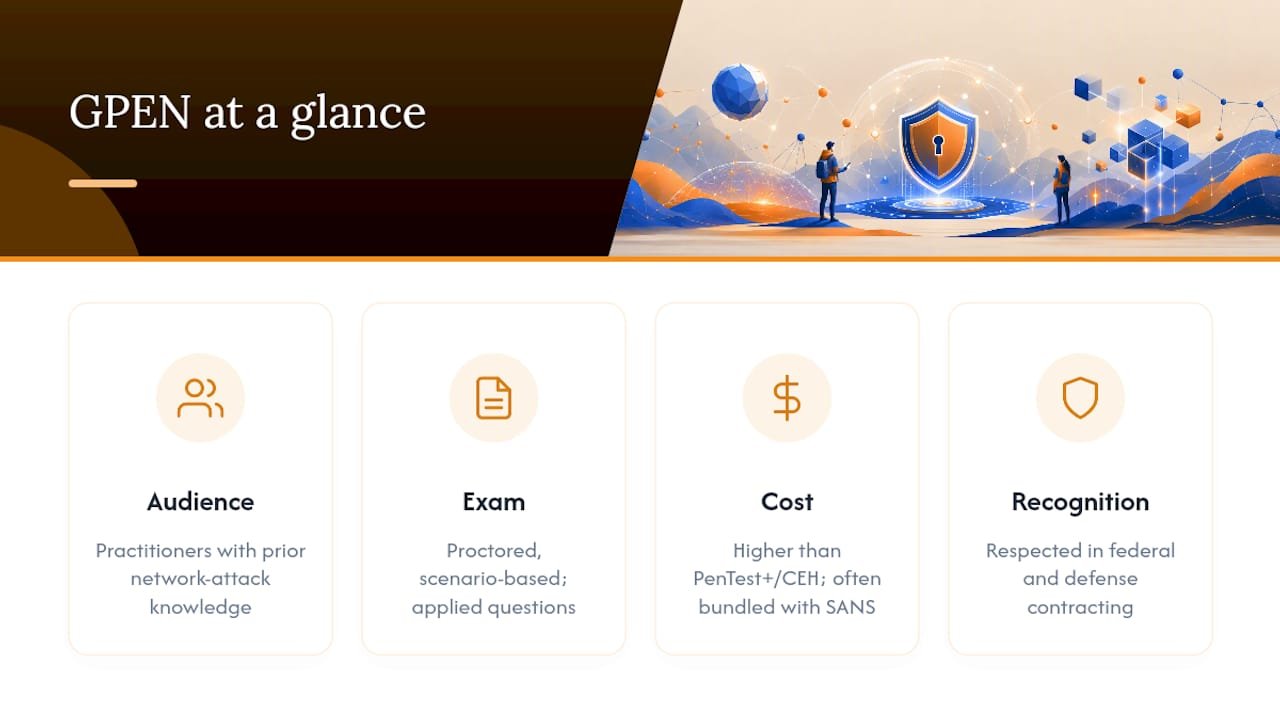
GPEN, issued by the SANS Institute’s GIAC arm, targets intermediate to advanced practitioners who already understand network attacks and want a credential that validates process discipline: scoping, methodology, exploitation, and reporting. The exam is proctored and heavily scenario-based, though it leans more toward applied knowledge questions than a live network compromise. GIAC certifications carry serious weight in government and enterprise security teams because SANS training feeds directly into federal and defense contracting pipelines. Cost runs considerably higher than PenTest+ or CEH, largely because it is often bundled with SANS coursework. GPEN fits someone already working in security who wants a credential that signals depth of methodology, not a first certification for a career changer.
5. Offensive Security Certified Professional (OSCP)
OSCP is the certification most senior pentesters cite as the one that actually changed how employers looked at them. The exam requires compromising multiple machines in a live virtual network within a set time window, then submitting a professional penetration test report. There is no multiple-choice component and no way to bluff through it. Passing OSCP demonstrates you can chain enumeration, exploitation, and privilege escalation under real time pressure, which is precisely what a red team engagement demands. It has no strict prerequisites, but nearly every experienced instructor advises against attempting it without solid scripting, Linux, and Active Directory fundamentals already in place. Save OSCP for after you have a foundation cert and real lab hours behind you.
6. Practical Network Penetration Tester (PNPT)
PNPT, from TCM Security, is the newest name on this list and has built a reputation fast because its exam mirrors a real consulting engagement almost exactly: external reconnaissance, initial compromise, internal network pivoting, Active Directory attacks, and a client-ready written report, followed by a live debrief presentation. That final presentation step is unusual among certifications and forces candidates to defend their findings the way they would in front of an actual client. Cost sits below OSCP, and the exam window allows multiple days to complete. PNPT fits candidates who already hold a foundation certification and want a credential built specifically around consulting-style engagements rather than isolated exploitation skills.
How to Choose the Right Certification for Your Situation
Match the certification to where you actually stand, not where you want to be in two years. Run through this checklist before you register for anything.
- Career stage first. Absolute beginners belong with eJPT or CompTIA PenTest+; working IT or security analysts fit GPEN or CEH; anyone targeting a red team or consulting role should be building toward OSCP or PNPT.
- Role match matters. Application security roles reward web-focused practice and PenTest+’s broader methodology coverage; red team and consulting roles reward OSCP or PNPT’s live-network exploitation format; cloud-focused roles need supplemental cloud security training beyond any single pentesting cert.
- Confirm the exam format. If a job posting says “hands-on” or “practical assessment” anywhere in its requirements, prioritize a cert with a live-network exam over a knowledge-only test.
- Check renewal terms before you pay. CompTIA certifications require continuing education units within three years; GIAC certifications require renewal within four years; Offensive Security certifications do not expire, but the skills behind them age quickly without practice.
- Budget the full cost, not just the exam fee. Factor in retake fees, since OSCP and PNPT both charge for a second attempt, and factor in training time, since none of these exams reward last-minute cramming.
Pro Tip: If a certification’s marketing leans hard on “no experience needed” language but the job postings in your target role all say “proven hands-on skills,” treat that as a warning sign the cert alone will not get you hired. Pair it with lab hours you can talk about in an interview.
Building a Study Plan That Matches the Exam Format
Study methods should mirror the exam you are actually taking. A multiple-choice test rewards structured review and practice questions. A live-network practical exam rewards muscle memory built in a lab, not flashcards.
- Weeks 1 to 3: Build fundamentals in networking, Linux, and scripting through structured vendor labs, then start logging hours in a home lab you control end to end.
- Weeks 4 to 7: Rotate through capture-the-flag platforms and vulnerable-machine repositories, aiming for a mix of easy wins and machines that force you to research unfamiliar exploits.
- Weeks 8 to 10: Simulate the real exam format under time pressure, practicing report writing alongside exploitation since most graders weight documentation heavily.
- Exam week: Read the scope document twice before touching a keyboard, track time against each target instead of fixating on one machine, and write your report notes as you go rather than reconstructing them from memory afterward.
The payoff for this investment is real. The Bureau of Labor Statistics projects roughly 29% job growth for information security analysts between 2024 and 2034, a rate that outpaces nearly every other occupation category BLS tracks. Practice ethically and only against systems you own or have explicit written authorization to test; unauthorized access carries legal consequences no certification will shield you from.
Why Hands-On Instructor-Led Training Closes the Gap
Self-study gets many candidates to a passing score, but structured, mentored training tends to get them there faster and with fewer wasted attempts. Programs that pair instructor-led labs with career guidance consistently outperform self-study alone for entry-level readiness.
A penetration testing pathway built around that same principle includes more about the cybersecurity industry careers that practitioners pursue after earning certifications:
- Instructor-led labs modeled on the exact scenario formats used by PenTest+, CEH, and OSCP-style exams.
- Live mentoring that reviews your exploitation approach and report writing, not just your final answer.
- A program structure built for career changers and IT professionals moving into offensive security specifically.
- Team credibility backed by placing first in a CompTIA Partner Summit CTF competition.
What the Certification Race Gets Wrong
Most advice on this topic treats certifications like a checklist: collect enough letters after your name and the job offers follow. That is backwards. A stack of knowledge-only credentials with no lab hours behind them reads as weaker to hiring managers than a single practical certification paired with a documented home lab. The exam format is the signal, not the logo on your LinkedIn profile.
The conventional advice also underweights sequencing. Jumping straight to OSCP without a foundation cert like eJPT or PenTest+ wastes money on failed attempts and burns motivation before the skills are ready to support the exam’s pace. A staged path (entry practical cert, then an applied intermediate cert, then a rigorous advanced practical exam) shows steady capability growth to employers in a way that a random assortment of badges never will.
What should you prioritize first? Lab hours over certification count. Every hour spent compromising a deliberately vulnerable machine and writing up what you did builds the exact skill every practical exam on this list actually tests. The certification just proves it happened.
— Alden
Start Building Job-Ready Skills, Not Just a Certificate Pile
Reading about eJPT, PenTest+, or OSCP is useful, but none of it substitutes for guided lab hours and someone checking your work before an exam proctor does. The approach is built around that gap: hands-on labs, live mentoring, and exam preparation mapped to the certifications that actually move a hiring decision, instead of a self-paced video library you work through alone.
If you are starting from zero, a beginner’s career guide walks through how the training paths map to entry-level roles and which certification track fits your background. Enrollment provides structured labs, mentoring on report writing and exploitation technique, and a career-focused plan instead of a generic course catalog. Check a training prerequisites checklist to confirm readiness, then start enrollment when ready.
Sources
- Top 10 Pentesting Certifications to Promote Your Career | Cobalt
- Information security analysts | Occupational Outlook Handbook | BLS
- PenTest+ Certification V3 (New Version) | CompTIA
- Penetration testing for beginners: the exact study plan I’d follow | DecodedSecurity
FAQ
Which certification is best for penetration testing?
There is no single best certification for every situation. Beginners get the most value from eJPT or CompTIA PenTest+, working analysts benefit from GPEN or CEH, and practitioners targeting red team roles should aim for OSCP or PNPT.
How difficult is the OSCP exam to pass?
OSCP is widely considered one of the most rigorous practical exams in the field, requiring candidates to compromise multiple machines in a live virtual network within a set time window and submit a professional report. Most candidates who pass have already built solid Linux, scripting, and Active Directory fundamentals before attempting it.
What are the top penetration testing certifications?
The certifications most consistently recommended across the industry are eJPT, CompTIA PenTest+, CEH, GPEN, OSCP, and PNPT, each targeting a different career stage from entry level through advanced red team work.
How much does a Security+ certification cost, and does it help with pentesting?
CompTIA Security+ is a foundational certification, not a pentesting-specific one, and it is commonly recommended before PenTest+ to build baseline security knowledge. Check the current CompTIA course access details for up-to-date pricing before registering.
Do penetration testing certifications need to be renewed?
Yes, most require continuing education. CompTIA certifications need renewal within three years, GIAC certifications within four years, while Offensive Security certifications like OSCP do not formally expire but require ongoing skill maintenance to stay relevant.