
Start with the ISC2 Official Study Guide as your backbone text, pair it with a domain-mapped practice question bank, and run weekly timed mock exams from week one. Build your calendar around a structured multi-week plan, adjusted for your existing security background. Everything else, the supplementary videos, the forums, the flashcards, exists to reinforce that core loop, not replace it.
TL;DR:
- Focus on one primary resource, the ISC2 Official Study Guide, and integrate a domain-mapped practice question bank from the beginning to track your progress.
- Prioritize practice questions over additional books, logging errors by domain and reviewing explanations to develop both knowledge and reasoning skills.
- Allocate study time based on domain weights, especially emphasizing cloud data security, and tailor your plan to your experience level, whether 12 weeks or 4 to 6 weeks.
- Use full-length timed mock exams regularly to assess readiness, aiming for consistent scores above your target in at least three consecutive attempts.
- Always verify the current exam outline from ISC2, as domain weights and content evolve, to ensure your study focus remains aligned with the latest version.
Table of Contents
- The Best CCSP Study Guide and Reference Materials to Build Your Foundation
- How Should You Use CCSP Practice Questions to Study, Not Just Test?
- Which CCSP Study Plan Fits Your Timeline and Experience Level?
- What Should You Master in Each of the Six CCSP Domains?
- What Do You Need to Know About Exam Format and Registration?
- How Do You Know You’re Ready to Schedule the Exam?
- What Recent Changes to the CCSP Exam Should You Watch For?
- What Are the Biggest Myths About the CCSP Exam?
- A Study Advisor’s Perspective on What Separates Passing Candidates From Everyone Else
- Total Cyber Academy: When Self-Study Isn’t Enough on Its Own
- Where to Verify Every Fact in This Guide
- Sources
- FAQ
The Best CCSP Study Guide and Reference Materials to Build Your Foundation
Most candidates overbuild their resource list before they have opened a single chapter. That instinct is understandable and almost always counterproductive. The ISC2 Official Study Guide, published through Wiley’s Sybex imprint, is the canonical text because it maps directly to the six domains ISC2 tests, and it ships with online practice tools and full-length practice exams built into the same purchase. There’s no ambiguity about whether the material aligns to the current exam blueprint. It does, because ISC2 itself endorses it.
That alignment matters more in CCSP than in most certification exams. Cloud security content shifts fast, and a generic “cloud security” book written for a broad audience will drift from what ISC2 actually tests within a year or two. The Official Study Guide gets revised alongside domain updates, which keeps candidates from wasting hours mastering material the exam no longer weights heavily.
Why one primary text beats five partial ones
A common mistake among experienced professionals is treating CCSP prep like a research project, collecting PDFs, blog series, and half-finished video courses until the desk looks like a cybersecurity syllabus exploded. That approach burns time on redundant coverage and leaves genuine gaps unaddressed, because no single supplementary source maps cleanly to the domain weights ISC2 actually tests.
The better model:
- Pick one primary text (the Official Study Guide) and read it cover to cover, mapped to the domain order in the official exam outline.
- Add one practice-question bank mapped to those same six domains, used continuously from week one rather than saved for the final week.
- Reserve a second book or concise guide only for domains where you score consistently below target on practice tests, not as a blanket second pass.
- Use the Cloud Security Alliance’s Cloud Controls Matrix and STAR program materials as free, vendor-neutral references for architecture and data-security topics, since CSA frameworks appear conceptually throughout the exam even though they aren’t tested verbatim.
- Download the official exam outline PDF directly from ISC2 and treat it as your master checklist, not a supplementary document.
The CSA guidance deserves particular attention because it’s free and because CCSP leans heavily on vendor-neutral thinking. The exam doesn’t ask how to configure a specific provider’s console. It asks whether you understand shared responsibility, control ownership, and risk transfer in the abstract, and CSA’s Cloud Controls Matrix is built around exactly that abstraction.
Complement the primary text with one focused resource for hands-on reinforcement. If you’re newer to cloud architecture specifically, a foundational primer like Totalcyber’s cloud security basics content on securing accounts and entry-level cloud roles can fill conceptual gaps before you dive into CCSP-specific material. If you already work in cloud infrastructure daily, skip that step entirely and go straight to domain-mapped practice.
Pro Tip: Read the Official Study Guide once for comprehension, then read it a second time only for the sections tied to your two weakest domains on early practice tests. A blanket second read of material you already know wastes hours you don’t have.
One more rule worth stating plainly: resist the urge to buy a third or fourth book “just in case.” Every hour spent evaluating a new resource is an hour not spent answering practice questions, and practice questions are what actually predict your exam-day performance.
How Should You Use CCSP Practice Questions to Study, Not Just Test?
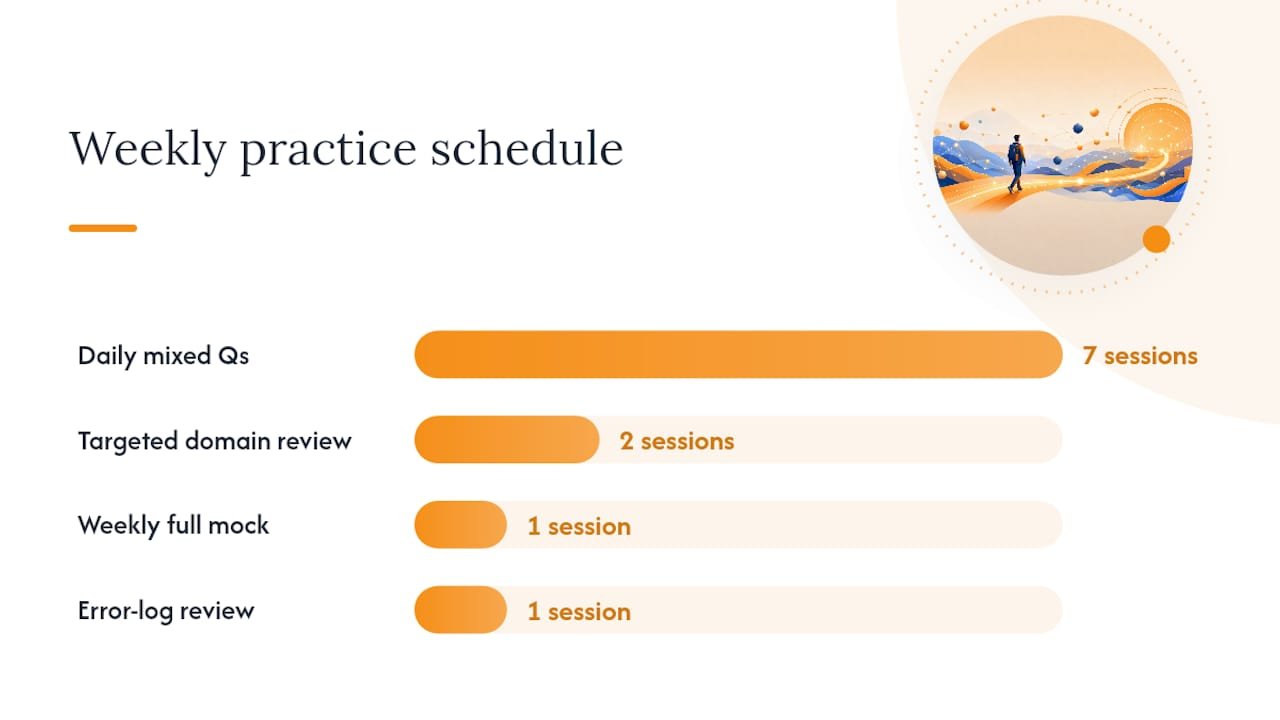
Practice questions work only when you track why you missed something, not just that you missed it. Set up a simple error log split by domain, one column for the topic tested, one for whether you missed it from a knowledge gap or a reasoning error, and review that log weekly rather than after the fact.
Here’s a sequence that turns raw question volume into durable knowledge instead of a false sense of progress:
- Run 20 to 30 mixed questions daily, pulled across all six domains rather than one domain at a time, since the real exam interleaves domains constantly.
- Log every miss with the domain, the specific concept, and whether the error came from not knowing the fact or from misjudging which “correct-ish” answer ISC2 actually wants.
- Run one full-length timed mock exam weekly, simulating the pressure of the Computerized Adaptive Testing format ISC2 uses, where question difficulty adjusts based on your prior answers.
- Review every explanation, right or wrong, because CCSP frequently presents two or three plausible answers and the explanation is where you learn the tiebreaker logic ISC2 expects.
- Revisit your error log every Sunday and schedule targeted review sessions for whichever two domains show the highest miss rate that week.
The reasoning behind step four deserves emphasis. CCSP is a judgment exam disguised as a knowledge exam. Scenario questions often present four technically defensible options, and the “best” answer depends on subtle cues in the scenario about cost, risk tolerance, or regulatory context. Reading only the explanation for questions you missed teaches you the facts. Reading the explanation for questions you got right by guessing teaches you the reasoning, which is the harder and more valuable skill.
A word of caution that ISC2 states directly on its own certification pages: avoid any site or forum claiming to sell “real” or “leaked” CCSP exam questions. These repositories violate ISC2’s copyright policies, frequently contain outdated or simply wrong content, and using them risks your certification eligibility entirely if ISC2 traces a violation back to you. Legitimate practice banks mapped to the official domains, paired with tools like a full Security+ style timed practice exam to build general test-taking stamina, give you the same benefit without the risk.
By the final two weeks, your daily mixed practice should feel almost boring, because the goal isn’t novelty. It’s repetition against your specific weak points until the reasoning becomes automatic under time pressure.
Which CCSP Study Plan Fits Your Timeline and Experience Level?
Your background dictates your timeline more than your available hours do. A CISSP holder with hands-on cloud experience can compress preparation into weeks. Someone newer to cloud architecture, even with strong general IT experience, usually needs the full runway to internalize six domains of vendor-neutral concepts.
The 90-day balanced plan
This works best for candidates without a security certification already in hand, or anyone who wants margin for a full second pass through weak domains. Exam Atlas and similar structured templates typically recommend 1 to 2 hours daily across roughly 12 weeks, with the first eight weeks split across domain reading and the final four dedicated almost entirely to mixed practice and timed mocks.
- Weeks 1 to 8: read one domain every 6 to 7 days, running 15 to 20 practice questions daily on material covered so far.
- Weeks 9 to 10: shift to mixed practice across all domains, 30 questions daily, with your first full timed mock at the start of week 9.
- Weeks 11 to 12: run one full timed mock every four days, spend remaining time exclusively on your two weakest domains from the error log.
The 10-week accelerated plan
Built for candidates with solid general security knowledge but limited cloud-specific depth. This plan assumes 2 to 3 hours daily and compresses domain reading into six weeks instead of eight, leaving four weeks for practice-heavy review.
The compressed plan for CISSP holders and cloud veterans
If you already hold a CISSP or work daily in cloud infrastructure, you can often compress to 4 to 6 weeks. Skip re-learning general security governance and access control concepts you’ve already mastered. Concentrate instead on cloud-specific application, like the shared responsibility model’s legal and contractual implications, data residency rules, and cloud-native incident response, since these areas trip up experienced security professionals more than newcomers, precisely because the concepts feel familiar but the cloud-specific nuances differ.
| Plan type | Best for | Weekly hours | Duration | Practice test frequency |
|---|---|---|---|---|
| 90-day balanced | New to cloud security | 8 to 12 hrs/week | 12 weeks | Weekly by week 9 |
| 10-week accelerated | Security background, limited cloud depth | 15 to 20 hrs/week | 10 weeks | Weekly by week 6 |
| Compressed | CISSP holders, cloud veterans | 15 to 20 hrs/week | 4 to 6 weeks | Twice weekly |
Whichever plan you choose, build in a contingency week. Life interrupts study schedules constantly, and a plan with zero slack collapses the first time work demands a late night or a family emergency eats your Saturday. Add one buffer week for every four weeks of core study, and treat it as insurance, not indulgence.
Part-time study, meaning under 8 hours weekly, generally pushes even experienced candidates toward the 90-day timeline rather than the accelerated one. Trying to force 10-week intensity into part-time hours is the single most common reason candidates burn out or delay their exam date.
What Should You Master in Each of the Six CCSP Domains?
The official exam outline breaks the exam into six domains with uneven weights, ranging from roughly 13 to 20 percent depending on the domain. Cloud Data Security carries the heaviest weight, which should shape how you allocate study hours rather than treating all six domains as equal.
Domain 1: Cloud Concepts, Architecture and Design
- Shared responsibility model across IaaS, PaaS, and SaaS
- Cloud deployment models: public, private, hybrid, community
- Reference architectures and the business impact of cloud migration decisions
Domain 2: Cloud Data Security
- Full data lifecycle from creation through destruction
- Encryption and key management, including where keys should live relative to the data they protect
- Data loss prevention and data masking or tokenization tradeoffs
Domain 3: Cloud Platform and Infrastructure Security
- Virtualization security controls and hypervisor risks
- Network segmentation strategies specific to cloud environments
- Infrastructure hardening and physical/logical facility considerations
Domain 4: Cloud Application Security
- Secure software development lifecycle adapted for cloud-native applications
- OWASP concerns as they apply specifically to cloud workloads and APIs
- API security patterns and identity and access management integration
Domain 5: Cloud Security Operations
- Logging and monitoring architecture across distributed cloud environments
- SIEM fundamentals and how they change when the infrastructure isn’t yours
- Incident response procedures adapted for cloud workloads and shared control
Domain 6: Legal, Risk and Compliance
- Contract review and vendor risk assessment for cloud service agreements
- Privacy frameworks and how they intersect with cross-border data transfer
- Audit considerations, including what evidence you can even access in a shared-responsibility environment
Domain 2’s weight makes it worth an extra pass regardless of your study plan. Scenarios frequently test whether you’d choose encryption, tokenization, or masking for a given data type and risk profile, and the “right” answer usually hinges on a detail buried in the scenario’s second sentence.
What Do You Need to Know About Exam Format and Registration?
CCSP uses Computerized Adaptive Testing delivered through Pearson VUE test centers. The exam adjusts question difficulty based on your prior answers, running between 100 and 150 items within a 3-hour window, and ISC2 sets the passing standard at 700 out of 1000 points on a scaled scoring model.
Eligibility requires five years of cumulative, paid work experience in IT, with three of those years specifically in security and at least one year in one or more of the six CCSP domains. Candidates who haven’t yet met the experience requirement can still pass the exam and earn the Associate of ISC2 designation, then convert to full CCSP certification once they accumulate the required experience.
Before you finalize a study plan, confirm the current exam outline directly on ISC2’s certification page, since domain content and weights get revised periodically and studying against an outdated outline wastes real hours.
- Bring two forms of government-issued ID matching your registration name exactly.
- Arrive at least 30 minutes before your scheduled time; late arrivals risk forfeiting the slot entirely.
- Leave personal items, phones, and notes in test-center storage; nothing electronic is allowed at the workstation.
- Expect a mandatory non-disclosure agreement on screen before the exam begins.
How Do You Know You’re Ready to Schedule the Exam?
Readiness isn’t a gut feeling. It’s a pattern across your last several full-length timed mocks. A reasonable benchmark: three consecutive timed mocks scoring at or above your target range, with no single domain dropping more than 10 to 15 points below your overall average.
- Check consistency, not a single high score. One strong mock after a lucky question set means less than three mocks in a row landing in your target zone.
- Read the per-domain breakdown after every mock, not just the overall score, and schedule a focused 2 to 3 day review cycle for whichever domain trails the others.
- In your final week, run two back-to-back timed mocks at least once to simulate the mental fatigue of adaptive testing under real exam conditions.
- Postpone rather than gamble if any domain is still inconsistent seven days out. A two-week delay costs far less than a failed attempt and a mandatory waiting period before retesting.
Weak-domain remediation works best in short, repeated cycles rather than one long cram session. Three 45-minute sessions on Cloud Data Security across a week beat one 3-hour session the night before your mock.
What Recent Changes to the CCSP Exam Should You Watch For?
ISC2 periodically revises the CCSP exam outline to reflect how cloud security practice actually evolves, and treating an old PDF as current is one of the easier mistakes to avoid. Domain weights shift between revisions, sometimes only by a percentage point or two, but enough to change where you should invest marginal study hours.
Cloud-native security operations content has expanded in recent revisions, reflecting how much incident response and monitoring work has moved toward containerized and serverless architectures rather than traditional virtual machines. Candidates studying from a guide more than one revision cycle old sometimes under-prepare for these operational scenarios because earlier editions leaned more heavily on infrastructure-as-a-service concepts.
Privacy and cross-border data transfer content in Domain 6 has also grown more prominent as global privacy regulation continues to fragment across jurisdictions. Exam scenarios increasingly test whether you understand that a conflict between data residency requirements and business continuity needs exists, not necessarily the fine print of any single regulation.
The practical takeaway: download the current outline directly from ISC2 before you buy a single resource, and check it again roughly a month before your scheduled test date, since ISC2 doesn’t always announce mid-cycle content clarifications through the same channels candidates typically monitor. A study guide that was accurate eighteen months ago may have quietly drifted from what the exam now weights.
What Are the Biggest Myths About the CCSP Exam?
The persistent myth that CCSP is “just CISSP with cloud vocabulary swapped in” causes more failed first attempts than almost any other misconception. CCSP tests cloud-specific architectural judgment, not general security management principles wearing a cloud costume. A CISSP background helps enormously with governance and risk concepts, but it doesn’t substitute for understanding shared responsibility boundaries or cloud-native data lifecycle management.
Another common myth: that memorizing provider-specific configuration steps, AWS console screens, Azure portal menus, and the like, prepares you for the exam. CCSP is deliberately vendor-neutral. Scenarios describe generic cloud service providers, and questions test conceptual understanding of controls and tradeoffs, not which button to click in a specific console.
A third misconception treats CCSP as easier than CISSP because it covers fewer domains. Six domains instead of eight doesn’t mean less depth. It means the same breadth of judgment-testing scenario questions concentrated into fewer, denser topic areas, and Domain 2’s weight alone demands a level of technical depth on encryption and key management that some candidates underestimate badly.
Finally, some candidates assume passing means recognizing the “textbook correct” answer. In practice, CCSP scenarios frequently present two technically valid options where the deciding factor is a business or risk detail mentioned once in the scenario’s setup. Rushing through scenario text to get to the answer choices is a fast way to miss that detail and pick the technically-correct-but-contextually-wrong answer.
A Study Advisor’s Perspective on What Separates Passing Candidates From Everyone Else
The candidates who pass on their first attempt almost always share one habit: daily, unglamorous consistency over sporadic marathon sessions. Thirty minutes of mixed practice every day beats a single four-hour Saturday cram, because CCSP rewards pattern recognition across scenario types, and pattern recognition needs repetition spread across time, not compressed into one sitting.
Hands-on labs matter more than most self-study candidates assume. Reading about shared responsibility models is abstract until you’ve configured access controls in an actual cloud environment and felt the boundary between provider and customer obligations firsthand. That’s the gap Totalcyber’s instructor-led labs and veteran-focused mentoring are built to close for candidates who learn better by doing than by reading alone.
— Alden
Total Cyber Academy: When Self-Study Isn’t Enough on Its Own
A study guide and a disciplined plan get most candidates to the finish line. Some candidates, especially those balancing full-time work, military transition timelines, or a hard deadline for a job requirement, need more structure than a book and a spreadsheet can provide. Totalcyber exists for exactly that gap: hands-on labs, instructor-led courses, and exam-focused curricula built by a veteran-owned academy that specializes in turning conceptual security knowledge into job-ready skill, with extra mentorship and live tutoring from working cybersecurity professionals rather than a static syllabus.

If your timeline is tight, or if you learn better with an instructor answering questions in real time than with a forum thread three months old, a guided path closes that gap faster than solo study alone. Totalcyber’s certification programs are built around real-world scenarios and structured mentorship for career changers and veterans specifically, pairing hands-on lab work with the exam-focused study most self-guided candidates struggle to structure on their own. Browse the current course catalog to see which program lines up with where you are in your cybersecurity career, and reach out to get started on a plan built around your actual timeline rather than a generic template.
Where to Verify Every Fact in This Guide
Study materials go stale. These four sources don’t, because they’re the primary authorities the exam itself is built on.
- The official CCSP exam outline gives you exact domain weights and CAT exam details straight from ISC2.
- The ISC2 CCSP certification page covers registration steps, eligibility rules, and the Associate of ISC2 pathway.
- The Official Study Guide listing on Wiley confirms edition details and included practice tools before you buy.
- Cloud Security Alliance resources give you free, vendor-neutral frameworks for the architecture and data-security concepts CCSP tests conceptually.
Sources
- Certification Exam Outline (ISC2) — CCSP (2026 exam outline)
- ISC2 — CCSP certification page
- ISC2 CCSP Certified Cloud Security Professional Official Study Guide, 3rd Edition — Wiley
- CCSP Study Plan: 10-Week Study Plan — Exam Atlas
- Cloud Security Alliance — resources and frameworks
FAQ
What is the best study guide for the CCSP exam?
The ISC2 Official Study Guide (Sybex/Wiley) is the best primary resource because it’s directly aligned to ISC2’s own domain weights and includes bundled practice tools. Pair it with a domain-mapped question bank rather than relying on the book alone.
Is CCSP hard to pass?
CCSP is challenging because it tests judgment across scenario-based questions rather than pure memorization, and Domain 2’s heavy weight demands real depth on encryption and key management. Consistent, mapped practice against your weak domains is what separates a pass from a retake far more than raw hours studied.
Is CCSP harder than CISSP?
Neither is uniformly harder. CCSP concentrates deep, cloud-specific technical judgment into six domains, while CISSP spreads broader security management concepts across eight. A CISSP holder often finds CCSP’s governance sections familiar but needs real focus on cloud-native data security and architecture, which CISSP doesn’t cover in the same depth.
How can I prepare for the CCSP exam?
Build your preparation around the Official Study Guide, a mapped practice-question bank, and a structured 8 to 12 week plan matched to your experience level. Run weekly timed mocks, log every missed question by domain, and confirm the current exam outline on ISC2’s site before you commit to a full plan.