
The most reliable route into civilian cybersecurity work is hands-on, certification-mapped training that starts with CompTIA Security+ (or A+/Network+ for those without IT backgrounds), aligned to the NICCS framework, with exam fees reimbursed through VA GI Bill benefits. Pair that certification with labs, capture-the-flag exercises, and a documented portfolio before applying for roles.
TL;DR:
- Veterans benefit from hands-on cybersecurity training that includes labs, capture-the-flag exercises, and a documented portfolio to demonstrate skills to employers.
- The recommended certification path spans 6 to 12 months, starting with A+ or Network+ for those without IT experience and progressing to Security+ plus role-specific certifications.
- Active-duty veterans can leverage VA GI Bill benefits, including exam fee reimbursements and prep course coverage, to reduce training costs.
- Choosing programs with mentor access, practical labs, and alignment to NICE framework improves job readiness and transition prospects.
- Developing a portfolio of lab reports, CTF results, and real-world projects significantly enhances hiring chances, especially when combined with civilian resume translation of military experience.
Table of Contents
- Why Veterans Are a Strong Fit for Cybersecurity Roles
- How to Choose a Civilian Cybersecurity Training Program
- Certification Pathway: A 6 to 12 Month Plan
- Hands-On Practice: Labs, CTFs, and Building a Portfolio
- Funding Your Training: GI Bill, SkillBridge, and Other Veteran Pathways
- Getting Hired: Resume Translation and Interview Readiness
- A Veteran-Focused View on What Actually Works
- Where Total Cyber Academy Fits Into This Roadmap
- FAQ
- Sources
Why Veterans Are a Strong Fit for Cybersecurity Roles
Military service builds habits that civilian cybersecurity employers actively look for: procedural discipline, situational awareness under pressure, and in many cases an active security clearance that shortens hiring timelines for government-adjacent roles. These traits map cleanly onto NICE Framework work roles such as cyber defense analyst or incident responder, where following established procedures under stress matters as much as technical depth.
CSO Online reporting notes that veterans carry real advantages into this field, but success still depends on translating military language into civilian terms and building a professional network from scratch. A title alone rarely closes that gap.
- Military operational discipline maps to NICE defender and analyst work roles.
- Clearance status can accelerate hiring for government and contractor positions.
- Hands-on lab work and CTF participation give employers concrete proof of skill, not just a certificate.
How to Choose a Civilian Cybersecurity Training Program
Picking the right program matters more than picking the fastest one. Veterans should evaluate options against a short, practical checklist before enrolling anywhere.
- Confirm the program includes hands-on labs, not just slide decks and practice quizzes.
- Check for mentor access from working cybersecurity professionals, not just automated grading.
- Ask whether career services exist: resume review, interview prep, employer connections.
- Verify the curriculum maps to NICE work roles so your training translates into job titles employers recognize.
- Confirm the program accepts VA benefits or offers exam vouchers, and ask about SkillBridge eligibility if you are still on active duty.
- Get a realistic estimate of live versus self-paced hours and a time-to-job range, not just a course length.
Pro Tip: Ask any program directly how many of their recent graduates passed their target certification on the first attempt. A real answer, even an approximate one, tells you more than a marketing page ever will.
Format matters too. A self-paced course that takes six months of evening study produces a different outcome than a live, instructor-led course compressed into eight weeks. Neither is wrong, but the choice should match your timeline and how much structure you need to stay on track.
Certification Pathway: A 6 to 12 Month Plan
A sequenced certification stack gives you forward progress you can point to in interviews, even before you land your first cybersecurity role. The common entry stack looks like this:
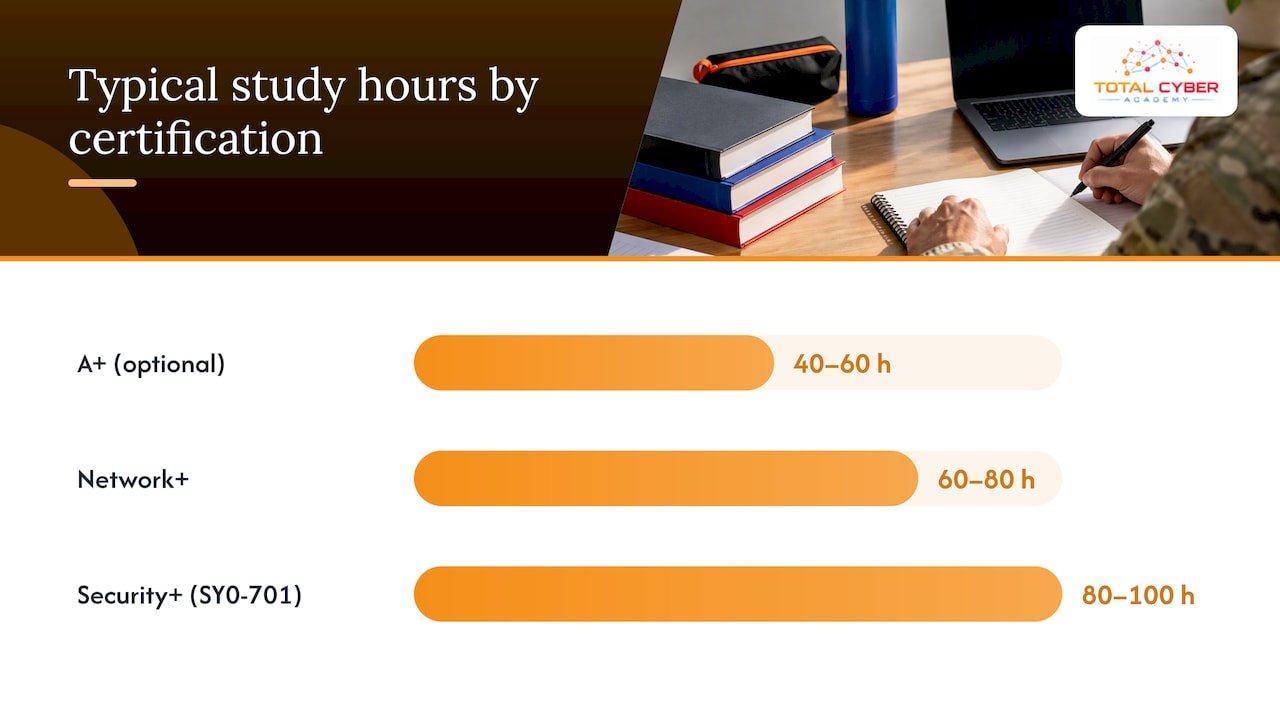
- A+ (optional, for those with no prior IT experience): builds foundational hardware and OS knowledge, typically 40 to 60 study hours.
- Network+: covers networking fundamentals that almost every security role assumes you already know, typically 60 to 80 study hours.
- Security+: the broadly recognized baseline certification for entry-level cybersecurity roles, typically 80 to 100 study hours combined with lab time.
- CySA+, PenTest+, or CEH: role-specific certifications chosen based on whether you’re heading toward defense, offense, or a generalist analyst track.
CompTIA’s own guidance describes these as stackable certifications that build progressively toward specialist clusters rather than isolated credentials, which is why sequencing them in order pays off more than jumping straight to an advanced exam.
Security+ V7, known by its exam code SY0-701, is the current version as of this writing, with a V8 update expected later in 2026. If you’re ready to test now, there’s little reason to wait for the next version. If you’re still months away from exam-ready, factor that update into your study timeline so you’re not caught studying outdated material near the transition.
A realistic pace for most career changers working full time is one certification every two to four months, which puts a three-certification stack within a 6 to 12 month window. Veterans using the months before separation to study part time often compress this further, since structured study time is easier to protect during terminal leave.
Hands-On Practice: Labs, CTFs, and Building a Portfolio
Certifications prove you know the material. Hands-on practice proves you can apply it, and employers increasingly ask for both. Research on virtual laboratories in cybersecurity education found that vLabs measurably increase engagement and help learners build practical skills in remote settings, which matters for veterans studying around work or family schedules.
A pilot program documented in research on veteran hardware security training ran a 12-week hybrid course combining hands-on hardware labs with internships for ten veterans, producing significant knowledge gains, though some participants needed extra support to build confidence in applying what they’d learned. That combination of structured practice and mentorship, sometimes called cognitive apprenticeship, consistently outperforms lecture-only formats.
- Prioritize incident response simulations, vulnerability scanning exercises, and exploit analysis over passive video content.
- Document every lab in a short writeup: what the scenario was, what you did, and what you found.
- Collect CTF results, lab completion badges, and project writeups in a single portfolio, whether that’s a GitHub repository or a simple personal site.
Pro Tip: Treat every lab writeup like a mini incident report. Hiring managers read these the same way they’d read a shift log, and clear, structured writing stands out.
Funding Your Training: GI Bill, SkillBridge, and Other Veteran Pathways
Money should rarely be the reason a veteran skips certification training. The VA’s licensing and certification benefit reimburses a substantial amount per approved test, with no cap on the number of tests or retakes you can claim, and GI Bill entitlement can also cover approved certification prep courses. That makes a multi-certification stack financially realistic for most eligible veterans.
Beyond the GI Bill, several structured pathways are worth checking before you pay out of pocket:
- SkillBridge: active-duty service members nearing separation can use approved SkillBridge placements for cybersecurity training and internships.
- NICCS and CISA resources: the NICCS Veterans User Guide maps training options directly to NICE work roles so you’re not guessing which path fits your goals.
- Nonprofit and federal pipelines: Military.com’s overview of veteran cyber pathways lists programs combining training with direct employer connections.
Before enrolling anywhere, confirm the program is VA-approved, apply for your certification voucher ahead of your test date rather than after, and ask your transition office whether SkillBridge slots are available if you’re still in uniform.
Getting Hired: Resume Translation and Interview Readiness
Training and certifications get you in the door. Getting hired still comes down to translating what you did in uniform into language a civilian hiring manager immediately understands. “Monitored network traffic for anomalies” lands better than a job title that means nothing outside the military, and framing your experience using NICE work-role terminology helps resume screening tools and human reviewers alike.
- Rewrite duty descriptions as measurable outcomes: systems monitored, incidents handled, reports delivered.
- Network through veteran cybersecurity groups, NICCS career tools, and alumni from your training program.
- Bring portfolio artifacts to interviews and be ready to walk through a lab scenario step by step.
- Mention active clearances early. They often shortcut background checks for cleared roles.
A Veteran-Focused View on What Actually Works
Veterans don’t need convincing that structure and repetition build competence. What the transition into cybersecurity often lacks is mentorship that bridges military habits to civilian workplace expectations, and that gap closes faster with hands-on labs than with lecture time alone. Persistence through a few failed lab attempts or a missed exam question teaches more than a passing score ever does.
We’ve seen this play out directly: students have claimed first place in capture-the-flag competitions, a curriculum maps to the NICE Workforce Framework, there’s an official partnership with (ISC)², and labs are built around hands-on, cognitive-apprenticeship-style instruction rather than passive video content. Expect a realistic 6 to 12 month runway from first course to first civilian offer, not a guaranteed shortcut.
— Alden
Where Total Cyber Academy Fits Into This Roadmap
We built our course catalog around the exact stack this guide recommends. If you’re starting from zero, our A+ 220-1201 and 220-1202 on-demand courses cover the fundamentals. If you’re ready for the baseline cybersecurity credential, our CompTIA Security+ SY0-701 live course and on-demand equivalent both prepare you for the current exam version.
For readers aiming at a specific career track rather than a single exam, our Penetration Tester Program and Cybersecurity Engineer Program combine certification prep with the hands-on labs and mentor access this guide points to throughout.
- Live and on-demand formats for Security+, Network+, CySA+, and CEH certification prep.
- Program tracks for penetration testing, cybersecurity engineering, IT operations, and cloud engineering.
- Mentorship from working cybersecurity professionals built into every course.
We hold an official partnership with (ISC)², and our students have placed first in capture-the-flag competitions, proof that hands-on training translates into real performance. Explore our course catalog to find the certification that fits where you are today.
FAQ
Does the VA GI Bill cover cybersecurity certification exams?
Yes, the VA reimburses approved certification test fees up to $2,000 per test, with no limit on how many tests or retakes you claim. Approved certification prep courses may also be covered under your GI Bill entitlement.
Which certification should veterans start with in cybersecurity?
Most veterans with some IT background should start with CompTIA Security+, the widely recognized baseline certification for entry-level roles. Those without IT experience often start with A+ or Network+ first to build foundational knowledge before attempting Security+.
How do I know if a training program is worth the cost?
Look for hands-on labs, mentor access from working professionals, career services, and alignment with the NICE Workforce Framework work roles. A program that accepts VA benefits or offers certification vouchers removes much of the financial risk.
How long does it take to become job-ready in cybersecurity after leaving the military?
A realistic timeline for a certification stack like Network+, Security+, and a role-specific certification is 6 to 12 months of part-time study. Veterans who study full time during transition leave or through SkillBridge often move faster.
Can SkillBridge be used for cybersecurity training?
Yes, active-duty service members nearing separation can use approved SkillBridge placements for cybersecurity training and internships before their final discharge date. Check with your transition office for which programs currently hold SkillBridge approval.
Sources
- VA — How to use benefits: licensing and certification tests
- NICCS — Veterans user guide (FY25)
- CompTIA — Security+ certification
- Bridging the gap: Empowering student veterans for hardware security careers
- Impact of virtual laboratories on engagement in cybersecurity distance education (2024)
- CSO Online — Veterans are an obvious fit for cybersecurity