
Cyber workforce development is defined as the structured process of building a skilled cybersecurity workforce through targeted education, training programs, and career pathways aligned with industry and organizational needs. The field draws on recognized frameworks like the NICE (National Initiative for Cybersecurity Education) framework, government initiatives, and hands-on training models to close a persistent talent gap. The cybersecurity profession grew from 2.28 million to 4.24 million professionals between 2010 and 2015. That near doubling in five years still could not keep pace with demand, and the shortage has only deepened since. Educators, employers, and policymakers who understand how workforce development works are better positioned to build sustainable talent pipelines rather than scrambling to fill roles after a breach.
What is cyber workforce development and how is it structured?
Cyber workforce development is organized around three core elements: defining work roles, building competencies, and delivering training that produces job-ready professionals. The NICE framework standardizes the Tasks, Knowledge, and Skills (TKS) model, giving employers and educators a shared language for describing cybersecurity roles. Without that common language, a job posting for a “security analyst” at one organization means something entirely different at another, making hiring and curriculum design inconsistent.
Competency-based training sits at the center of any effective program. Rather than measuring seat time, competency-based models assess whether a learner can actually perform a task under realistic conditions. Industry certifications such as CompTIA Security+, ISC2 SSCP, and CEH serve as external validation of those competencies, giving employers a standardized benchmark.

Hands-on training through cyber ranges and simulation platforms is the method that separates effective programs from theoretical ones. The Carnegie Mellon Software Engineering Institute identifies immersive Skilling Continuation Labs as essential for operational readiness, noting that real-time threat simulation closes the gap between academic knowledge and field performance. Accelerated formats also play a role. Programs like the Cyber Workforce Accelerator use 48-hour intensive modules to rapidly prepare students for entry-level roles with certification prep and practical exercises built in.
Key components of a well-structured cyber workforce development program include:
- Work role alignment with NICE TKS statements to define what each role requires
- Certification preparation tied to recognized credentials like CompTIA, ISC2, or GIAC
- Cyber range and simulation training for hands-on, scenario-based skill development
- Accelerated cohort programs that compress timelines without sacrificing depth
- Competency assessments that measure actual performance, not just course completion
Pro Tip: Map every training module to a specific NICE work role before you build it. That alignment makes it far easier to demonstrate program value to hiring managers and funding bodies.
How do organizations implement effective cybersecurity workforce training?
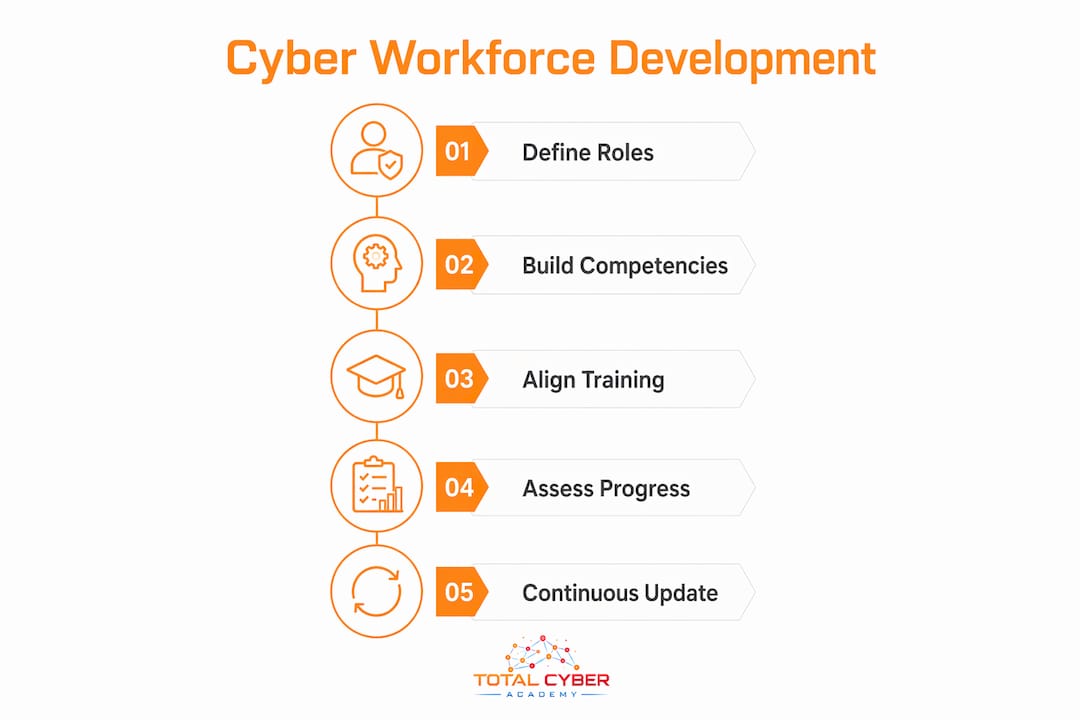
Effective implementation requires a deliberate combination of learning formats, institutional partnerships, and curriculum that tracks the actual job market. No single delivery method covers all learner needs or all role types.
A practical implementation model follows these steps:
- Conduct a skills gap analysis. Identify which roles are unfilled, which competencies are missing, and which NICE work role categories are underrepresented in your current workforce or applicant pool.
- Design a blended learning curriculum. Combine asynchronous content for foundational knowledge with live, hands-on labs for applied skills. Asynchronous modules let learners move at their own pace; labs create the pressure and realism that build true readiness.
- Build apprenticeship and progressive pathways. Paid apprenticeships give career changers and new entrants a way to earn while they learn, reducing the financial barrier that keeps many qualified candidates out of the field. Programs structured around career changer pathways show that non-traditional entrants can reach job-ready status faster than conventional degree programs suggest.
- Establish industry partnerships and consortiums. Employers who co-design curriculum with training providers get graduates who match their actual job requirements. Consortiums spread the cost of curriculum development and create shared hiring pipelines.
- Align curriculum to current job postings. Review active job postings quarterly and update learning objectives to match. Cybersecurity roles evolve faster than most academic catalogs, so static curricula quickly fall behind.
Workforce development requires ongoing alignment with evolving roles and technologies, not just a one-time training event. Organizations that treat program design as a living process rather than a fixed product produce graduates who remain relevant as the threat environment shifts. Veteran-focused programs, like those highlighted in cybersecurity veteran initiatives, demonstrate that structured pathways with clear milestones dramatically improve completion rates and employment outcomes.
What challenges impact sustainable cyber workforce development?
The most persistent challenge is the poaching paradox. Organizations hesitate to invest in comprehensive training because they fear competitors will hire away newly skilled staff. That fear is rational, but it creates a collective action problem where no one trains enough people and the overall talent shortage worsens.
“The poaching paradox creates a situation where the organizations most capable of training talent are the least incentivized to do so. The solution is not to stop training. It is to build a retention culture strong enough that trained professionals choose to stay.”
Hiring requirements compound the problem. 84% of cybersecurity job postings require a bachelor’s degree, and 83% require at least three years of experience. Those thresholds eliminate large portions of otherwise capable candidates, including career changers, veterans, and self-taught practitioners. Skills-based hiring, which evaluates demonstrated competency rather than credentials, is the direct counter to this barrier.
Additional challenges that undermine sustainable development include:
- Organizational silos. Workforce development often sits inside IT or HR without connection to broader risk management or business strategy. That isolation limits funding and leadership support.
- Lack of leadership buy-in. When executives do not see workforce development as a security function, budget requests compete with other IT priorities rather than being treated as a defense investment.
- Retention gaps. Without clear career advancement pathways, trained professionals leave for roles that offer growth. Training without a career ladder produces churn, not stability.
- Accessibility barriers. High program costs and geographic concentration of training resources exclude candidates from underrepresented communities, narrowing the talent pool unnecessarily.
Addressing these challenges requires treating workforce development as an organizational priority, not a departmental task. Server security management frameworks and similar role-aligned standards show how structured competency definitions help organizations make the case for sustained investment.
How does workforce development strengthen cybersecurity resilience?
Workforce development is a strategic cybersecurity function, not a reactive HR exercise. Long-term investment in career pathways strengthens the entire cyber ecosystem by producing professionals who understand both technical operations and organizational risk. A team built through deliberate development responds to incidents faster and with greater precision than one assembled through emergency hiring.
Mentorship and community building are underrated components of resilience. Mentorship and community engagement build confidence and belonging, which are key drivers of long-term retention. A professional who feels connected to a community of practice is less likely to leave after the first difficult incident or competitive offer.
Cross-sector collaboration multiplies the effect of individual program investments. When government agencies, academic institutions, and private employers share curriculum standards, hiring criteria, and training infrastructure, the entire talent pipeline becomes more efficient. The NICE framework exists precisely to enable that kind of collaboration by giving all parties a common vocabulary.
Practical readiness directly affects incident response effectiveness. A practitioner who has worked through simulated ransomware scenarios in a cyber range responds differently to a live incident than one who has only read about the attack chain. Hands-on labs simulate real-world threats in ways that classroom instruction cannot replicate.
Key benefits of treating workforce development as a strategic priority:
- Faster incident detection and response from teams with practiced, scenario-based training
- Higher retention rates when career advancement pathways are clearly defined
- Stronger hiring pipelines through consistent curriculum aligned to NICE work roles
- Greater organizational resilience when workforce planning integrates with risk management
- Broader talent access when skills-based hiring replaces rigid degree requirements
Pro Tip: Tie workforce development metrics, such as time-to-hire, certification pass rates, and retention rates, directly to your organization’s security risk register. That connection makes the business case for sustained funding far more persuasive to leadership.
Key Takeaways
Cyber workforce development is the most direct mechanism organizations have for closing the cybersecurity talent gap, and it requires structured frameworks, hands-on training, and retention-focused career pathways to produce lasting results.
| Point | Details |
|---|---|
| NICE framework alignment | Map all training and hiring criteria to NICE TKS work roles for consistent communication between educators and employers. |
| Hands-on training is non-negotiable | Cyber ranges and simulation labs produce operationally ready professionals that classroom instruction alone cannot. |
| Skills-based hiring expands the pool | Removing degree and experience barriers opens access to career changers, veterans, and self-taught candidates. |
| Retention culture counters poaching | Clear career advancement pathways keep trained professionals in place and justify the investment in development. |
| Workforce development is a security function | Integrating talent strategy with risk management secures leadership buy-in and sustained funding. |
Why the workforce gap will not close without deliberate design
I have watched organizations cycle through the same pattern for years: a high-profile incident triggers an emergency hiring push, a few roles get filled at inflated salaries, and six months later the team is short-staffed again because no one built a pipeline. The gap does not close through reactive hiring. It closes through deliberate design.
The most important shift I have seen in effective programs is treating the curriculum as a living document. The threat environment changes faster than any fixed course catalog can track. Programs that review job postings quarterly, update lab scenarios to reflect current attack techniques, and build feedback loops with hiring managers consistently produce graduates who land roles and stay in them.
AI and automation are already reshaping which skills matter most. Threat detection is increasingly automated, which means the human value-add is now in interpretation, response, and adversarial thinking. Workforce development programs that still emphasize rote tool operation over analytical judgment are preparing people for jobs that will not exist in five years.
The organizations that get this right share one characteristic: they treat workforce development as a core security function with its own budget line, its own metrics, and its own seat at the leadership table. That is not a training department decision. It is a security strategy decision.
— Alden
Totalcyber’s training programs for cyber workforce readiness
Totalcyber is a veteran-owned cybersecurity training organization built specifically to address the workforce gap through expert-led instruction, hands-on labs, and industry-recognized certification preparation.
Every Totalcyber program aligns with current industry standards and is designed to produce job-ready professionals, not just certificate holders. Whether you are an educator building a curriculum, an employer developing internal talent, or an individual preparing for a career transition, Totalcyber’s cybersecurity training programs provide the practical depth the field demands. Explore the full course catalog to find programs matched to your workforce development goals, from foundational IT skills through advanced certification prep.
FAQ
What is cyber workforce development?
Cyber workforce development is the structured process of training, educating, and preparing individuals to fill cybersecurity roles that meet organizational and industry needs. It includes work role definition, competency-based training, certification preparation, and career pathway design.
Why does the NICE framework matter for workforce development?
The NICE framework standardizes Tasks, Knowledge, and Skills (TKS) statements across cybersecurity work roles, giving employers and educators a shared language for curriculum design and hiring. That alignment reduces mismatches between what training programs produce and what organizations actually need.
How do hands-on labs improve cybersecurity training outcomes?
Hands-on labs and cyber ranges simulate real-world threats, giving practitioners experience with actual attack scenarios before they face them in production environments. The Carnegie Mellon Software Engineering Institute identifies immersive simulation labs as essential for closing the gap between academic knowledge and operational readiness.
What is the poaching paradox in cybersecurity hiring?
The poaching paradox describes the reluctance of organizations to invest in training because they fear competitors will hire away newly skilled staff. The solution is building retention cultures with clear career advancement pathways that make staying more attractive than leaving.
How can organizations remove hiring barriers in cybersecurity?
Organizations remove hiring barriers by adopting skills-based hiring criteria instead of requiring bachelor’s degrees and years of experience. Research shows 84% of cybersecurity job postings require a degree and 83% require at least three years of experience, thresholds that exclude large numbers of qualified candidates including career changers and veterans.
Recommended
- What Is the Cybersecurity Skills Gap in 2026? – Total Cyber Academy!
- Cybersecurity Workforce Veteran Initiatives: 2026 Guide – Total Cyber Academy!
- Top 6 DSDT.com Alternatives for Cybersecurity Training 2026 – Total Cyber Academy!
- Cybersecurity Job Interview Preparation Guide 2026 – Total Cyber Academy!