
Self-paced cybersecurity training is an asynchronous online learning format that lets you advance your cybersecurity skills on your own schedule, without fixed class times or real-time instructor interaction. Unlike cohort-based programs that assign deadlines, self-paced training gives you full control over timing, speed, and the sequence of course content. This model suits beginners, career changers, and working professionals who need flexibility without sacrificing depth. Programs range from free introductory modules aligned with the NICE Framework to paid certification prep courses with hands-on labs, making entry into cybersecurity more accessible than ever.
What is self-paced cybersecurity training, and how does it work?
Self-paced cybersecurity training is defined as an asynchronous learning model where the learner, not an instructor or cohort schedule, controls the pace of study. You access pre-recorded videos, reading materials, quizzes, and labs whenever your schedule allows. There are no live sessions to attend and no penalties for pausing between modules.
A critical distinction separates self-paced learning from other asynchronous formats. All self-paced learning is asynchronous, but not all asynchronous learning is self-paced. A cohort-based online program with weekly deadlines is asynchronous but not self-paced. True self-paced training removes those external time constraints entirely.
The NICE Framework, published by the National Institute of Standards and Technology, organizes cybersecurity work into defined roles and skill categories. Many self-paced programs align their content to these categories, giving learners a structured path even without a live instructor. CISA Learning, operated through NICCS, offers 850 hours of training covering beginner to advanced topics at no cost, accessible on multiple devices. That volume of free content signals just how accessible entry-level cybersecurity education has become.

What are the key benefits of self-paced cybersecurity training?
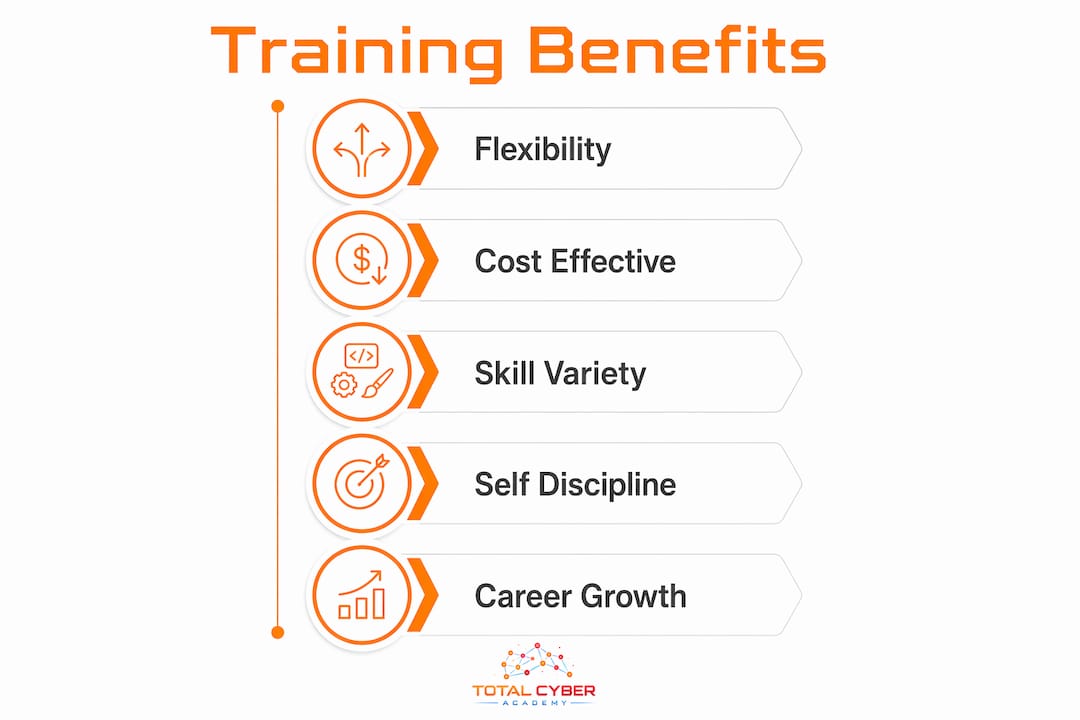
Flexible cybersecurity training programs offer advantages that fixed-schedule courses cannot replicate. The most significant benefit is control. You decide when to study, how long to spend on each topic, and whether to revisit a concept before moving forward.
The core benefits include:
- Schedule flexibility. You study at 6:00 AM before work or 10:00 PM after the kids are in bed. No class conflicts, no commute.
- Reduced burnout. Self-paced progression reduces burnout for working professionals by allowing them to pause, revisit, or accelerate content based on their current workload.
- Deeper knowledge retention. Educational research confirms that active engagement with material, rather than passive watching, improves long-term retention. Self-paced formats support this by letting you replay difficult sections.
- Cost flexibility. Programs range from free to paid, with free courses testing your interest effectively and paid programs providing hands-on labs that mimic enterprise tools.
- Accessibility for diverse skill levels. Whether you are a complete beginner or an IT professional adding a security specialty, self-driven cybersecurity courses can be calibrated to your existing knowledge.
Pro Tip: Before enrolling in any paid program, complete a free introductory course first. CISA Learning offers no-cost modules that help you confirm cybersecurity is the right direction before you invest money in certification prep.
Self-paced formats also support learners with different learning styles. Visual learners benefit from video demonstrations. Analytical learners can pause and read supplementary documentation. Hands-on learners get the most from lab environments that let them practice configurations in real time.
How does self-paced training compare with other learning formats?
Understanding the differences between learning formats helps you choose the right one for your goals and situation.
| Format | Schedule | Accountability | Interactivity | Best for |
|---|---|---|---|---|
| Self-paced online | Fully flexible | Self-directed | Pre-recorded labs and quizzes | Working professionals, beginners |
| Cohort-based asynchronous | Flexible within deadlines | Peer and instructor deadlines | Discussion boards, group projects | Learners who need structure |
| Live instructor-led (virtual or in-person) | Fixed schedule | High, real-time feedback | Direct Q&A, live demos | Learners who prefer guided instruction |
| Intensive bootcamp | Compressed, fixed | Very high | Immersive, team-based | Career changers with full-time availability |
Self-paced training wins on flexibility and cost but requires strong self-discipline. Cohort-based programs add accountability through deadlines and peer interaction, which helps learners who struggle to stay consistent on their own. Live instructor-led formats provide immediate feedback and real-time troubleshooting, which is valuable when working through complex technical concepts.
The tradeoff is real. Self-paced learners report higher abandonment rates, often when they hit unexplained errors in course materials and have no instructor to ask. Abandonment frequently occurs at exactly these friction points. Knowing this risk in advance lets you prepare a strategy, such as joining a community forum, before you hit that wall.
Choose self-paced training when your schedule is unpredictable, your budget is limited, or you are testing a new career direction. Choose a bootcamp or live format when you have a firm start date for a new job and need to build skills fast under structured pressure.
What should learners expect during self-paced cybersecurity training?
A typical self-paced cybersecurity course delivers content through a combination of formats. Knowing what to expect helps you engage more effectively from day one.
- Video lectures. Instructors explain concepts, demonstrate tools, and walk through scenarios. These form the backbone of most courses.
- Reading materials and documentation. Supplementary guides, vendor documentation, and framework references deepen understanding beyond the video content.
- Quizzes and knowledge checks. Short assessments after each module confirm comprehension before you advance.
- Hands-on labs. Paid programs typically include virtual lab environments where you configure firewalls, analyze logs, or simulate incident response. A Coursera introductory cybersecurity course, for example, culminates in configuring security settings in a Windows Server environment.
- Final projects or assessments. Capstone projects produce artifacts, such as incident response writeups or lab screenshots, that demonstrate real capability to employers.
The most common mistake is passive consumption. Watching videos without practicing the skills creates a false sense of progress. Experts recommend a 90–180 day learning roadmap focused on building practical artifacts rather than accumulating completion certificates. That roadmap keeps you moving toward job readiness, not just course completion.
Pro Tip: Treat practice exams as a readiness signal, not a primary study method. Memorizing exam questions does not guarantee the ability to perform technical tasks in real settings. Use exams to confirm you are ready, then validate that readiness through hands-on lab work.
Another common pitfall is “tutorial hell,” the cycle of starting new courses without finishing or applying any of them. The fix is committing to one structured path, completing it, and producing tangible work before moving to the next topic.
How can beginners and career changers advance through self-paced training?
Completing a self-paced course is a starting point, not a finish line. Pairing self-paced study with practical projects and certifications improves employability significantly. Employers want evidence of capability, and a certificate of completion rarely provides that on its own.
Strategies that produce results include:
- Align your study path with a recognized certification. CompTIA Security+, CompTIA Network+, and ISC2 CC are common entry points. Each maps to specific skills that employers recognize and value.
- Build a cybersecurity portfolio. Document your lab work, write up simulated incident responses, and publish your findings. A cybersecurity portfolio demonstrates practical skill in a way that no certificate can replicate.
- Set a non-negotiable study schedule. Treat your study block the same way you treat a work meeting. Self-paced training lacks built-in accountability, so you must create your own.
- Engage with community forums and peer groups. Online communities provide accountability, answers to technical questions, and motivation when progress feels slow. Community engagement is critical for overcoming the lack of live instructor support.
- Use a career roadmap. Career changers benefit from a structured plan that sequences skills, certifications, and portfolio milestones. A 2026 career changer roadmap can clarify which steps to take and in what order.
The cybersecurity field has a well-documented skills gap, which means employers are actively looking for qualified candidates. Self-paced training, combined with certifications and demonstrated projects, positions you as a credible candidate even without a traditional computer science degree.
Key Takeaways
Self-paced cybersecurity training delivers real career value only when learners combine flexible online study with hands-on practice, recognized certifications, and a structured portfolio-building plan.
| Point | Details |
|---|---|
| Definition matters | Self-paced training is fully asynchronous with no fixed deadlines, unlike cohort-based programs. |
| Free options exist | CISA Learning provides 850 hours of no-cost training aligned to the NICE Framework. |
| Passive learning fails | A 90–180 day roadmap focused on practical artifacts outperforms passive video consumption. |
| Certifications amplify results | Pairing self-paced study with CompTIA Security+ or ISC2 CC improves employer recognition. |
| Community prevents dropout | Engaging with peer forums reduces abandonment when course materials become difficult. |
Why self-paced training rewards the disciplined, not just the flexible
Self-paced cybersecurity training gets marketed as the easy path. It is not. The flexibility that makes it accessible also makes it easy to stall. I have seen learners collect five course certificates without ever configuring a firewall or writing a single incident report. That is not preparation for a cybersecurity career. That is expensive procrastination.
The learners who succeed treat self-paced training as a framework, not a destination. They pick one certification target, map their coursework to it, and build something tangible every week. They join Discord servers, Reddit communities, or local cybersecurity groups to stay accountable. They treat unexplained errors in lab environments as learning opportunities, not reasons to quit.
The other thing worth saying directly: timeline expectations matter. A 90–180 day roadmap is realistic for reaching entry-level readiness, but only if you study consistently. Expecting to be job-ready in three weeks sets you up for frustration. Expecting to be job-ready in six months with daily practice sets you up for success.
Totalcyber was built specifically for people in this position, beginners and career changers who need structured guidance without a rigid schedule. The combination of expert instruction, hands-on labs, and certification prep gives self-paced learners the structure they need to actually finish and get hired.
— Alden
Totalcyber’s self-paced training programs for career changers
Totalcyber offers a full range of self-paced cybersecurity courses designed for beginners and career changers who need flexibility without sacrificing quality. Programs include hands-on labs, expert instruction, and preparation for industry-recognized certifications like CompTIA Security+ and ISC2 CC.
Whether you are starting from zero or transitioning from another field, Totalcyber’s career-focused curriculum maps directly to employer expectations. The beginner’s career guide is a strong first step for anyone who wants to understand which path fits their goals before committing to a full program. Veteran-owned and mission-driven, Totalcyber prepares you not just to pass exams, but to perform on the job.
FAQ
What is self-paced cybersecurity training?
Self-paced cybersecurity training is an asynchronous online learning format where learners control the timing, speed, and sequence of study with no fixed class schedule or live instructor interaction.
Is self-paced training enough to get a cybersecurity job?
Self-paced courses alone are rarely sufficient. Pairing coursework with hands-on projects, a cybersecurity portfolio, and a recognized certification like CompTIA Security+ significantly improves employability.
How long does self-paced cybersecurity training take?
A realistic timeline for reaching entry-level job readiness is 90–180 days, based on consistent daily study and active portfolio building rather than passive video consumption.
Are there free self-paced cybersecurity courses?
CISA Learning through NICCS offers 850 hours of free, no-cost cybersecurity training covering beginner to advanced topics, aligned with the NICE Framework and accessible on multiple devices.
What certifications work well with self-paced study?
CompTIA Security+, CompTIA Network+, and ISC2 CC are the most recognized entry-level certifications and align well with self-paced study paths designed for beginners and career changers.