
GI Bill cybersecurity training programs give eligible veterans and active military members funded access to accredited cybersecurity education, certification prep, and bootcamps approved by the VA. The Post-9/11 GI Bill covers tuition, housing allowances, and book stipends, while the VA reimburses up to $2,000 per certification exam for approved credentials like CompTIA Security+ and CISSP. Federal and private sector demand for cybersecurity professionals continues to grow, making this one of the most direct paths from military service to a stable, high-paying IT career. Knowing how to use these benefits strategically is the difference between a good outcome and a great one.
What types of GI Bill cybersecurity training programs are available?
GI Bill benefits cover a wider range of educational formats than most veterans realize. Approved options include accredited degree programs, intensive bootcamps, certification prep courses, and standalone certification exams. Each format serves a different career goal and timeline.
Here are the main program types available to veterans:
- Accredited degree programs. Four-year and two-year programs in cybersecurity, information assurance, or computer science at VA-approved colleges and universities. These qualify for full tuition coverage and the Basic Allowance for Housing (BAH) under the Post-9/11 GI Bill.
- Coding and cybersecurity bootcamps. Shorter, intensive programs approved under the standard GI Bill or the newer VET TEC 2.0 program. These typically run weeks to months rather than years.
- Certification prep courses. Standalone prep courses for credentials like CompTIA Security+, CISSP, or Certified Ethical Hacker (CEH). The VA reimburses the cost of both the prep course and the exam itself.
- Standalone certification exams. Veterans can submit for direct exam fee reimbursement without enrolling in a full course, preserving entitlement months for other training.
- Free supplemental content. CISA provides over 850 hours of free cybersecurity training for veterans. Using this content alongside GI Bill-funded exams stretches your entitlement significantly.
The critical step before enrolling in any program is verification. The VA GI Bill Comparison Tool is the definitive source to confirm whether a program is approved for benefits use. Enrolling in a non-approved program means losing entitlement with no reimbursement.
Pro Tip: Search the VA GI Bill Comparison Tool before you contact any school or bootcamp. Approval status can change, and confirming it yourself takes less than five minutes.

How to maximize your GI Bill benefits for cybersecurity education
Strategic benefit use separates veterans who exhaust their entitlement on one program from those who earn multiple credentials. The VA’s entitlement structure rewards careful planning.
Follow these steps to get the most from your benefits:
- Audit your remaining entitlement. Log into VA.gov to check your Post-9/11 GI Bill or Chapter 35 balance. Know exactly how many months you have left before committing to any program.
- Prioritize certification exams over long bootcamps. The VA charges entitlement proportionally to the actual cost of an exam or prep course, not a flat monthly rate. A $400 Security+ exam uses a fraction of the entitlement that a $15,000 bootcamp consumes.
- Explore VET TEC 2.0. This program charges 1 month of entitlement for every 1 month of full-time training. It is designed specifically for high-tech training programs and often covers cybersecurity bootcamps that standard GI Bill does not.
- Layer free federal training. CISA’s free content library gives veterans access to 850+ hours of cybersecurity instruction at no cost. Use it to build foundational knowledge, then spend GI Bill funds on the certification exams themselves.
- Submit VA Form 22-0803 for exam reimbursement. This form covers licensing and certification test fees. File it promptly after passing an approved exam to receive reimbursement up to $2,000 per test.
- Verify approval status every enrollment cycle. Program approval can be revoked. Always recheck the VA GI Bill Comparison Tool before each new enrollment period.
Pro Tip: Many certification vendors offer veteran discounts on exam vouchers. CompTIA, for example, has worked with veteran organizations on reduced pricing. Combine a discounted voucher with VA reimbursement and your net cost approaches zero.
What certifications should veterans pursue with GI Bill benefits?
Certifications deliver faster, more direct hiring results than degrees for most cybersecurity roles, particularly in defense and cleared contractor positions. Veterans get the best career ROI by focusing GI Bill funds on credentials that map directly to employer requirements.
The most career-relevant certifications for veterans include:
- CompTIA A+, Network+, and Security+. Known as the CompTIA Trifecta, these three certifications align with DoD 8570 IAT Level II requirements. That alignment makes them a prerequisite for most cleared IT roles in the federal government and defense contracting sector.
- CISSP (Certified Information Systems Security Professional). The CISSP is the gold standard for senior security roles. Totalcyber’s partnership with (ISC)² gives veterans access to structured prep aligned with this credential.
- CEH (Certified Ethical Hacker). Valued in penetration testing and red team roles, the CEH is reimbursable under the VA’s licensing and certification program.
- GIAC certifications. The GIAC series, including GSEC and GPEN, covers specialized technical domains and carries strong recognition in federal cybersecurity hiring.
- Cloud certifications. AWS Certified Security Specialty and Microsoft Azure Security Engineer Associate are increasingly required as federal agencies migrate infrastructure to cloud environments.
| Certification | DoD 8570 Alignment | Typical Role |
|---|---|---|
| CompTIA Security+ | IAT Level II | Security analyst, IT admin |
| CISSP | IAM Level III | Security manager, CISO |
| CEH | CEPT | Penetration tester |
| GIAC GSEC | IAT Level II | Security operations |
| AWS Security Specialty | Not mapped directly | Cloud security engineer |
Training aligned with the NICE Framework ensures the skills you build match what federal and private employers actually need. When evaluating any program, confirm it references NICE Framework work roles as part of its curriculum design.
How to plan your GI Bill cybersecurity training path
A clear sequence prevents wasted entitlement and keeps your career timeline on track. Veterans who plan their training path before enrolling consistently reach employment faster than those who enroll reactively.
Step 1: Confirm your benefit eligibility. Determine whether you qualify for Post-9/11 GI Bill (Chapter 33), Chapter 35, or VET TEC 2.0. Each has different entitlement structures and approved program lists.
Step 2: Verify program approval. Use the VA GI Bill Comparison Tool to confirm every program, course, and exam you plan to pursue. This step is non-negotiable.
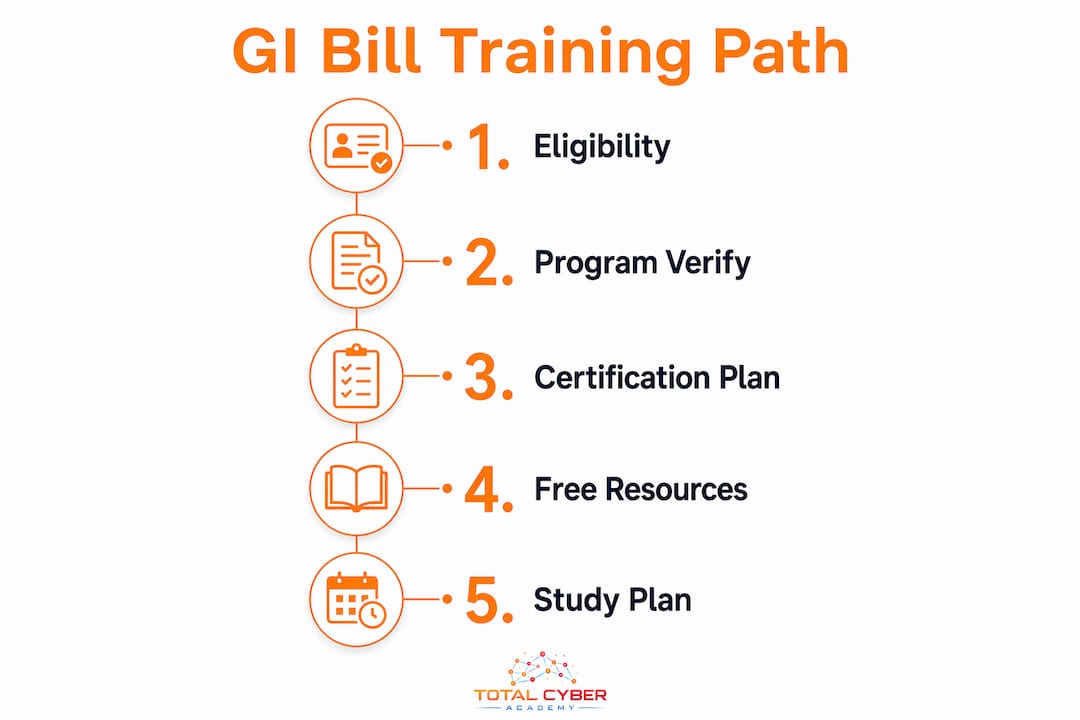
Step 3: Sequence your certifications strategically. Start with CompTIA A+ and Network+ if you need foundational IT knowledge. Move to Security+ next, as it satisfies DoD 8570 IAT Level II and opens the most entry-level cleared roles. Build toward CISSP or GIAC credentials as your experience grows.
Step 4: Use free resources to fill gaps. Access CISA’s free training catalog through NICCS to cover domains where your knowledge is thin. Reserve GI Bill funds for the certification exams and any paid prep courses that add clear value.
Step 5: Submit reimbursement paperwork promptly. File VA Form 22-0803 after each exam. Delays in filing can complicate reimbursement processing.
Additional resources worth knowing:
- Scholarships. Organizations like the National Cybersecurity Alliance and SANS Institute offer veteran-specific scholarships that can supplement GI Bill funding.
- Employer support programs. Many defense contractors and federal agencies offer tuition assistance or exam fee coverage for cleared employees, which can stack with VA benefits in some cases.
- Veteran service organizations. Your VSO can help you navigate VA paperwork and identify additional funding sources you may not know about.
Pro Tip: Build your IT certification study plan before you enroll in anything. Knowing your end goal, whether that is a cleared analyst role or a cloud security position, determines which certifications to prioritize and in what order.
Key Takeaways
Veterans who use GI Bill benefits for targeted cybersecurity certifications aligned with DoD 8570 and the NICE Framework reach employment faster and preserve more entitlement than those who default to long degree programs.
| Point | Details |
|---|---|
| Certification exam reimbursement | The VA reimburses up to $2,000 per approved exam, making individual certs cost-effective. |
| VET TEC 2.0 entitlement ratio | VET TEC 2.0 charges 1 month of entitlement per month of full-time training for tech programs. |
| Free training supplements | CISA offers 850+ hours of free content veterans can use to reduce paid training costs. |
| DoD 8570 alignment | CompTIA Security+ satisfies IAT Level II, the baseline requirement for most cleared IT roles. |
| Verify before enrolling | Always confirm program approval via the VA GI Bill Comparison Tool to protect your entitlement. |
Why certifications beat degrees for most veterans entering cybersecurity
Veterans transitioning into cybersecurity often ask whether they should pursue a degree or go straight to certifications. My honest answer, based on years of working with this community, is that certifications win for most people in most situations.
A four-year degree consumes the majority of your GI Bill entitlement in one program. A well-sequenced certification path, starting with the CompTIA Trifecta and building toward CISSP or a GIAC credential, can be completed in a fraction of the time and cost. More importantly, DoD 8570 compliance is a hard requirement for cleared roles. A degree does not satisfy it. CompTIA Security+ does.
The veterans I have seen struggle most are those who enrolled in a bootcamp or degree program without verifying VA approval first. Losing months of entitlement to a non-approved program is a painful and entirely avoidable mistake. The VA GI Bill Comparison Tool takes five minutes to use. That five minutes protects years of earned benefits.
One more thing: GI Bill funding is a starting point, not a finish line. Cybersecurity demands continuous learning in IT long after your initial credentials are earned. The field moves fast. Plan to keep studying even after your entitlement is spent.
— Alden
Totalcyber’s cybersecurity training for GI Bill beneficiaries
Totalcyber is a veteran-owned cybersecurity training organization built specifically for people making the transition from military service to IT careers. Its programs focus on hands-on labs, expert instruction, and certification prep that aligns with DoD 8570 and NICE Framework requirements.
Veterans using GI Bill benefits can access Totalcyber’s cybersecurity training courses covering CompTIA certifications, security fundamentals, and career-focused labs. The academy also provides resources on accessing CompTIA course materials and exam preparation strategies designed for veterans who need efficient, structured study paths. If you are ready to put your GI Bill benefits to work in a program built with your background in mind, Totalcyber is the place to start.
FAQ
What does the GI Bill cover for cybersecurity training?
The GI Bill covers tuition, housing allowances, and book stipends for VA-approved cybersecurity degree programs, bootcamps, and certification prep courses. The VA also reimburses up to $2,000 per approved certification exam under the licensing and certification reimbursement program.
Is VET TEC 2.0 different from the standard GI Bill?
VET TEC 2.0 is a separate VA program designed for high-tech training. It charges 1 month of GI Bill entitlement for every 1 month of full-time training and covers many cybersecurity bootcamps that the standard GI Bill does not approve.
Which cybersecurity certifications give veterans the best hiring advantage?
CompTIA Security+ is the most direct path to cleared IT roles because it satisfies DoD 8570 IAT Level II requirements. CISSP and GIAC certifications open senior and specialized positions in both federal agencies and private sector security teams.
How do I verify that a cybersecurity program is GI Bill approved?
Use the VA GI Bill Comparison Tool at VA.gov to confirm approval status before enrolling. Program approval can change, so verify at every enrollment cycle, not just once.
Can veterans use free training alongside GI Bill benefits?
Yes. CISA offers over 850 hours of free cybersecurity training through NICCS that veterans can use at no cost. Combining free content with GI Bill-funded certification exams is one of the most effective ways to preserve entitlement while building skills.