
The SkillBridge program is a Department of Defense initiative that allows active-duty service members to participate in civilian internships, apprenticeships, or industry training during their final 180 days of service while continuing to receive full military pay and benefits. Authorized under 10 U.S.C. § 1143(e), the program connects transitioning personnel with over 6,300 approved civilian organizations. Approximately 25,000 service members participate annually, making it one of the most widely used military transition tools available. If you are approaching separation and want to enter the civilian workforce with real experience already on your record, SkillBridge is the most direct path available to you.
What is the SkillBridge program and who runs it?
The SkillBridge program is administered by the Department of Defense and implemented through service branch policies. It replaces your normal military duties with full-time civilian work experience during the final phase of your service. You keep your military paycheck, your Basic Allowance for Housing (BAH), your Basic Allowance for Subsistence (BAS), and your medical coverage throughout the entire period.
The program exists because the military-to-civilian transition gap is real and well documented. Veterans often have strong technical and leadership skills but lack the civilian credentials and work history that employers use to screen candidates. SkillBridge closes that gap by giving you a paid runway to prove yourself in a civilian role before your separation date arrives.

Host organizations hold active Memoranda of Understanding (MOU) with the DoD. You cannot participate with employers who lack that agreement, and MOU approval can take months. Checking an employer’s MOU status early is not optional. It is the first step in any serious SkillBridge plan.
Who qualifies for SkillBridge?
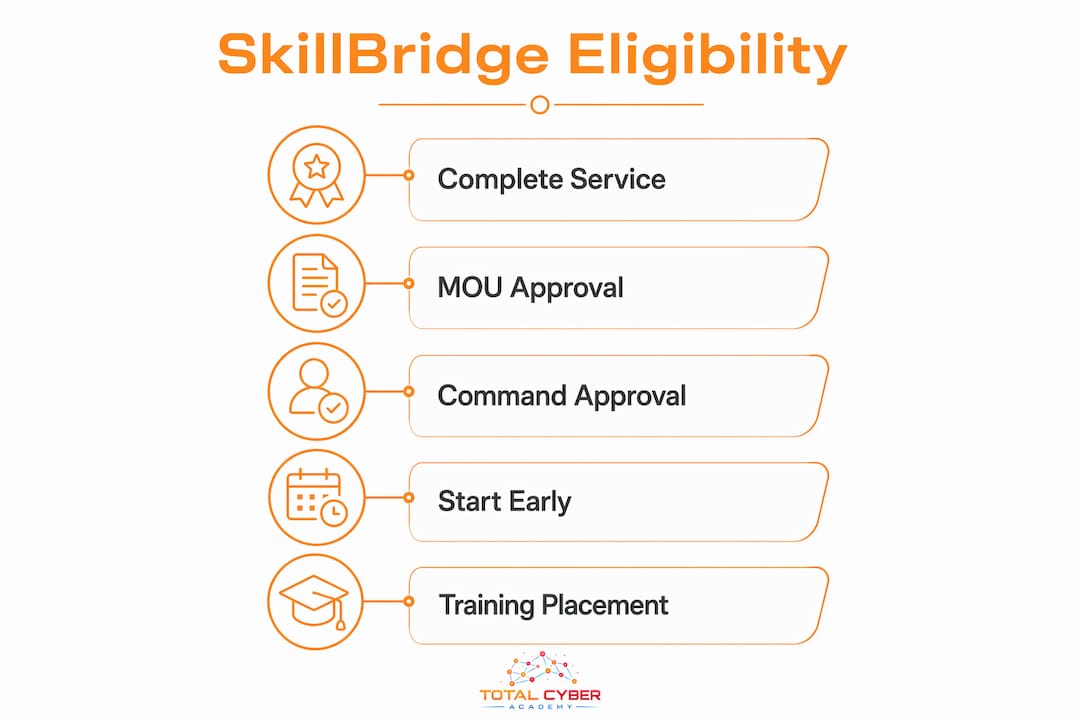
Eligibility for the SkillBridge program requires meeting three core conditions. First, you must have completed at least 180 continuous days of active duty. Second, your separation date must fall within 180 days of your planned start date. Third, and most critically, your commanding officer must approve your participation.
Commander approval is the primary gating factor for enrollment. Mission requirements come first, and no policy guarantees approval regardless of your qualifications or timeline. Each military branch also administers the program under its own regulations. The Army follows AR 600-81, while the Navy operates under NAVADMIN 064/23. Requirements and approval processes vary by branch and unit, so confirming your local unit’s policies is mandatory before you invest time in applications.
The application process follows these steps:
- Identify an approved employer. Search the DoD SkillBridge directory at skillbridge.osd.mil and confirm the employer holds an active MOU.
- Develop a training plan. Work with the host organization to define specific learning objectives, a schedule, and measurable outcomes.
- Submit for command approval. Present your training plan to your chain of command. Include your separation date, the internship location, and the duration.
- Receive official orders. Once approved, your unit issues orders placing you in permissive Temporary Duty (TDY) status for the internship period.
- Begin participation. Report to the host organization and treat day one as your first day in a civilian career.
Pro Tip: Start the process at least nine months before your separation date. MOU verification, command approval, and travel planning all take longer than most service members expect.
How does SkillBridge work during your final months of service?
SkillBridge replaces your military duties with civilian training. You report to a host organization instead of your unit, but your pay and benefits continue without interruption. The program covers four opportunity types: internships, apprenticeships, employment skills training, and job shadowing. Each type has specific duration and accreditation criteria set by the DoD.
Federal law prohibits dual compensation. Host organizations cannot pay you a salary or wages during the internship. Your military pay is your only income during this period. This rule protects the integrity of the program and prevents legal complications for both you and the employer.
Participation typically occurs under permissive TDY status. The DoD does not reimburse travel or lodging costs in most cases. Some corporate partners offer housing stipends, but that is not standard. You need to budget for relocation and daily expenses independently.
The table below summarizes the four program types and their primary characteristics:
| Opportunity Type | Primary Focus | Typical Duration |
|---|---|---|
| Internship | Role-specific civilian work experience | 30–180 days |
| Apprenticeship | Trade or technical skill development | 90–180 days |
| Employment skills training | Certification or structured coursework | 30–120 days |
| Job shadowing | Career exploration and observation | Short term, varies |
Pro Tip: If your internship location differs from your duty station, calculate your actual living costs against your BAH rate before accepting. BAH stays tied to your official duty station, not where you intern.
What are the real benefits of SkillBridge for veterans?
SkillBridge lets you test-drive a civilian career under real conditions while the military still covers your financial obligations. That combination is rare. Most career changers take on financial risk when switching fields. SkillBridge removes that risk entirely during the transition window.
The concrete benefits include:
- Civilian work experience on your resume. You enter the job market with documented, verifiable experience in a civilian role, not just a military job description translated into civilian language.
- Professional references. Supervisors and colleagues at your host organization become references who can speak to your performance in a civilian context.
- Network access. You build relationships inside an industry before you separate, giving you contacts who can refer you to open positions.
- Career field validation. You confirm whether a career path fits you before committing to it permanently. Discovering a poor fit during SkillBridge costs you nothing. Discovering it after separation costs you months.
- Potential job offer. Many host organizations use SkillBridge as an extended interview. Strong performance frequently leads to a full-time offer, though no offer is guaranteed.
SkillBridge helps close the experience gap for transitioning members and lets veterans test civilian careers under real conditions. That practical exposure is valued by industry employers who recognize the discipline and reliability veterans bring to the workplace.
The cybersecurity skills gap in 2026 makes fields like IT and cybersecurity especially receptive to SkillBridge participants. Employers in those sectors actively seek candidates with structured training backgrounds, and veterans fit that profile well.
Common misconceptions veterans should know before applying
SkillBridge is a training and education program. It is not a job placement agency, and it does not guarantee employment. The program is a professional trial period where demonstrating competence is what drives hiring outcomes. Veterans who treat it as a formality rather than an audition consistently report worse results.
Several other misconceptions cause real problems:
- “My commander has to approve me.” Approval is mission dependent. Your commander can deny the request if your unit cannot absorb your absence. Applying early and maintaining a strong service record improves your odds.
- “I’ll get paid by the company too.” Federal law prohibits this. Your military pay is your only compensation. Any employer offering additional pay is violating the MOU terms.
- “My BAH will cover my new city.” BAH stays tied to your official duty station. If you intern in a city with a higher cost of living, you cover the difference yourself.
- “Any employer will work.” Only employers with active DoD MOUs qualify. An employer you find independently must complete the MOU process before you can participate, which takes time.
- “I can start whenever I want.” Scheduling requires command approval, valid orders, and coordination with the host organization. Last-minute requests rarely succeed.
Pro Tip: Treat your SkillBridge internship as a 90-day job interview. Arrive early, communicate proactively, and ask for feedback at the 30-day mark. Employers remember the candidates who behaved like employees from day one.
How to maximize your SkillBridge experience and land a job
Preparation separates veterans who receive job offers from those who do not. The program provides access. What you do with that access determines the outcome.
Follow these steps to get the most from your participation:
- Start nine months out. Research approved employers, confirm MOU status, and begin conversations with host organizations well before you need command approval.
- Align the internship with your career goal. Choose an opportunity in the field you intend to enter. A SkillBridge internship in the wrong industry delays your transition rather than accelerating it.
- Write a specific training plan. Vague plans get rejected or produce weak results. Define what skills you will develop, what projects you will complete, and how success will be measured.
- Build your professional profile before you start. Update your LinkedIn profile, translate your military experience into civilian language, and connect with your host organization’s team before day one. Totalcyber’s LinkedIn readiness guide covers this translation process in detail.
- Network deliberately. Attend company meetings, introduce yourself to colleagues outside your immediate team, and ask for informational conversations with people in roles you want.
- Seek mentorship. Identify one senior person at the host organization who is willing to give you honest feedback. That relationship often matters more than the internship title itself.
- Prepare a backup plan. Not every internship leads to a job offer. Have two or three other target employers identified before your separation date arrives.
Understanding veteran career initiatives in 2026 gives you additional context on which industries are actively recruiting transitioning service members and what certifications carry the most weight.
Key Takeaways
SkillBridge is the most financially protected way for active-duty service members to gain civilian work experience, but commander approval, MOU verification, and early planning determine whether you can access it at all.
| Point | Details |
|---|---|
| Program definition | SkillBridge provides civilian internships during your last 180 days with full military pay and benefits. |
| Eligibility requirement | You need 180 days of active duty completed, a validated separation date, and commander approval. |
| No dual compensation | Host organizations cannot pay you; federal law prohibits salary from employers during participation. |
| BAH stays at duty station | Your housing allowance reflects your official station, not your internship location. |
| Not a job guarantee | SkillBridge is a training period; professional performance drives hiring outcomes, not program enrollment. |
SkillBridge is a runway, not a landing strip
I have spoken with dozens of veterans who entered SkillBridge expecting a job offer to materialize automatically. Most of them were disappointed. The ones who succeeded treated the program as a paid audition and showed up with the same intensity they brought to their military duties.
The program’s real value is not the internship itself. It is the combination of financial security, real-world exposure, and professional credibility you build during those 180 days. You get to fail forward without losing your paycheck. That is genuinely rare in any career transition, military or civilian.
What I find most underused is the networking component. Veterans tend to focus on the technical work and ignore the relationship-building that actually drives hiring decisions. The colleague who vouches for you in a hiring meeting carries more weight than any resume line. Use every week of your SkillBridge internship to build those relationships deliberately.
One more thing: do not skip the backup plan. SkillBridge is not a guarantee, and the job market does not pause for your separation date. Know your next three moves before you walk out of your final formation.
— Alden
Totalcyber supports veterans through SkillBridge and beyond
Totalcyber is a veteran-owned cybersecurity training organization built specifically for people making the military-to-civilian transition. If your SkillBridge internship is in IT or cybersecurity, the right certification can be the difference between a job offer and a callback that never comes. Totalcyber offers hands-on labs, expert instruction, and preparation for industry-recognized credentials including CompTIA and EC-Council certifications. Veterans who pair SkillBridge experience with structured certification training enter the civilian workforce with both practical experience and verified credentials. Explore the full catalog of cybersecurity and IT courses at Totalcyber and find the program that fits your transition timeline.
FAQ
What is the SkillBridge program in simple terms?
SkillBridge is a DoD program that lets active-duty service members work at civilian companies during their last 180 days of service while still receiving full military pay and benefits.
Is SkillBridge only for certain military branches?
All branches of the U.S. military participate, but each branch administers the program under its own policies. The Army follows AR 600-81 and the Navy uses NAVADMIN 064/23, so requirements vary by branch and unit.
Can a SkillBridge host company pay me a salary?
No. Federal law prohibits dual compensation, meaning host organizations cannot pay participants a salary or wages during the internship period.
Does SkillBridge guarantee a job after separation?
SkillBridge does not guarantee employment. The program is a training period, and hiring decisions depend on your performance, the employer’s needs, and the professional relationships you build during participation.
How early should I start the SkillBridge application process?
Start at least nine months before your separation date. MOU verification, command approval, and logistical planning each take significant time, and last-minute applications rarely succeed.
Recommended
- Cybersecurity Workforce Veteran Initiatives: 2026 Guide – Total Cyber Academy!
- Skillbridge – Total Cyber Academy!
- What Is the Cybersecurity Skills Gap in 2026? – Total Cyber Academy!
- Cybersecurity Portfolio Building Step by Step – Total Cyber Academy!