
Practical cybersecurity experience is defined as hands-on, applied engagement with real security tools, live environments, and realistic threat scenarios that build job-ready competency. Unlike classroom theory alone, this applied cybersecurity practice develops the muscle memory analysts need to triage alerts, hunt threats, and respond to incidents under pressure. Frameworks like MITRE ATT&CK and industry bodies like (ISC)² recognize that employers consistently prioritize candidates who demonstrate real-world cybersecurity experience over those with credentials alone. Whether you are an entry-level job seeker, a career changer, or a veteran transitioning into tech, understanding what this experience looks like and how to build it is the first step toward a credible cybersecurity career.
What is practical cybersecurity experience?
Practical cybersecurity experience is the direct application of security knowledge to real or simulated environments using professional-grade tools and structured workflows. The industry term for this is “applied cybersecurity,” and it covers everything from configuring a SIEM to running a full incident response exercise. Theoretical knowledge tells you what a SQL injection attack is. Applied cybersecurity experience teaches you how to detect one in a live log stream, contain it, and write the post-incident report.
Three core competencies define this type of experience. First, you must work with actual tools, not just read about them. Second, you must operate within structured workflows that mirror how security operations centers (SOCs) function. Third, you must document your findings in a format that communicates professional judgment. Totalcyber’s training model is built around all three of these pillars, connecting learners to lab environments that replicate the conditions they will face on the job.

The urgency here is real. Hiring managers screen resumes for evidence of hands-on cybersecurity skills because theoretical knowledge does not transfer automatically to fast-moving threat situations. A candidate who has triaged 50 simulated alerts in a lab environment makes faster decisions on day one than a candidate who has only read about alert triage. That speed directly affects an organization’s ability to contain a breach.
What tools and environments build real cybersecurity skills?
The tools that define practical cybersecurity experience fall into four major categories: SIEM platforms, network monitoring tools, threat intelligence platforms, and incident response frameworks. Each category develops a distinct set of cybersecurity job competencies.
| Tool Category | Example Tools | Core Skill Developed |
|---|---|---|
| SIEM and log management | OpenSearch, Splunk (free tier) | Alert triage, log correlation |
| Network monitoring | Zeek, Suricata | Packet analysis, intrusion detection |
| Threat intelligence | MISP | Indicator management, threat context |
| Adversary emulation | MITRE ATT&CK-mapped tools | Attack simulation, detection validation |
Modern SOC labs can be deployed quickly and include 12 or more integrated tools for end-to-end security operations training. That density of tooling in a single environment means learners practice realistic workflows rather than isolated skills. A Docker Compose setup, for example, can spin up OpenSearch, Zeek, Suricata, and MISP together, simulating a production SOC in a home lab.
Typical activities in these environments include:
- Alert triage: Reviewing and prioritizing security alerts by severity and context
- Threat hunting: Proactively searching logs and network data for indicators of compromise
- Incident response exercises: Following structured playbooks to contain and remediate simulated attacks
- Adversary emulation: Mapping attack behaviors to MITRE ATT&CK techniques to validate detection coverage
Pro Tip: When you set up a lab environment, run it continuously for at least two weeks rather than in isolated sessions. Sustained exposure to log noise trains your pattern recognition far faster than short bursts.
How to build practical cybersecurity skills from scratch
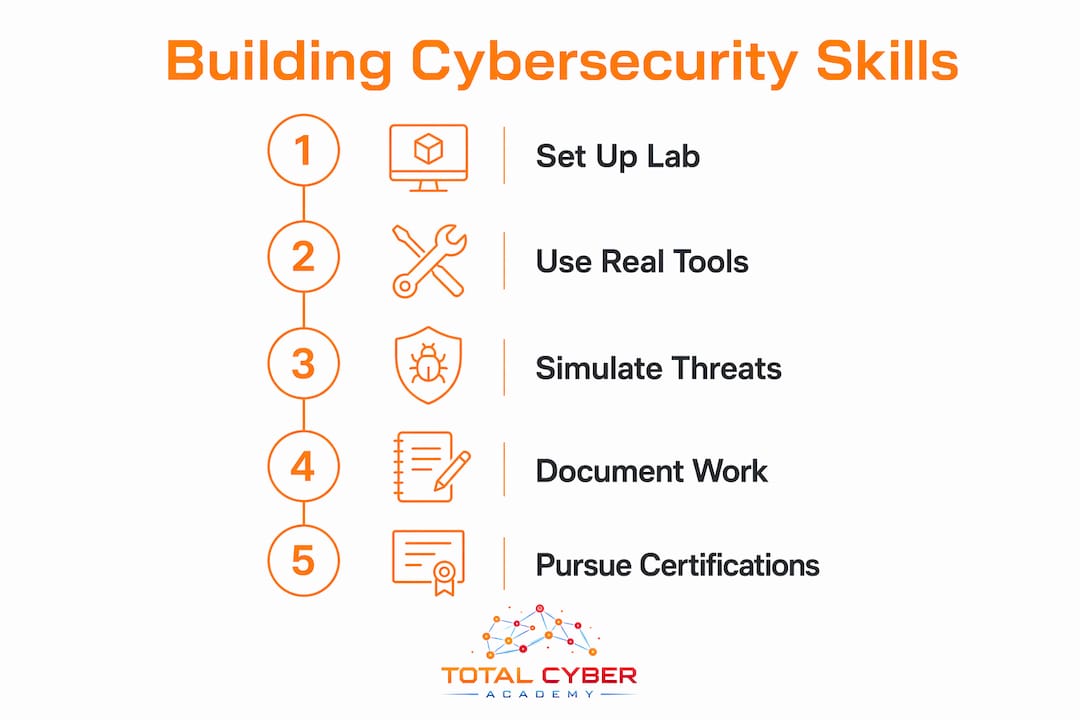
Building hands-on cybersecurity training experience without a prior job is entirely achievable through a structured sequence of self-directed activities. The key is to treat each step as a professional project, not a casual exercise.
-
Set up a home lab. Use a spare laptop or a free-tier cloud account to install virtualization software. Deploy open-source tools like Zeek and OpenSearch. Open-source security tools replicate enterprise-grade workflows and frameworks such as MITRE ATT&CK, making them a credible starting point for any learner.
-
Participate in capture-the-flag (CTF) events. CTF competitions present real attack and defense scenarios in a competitive format. CTF participation and simulated attack labs help beginners gain applied cybersecurity skills through consistent practice in varied scenarios.
-
Complete guided online exercises. Structured platforms offer scenario-based modules that walk you through alert triage, malware analysis, and network forensics. These guided paths are especially useful for career changers who need a clear progression from foundational to advanced skills.
-
Enroll in certification training with embedded labs. Programs that combine certification preparation with hands-on labs accelerate skill development. Totalcyber’s courses pair CompTIA Security+ preparation with lab exercises that mirror real SOC workflows, giving learners both the credential and the experience simultaneously.
-
Document every exercise as a case study. Write up what you did, what you found, and what you would do differently. Lab documentation transforms practice into professional evidence rather than casual exercises. This documentation becomes your portfolio.
-
Join a peer community. Structured learning with peer support increases motivation and skill retention. Forums, study groups, and collaborative projects provide accountability and expose you to problem-solving approaches you would not encounter alone.
Pro Tip: Treat your home lab write-ups the same way a professional analyst treats an incident report. Use a consistent format: objective, tools used, findings, and recommendations. Employers recognize that structure immediately.
Do certifications prove practical cybersecurity experience?
Certifications and practical project portfolios work together. Neither alone is sufficient. A certification proves you understand the concepts. A portfolio proves you can apply them.
CompTIA Security+ is the most widely recognized entry-level credential in the field. CompTIA Security+ labs contribute directly to practical cybersecurity skill development, and the certification serves as a proof point during employment evaluation when accompanied by project portfolios. The Google Cybersecurity Certificate takes a similar approach. Certificate holders gain hands-on experience with Python, Linux, SQL, and SIEM tools, aligning directly with what employers require in entry-level SOC roles.
| Certification | Practical Skill Focus | Typical Prerequisite |
|---|---|---|
| CompTIA Security+ | Network defense, threat detection, incident response | Basic IT knowledge |
| Google Cybersecurity Certificate | SIEM use, Python scripting, Linux fundamentals | No prior experience required |
Employers value portfolios that demonstrate hands-on incident responses, threat hunting, and detection engineering. Detailed case studies from lab exercises improve credibility and job market success more than a list of certifications without supporting evidence. The most competitive candidates present both: a recognized credential and a GitHub repository or portfolio site showing documented lab work.
Veterans transitioning into cybersecurity hold a particular advantage here. Military experience in signals intelligence, network operations, or information assurance maps directly to SOC analyst competencies. Pairing that background with a CompTIA Security+ and a documented lab portfolio creates a profile that stands out in a crowded applicant pool.
What challenges block practical experience, and how do you overcome them?
The most common barriers to building real-world cybersecurity experience are access constraints, resource limitations, and self-motivation difficulties. Each has a direct solution.
- Limited access to professional tools. Community-supported labs and open-source software lower this barrier significantly. Tools like Suricata, Zeek, and OpenSearch are free and actively maintained by large security communities.
- Hardware and cost constraints. A single mid-range laptop running VirtualBox or VMware Workstation Player (free tier) is sufficient to run a functional SOC lab. Cloud providers also offer free-tier compute resources that support basic lab environments.
- Self-motivation and consistency. Structured study plans with defined weekly goals outperform open-ended self-study. Totalcyber’s (ISC)² partnership reflects a commitment to structured, mentor-supported learning that addresses this challenge directly.
- Not knowing what to practice. MITRE ATT&CK provides a public, free catalog of adversary techniques organized by tactic. Working through the catalog systematically, one technique per week, gives learners a clear and professionally relevant practice agenda.
Pro Tip: Pick one MITRE ATT&CK technique each week, simulate it in your lab, detect it, and write a one-page case study. After three months, you have a 12-entry portfolio that demonstrates systematic, professional-grade thinking.
Key Takeaways
Practical cybersecurity experience is built through consistent, documented engagement with real tools and structured scenarios, not through passive study alone.
| Point | Details |
|---|---|
| Definition matters | Applied cybersecurity experience means working with real tools in structured, scenario-based environments. |
| Tools are the foundation | SIEM platforms, Zeek, Suricata, and MISP form the core toolkit for SOC-level skill development. |
| Certifications need portfolios | CompTIA Security+ and Google Cybersecurity Certificate gain credibility when paired with documented lab work. |
| Access barriers are solvable | Open-source tools and free-tier cloud resources make professional-grade lab setups available to anyone. |
| Documentation is the differentiator | Writing formal case studies from lab exercises converts practice into employer-ready evidence. |
The uncomfortable truth about cybersecurity training today
By Alden
Most people entering cybersecurity underestimate how much the documentation habit matters. I have seen candidates with impressive lab setups who could not articulate what they found or why it mattered. The technical work was solid. The professional communication was absent. Hiring managers noticed immediately.
The field has also shifted in a way that benefits non-traditional candidates more than many realize. A veteran who spent four years managing network operations in a forward-deployed environment has practiced incident response under conditions no lab can fully replicate. The gap is usually certification and vocabulary, not competence. Closing that gap with a structured program and a documented portfolio levels the playing field fast.
What I find most encouraging is that the open-source tooling available today is genuinely enterprise-grade. Suricata and Zeek are not “training wheels” tools. They run in production SOCs at major organizations. Learning on them means you are learning on the real thing. That was not true ten years ago, and it changes the calculus for anyone who thinks they need a job to get experience.
Treat your lab as a professional environment from day one. Name your projects. Write your reports. Version-control your configurations. The habit of treating practice as professional work is what separates candidates who get interviews from those who do not.
— Alden
Totalcyber’s approach to hands-on cybersecurity training
Totalcyber is a veteran-owned training organization built specifically for learners who need more than lecture slides.
Every course at Totalcyber integrates hands-on labs, real-world scenarios, and expert instruction designed to produce job-ready analysts. The curriculum aligns with CompTIA certifications and (ISC)² standards, so the skills you build map directly to what employers screen for. Career changers and veterans receive structured pathways that account for prior experience and accelerate the transition into cybersecurity roles. If you are ready to move from theory to applied practice, the beginner’s career guide is the clearest starting point. For a full view of available tracks, the complete course catalog shows every program Totalcyber offers, from foundational IT to advanced security operations.
FAQ
What is practical cybersecurity experience?
Practical cybersecurity experience is hands-on engagement with real security tools and simulated threat scenarios that develop job-ready skills. It includes activities like alert triage, threat hunting, and incident response in environments that mirror professional SOC workflows.
How do beginners gain real-world cybersecurity experience?
Beginners build experience by setting up home labs with open-source tools, participating in CTF events, and completing certification programs that include hands-on labs. Documenting each exercise as a formal case study converts that practice into a professional portfolio.
Does CompTIA Security+ count as practical experience?
CompTIA Security+ preparation includes hands-on labs that contribute to practical skill development, but the certification alone is not sufficient. Employers expect a portfolio of documented lab work alongside the credential to confirm applied competency.
What tools are used in practical cybersecurity training?
Core tools include SIEM platforms like OpenSearch, network monitors like Zeek and Suricata, and threat intelligence platforms like MISP. These tools are open-source, actively maintained, and used in production SOC environments worldwide.
Can veterans transition into cybersecurity without prior IT experience?
Veterans with backgrounds in signals intelligence, network operations, or information assurance already possess core cybersecurity competencies. Pairing that experience with a recognized certification and a documented lab portfolio creates a competitive profile for entry-level SOC analyst roles.
Recommended
- Cybersecurity Training Explained: A Beginner’s Career Guide – Total Cyber Academy!
- Career Changer Cybersecurity Success Roadmap: 2026 Guide – Total Cyber Academy!
- Cybersecurity Portfolio Building Step by Step – Total Cyber Academy!
- Cybersecurity Apprenticeship: What It Is and How to Start – Total Cyber Academy!