
Military service is defined as one of the most direct pathways into IT and cybersecurity careers, because veterans enter civilian hiring with technical depth, operational discipline, and security clearances that most candidates spend years trying to build. The role of military skills in IT goes far beyond soft skills. Veterans who served in signals intelligence, cyber operations, or communications have defended real networks against real threats, a credential no classroom replicates. Certifications like CompTIA Security+ and active TS/SCI clearances further separate veteran candidates in a market where cybersecurity and IT roles are growing at 19.5% through 2033. The challenge is not whether your skills qualify you. The challenge is translating them so civilian hiring managers can see it.
How military soft skills drive success in IT and cybersecurity jobs
Military service builds a specific set of professional behaviors that IT teams actively seek. Leadership, composure under pressure, and the ability to communicate across ranks translate directly into IT project management, incident response, and team coordination. These are not abstract qualities. They show up in measurable ways on the job.
Civilian IT environments reward the same behaviors the military demands:
- Leadership under pressure. Incident response requires calm, decisive action when systems fail. Veterans trained in high-stakes environments perform this naturally.
- Structured communication. Military briefings train personnel to deliver clear, concise information to decision-makers. That skill maps directly to stakeholder reporting in IT.
- Adaptability. Technology changes fast. Veterans who operated across multiple deployments and equipment generations adapt to new tools without friction.
- Team accountability. Military units depend on every member performing their role. That culture of accountability strengthens IT teams where a single misconfiguration can cascade into a breach.
- Critical thinking. Threat analysis in the field and threat analysis in a security operations center require the same logical framework: assess, prioritize, respond.
Recruiters confirm that military service functions as a positive secondary signal. Primary hiring signals remain technical skills and demonstrated project work. That means soft skills open doors, but certifications and hands-on experience close them.
Pro Tip: Build a one-page skills summary that maps each military role to a civilian IT function. Use civilian job titles, not MOS codes. Hand this to recruiters before they see your full resume.

How do you translate military technical experience into civilian IT qualifications?
Resume translation is the single biggest technical hurdle veterans face in IT hiring. Military acronyms and MOS codes confuse applicant tracking systems (ATS) and civilian recruiters alike. Replacing “25U Signal Support Systems Specialist” with “IT Operations Manager” is not dumbing down your experience. It is making your experience readable to the systems that filter candidates before a human ever sees your file.
The most effective translation approach follows a clear structure:
- Replace MOS codes with civilian job titles. “17C Cyber Operations Specialist” becomes “Cybersecurity Analyst” or “Penetration Tester” depending on your actual duties.
- List technical skills in civilian categories. Format them as: Operating Systems (Windows Server 2019, RHEL 8), Security Tools (Splunk, Nessus), Cloud Platforms (AWS, Azure). Include version numbers where relevant.
- Highlight clearances prominently. A TS/SCI clearance adds $15,000–$30,000 in salary premium in defense technology roles. Place it near the top of your resume, not buried in a footnote.
- Lead with certifications. CompTIA Security+, Network+, AWS Cloud Practitioner, and Certified Ethical Hacker (CEH) are the credentials civilian hiring managers recognize immediately.
- Quantify every achievement. “Managed network infrastructure” tells a hiring manager nothing. “Managed a 3,000-user network with 99.9% uptime and reduced help desk tickets by 40%” tells them everything.
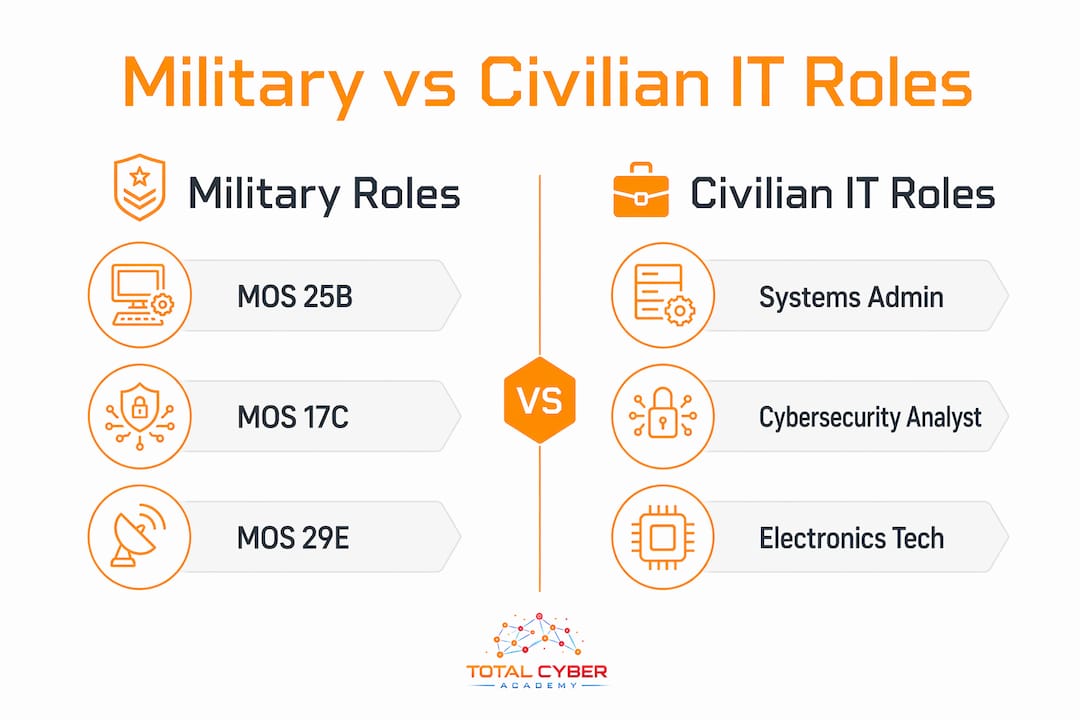
| Military Term | Civilian IT Equivalent |
|---|---|
| MOS 25B (IT Specialist) | Systems Administrator |
| MOS 17C (Cyber Ops) | Cybersecurity Analyst |
| MOS 35Q (Cryptologic Network Warfare) | Network Security Engineer |
| Signal Officer | IT Project Manager / Network Architect |
| SIGINT Analyst | Threat Intelligence Analyst |
Technical hiring managers prioritize certifications, project experience, and technical proficiency over military rank or length of service. Front-load your resume with those elements.
Pro Tip: Run your resume through a free ATS scanner before submitting. If your military job titles do not appear in the results, rewrite them using the civilian equivalents from the table above.
What tools and programs support military-to-IT transitions in 2026?
The infrastructure supporting veteran IT transitions has expanded significantly in 2026. Veterans no longer need to navigate the civilian job market alone.
- Workday Military Skills Mapper. This tool translates military job codes and skills into civilian equivalents recognized by ATS and hiring managers automatically. It removes the guesswork from resume translation and helps employers identify veteran talent they might otherwise overlook.
- SkillBridge Program. The Department of Defense’s SkillBridge program allows active-duty service members to work with civilian employers during their final 180 days of service. Cybersecurity training organizations participate directly, giving veterans real-world IT experience before separation.
- GI Bill benefits for IT certifications. Veterans can apply GI Bill funding toward cybersecurity certification programs, covering costs for CompTIA Security+, ISC2 CISSP, and other credentials that civilian employers require.
- Federal “War Force” hiring initiatives. Federal agencies actively recruit veterans for GS-14 technical roles in cybersecurity and IT. These positions pay competitively and value active clearances as a primary qualification.
- Army Software Warrant Officer program. The Army created a dedicated career track converting experienced NCOs into Software Warrant Officers, addressing the retention gap in military software talent and building a pipeline of credentialed IT professionals.
The job market context reinforces why these programs matter. Cybersecurity and IT roles are projected to grow 19.5% through 2033, with the professional and technical services sector adding 163,500 software developer jobs in the same period. Veterans who enter the pipeline now position themselves ahead of a demand curve that shows no sign of flattening.
What are the best IT career paths for veterans?
Veterans with military backgrounds fit naturally into several high-demand IT roles. The right path depends on your military specialty and the type of work you find most engaging.
- Cybersecurity analyst. Veterans with signals intelligence or cyber operations backgrounds have hands-on experience defending real networks against actual threats. Defense contractors and government agencies actively recruit these candidates, especially those with active clearances.
- IT project manager. Veterans with leadership experience translate directly into project management. The Project Management Professional (PMP) certification qualifies candidates for roles paying $110,000 or more, and military leadership skills reduce the need for deep technical coding expertise in this track.
- Cloud architect or cloud engineer. Veterans who managed distributed communications infrastructure adapt well to cloud environments. AWS Cloud Practitioner and Microsoft Azure certifications provide the civilian credentials to formalize that experience.
- Network engineer or systems administrator. Signal and communications veterans often have direct experience with the hardware and protocols that underpin enterprise networks. CompTIA Network+ and Cisco CCNA certifications validate those skills for civilian employers.
Nearly 50% of tech job postings no longer require a four-year degree. Employers rely instead on industry certifications as the primary credential. That shift benefits veterans who can earn CompTIA Security+, AWS Cloud Practitioner, or ISC2 certifications through focused study rather than a multi-year degree program.
Pro Tip: Choose your first certification based on your military specialty, not general popularity. A 17C veteran should target CompTIA CySA+ or CEH before pursuing a broad certification like A+. Alignment between your background and your credential makes your resume more coherent to hiring managers.
How do you quantify military experience for IT hiring managers?
Hiring managers prioritize results with measurable business impact over descriptions of military duties. The difference between a resume that gets an interview and one that gets filtered out often comes down to a single sentence.
Effective quantification follows a consistent pattern:
- State the scale. How many users, systems, or locations did you support?
- State the outcome. What uptime, error rate, or efficiency did you achieve?
- State the impact. What did that outcome mean for the mission or organization?
| Weak Resume Language | Strong Resume Language |
|---|---|
| “Maintained network systems” | “Managed 3,000-user network with 99.9% uptime” |
| “Supported cybersecurity operations” | “Reduced security incidents 40% through firewall rule optimization” |
| “Led IT team” | “Directed 12-person IT team supporting 5 forward operating bases” |
| “Handled communications equipment” | “Deployed and maintained SATCOM systems across 3 time zones” |
Avoid military acronyms in every line of your resume. Terms like SIPR, NIPR, and JTRS mean nothing to a civilian ATS. Replace them with the civilian equivalents: classified network, unclassified network, and tactical radio system. Clarity always outperforms authenticity in civilian hiring.
Key Takeaways
Veterans bring a combination of technical depth, operational discipline, and security clearances that civilian candidates rarely match from the start.
| Point | Details |
|---|---|
| Clearances add real salary value | A TS/SCI clearance adds $15,000–$30,000 in salary premium in defense technology roles. |
| Certifications replace degrees | Nearly 50% of tech postings accept certifications like CompTIA Security+ instead of a four-year degree. |
| Resume translation is critical | Replace MOS codes and military jargon with civilian job titles to pass ATS screening. |
| Quantify every achievement | Metrics like “99.9% uptime” and “40% ticket reduction” convert military experience into hiring signals. |
| Tools exist to help | The Workday Military Skills Mapper and SkillBridge program actively support veteran IT transitions in 2026. |
Why most veterans undersell themselves in IT hiring
Veterans consistently undersell their IT experience, and I have seen this pattern repeat across hundreds of career transitions. The instinct to be modest about rank and role is a military virtue. In civilian hiring, it is a liability.
The veterans who land senior IT roles fastest are not the ones with the most experience. They are the ones who learned to narrate their experience in the language civilian hiring managers use. A signals sergeant who managed a 500-node tactical network for three years has more practical infrastructure experience than most mid-level network engineers. But if that resume says “maintained SINCGARS and JTRS communications systems,” a recruiter will pass without a second look.
The mindset shift required here is not about abandoning military identity. It is about recognizing that translation is a professional skill, and it is one worth investing time in before you submit a single application. Pair that translation work with one or two targeted certifications, and you become a candidate that hiring managers actively compete for. The career changer roadmap for cybersecurity is shorter than most veterans assume. The gap between where you are and where you want to be is usually a certification and a rewritten resume, not years of additional experience.
— Alden
Totalcyber supports veterans entering IT and cybersecurity
Totalcyber is a veteran-owned cybersecurity training organization built specifically for people making the transition you are considering. The programs combine hands-on labs, expert instruction, and preparation for industry-recognized certifications including CompTIA Security+, Network+, and ISC2 credentials.
Veterans can apply GI Bill benefits and SkillBridge eligibility toward Totalcyber’s cybersecurity training programs, reducing out-of-pocket costs significantly. The curriculum is designed around real-world scenarios, not theory, which means your military experience with actual systems and threats gives you a head start from day one. Explore the full course catalog and find the certification path that aligns with your background and career goals.
FAQ
What IT skills transfer directly from military service?
Network administration, cybersecurity operations, systems maintenance, and project management all transfer directly from military roles. Veterans with signals, cyber, or intelligence backgrounds often have more practical experience than civilian candidates with equivalent job titles.
Do veterans need a degree to get an IT job?
Nearly 50% of tech job postings no longer require a four-year degree. Industry certifications like CompTIA Security+ and AWS Cloud Practitioner serve as equivalent credentials for most entry and mid-level IT roles.
How valuable is a security clearance in civilian IT hiring?
A TS/SCI clearance adds $15,000–$30,000 in salary premium in defense technology roles. It also reduces employer onboarding time, making cleared veterans significantly more attractive to defense contractors and government agencies.
What certifications should veterans pursue first?
Veterans should align their first certification with their military specialty. Cyber operations veterans should target CompTIA CySA+ or CEH. Communications and network veterans should start with CompTIA Network+ or Cisco CCNA. Leadership-track veterans should pursue the PMP certification.
What is the Workday Military Skills Mapper?
The Workday Military Skills Mapper is a tool that automatically translates military job codes and skills into civilian equivalents recognized by ATS and hiring managers. It helps both veterans and employers identify skill alignment without requiring manual translation.
Recommended
- Cybersecurity Job Interview Preparation Guide 2026 – Total Cyber Academy!
- SkillBridge Program for Veterans: 2026 Complete Guide – Total Cyber Academy!
- Cybersecurity Workforce Veteran Initiatives: 2026 Guide – Total Cyber Academy!
- Career Changer Cybersecurity Success Roadmap: 2026 Guide – Total Cyber Academy!