
A veteran cybersecurity certification study guide is a structured, career-stage approach to selecting, funding, and passing the certifications that open doors in government, defense, and private sector cybersecurity roles. Veterans bring a measurable advantage to this process. Military backgrounds in information assurance, COMSEC, or cyber operations map directly to frameworks like DoD 8140, which mandates specific credentials for federal IT positions. Organizations like ISC2 and CompTIA have built certification pathways that align with those frameworks. Totalcyber was founded specifically to help veterans navigate this transition with hands-on training and career-focused preparation.
Which cybersecurity certifications provide the best starting point for veterans?
CompTIA Security+ is the baseline certification required by DoD 8140 for most federal cybersecurity positions. That single fact makes it the non-negotiable first step for any veteran targeting government or defense work. DoD 8140 maps credentials to 52 NICE workforce roles, so Security+ opens access to a wide range of entry-level federal positions from the moment you pass.
The exam costs $404 and typically takes 4–8 weeks to prepare for veterans who already have an IT background. That study window is shorter than most civilians need because military technical training transfers directly. Veterans with no prior IT exposure should consider CompTIA A+ or Network+ first to build foundational knowledge before sitting for Security+.
- CompTIA A+: Covers hardware, operating systems, and basic troubleshooting. Ideal for veterans without formal IT training.
- CompTIA Network+: Covers TCP/IP, network architecture, and protocols. Directly relevant to veterans with communications or signals experience.
- CompTIA Security+: DoD 8140 baseline. Required for most federal cybersecurity roles. Exam cost: $404.
- ISC2 CC (Certified in Cybersecurity): A free entry-level credential from ISC2. Good for veterans building toward CISSP.
Pro Tip: CompTIA offers a 50% military discount on exam vouchers. Verify eligibility through the CompTIA academic store before purchasing at full price.
How can veterans leverage military experience and funding to maximize certification success?

Military experience counts in ways most veterans underestimate. Information assurance duties, COMSEC management, and cyber operations roles all qualify as professional experience toward advanced certification thresholds. The CISSP, for example, requires five years of paid work experience in cybersecurity. Veterans who served in qualifying roles can count that time directly, which means many are already eligible to sit for senior-level exams without additional civilian work history.
Funding removes the financial barrier entirely for most veterans. The programs below cover exam fees, training costs, or both:
- Credentialing Assistance (CA): Available to active duty service members. Covers exam fees for approved certifications including Security+ and Network+.
- VET TEC: Covers tuition for approved technology training programs. Veterans can use this for instructor-led cybersecurity courses that include certification prep.
- GI Bill: Covers training programs at approved institutions. Veterans using the GI Bill for cybersecurity training can attend full programs at little or no out-of-pocket cost.
- CompTIA Military Discount: A 50% reduction on exam vouchers for active duty, veterans, and military spouses.
Pro Tip: Stack your benefits. Use Credentialing Assistance while still on active duty to earn Security+ before separation. Then use VET TEC or the GI Bill to fund advanced training after transition.
Veterans who document their military duties carefully gain a direct advantage in certification applications. A DD-214 and a detailed description of technical duties can satisfy experience requirements for multiple certifications without additional civilian work.
What is an effective step-by-step study plan for passing veteran-relevant cybersecurity exams?
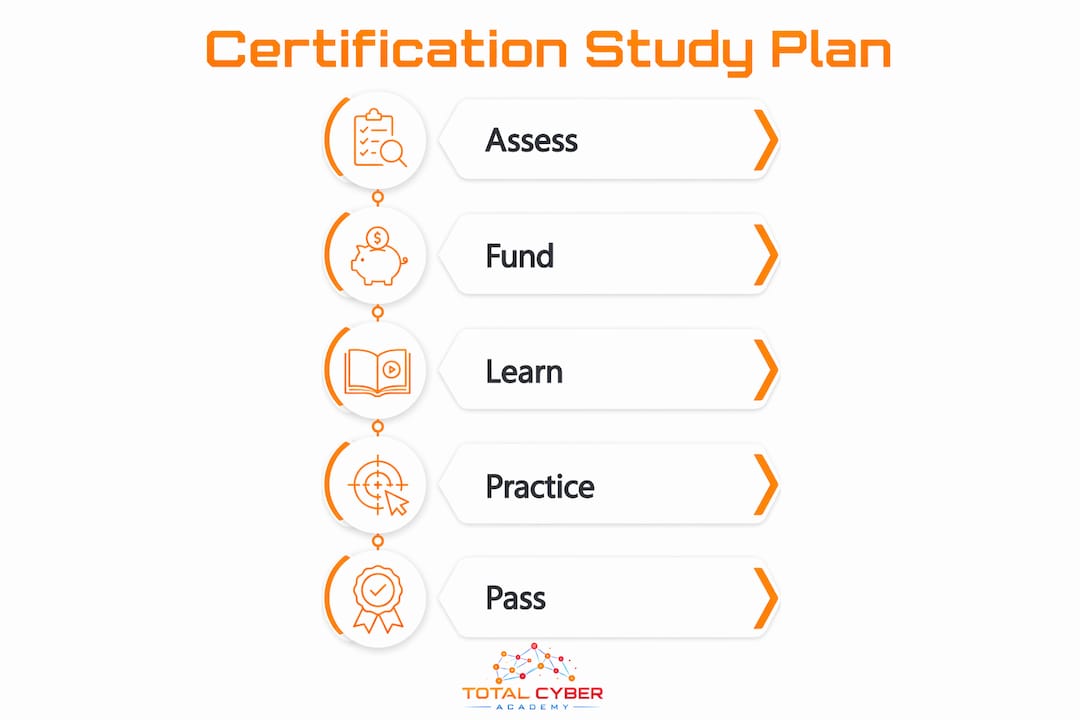
A structured study plan is the single most reliable predictor of passing a certification exam. Setting an exam date early creates accountability and prevents indefinite preparation. Most veterans who pass on the first attempt schedule the exam before they feel fully ready, then work backward to build a study schedule.
Follow this sequence for Security+ or any entry-level exam:
- Schedule the exam first. Pick a date 6–8 weeks out. Pay the fee. The financial commitment increases follow-through.
- Audit your knowledge gaps. Take a free practice exam on day one. Score it. Study the domains where you scored below 70%.
- Use layered study resources. Professor Messer’s free YouTube video series covers every Security+ domain in detail. Supplement with Udemy practice exams for timed repetition.
- Join a veteran study group. Online communities on Reddit (r/CompTIA) and Discord host active veteran cohorts. Peer accountability accelerates retention.
- Take timed practice exams weekly. Score yourself against a 75% passing benchmark. Increase frequency in the final two weeks before the exam.
- Review weak domains the day before. Do not cram new material. Reinforce what you already know.
The best study resources for veteran IT certification prep include:
- Professor Messer: Free YouTube video series covering CompTIA exams in full.
- Udemy practice exams: Low-cost, high-volume question banks with detailed answer explanations.
- Totalcyber study materials: Veteran-focused practice exams and exam preparation strategies built for the pace and structure of military learners.
- Jason Dion courses: Widely used for Security+, Network+, and CySA+ preparation.
Exam day performance depends on pacing. Security+ gives you 90 minutes for up to 90 questions. Flag uncertain questions and return to them. Performance-based questions appear early and take more time. Budget accordingly.
Which advanced cybersecurity certifications should veterans consider for career advancement?
The CISSP (Certified Information Systems Security Professional) is the gold standard for senior cybersecurity roles. The exam costs $749, runs up to four hours, and covers 125–175 questions. The first-attempt pass rate sits at 20–25%, making it one of the most difficult exams in the field. Veterans who meet the five-year experience requirement through military service are already positioned to pursue it.
The table below maps advanced certifications to career tracks and DoD 8140 relevance:
| Certification | Focus area | DoD 8140 relevance | Typical study time |
|---|---|---|---|
| CISSP | Security management and architecture | High: senior roles across all categories | 3–6 months |
| CASP+ | Advanced technical security | High: DoD technical roles | 2–4 months |
| CEH | Ethical hacking and penetration testing | Moderate: offensive security roles | 2–3 months |
| OSCP | Hands-on penetration testing | Moderate: red team and offensive roles | 3–6 months |
| CISM | Security management | High: management and governance roles | 2–4 months |
| CISA | Audit and compliance | High: audit and risk roles | 2–4 months |
Veterans with signals intelligence, cyber operations, or information assurance backgrounds often qualify for CISSP without additional civilian experience. That is a significant advantage. Civilian candidates frequently spend years in junior roles before they can sit for the exam.
Pro Tip: Do not pursue OSCP or CEH before earning Security+. Foundational knowledge gaps will cost you time and money. Sequence matters more than speed.
Planning a multi-year certification track aligned to DoD 8140 work roles produces better career outcomes than collecting credentials without a clear direction. Veterans who specialize in cloud security after Security+ by adding AWS or Azure cloud certifications gain skills that employers increasingly require alongside baseline credentials.
What common pitfalls should veterans avoid when pursuing cybersecurity certifications?
The most common mistake is skipping foundational certifications. Veterans with strong technical backgrounds sometimes attempt CISSP or CEH without Security+. That approach fails more often than it succeeds because the foundational exams build the conceptual vocabulary that advanced exams test at a deeper level.
- Skipping Security+: DoD 8140 requires it for most roles. Skipping it creates a compliance gap even if you pass a harder exam.
- Collecting certs without depth: Piling up certifications too quickly without building real expertise signals credential inflation to hiring managers.
- Ignoring renewal requirements: CompTIA certifications require continuing education units (CEUs) every three years. CISSP requires 120 CPE credits over three years. Missing renewal deadlines voids the credential.
- Misaligning certs to career goals: A veteran targeting federal audit roles should pursue CISA, not OSCP. Mapping certs to DoD 8140 roles before studying prevents wasted effort.
- Underestimating study time: Veterans with strong military backgrounds still need 4–8 weeks of focused preparation for Security+. Overconfidence leads to failed first attempts.
“Certifications act as material gates to many government and defense roles. Selecting the right credential at the right career stage is the most consequential decision a veteran makes during the cybersecurity transition.”
Burnout is a real risk for veterans who pursue multiple certifications simultaneously while managing a job search or transition. One certification at a time, completed thoroughly, produces better results than three certifications started and abandoned. Realistic scheduling protects both your timeline and your performance.
Key Takeaways
Veterans who follow a sequenced, DoD 8140-aligned certification plan and use available military funding programs pass exams faster and enter cybersecurity careers with stronger credentials than those who study without a structured approach.
| Point | Details |
|---|---|
| Start with Security+ | CompTIA Security+ is the DoD 8140 baseline and the required first step for most federal cybersecurity roles. |
| Use military funding | Credentialing Assistance, VET TEC, and the GI Bill can cover exam and training costs at little or no out-of-pocket expense. |
| Count military experience | Veterans with IA, COMSEC, or cyber operations backgrounds often already meet CISSP’s five-year experience requirement. |
| Sequence certifications | Follow a multi-year plan aligned to DoD 8140 work roles rather than pursuing advanced certs before foundational ones. |
| Avoid credential inflation | Deep expertise in fewer certifications outperforms a long list of credentials without practical experience behind them. |
Why I think most veterans underestimate their starting position
Veterans consistently undervalue what they already bring to the certification process. I have seen service members with years of information assurance or COMSEC experience assume they need to start from zero. They do not. The military builds technical discipline, security awareness, and operational rigor that civilian candidates spend years trying to develop.
The certification pathway works best when veterans treat it as a translation exercise, not a reinvention. Your MOS, your clearance history, and your technical duties are assets. Document them carefully. Use them to satisfy experience requirements. Use them to compress your study timeline.
The veterans who struggle are usually the ones who try to rush the process. They skip Security+ because it feels too basic. They attempt CISSP without a study plan. They collect three certifications in six months and cannot explain the concepts behind any of them in an interview. The cybersecurity workforce veteran initiatives that produce the best outcomes share one trait: they treat certification as a multi-year investment, not a shortcut.
My honest advice is to build a two-year plan, start with Security+, and specialize deliberately. The cybersecurity field rewards depth. Veterans who commit to that approach consistently outperform civilian peers who entered the field without structured military training behind them.
— Alden
Totalcyber’s training programs for veteran certification success
Totalcyber was built by veterans, for veterans. The academy’s cybersecurity training programs cover every stage of the certification pathway, from CompTIA A+ and Security+ through CISSP preparation, with hands-on labs and real-world scenarios designed for military learners.
Veterans can access Security+ practice exams, structured study plans, and expert instruction through Totalcyber’s course catalog. The academy also provides guidance on using GI Bill and VET TEC funding to cover training costs. Whether you are starting with foundational IT skills or preparing for a senior-level credential, Totalcyber’s programs are built to get you certified and employed. Small business owners looking to understand the cybersecurity landscape their future employees will protect can find relevant context at Stanfield IT’s cybersecurity overview.
FAQ
What is the first certification a veteran should earn?
CompTIA Security+ is the required starting point for most federal cybersecurity roles under DoD 8140. Veterans with no prior IT background should complete CompTIA A+ or Network+ first.
Can veterans use the GI Bill to pay for cybersecurity certification training?
Yes. The GI Bill and VET TEC both cover approved cybersecurity training programs, and Credentialing Assistance covers exam fees for active duty service members.
Does military experience count toward the CISSP five-year requirement?
Military information assurance, COMSEC, and cyber operations experience counts toward CISSP’s five-year work requirement, allowing many veterans to sit for the exam without additional civilian experience.
How long does it take a veteran to prepare for Security+?
Veterans with an IT background typically need 4–8 weeks of study to prepare for Security+. Veterans without prior IT training should budget additional time for foundational coursework.
What advanced certifications align with government cybersecurity roles?
CISSP, CASP+, CISM, and CISA all map to DoD 8140 work roles and are recognized across federal and defense cybersecurity positions. Sequencing these after Security+ produces the strongest career outcomes.