
A cyber risk assessment is a structured process that identifies which digital assets could be attacked, how likely that attack is, and how much damage it would cause. In business terms, it comes down to one equation: likelihood multiplied by impact equals exposure. Get that number right, and every security decision that follows, from budget requests to board reporting, gets easier to defend.
The process typically runs in five broad moves: define the scope, inventory the assets, identify threats and vulnerabilities, analyze likelihood and impact, and decide how to respond. NIST SP 800-30 formalized this as the reference model federal agencies and private organizations still build on today. CISA’s starter guide adapts it into worksheets a smaller team can run in days rather than months.
Who owns this work? In most organizations it’s a mix: a CISO or IT security lead drives the technical analysis, business unit owners weigh in on operational impact, and executive leadership sets the risk appetite that determines what counts as “acceptable.” Run it whenever you deploy a new system, after a major infrastructure change, and at minimum once a year even if nothing changes.
- Scope the assessment (what systems, data, or business units are in play)
- Inventory the assets and their owners
- Identify threats and existing vulnerabilities
- Analyze likelihood and business impact
- Decide on risk response and document it
Organizations that skip straight to buying security tools without this step often spend money on the wrong problems. NIST IR 8286 exists precisely because technical risk and business risk kept getting evaluated in separate silos, with neither side able to explain the other’s priorities.
Key Takeaways
A cyber risk assessment works because it converts vague technical concerns into prioritized, business-relevant exposure figures that guide both remediation and budget decisions.
| Point | Details |
|---|---|
| Definition in one line | Risk equals likelihood multiplied by impact, expressed as potential business loss exposure. |
| Follow a repeatable process | Scope, inventory assets, identify threats, analyze likelihood and impact, then prioritize and respond. |
| Match the method to maturity | Use qualitative scoring early, then graduate to semi-quantitative or quantitative as data improves. |
| Score with real formulas | Annualized Loss Expectancy (SLE × ARO) turns a vague risk into a defensible dollar figure. |
| Connect to ERM | Feed the cybersecurity risk register into enterprise risk management using NIST IR 8286 structure. |
Where to Find the Official Guides and Templates
Practitioners running their first assessment should start with CISA’s getting-started guide for immediate templates, then move to NIST SP 800-30 for the underlying methodology.
- NIST SP 800-30 — the core risk assessment process and Generic Risk Model
- NIST IR 8286 and NIST IR 8286B — ERM integration and prioritization
- CISA’s risk assessment resource hub — sector-specific tools and CSET
- NIST CSRC glossary entry on risk assessment — quick reference for terminology
Executives short on time should read the CISA guide’s summary and skip straight to the NIST IR 8286 series once ERM integration becomes the priority; analysts running the assessment day to day will spend more time inside SP 800-30’s methodology.
Table of Contents
- Why Cyber Risk Assessments Matter to the Business
- Which Frameworks and Standards Should You Follow?
- Qualitative, Semi-Quantitative, or Quantitative: Which Method Fits?
- What Are the Steps in a Cyber Risk Assessment?
- How Do You Calculate and Score Cyber Risk?
- Tools, Templates, and Trusted Resources for Cyber Risk Assessment
- Common Pitfalls and Best Practices in Cyber Risk Assessment
- How Cyber Risk Assessment Fits Into Enterprise Risk Management
- Start Building the Skills Behind Every Great Risk Assessment
- Sources
Why Cyber Risk Assessments Matter to the Business
A risk assessment isn’t a compliance checkbox. It’s how a security team earns a seat at the budget table. Without one, security spending tends to follow whatever made headlines last quarter rather than what actually threatens the organization.
Done well, an assessment produces a prioritized list of what to fix first, based on real exposure rather than gut instinct. That reordering alone often reveals that the “urgent” vulnerability everyone was arguing about ranks below a boring, unpatched legacy system nobody had looked at in two years. Microsoft’s overview of cybersecurity risk assessments frames this as the difference between reactive firefighting and a deliberate, prioritized remediation plan.
The business payoff shows up in a few concrete places:
- Prioritized remediation — limited security budget goes toward the highest-exposure gaps first, not the loudest ones.
- Faster board conversations — leadership sees exposure in terms they already use for other business risks (dollars, probability, timeline).
- Compliance support — many regulatory frameworks require documented risk assessments, and a mature process satisfies several requirements at once.
- Incident readiness — teams that have already mapped their assets and threats respond faster because they aren’t discovering their own network for the first time mid breach.
There’s also a quieter benefit: an assessment gives you defensible numbers when someone asks “why does this need $200,000 and not $20,000?” Tying spend to a documented risk appetite and a small set of key risk indicators (KRIs) turns a subjective argument into a data-backed one, which is usually the difference between a budget approval and a shrug.
Which Frameworks and Standards Should You Follow?
You don’t need to invent a methodology from scratch. Three sources cover almost every situation: NIST for method, ISO for governance alignment, and CISA for ready-to-use templates.
NIST SP 800-30 remains the reference for the actual assessment mechanics: how to identify threat sources, characterize vulnerabilities, and calculate risk using its Generic Risk Model. The NIST IR 8286 series extends that work specifically for organizations that need cybersecurity risk to plug into enterprise risk management, using a documented cybersecurity risk register (CSRR) as the connective tissue. NIST’s Cybersecurity Framework 2.0 sits alongside both as a higher-level organizing structure for governance and outcomes rather than a step-by-step assessment method.
ISO 31000 covers general risk management principles that apply well beyond cybersecurity, useful if your organization already runs enterprise risk management under that standard and wants cyber risk to speak the same language. ISO/IEC 27005 narrows that down specifically for information security risk, often paired with an ISO 27001 certification effort.
CISA fills a different gap entirely: practical, fast-start templates. Its getting-started guide and broader risk assessment resources give smaller teams and public-sector organizations worksheets they can use in the first week, without waiting on a consultant to build the methodology from scratch.
| Framework | Best for | Primary use |
|---|---|---|
| NIST SP 800-30 | Any organization needing a formal assessment method | Risk identification, analysis, and evaluation steps |
| NIST IR 8286 series | Organizations integrating cyber risk into ERM | Cybersecurity risk register structure and reporting |
| ISO 31000 | Enterprises with existing ERM programs | General risk management governance |
| ISO/IEC 27005 | Organizations pursuing ISO 27001 alignment | Information security risk specifics |
| CISA guidance | Smaller teams and public-sector organizations | Ready-to-use templates and worksheets |
Most mature programs don’t pick one and discard the rest. They use NIST for the method, ISO for policy alignment if leadership already reports risk that way, and CISA’s templates to avoid building forms from a blank page.
Qualitative, Semi-Quantitative, or Quantitative: Which Method Fits?
The method you choose determines whether your final report says “high risk” or “$1.2 million in expected annual loss.” Both have their place, and the right choice depends on your data maturity and who’s reading the report.

Qualitative assessment uses descriptive scales, typically low/medium/high or a simple color-coded matrix. It’s fast to run and doesn’t require historical loss data, which makes it the default for smaller organizations or a first-pass assessment. Its weakness is precision: two analysts can look at the same scenario and rate it differently, and “high risk” doesn’t tell a CFO how much budget to allocate.
Semi-quantitative assessment assigns numeric scores, usually 1 to 5, to likelihood and impact, then multiplies them to produce a risk score. This adds consistency across assessors and lets you rank risks numerically without needing full financial modeling. It’s the workhorse method for mid-sized organizations that have outgrown color charts but don’t have the loss history to model dollar figures confidently.
Quantitative assessment converts risk into financial terms, using calculations like Annualized Loss Expectancy. It demands more data (asset values, historical incident frequency, control effectiveness), and it takes longer to build credibly. But it’s the only method that answers the question every executive eventually asks: “What could this actually cost us?”
A 2026 systematic review of cyber risk assessment methods cataloged 80 distinct mathematical risk-assessment approaches and 137 standards and frameworks, and found a clear industry shift toward hybrid models that pair qualitative governance with quantitative outputs. That combination lets a team keep the speed of qualitative triage while still producing dollar figures for the risks that matter most to leadership.
Pro Tip: Don’t force full quantitative modeling on every risk in your register. Reserve it for your top ten highest-priority items; qualitative or semi-quantitative scoring is perfectly defensible for the long tail of lower-priority risks.
Regulated industries and large enterprises tend to gravitate toward hybrid or quantitative approaches because auditors and boards expect defensible numbers. Small and mid-sized businesses often start qualitative and graduate to semi-quantitative scoring as their data improves.
What Are the Steps in a Cyber Risk Assessment?
Here’s a repeatable seven-step workflow you can run whether you’re assessing a single application or an entire enterprise network.
-
Define scope and objectives. Decide what’s in bounds: a single system, a business unit, or the whole organization. Write down what decision this assessment will inform (budget request, compliance audit, new vendor evaluation) because that shapes how deep each later step needs to go. Output: a one-page scope statement signed off by the risk owner.
-
Inventory assets. List every system, dataset, and process in scope, along with its owner and its business value. This step routinely surfaces shadow IT and forgotten systems nobody remembered were still running. Output: an asset inventory with owner, criticality rating, and data classification for each entry.
-
Identify threats and vulnerabilities. Map realistic threat sources (external attackers, insider misuse, supply-chain compromise) against known weaknesses in each asset, informed by an industry analysis of threat economics that highlights which attack types are most profitable. Palo Alto Networks’ description of the process stresses pulling in real threat intelligence here rather than relying purely on generic checklists. Reviewing recent threat categories professionals actually defend against helps ground this step in current attack patterns rather than a stale list from three years ago. Output: a threat and vulnerability matrix tied to each asset.
-
Analyze likelihood and impact. For each threat/vulnerability pair, estimate how likely it is to occur and what it would cost the organization if it did, factoring in financial, operational, legal, and reputational impact. Output: a scored risk description for each scenario, following the Generic Risk Model inputs NIST SP 800-30 lays out.
-
Prioritize and select risk responses. Rank scenarios by exposure and decide, for each, whether to accept, mitigate, transfer (insurance), or continue monitoring. NIST IR 8286B provides the structure for documenting these decisions consistently, including who owns each response and its current status. Output: a treatment plan with assigned owners and target dates.
-
Document in a risk register. Every scenario gets logged with its asset, threat, vulnerability, likelihood, impact, exposure, priority, owner, and status. This register becomes the single source of truth that feeds both operational teams and executive reporting. Output: a maintained cybersecurity risk register (CSRR).
-
Monitor and reassess. Risk isn’t static. New assets get added, threat actors change tactics, and controls degrade over time. Set a recurring cadence, quarterly for high-priority risks, annually for the full register, to keep the assessment current. Output: a review calendar with defined triggers for ad hoc reassessment (new system, major incident, regulatory change).
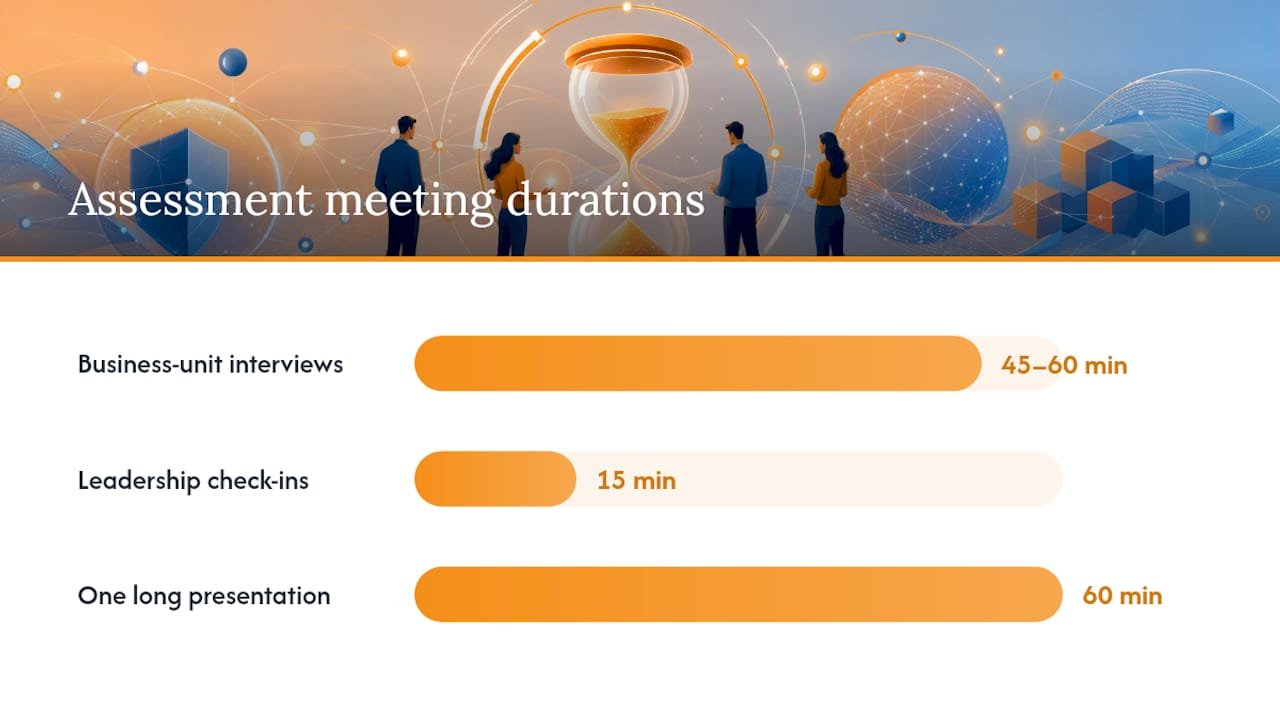
Interviews and workshops carry most of the real work in steps 2 through 4. Asset owners rarely know what a security team means by “impact” until you walk them through a concrete scenario, so plan 45 to 60 minutes per business unit and bring examples, not just blank templates. A business impact analysis (BIA) input sheet, distributed before the meeting, cuts that time roughly in half because people arrive having already thought about their answers.
Pro Tip: If a business owner can’t estimate a dollar impact, ask what would happen if the system was down for a full business day. Translating downtime into lost hours or missed transactions almost always unlocks a number they can actually defend.
Keeping leadership engaged across a multi-week assessment is its own challenge. Short, scheduled check-ins (fifteen minutes, not an hour) at each major milestone work better than one long presentation at the end, because executives who’ve seen the data evolve are far more likely to trust the final prioritization.
How Do You Calculate and Score Cyber Risk?
Scoring risk turns a vague sense of danger into a number you can rank, compare, and defend. The simplest approach maps qualitative ratings to numbers: likelihood on a 1 to 5 scale (rare to almost certain), impact on the same scale (negligible to severe), then multiply the two for a risk score from 1 to 25.
A semi-quantitative example: a phishing campaign against your finance team scores a likelihood of 4 (likely, given how common these attacks are) and an impact of 4 (significant financial and reputational damage), producing a risk score of 16, which lands in your “high priority” band.
For full quantitative scoring, the classic formula is Annualized Loss Expectancy (ALE), built from two inputs:
- Single Loss Expectancy (SLE) = asset value × exposure factor (the percentage of value lost in one incident)
- Annualized Rate of Occurrence (ARO) = how many times per year you expect the event
- ALE = SLE × ARO
If a data breach would cost your organization $500,000 (SLE) and you estimate it happening once every four years (ARO of 0.25), your ALE comes out to $125,000 per year. That figure alone tells you whether a $40,000 annual control investment is a reasonable trade or overkill.
| Risk score | Priority band | Recommended response |
|---|---|---|
| 1–5 | Low | Monitor, no immediate action |
| 6 | Moderate | Mitigate on standard timeline |
| — | High | Mitigate urgently or transfer via insurance |
| 20–25 | Critical | Immediate mitigation or accept only with executive sign-off |
Every scenario you score belongs in the risk register, with fields for asset, threat, vulnerability, likelihood, impact, calculated exposure, priority band, assigned owner, and current status. That register, not the one-time report, is what keeps the assessment useful six months later instead of becoming a PDF nobody reopens.
Tools, Templates, and Trusted Resources for Cyber Risk Assessment
You don’t need enterprise software to start. Four categories of tools cover almost every organization’s needs, and the right pick depends on scale, not ambition.
- Spreadsheets and templates handle asset inventories and risk registers for small teams; they’re free, flexible, and often the fastest way to get moving in week one.
- Open-source tools like CISA’s Cyber Security Evaluation Tool (CSET) offer structured assessment workflows without licensing costs.
- Vendor platforms automate scoring, asset discovery, and continuous monitoring, useful once your asset count outgrows manual tracking.
- GRC (governance, risk, and compliance) solutions aggregate assessments across the enterprise and connect directly to ERM reporting, best suited for organizations already running formal enterprise risk programs.
For official templates, start with two places:
- CISA’s getting-started guide for downloadable worksheets aimed at organizations running their first formal assessment.
- CISA’s broader risk assessment resource hub for sector-specific tools including CSET.
As you build your template set, plan to produce at minimum an asset inventory template, a risk register entry template with the fields listed above, and a mitigation tracking sheet that logs treatment status over time. Teams new to structuring this kind of program often benefit from reviewing security awareness training fundamentals alongside the technical templates, since a meaningful share of identified risks trace back to user behavior rather than infrastructure gaps.
How Long Does a Cyber Risk Assessment Take and Cost?
A light-touch assessment for a single system or small business can run a few days to two weeks using CISA’s starter templates. A mid-sized organization covering multiple business units typically needs four to eight weeks, factoring in stakeholder interviews and data collection across departments. Enterprise programs don’t really finish; they run as ongoing processes with quarterly refreshes feeding a continuously updated CSRR.
Cost scales with a few clear drivers:
- Scope and asset count — more systems means more interviews and more data to reconcile.
- Data availability — organizations with existing asset inventories and incident history move faster and cheaper than those starting from scratch.
- Third-party dependencies — assessing vendor and supply-chain risk adds coordination overhead that’s easy to underestimate.
- Quantitative modeling needs — building defensible ALE figures takes more analyst time than qualitative scoring.
- Consultant vs. in-house labor — external assessors bring speed and objectivity but cost more per hour than building internal capability.
A phased approach, assess your highest-value assets first, expand scope in later cycles, keeps the first pass affordable while still producing usable results. Sampling a representative subset of similar systems, rather than assessing every server individually, cuts effort substantially without meaningfully hurting accuracy.
Common Pitfalls and Best Practices in Cyber Risk Assessment
The single most common failure mode is treating the whole exercise as an IT-only task. When business owners never get pulled into the process, the resulting report reads like a technical audit, and executives skim past it because nothing in it speaks their language.
A close second: building a color-coded heat map with no business context attached. “This is red” means nothing to a CFO without a dollar figure or an operational consequence behind it. Registers also go stale fast when nobody owns the update cadence, and third-party or supply-chain risk gets left out entirely because it’s harder to assess than internal systems.
The fixes are straightforward, even if the discipline to maintain them is not:
- Tie every risk entry to a business impact statement, not just a technical description.
- Express exposure in monetary or operational terms wherever the data supports it.
- Define risk appetite and named owners before the assessment starts, not after.
- Fold the cybersecurity risk register into the broader ERM process rather than keeping it as a standalone security document.
Pro Tip: If your risk register hasn’t been updated in the last quarter, treat that as a finding in itself. A stale register is often a bigger risk indicator than any single vulnerability on the list.
How Cyber Risk Assessment Fits Into Enterprise Risk Management
Cybersecurity risk doesn’t belong in a silo separate from financial risk, operational risk, or legal risk. It’s one input into the same enterprise risk management process, and NIST IR 8286 makes that integration explicit through the cybersecurity risk register, which documents each scenario’s likelihood, impact, and priority in a format designed to roll up into enterprise-level reporting.
NIST IR 8286B adds the prioritization layer: standardized fields for risk response, risk owner, and status, so an enterprise risk committee can aggregate dozens of individual CSRRs into a coherent organizational view without each business unit inventing its own format.
The industry direction here is unambiguous. The 2026 systematic review cataloging dozens of frameworks found a consistent shift toward hybrid and quantitative methods specifically because boards want exposure expressed in terms they can weigh against other enterprise risks, in dollars, not color codes. Experts increasingly frame CSRM as something leadership must actively steer through a stated risk appetite and tolerance, rather than something IT reports on after the fact.
For teams building organization-level dashboards, a few KPIs and KRIs do most of the work: total risk exposure by business unit, number of high-priority risks past their treatment deadline, and percentage of the asset inventory covered by a current assessment. A quarterly reporting cadence to the risk committee, with monthly internal reviews at the operational level, keeps the register from going stale between formal cycles.
Why Integrating Risk Assessment With ERM Changes the Outcome
I’ve watched security teams present a technically flawless risk assessment to a board and get nowhere, because the report never translated into terms the room could act on. The moment a team starts expressing cyber exposure in the same dollars-and-probability language the CFO already uses for supply chain or market risk, the conversation shifts from “why do you need this budget” to “which risk do we tackle first.” That shift is the entire point of tying cybersecurity risk management to enterprise risk management rather than running it in parallel.
Building the skill to run this kind of assessment, and to translate its findings for leadership, is exactly the kind of practical capability that separates an entry-level analyst from someone leadership trusts with real budget conversations. Total Cyber Academy built its hands-on labs around scenarios like this one.
Start Building the Skills Behind Every Great Risk Assessment
Reading about risk assessment methodology gets you halfway there. Running one, gathering the interviews, scoring the scenarios, defending the numbers to a skeptical stakeholder, is where the real skill develops, and it’s the kind of skill employers specifically screen for when hiring analysts and risk owners.
Total Cyber Academy’s programs are built around exactly that hands-on gap: practical labs, real-world scenarios, and certification preparation covering CompTIA, EC-Council, and ISC2 paths, designed for beginners, career changers, veterans, and IT professionals who want to move past theory. If you’re ready to turn this article’s concepts into a demonstrable, resume-ready skill set, explore Total Cyber Academy’s beginner-friendly training path and see which track fits where you’re starting from.
Sources
- Identifying and Estimating Cybersecurity Risk for Enterprise Risk Management
- Prioritizing Cybersecurity Risk for Enterprise Risk Management
- Guide for Conducting Risk Assessments (NIST SP 800-30 Rev. 1)
- Guide to Getting Started with a Cybersecurity Risk Assessment (CISA)
- Bridging the gaps in cyber risk assessment: a comprehensive systematic review of standards, frameworks and quantification methods
Recommended
- Cyber Workforce Development: What It Means in 2026 – Total Cyber Academy!
- How to Conduct a Basic Cyber Security Audit at Home – Total Cyber Academy!
- Self-Paced Cybersecurity Training: A Beginner’s Guide – Total Cyber Academy!
- Cybersecurity Apprenticeship: What It Is and How to Start – Total Cyber Academy!