
SkillBridge cybersecurity training is a Department of Defense initiative that enables active-duty service members to gain hands-on civilian cybersecurity experience during their final days of military service. The DoD SkillBridge program allows participants with 180 days or fewer remaining in service to train with approved civilian employers while retaining full military pay and benefits. For veterans eyeing a career in cybersecurity, this is one of the most practical and financially safe transitions available. You keep your paycheck, gain real-world skills, and enter the civilian job market with documented experience rather than just a resume of military duties.
How does the SkillBridge cybersecurity training program work?
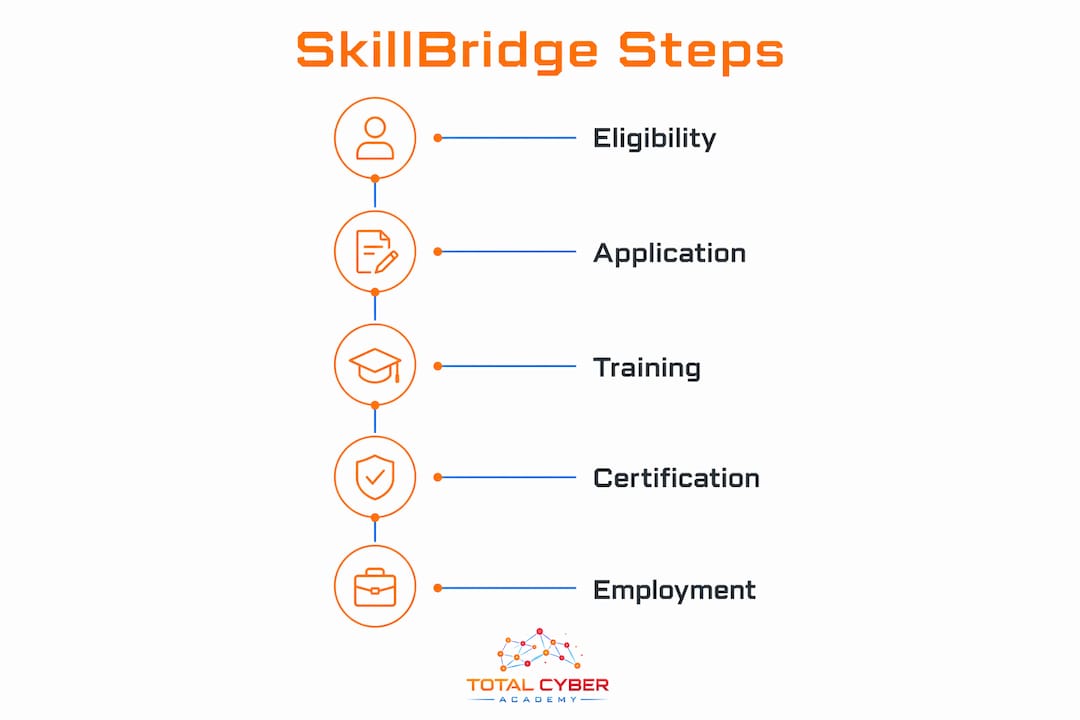
The SkillBridge program follows a defined process, and understanding each step prevents costly delays. Eligibility requires 180 days or fewer remaining on active duty, completion of all Transition Assistance Program (TAP) requirements, and command authorization. TAP is the mandatory pre-separation counseling program that covers career planning, financial literacy, and employment resources. Commanders prioritize applicants who have completed TAP and present clear career objectives with defined training outcomes.
The application process moves in a specific sequence:
- Complete TAP requirements. TAP compliance is non-negotiable. Commanders view it as a baseline indicator that you are serious about your transition.
- Identify an approved provider. Every SkillBridge provider must hold a DoD-authorized Memorandum of Understanding (MOU). The DoD SkillBridge program lists thousands of approved employers across industries, with cybersecurity growing as a focus area.
- Build a detailed training plan. Your plan must demonstrate that you will acquire specific, marketable civilian skills. Vague plans get rejected.
- Submit for command approval. Administrative approval typically takes 30–45 days after submission, depending on installation workload.
- Begin training. Training periods range from 30 to 180 days, with 90–120 days being the most common duration.
Pro Tip: Submit your application package at least 60 days before your intended start date to absorb the 30–45 day command approval window without losing training time.
What cybersecurity skills and certifications does SkillBridge cover?

SkillBridge cybersecurity programs cover a broad range of technical disciplines. Training typically includes network defense, incident response, and penetration testing, delivered through a mix of classroom instruction and hands-on internships. The practical component is what separates SkillBridge from a standard online course. You work inside real security operations environments, not simulated ones.
The career roles most commonly targeted by SkillBridge cybersecurity tracks include:
- SOC Analyst (Security Operations Center): monitors networks for threats and responds to alerts in real time
- Incident Responder: investigates and contains active security breaches
- Threat Hunter: proactively searches for hidden threats within an organization’s systems
- Penetration Tester: simulates cyberattacks to identify vulnerabilities before adversaries do
Certification preparation is a core component of most programs. CompTIA Security+ is the most common target certification, as it meets DoD 8570 requirements and is recognized across federal and private-sector employers. More advanced programs prepare participants for certifications like CISSP (Certified Information Systems Security Professional), which is suited for those with prior IT or security experience. Understanding cybersecurity best practices before entering a SkillBridge program gives you a measurable head start in both the classroom and the workplace.
Pro Tip: If your SkillBridge provider offers CompTIA Security+ prep, complete a Security+ practice exam before your first week. Knowing where your gaps are on day one lets you focus your study time where it counts.
What are the key benefits and limitations of SkillBridge for veterans?
SkillBridge delivers concrete advantages that no self-funded training program can replicate. The most significant is financial. Participants retain full military pay and benefits throughout the training period. That means you can pursue a 90-day cybersecurity internship without taking on debt or depleting savings.
| Benefit | What it means in practice |
|---|---|
| Full military pay retained | No income gap during training, unlike self-funded programs |
| Civilian work experience | Employers see documented, verifiable on-the-job performance |
| Professional networking | Direct access to hiring managers and cybersecurity teams |
| Certification preparation | Many programs include CompTIA Security+ and similar exam prep |
| Portfolio development | Veterans build portfolios of real projects during internships |
The limitations are equally important to understand before you apply:
- No employer salary. Federal law prohibits receiving dual compensation. Civilian employers cannot pay you during SkillBridge. Your military pay is your only income.
- No guaranteed job offer. SkillBridge does not guarantee employment. Many veterans receive job offers after strong internships, but the program itself makes no placement commitments.
- Provider quality varies. Not all approved providers offer the same depth of training. Selecting a provider with a weak program wastes your most valuable pre-separation window.
The dual-compensation prohibition surprises many applicants. It is not a policy choice by the DoD. It is a federal law. Plan your finances accordingly before you begin.
How can veterans maximize success in SkillBridge cybersecurity training?
Success in SkillBridge depends almost entirely on preparation done months before the program starts. Starting research at least 9 months before separation gives you time to identify quality providers, build a strong training plan, and absorb the command approval timeline without rushing. Veterans who begin planning at the 3-month mark often find their best provider options are already filled.
Follow this sequence to position yourself for the best outcome:
- Research providers early. Use the DoD SkillBridge directory to identify cybersecurity-focused providers with DoD-authorized MOUs. Cross-reference employer reputation through LinkedIn and veteran community forums. Totalcyber’s SkillBridge program guide outlines what to look for in a quality provider.
- Build a specific training plan. Commander approval depends on the quality and specificity of your training plan. Name the exact skills you will develop, the certifications you will pursue, and the civilian roles you are targeting.
- Complete TAP early. Do not wait until TAP is mandatory. Completing it ahead of schedule signals to your commander that you are organized and mission-focused.
- Treat the internship as a working interview. Every day of your SkillBridge placement is an audition. Arrive early, ask technical questions, and document your work. Employers notice the difference between veterans who coast and those who contribute.
- Build your portfolio and network simultaneously. Collect work samples, request written recommendations, and connect with every cybersecurity professional you meet. The network you build during SkillBridge often matters more than the certification you earn.
Pro Tip: Ask your SkillBridge employer on day one whether they have converted previous SkillBridge participants into full-time hires. That single question tells you more about the program’s value than any brochure.
Veteran-focused cybersecurity workforce initiatives can also supplement your SkillBridge preparation by connecting you with mentors and career resources before your internship begins.
Key Takeaways
SkillBridge cybersecurity training gives veterans a structured, financially protected path into civilian cybersecurity careers, but success requires early planning, a specific training plan, and treating every internship day as a job interview.
| Point | Details |
|---|---|
| Eligibility window | Service members with 180 days or fewer remaining qualify for SkillBridge participation. |
| Financial protection | Participants keep full military pay; federal law prohibits additional employer salary. |
| Training content | Programs cover network defense, incident response, and certification prep like CompTIA Security+. |
| Application timeline | Begin research 9 months before separation to meet command approval and provider deadlines. |
| Employment outcome | SkillBridge does not guarantee a job offer; strong performance and networking drive hiring results. |
Why I think most veterans underestimate what SkillBridge actually requires
Veterans often approach SkillBridge as a formality, a box to check before separation. That mindset is the fastest way to waste the program’s potential. I have seen service members spend their entire internship observing rather than contributing, then wonder why no job offer came. The employers who partner with SkillBridge are evaluating you from day one. They are not running a charity. They are looking for their next hire.
The other mistake I see repeatedly is poor provider selection. Not every DoD-authorized MOU holder runs a serious cybersecurity program. Some providers offer little more than shadowing. You need to ask hard questions before you commit: What certifications will I work toward? Who will supervise my training? Have previous participants been hired? A weak provider wastes your final 90–120 days of military service, and you cannot get that time back.
My honest recommendation is to treat the 9-month preparation window as the most important phase of your transition. The veterans who enter SkillBridge with a specific career target, a documented training plan, and a completed TAP package consistently outperform those who apply at the last minute. Cybersecurity is a field that rewards preparation and specificity. The same discipline that made you effective in uniform will make you competitive in a SOC or incident response team. Use it.
— Alden
Totalcyber’s cybersecurity training for SkillBridge veterans
Totalcyber is a veteran-owned cybersecurity training organization built specifically for people making the transition from military to civilian careers. Its courses cover CompTIA Security+, network defense, and hands-on lab environments that mirror real-world security operations.
Whether you are preparing for a SkillBridge internship or building skills after separation, Totalcyber’s cybersecurity training courses give you the technical foundation employers expect. The platform includes certification exam preparation, practice exams, and instructor-led content aligned with DoD 8570 requirements. Veterans who want a structured path into cybersecurity can start training at Totalcyber and arrive at their SkillBridge placement ready to contribute from day one.
FAQ
What is the DoD SkillBridge program?
The DoD SkillBridge program allows active-duty service members with 180 days or fewer remaining in service to train with approved civilian employers while retaining full military pay and benefits.
Can I receive a salary from my SkillBridge employer?
No. Federal law prohibits dual compensation, so you receive only your military pay during SkillBridge training. Civilian employers cannot pay you an additional salary.
How long does SkillBridge cybersecurity training last?
Training periods range from 30 to 180 days, with 90–120 days being the most common duration for cybersecurity programs.
Does SkillBridge guarantee a job after training?
SkillBridge does not guarantee employment. Many veterans receive job offers following strong internship performance, but placement is not a program commitment.
When should I start applying for SkillBridge?
Start researching providers at least 9 months before your separation date. Command approval alone takes 30–45 days, and quality providers fill their cohorts early.