
Cybersecurity job interview preparation is defined as the structured process of building technical knowledge, hands-on skills, and communication ability to meet the specific demands of a security role. Hiring managers in 2026 evaluate far more than textbook answers. They assess whether you can articulate your thought process under pressure, explain risk to non-technical stakeholders, and demonstrate real experience through labs, Capture The Flag (CTF) challenges, or live projects. Mastering the CIA triad, security frameworks like NIST and ISO 27001, and current threat awareness are baseline expectations. The candidates who stand out combine that technical foundation with clarity, focus, and role-specific preparation.
How to research the role and company before your interview
Targeted research is the single most effective pre-interview activity. Generic preparation produces generic answers. Role-specific preparation produces answers that land.
Start with the job description. Analyze it deeply to identify every technology, framework, and skill the employer lists. Then map your existing experience to those requirements before you walk in the door.

Next, identify the specific cybersecurity function the role covers. Organizations require candidates to be extremely clear about their specialization, whether that is GRC, SOC analysis, penetration testing, or incident response. Broad knowledge is less valued than focused expertise that matches the company’s actual needs. Knowing which division you are targeting signals maturity and seriousness.
Research the company’s industry, its known threat exposure, and any recent security incidents that are publicly documented. A candidate interviewing at a healthcare organization should understand HIPAA compliance pressures. One interviewing at a financial firm should know PCI DSS requirements. This context shapes every answer you give.
Use these resources to gather intelligence before the interview:
- The company’s official website and recent press releases
- LinkedIn profiles of current security team members to understand their backgrounds
- Public job postings from the past year to spot recurring skill priorities
- Industry threat reports from CISA, SANS, or the Verizon Data Breach Investigations Report
- GitHub repositories or CVE disclosures linked to the company’s products
Pro Tip: Search the company name alongside terms like “data breach,” “vulnerability disclosure,” or “security incident” to find publicly reported issues. Referencing one of these in your interview shows genuine preparation and situational awareness.
What technical skills do cybersecurity interviewers actually test?
Hiring managers in 2026 prioritize candidates who demonstrate hands-on experience over pure theoretical knowledge. Labs, CTF challenges, and real-world projects carry more weight than certifications alone. That shift changes how you should prepare.
The core technical areas you must be able to discuss and demonstrate include:
- Networking fundamentals — TCP/IP, DNS, firewalls, VPNs, and packet analysis using tools like Wireshark
- Linux command line — file permissions, log analysis, process management, and basic scripting in Bash
- Security frameworks — NIST Cybersecurity Framework, MITRE ATT&CK, and ISO 27001 at a conceptual and applied level
- Threat and vulnerability management — CVE identification, CVSS scoring, and patch prioritization
- Identity and access management — principles of least privilege, multi-factor authentication, and Active Directory basics
- Incident response — the six-phase NIST IR lifecycle: preparation, detection, containment, eradication, recovery, and post-incident review
Hands-on practice is the fastest way to internalize these skills. Platforms offering CTF challenges let you work through real attack and defense scenarios. Mock interviews and scenario-based practice build confidence and sharpen how you articulate your thought process under pressure.
For candidates preparing for offensive security roles, resources covering penetration testing methodology provide practical depth that translates directly to interview scenarios.
| Skill area | Interview format | Preparation method |
|---|---|---|
| Networking and protocols | Technical Q&A | Packet analysis labs, Wireshark practice |
| Linux administration | Live terminal challenge | Daily CLI use, TryHackMe or similar labs |
| Security frameworks | Scenario discussion | Framework documentation, case study review |
| Incident response | Scenario walkthrough | Tabletop exercises, IR playbook study |
| Penetration testing | Practical challenge | CTF competitions, home lab environments |
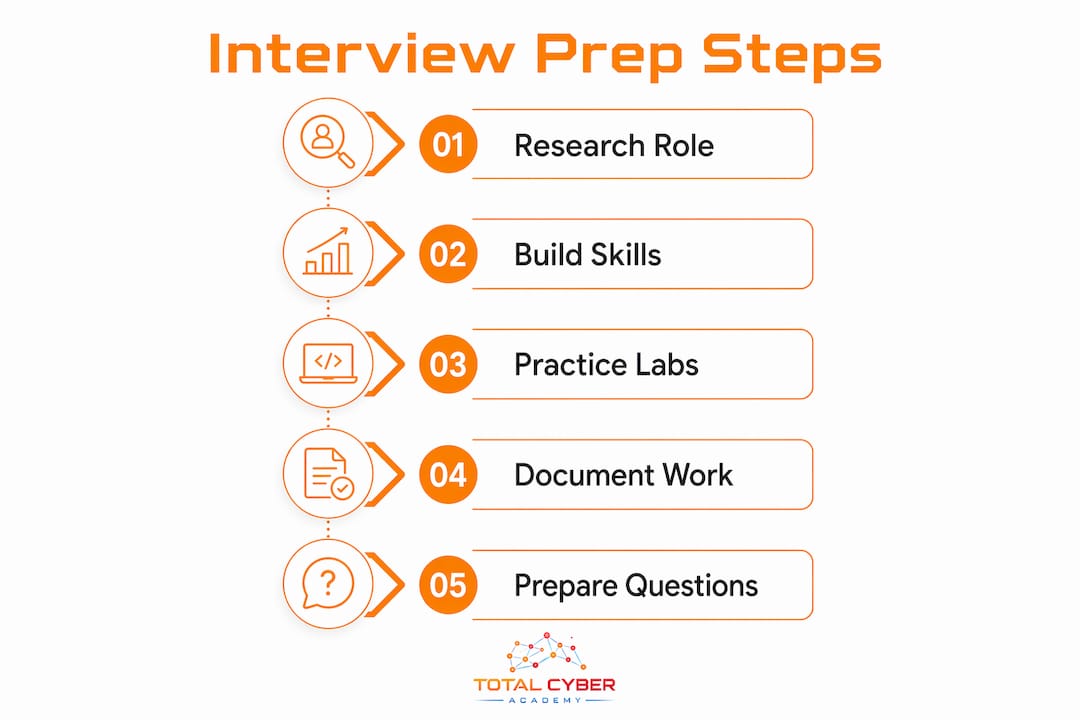
Pro Tip: Document every lab or CTF challenge you complete in a short write-up. These write-ups become portfolio evidence you can reference directly during the interview when asked about hands-on experience.
Building a cybersecurity portfolio that captures your project work, certifications, and lab outcomes gives interviewers concrete proof of your skills rather than claims alone.
What are the most common cybersecurity interview question types?
Cybersecurity interviews use three distinct question types, and each requires a different preparation strategy. Treating them as one category is a common mistake.
Technical questions test your knowledge of specific concepts, tools, and protocols. Expect questions like “Explain the difference between symmetric and asymmetric encryption” or “What is the purpose of a SIEM?” The goal is not just a correct answer. Hiring managers evaluate your communication and stress management as much as your technical accuracy. If you freeze, verbalize your reasoning out loud. That behavior demonstrates problem-solving ability even when you are uncertain.
Scenario-based questions present a realistic security situation and ask how you would respond. For example: “A user reports their workstation is behaving strangely after clicking an email link. Walk me through your response.” These questions test your methodology, not just your knowledge. Use the STAR method (Situation, Task, Action, Result) to structure your answer. Structured responses convey logical thinking under pressure.
Behavioral questions assess your interpersonal skills, resilience, and team fit. Common examples include:
- “Describe a time you had to explain a security risk to a non-technical manager.”
- “Tell me about a project where you had to work under a tight deadline.”
- “How do you stay current with emerging threats?”
- “Describe a situation where you disagreed with a colleague’s security recommendation.”
- “What do you do when you encounter a problem you have never seen before?”
Each of these questions targets a specific competency. Prepare two to three concrete examples from your experience for each behavioral theme: communication, conflict resolution, continuous learning, and performance under pressure. Vague answers cost you the role. Specific, structured answers win it.
How do communication skills affect your cybersecurity interview outcome?
Employers increasingly value the ability to explain complex cybersecurity concepts to non-technical stakeholders as much as deep technical expertise. Effective communication that connects technical risk to business impact is a key differentiator. This is the skill that separates technically qualified candidates from those who actually get hired.
Candidates who can say “This vulnerability creates a $2 million liability exposure if exploited” communicate more effectively than those who say “This is a critical CVSS 9.8 finding.” Both statements are accurate. Only one lands with a business audience.
Common communication mistakes to avoid in cybersecurity interviews:
- Using acronyms without defining them when the interviewer is from HR or a business unit
- Giving answers that are technically correct but lack any business context
- Failing to pause and structure your response before speaking
- Talking past the question because you are nervous
- Missing the opportunity to ask the interviewer a thoughtful question
Asking insightful questions about current threats the team faces or how the organization supports ongoing skill development is one of the most overlooked opportunities in an interview. It signals genuine engagement and team mindset. Candidates who ask nothing signal indifference.
For candidates who want to sharpen how they communicate defensive security concepts, resources on IAM hardening and Zero Trust provide real-world frameworks that translate well into interview discussions about security architecture.
Pro Tip: Prepare three questions for every interview. One about the team’s current threat priorities, one about professional development support, and one about what success looks like in the first 90 days. These questions show you are thinking about contribution, not just compensation.
Key Takeaways
Effective cybersecurity interview preparation requires role-specific research, documented hands-on skills, structured answers to scenario questions, and clear communication that connects technical risk to business impact.
| Point | Details |
|---|---|
| Research the role precisely | Analyze the job description and map your skills to the specific cybersecurity function advertised. |
| Prioritize hands-on evidence | Document labs, CTF challenges, and projects in write-ups you can reference during the interview. |
| Use STAR for scenario questions | Structure scenario and behavioral answers with Situation, Task, Action, and Result for clarity. |
| Communicate risk in business terms | Translate technical findings into business impact language to stand out with non-technical interviewers. |
| Ask thoughtful questions | Prepare questions about current threats and professional development to signal genuine team fit. |
What actually makes a cybersecurity candidate memorable in 2026
Most candidates prepare broadly. The ones who get hired prepare specifically. That is the single most important lesson I have taken from watching cybersecurity hiring cycles play out.
The instinct to demonstrate wide knowledge is understandable, especially for career changers or veterans transitioning into the field. But being ultra-specific about your niche dramatically increases interview success. A candidate who says “I want to work in threat detection within a SOC environment, and here is the detection logic I built in a home lab” is far more compelling than one who says “I am interested in all areas of cybersecurity.”
Honesty about skill gaps also matters more than most candidates realize. Interviewers are experienced professionals. They know when someone is bluffing. Saying “I have not worked with that tool directly, but here is how I would approach learning it” is a stronger answer than a vague claim of familiarity. It shows self-awareness and a learning orientation, both of which hiring managers actively look for.
The post-interview follow-up is another area where most candidates leave value on the table. A concise, specific thank-you email sent within 24 hours that references one specific topic from the interview conversation reinforces your engagement and attention to detail. Generic follow-ups are forgettable. Specific ones are not.
View the interview as a two-way evaluation. You are assessing whether this team and organization will support your growth. That mindset shifts your posture from anxious to confident, and interviewers notice the difference.
— Alden
Totalcyber’s training resources for interview-ready candidates
Preparation is only as good as the practice behind it. Totalcyber is a veteran-owned cybersecurity training organization that builds candidates for exactly the kind of interviews described in this article.
Totalcyber’s cybersecurity training courses include hands-on labs, CTF challenges, and real-world scenarios that produce the documented experience interviewers want to see. The curriculum covers CompTIA Security+, penetration testing, and incident response, giving candidates both the credentials and the practical depth to answer scenario-based questions with confidence. Totalcyber also provides interview success resources covering common question types, mock interview practice, and answer frameworks. If you are preparing for your first cybersecurity role or transitioning from another field, these resources close the gap between knowledge and job-ready performance.
FAQ
What is a cybersecurity job interview?
A cybersecurity job interview is a structured evaluation where employers assess a candidate’s technical knowledge, hands-on experience, problem-solving approach, and communication skills for a specific security role. It typically includes technical questions, scenario-based challenges, and behavioral questions.
What are the most common cybersecurity interview questions?
Common questions cover networking fundamentals, encryption concepts, the CIA triad, incident response procedures, and security frameworks like NIST and MITRE ATT&CK. Behavioral questions about communication, teamwork, and handling pressure are equally standard.
How should I prepare for scenario-based cybersecurity questions?
Use the STAR method (Situation, Task, Action, Result) to structure your answers. Practice walking through realistic incident response or threat detection scenarios out loud, and document your home lab or CTF work so you have concrete examples ready.
How important are soft skills in a cybersecurity interview?
Soft skills are critical. Employers value the ability to explain technical risk in business terms as much as deep technical expertise. Candidates who communicate clearly and demonstrate resilience under pressure consistently outperform those with technical knowledge alone.
How do I stand out in a cybersecurity interview?
Be specific about your cybersecurity niche and back your claims with documented hands-on work. Ask thoughtful questions about the team’s current threat priorities and professional development support. Send a specific, personalized follow-up email within 24 hours of the interview.