
A cybersecurity apprenticeship is defined as a paid, earn-while-you-learn program that combines structured on-the-job training with formal classroom instruction to prepare individuals for careers in cybersecurity. Unlike a degree program, apprentices earn a salary from day one while building skills under direct supervision. The U.S. Department of Labor sets the standards for these programs, requiring 2,000+ hours of on-the-job training and at least 144 hours of classroom instruction annually. Cybersecurity jobs are projected to grow 32% through 2032, making this pathway one of the most practical routes into the field for career changers, veterans, and newcomers alike.
What is a cybersecurity apprenticeship program?
A cybersecurity apprenticeship is a formal, registered training program that follows U.S. Department of Labor standards for program length, training hours, and supervised progression. Programs typically run 12–24 months and require apprentices to complete both paid work experience and structured classroom learning simultaneously. This dual structure separates apprenticeships from informal internships or self-study paths.
Apprenticeships combine paid work, structured training, and supervised progression in a way that changes the risk profile for candidates who cannot afford unpaid routes. Employers also benefit because apprentices arrive with baseline knowledge aligned to real job tasks. The result is a training model that serves both sides of the hiring equation.

The table below summarizes the core components of a typical cybersecurity apprenticeship program.
| Component | Details |
|---|---|
| Program length | 12–24 months |
| On-the-job training | 2,000+ hours of supervised work experience |
| Classroom instruction | 144+ hours annually |
| Starting roles | Security operations support, IT support, network infrastructure |
| Credentials earned | Industry-recognized certifications such as CompTIA Security+ |
| Oversight | Registered with U.S. Department of Labor |
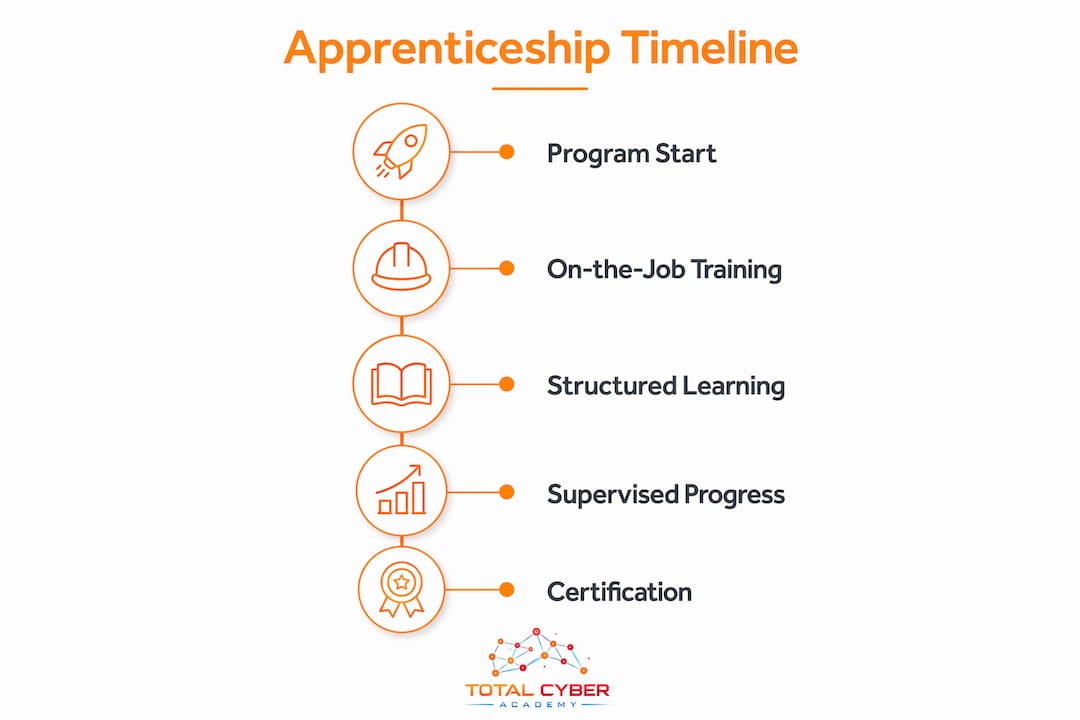
Common entry-level tasks include monitoring security alerts, handling IT support tickets, configuring endpoint devices, and assisting with network setup. As apprentices demonstrate reliability and technical growth, they progress toward core cybersecurity responsibilities such as incident response support, vulnerability scanning, and risk and compliance tasks. Employers prioritize process adherence and documentation accuracy at every stage.
Pro Tip: Before applying, map out which specific tasks interest you most. Knowing whether you prefer network security, cloud governance, or risk and compliance helps you target programs that align with your goals.
Who qualifies? Entry requirements and how to prepare
Most cybersecurity apprenticeship programs require a high school diploma or GED as the minimum education credential. Many programs do not require prior formal experience, but they do look for aptitude in communication, problem solving, and basic technical areas such as networking or operating system familiarity. That distinction matters: “no experience required” does not mean “no preparation needed.”
Recruiters emphasize that self-study and certifications matter significantly even when formal experience is absent. Candidates who complete foundational courses or earn entry-level credentials before applying stand out from those who arrive with nothing. The field rewards initiative, and apprenticeship selection panels notice it.
Strong candidates typically demonstrate the following before applying:
- A high school diploma or GED (minimum requirement for most programs)
- Foundational certifications such as CompTIA A+ or CompTIA Network+
- Participation in Capture The Flag competitions or home lab projects
- Basic familiarity with Windows and Linux operating systems
- Clear written and verbal communication skills
- Willingness to pass a background check
Background checks are standard across most registered apprenticeship programs, particularly those tied to government or defense contractors. Communication skills matter as much as technical aptitude because apprentices write incident tickets, document procedures, and report findings to senior staff daily.
Pro Tip: Complete at least one free or low-cost online course in networking or operating systems before you apply. Platforms offering structured labs give you concrete talking points in interviews and demonstrate the self-starter behavior employers want.
Cybersecurity apprenticeships for veterans
Veterans hold a structural advantage when entering cybersecurity apprenticeships. The DoD SkillBridge program allows active-duty service members to participate in apprenticeships during their last 180 days of service while continuing to receive full military pay and benefits. That arrangement eliminates the financial risk that stops many career changers from pursuing apprenticeships.
For veterans who have already separated, the GI Bill covers approved apprenticeship programs and provides a monthly housing allowance during training. This benefit makes the apprenticeship model financially viable for veterans who might otherwise feel pressure to take any available job immediately after service. The combination of SkillBridge and GI Bill creates a two-stage transition pathway that few other career fields can match.
Veterans pursuing these benefits must follow a specific verification process:
- Confirm the apprenticeship program is registered with the U.S. Department of Labor.
- Verify the program holds VA approval specifically for apprenticeship training, not just general education approval.
- Contact your State Approving Agency to confirm GI Bill housing allowance eligibility for the specific program.
- Submit SkillBridge requests through your chain of command at least 180 days before your separation date.
- Request written confirmation of program approval before signing any enrollment agreement.
Veterans must confirm program registrations with both DOL and State Approving Agencies to ensure GI Bill benefits and housing allowances apply correctly. General education approval from the VA is not sufficient for apprenticeship housing allowances. This is a common and costly mistake that delays benefit payments.
Pro Tip: Use the Totalcyber SkillBridge training guide to verify program eligibility and understand exactly which documentation your chain of command needs before you submit your SkillBridge request.
Benefits of apprenticeships versus traditional degree programs
Cybersecurity apprenticeships offer a fundamentally different financial model than four-year degree programs. Apprentices earn a salary throughout their training period instead of paying tuition. That difference compounds over time: a degree candidate may spend four years accumulating debt, while an apprentice spends the same period building savings, work history, and credentials.
“The apprenticeship model removes the financial barrier that keeps talented people out of cybersecurity. You do not need to choose between paying rent and building a career. The program pays you to learn the job.”
The 32% projected job growth in cybersecurity through 2032 means the demand for qualified professionals will continue to outpace supply. Apprenticeships address the cybersecurity skills gap directly by producing job-ready candidates faster than traditional academic pipelines. Employers who sponsor apprentices also reduce their own hiring risk because they train candidates to their specific processes and culture.
| Factor | Apprenticeship | Degree program |
|---|---|---|
| Cost to learner | Paid from day one | Tuition costs throughout |
| Time to employment | 12–24 months | 4+ years |
| Work experience | Integrated throughout | Typically limited to internships |
| Credentials earned | Industry certifications | Academic degree |
| Debt risk | Minimal | High |
| Employer alignment | Direct, program-specific | General, requires onboarding |
Industry-recognized credentials such as CompTIA Security+ are commonly earned during or immediately after apprenticeship programs. These certifications carry weight with hiring managers regardless of whether a candidate holds a degree. For career changers entering cybersecurity from unrelated fields, this credential pathway is often faster and more directly valued than returning to school.
How to succeed and advance during your apprenticeship
Success in a cybersecurity apprenticeship starts with reliability, not technical brilliance. Employers value apprentices who follow security processes and documentation protocols consistently over those who seek only high-profile tasks. Showing up on time, completing assignments accurately, and communicating clearly with supervisors builds the trust that leads to expanded responsibilities.
Apprenticeships typically start with security-adjacent IT roles such as IT support or infrastructure work before granting access to core security tools and live incidents. This progression is intentional. Employers need to know you understand the underlying technology before you touch sensitive systems. Treat the early months as a foundation-building phase, not a delay.
Practical steps that accelerate advancement include:
- Build a personal home lab to practice skills outside of work hours
- Participate in Capture The Flag competitions to sharpen problem-solving under pressure
- Earn incremental certifications aligned with your apprenticeship track
- Document every task, project, and skill gained for your cybersecurity portfolio
- Ask your supervisor for feedback after completing each major assignment
Candidates who demonstrate self-starter behaviors through home lab projects and CTF participation are more likely to succeed in interviews and progress faster within apprenticeship programs. The habit of continuous learning signals to employers that you will grow beyond the apprenticeship role. That signal directly influences whether you receive a full-time offer at the end of the program.
Pro Tip: Keep a weekly log of tasks completed, tools used, and problems solved during your apprenticeship. This log becomes the raw material for your resume, portfolio, and future job interviews.
Key Takeaways
A cybersecurity apprenticeship is the most direct, debt-free pathway into the cybersecurity field, combining paid work, structured training, and industry credentials within 12–24 months.
| Point | Details |
|---|---|
| Definition | A paid, DOL-registered program combining 2,000+ hours of work experience with 144+ classroom hours annually. |
| Entry requirements | High school diploma or GED required; self-study and foundational certifications significantly improve selection odds. |
| Veteran benefits | DoD SkillBridge covers the last 180 days of service; GI Bill provides housing allowance for VA-approved programs. |
| Career outcomes | Apprentices earn industry certifications and enter a field projected to grow 32% through 2032. |
| Success factors | Reliability, documentation discipline, and continuous self-directed learning drive advancement to full-time roles. |
Why apprenticeships deserve more credit than they get
Most people who ask about cybersecurity apprenticeships expect to hear about firewalls and ethical hacking from week one. That expectation sets them up for frustration. The reality is that the first months of any apprenticeship look a lot like IT support work, and that is exactly how it should be. You cannot defend a network you do not understand at the infrastructure level.
The misconception I see most often is that “no experience required” means the program will teach you everything from scratch with no effort on your part. It does not. The programs that produce the best outcomes are the ones where candidates arrive having already completed foundational coursework, earned a basic certification, or built something in a home lab. The apprenticeship then accelerates what you already started.
Veterans and career changers actually have a structural advantage here that they often underestimate. Military service builds exactly the discipline, process adherence, and communication skills that cybersecurity employers value most. A veteran who has managed communications equipment or maintained classified systems already thinks in terms of access control and operational security. That mindset transfers directly. The technical knowledge fills in quickly when the professional habits are already solid.
The path is not glamorous at the start. It is methodical, structured, and sometimes repetitive. But the candidates who treat that structure as an asset rather than an obstacle are the ones who receive full-time offers and advance into roles that genuinely matter. If you are a career changer or veteran considering this path, the career changer roadmap at Totalcyber is worth reviewing before you apply anywhere.
— Alden
Totalcyber training for cybersecurity apprentice candidates
Preparing for a cybersecurity apprenticeship requires more than reading about the field. You need hands-on practice, certification preparation, and structured guidance aligned with what employers actually test during selection.
Totalcyber offers expert-led cybersecurity training courses built specifically for beginners, career changers, and veterans entering the field. The curriculum covers CompTIA A+, Network+, and Security+ certification preparation alongside practical lab work that mirrors real apprenticeship tasks. Veterans can access GI Bill-eligible training programs designed to align with DOL-registered apprenticeship requirements. Whether you are preparing your first application or strengthening your credentials mid-program, Totalcyber’s full course catalog provides the structured preparation that selection panels notice.
FAQ
What is a cybersecurity apprenticeship?
A cybersecurity apprenticeship is a paid, DOL-registered training program that combines 2,000+ hours of supervised on-the-job experience with 144+ hours of annual classroom instruction, typically lasting 12–24 months.
Do I need a college degree to apply?
Most programs require only a high school diploma or GED. Prior formal experience is not required, but foundational certifications such as CompTIA A+ or Network+ significantly improve your selection odds.
How do veterans use GI Bill benefits for apprenticeships?
Veterans can use GI Bill benefits to receive a monthly housing allowance during an approved apprenticeship, but the program must hold specific VA and DOL approval for apprenticeship training, not just general education approval.
What entry-level cybersecurity roles do apprentices start in?
Apprentices typically begin in IT support, security operations support, or network infrastructure roles before progressing to core cybersecurity tasks such as incident response support and vulnerability scanning.
How long does a cybersecurity apprenticeship take?
Most registered cybersecurity apprenticeship programs run 12–24 months, after which graduates typically earn industry-recognized certifications and qualify for full-time cybersecurity positions.