
A cybersecurity specialization is a focused career path within the broader security field, where professionals develop deep expertise in one domain such as offensive security, defensive operations, or governance and compliance. 59% of organizations report critical or significant cybersecurity skills gaps, with a global shortage of 4 million professionals in 2025. That shortage means opportunity, but only for those who choose the right path with intention. This cybersecurity specialization choosing guide walks you through the foundational skills you need first, the main career tracks available, and a practical framework for matching your personality and goals to the right role. Choosing well from the start saves you years of wasted effort and misdirected certification spending.
What foundational skills do you need before choosing a cybersecurity specialization?
Every cybersecurity career starts in the same place, regardless of which specialization you eventually pursue. You need a working command of Linux, networking fundamentals, and operating system internals before any specialization makes sense. Without these, advanced concepts in either offensive or defensive security will not stick.
The core prerequisites most hiring managers expect include:
- Linux proficiency: File permissions, command-line navigation, process management, and basic shell scripting
- Networking fundamentals: TCP/IP, DNS, HTTP/S, firewalls, VPNs, and packet analysis using tools like Wireshark
- Operating system internals: Windows Active Directory, registry structure, and process behavior
- Scripting basics: Python or Bash for automating tasks and understanding attack scripts
- Security concepts: CIA triad, authentication models, and common vulnerability classes
Beginners typically spend 2–3 years building these foundational skills before specializing effectively. That timeline is not a barrier. It is the period where you build the awareness needed to make an informed specialization choice.
Early specialization risks wasted investment; professionals who skip the foundation often find themselves unable to perform the hands-on work their certifications imply. Breadth first, depth second is the correct sequence. A beginner who understands how a network packet travels from source to destination will outperform a certified specialist who cannot read a packet capture.
Pro Tip: Build a home lab using free tools like VirtualBox and Kali Linux before spending money on any certification. Employers value demonstrated hands-on experience over a certificate list.
For a structured starting point, Totalcyber’s beginner career guide maps out exactly which foundational skills to build and in what order.
What are the main types of cybersecurity specializations explained by role and work style?
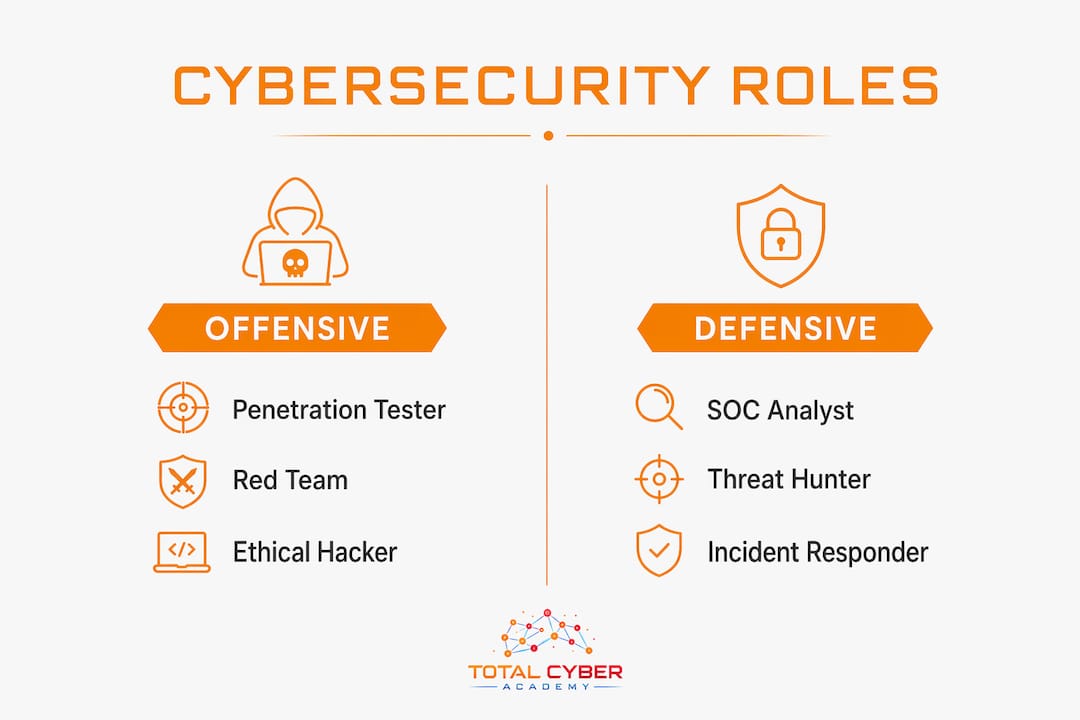
Cybersecurity specializations fall into three broad categories: offensive security, defensive security, and governance, risk, and compliance (GRC). Each category contains multiple roles, and each demands a different thinking style and daily work environment.
Offensive security
Offensive security professionals, commonly called penetration testers or Red Team operators, simulate attacks against systems to find weaknesses before real attackers do. This work rewards creative, lateral thinking. A penetration tester must think like an adversary, which means understanding not just what a system does but how it can be abused. Roles include penetration tester, Red Team operator, bug bounty hunter, and exploit developer.

Defensive security
Defensive security, or Blue Team work, focuses on detecting, analyzing, and responding to threats. SOC Analysts monitor security event logs and alerts. Incident Responders investigate confirmed breaches and contain damage. The fastest path to employment runs through Blue Team roles because the work is structured, the entry requirements are clearer, and demand is constant. This path suits professionals who prefer pattern recognition and systematic problem-solving over open-ended creative challenges.
Governance, risk, and compliance
GRC professionals translate technical risk into business language. They write policies, conduct risk assessments, manage compliance frameworks like NIST CSF, ISO 27001, and SOC 2, and communicate security posture to executives. This path suits professionals with strong communication skills and an interest in organizational process rather than hands-on technical work.
Emerging specializations
Beyond the three core tracks, several high-growth areas deserve attention:
- Cloud security: Securing AWS, Azure, and Google Cloud environments. Cloud security roles lead in job openings and salary growth in 2026.
- Application security (AppSec): Integrating security into software development pipelines using SAST, DAST, and threat modeling.
- Digital forensics and incident response (DFIR): Collecting and analyzing digital evidence after a breach.
- Industrial control systems (ICS) security: Protecting operational technology in manufacturing, energy, and utilities.
| Specialization | Work style | Entry speed | Salary trajectory |
|---|---|---|---|
| Offensive (Red Team) | Creative, adversarial | Slower (2–4 years) | High with experience |
| Defensive (Blue Team / SOC) | Structured, reactive | Faster (1–2 years) | Steady, strong growth |
| GRC | Analytical, communicative | Moderate (1–3 years) | High at senior levels |
| Cloud security | Technical, architecture-focused | Moderate (2–3 years) | Highest current demand |
Pro Tip: The distinction between Blue and Red Teams is becoming fluid. Professionals who gain experience on both sides become significantly more effective and more employable.
How do you assess your personality and goals to match the right cybersecurity path?
Matching your personality to a specialization is the most underrated step in the entire decision process. Most beginners choose a path based on salary data or what sounds exciting. The professionals who stay satisfied five years in chose based on how they actually think and what kind of work they want to do every day.
Use this framework to assess your fit:
- Identify your thinking style. Do you prefer open-ended problems with no defined solution (offensive), structured workflows with clear procedures (defensive), or strategic communication and policy work (GRC)?
- Examine your daily work preferences. Do you want to write code and break systems, monitor dashboards and respond to alerts, or write reports and brief executives?
- Map your existing experience. Previous career experience in adjacent disciplines accelerates transition and adds employer value. A former network engineer transitions naturally into defensive security. A former auditor fits GRC immediately.
- Set realistic salary expectations. Cloud security and offensive roles pay the most at senior levels, but they also require the longest ramp-up time. Blue Team roles offer faster income with a steady growth curve.
- Accept that your choice is not permanent. Specialization is iterative; many professionals shift focus as interests and industry demands evolve. Choosing a starting point is not a lifetime commitment.
The most common mistake is selecting a specialization based on a job title that sounds impressive rather than the actual daily tasks that title requires. Shadow a professional in your target role, watch day-in-the-life content, or complete a short lab course in that domain before committing to a certification path.
Pro Tip: Before spending money on any certification, read three to five real job postings for your target role. Note the tools, responsibilities, and required experience. That list is your actual curriculum.
What practical steps and timelines should beginners follow to pursue a specialization?
The path from zero to employed in cybersecurity follows a predictable sequence, even if the timeline varies by specialization.
- Build the foundation first. Complete CompTIA Security+ and Network+ as your entry-level credentials. These are the industry standard starting point recognized by most employers.
- Choose your track and go deeper. For Blue Team, pursue CompTIA CySA+ or a SOC-focused training program. For offensive security, target eJPT (eLearnSecurity Junior Penetration Tester) before moving to OSCP. For GRC, pursue CompTIA Security+ combined with a NIST or ISO 27001 foundation course.
- Build hands-on evidence. Employers prioritize demonstrated hands-on skills over certification lists. Use platforms like TryHackMe and Hack The Box for Blue and Red Team practice. Build a cybersecurity portfolio that documents your lab work and projects.
- Apply for internships or entry-level roles early. Do not wait until you feel fully ready. A SOC Analyst role at an MSSP (managed security service provider) gives you real alert triage experience that no lab fully replicates.
- Adjust based on market demand. Cloud security certifications like AWS Security Specialty or Microsoft SC-900 add significant value regardless of your primary track.
Starting in a SOC role provides experience that directly improves pentesting and offensive effectiveness. Professionals who understand how defenders think and what logs they monitor become far more dangerous and effective as Red Team operators. The two sides of cybersecurity are not separate careers. They are two perspectives on the same system.
| Career track | Typical entry timeline | Key certifications |
|---|---|---|
| SOC Analyst (Blue Team) | 12–18 months | CompTIA Security+, CySA+ |
| Penetration Tester (Red Team) | 24–36 months | eJPT, OSCP, CEH |
| GRC Analyst | 12–24 months | CompTIA Security+, CISM |
| Cloud Security Engineer | 18–30 months | AWS Security, SC-900 |
Chasing certifications without understanding daily role realities is the most expensive mistake beginners make. A certification proves you studied. A portfolio of lab work and real experience proves you can do the job. For those making a career change, Totalcyber’s career changer roadmap provides a structured path from your current background into cybersecurity.
Key Takeaways
Choosing the right cybersecurity specialization requires assessing your thinking style, building a solid technical foundation, and aligning your path with real market demand before committing to any certification.
| Point | Details |
|---|---|
| Foundation before specialization | Build Linux, networking, and scripting skills before choosing any focused path. |
| Personality drives satisfaction | Match your thinking style to the work: creative for offensive, structured for defensive, communicative for GRC. |
| Blue Team offers the fastest entry | SOC Analyst roles provide the quickest path to employment and build skills that benefit all other tracks. |
| Hands-on evidence beats certifications | Employers value lab work, internships, and portfolios more than certification lists alone. |
| Specialization is not permanent | Most professionals shift focus as their interests and the industry evolve. Start somewhere and adapt. |
Why your first specialization choice matters less than you think
Here is the uncomfortable truth I have seen play out repeatedly: most people entering cybersecurity spend months agonizing over which specialization to choose, then pick one based on salary rankings or what sounds exciting in a YouTube video. That approach almost always leads to a mismatch between expectations and daily reality.
The professionals I have seen build the most satisfying careers started broad, got their hands dirty in a SOC or help desk role, and let their natural inclinations surface through actual work. You do not fully know whether you prefer hunting threats or breaking systems until you have done both, even briefly. Many professionals adapt their specialization focus throughout their careers as interests and industry demands shift. That is not a failure of planning. That is how the field works.
What I would caution against is the certification treadmill. Depth in a chosen niche drives salary and advancement far more than a long list of credentials without hands-on practice behind them. One well-documented home lab project that demonstrates real skill will open more doors than three certifications you cannot speak to in an interview.
My practical advice: pick the track that matches how you think, not how much it pays at the top. The salary follows the skill. The skill follows genuine interest. And genuine interest is the only thing that keeps you learning in a field that changes as fast as cybersecurity does.
— Alden
Totalcyber’s training paths for aspiring cybersecurity professionals
Totalcyber was built specifically for people at the beginning of this decision process.
Whether you are a complete beginner, a career changer, or a veteran transitioning into IT, Totalcyber’s cybersecurity training programs are structured around the exact foundational skills and specialization tracks covered here. Courses include hands-on labs, expert instruction, and preparation for industry-recognized credentials like CompTIA Security+ and Network+. The CompTIA course catalog covers both entry-level and advanced certification paths, with flexible formats designed to fit around your current schedule. Totalcyber’s mission is direct: prepare you for a real job, not just an exam.
FAQ
What is a cybersecurity specialization?
A cybersecurity specialization is a focused area of expertise within the broader security field, such as penetration testing, SOC analysis, cloud security, or governance and compliance. Professionals choose a specialization after building general foundational skills in networking, Linux, and security concepts.
How long does it take to get a cybersecurity job?
Blue Team roles like SOC Analyst are typically reachable within 12–18 months for motivated beginners who build foundational skills and earn CompTIA Security+. Offensive security roles like penetration tester generally require 24–36 months of preparation and hands-on experience.
Which cybersecurity specialization pays the most?
Cloud security roles currently lead in salary growth and job openings in 2026. Experienced penetration testers and Red Team operators also command high salaries, though they require a longer ramp-up period than defensive or GRC roles.
Do I need a degree to specialize in cybersecurity?
A degree is not required for most cybersecurity roles. Employers consistently prioritize hands-on skills, industry certifications like CompTIA Security+, and demonstrated lab experience over formal academic credentials.
What is the best first certification for cybersecurity?
CompTIA Security+ is the most widely recognized entry-level certification and serves as a prerequisite or baseline for most cybersecurity job postings. Pairing it with CompTIA Network+ builds the networking foundation that every specialization requires.
Recommended
- Cybersecurity Job Interview Preparation Guide 2026 – Total Cyber Academy!
- Career Changer Cybersecurity Success Roadmap: 2026 Guide – Total Cyber Academy!
- Cybersecurity Portfolio Building Step by Step – Total Cyber Academy!
- Cybersecurity Workforce Veteran Initiatives: 2026 Guide – Total Cyber Academy!