
Cybersecurity careers fall into six main role families: defensive analysis, incident response, offensive testing, security engineering and cloud, governance and risk, and leadership. The fastest way in is to map your background to a NICE Framework work role, earn a foundational credential like Security+, and start proving your skills in labs or a hands-on training program.
TL;DR:
- Most entry-level cybersecurity roles require a foundational certification like Security+ and practical lab experience, usually after 6 to 18 months in related IT jobs.
- Cybersecurity tends to branch into six main families, with roles favoring either investigative, builder, or communicator skills depending on the specialization.
- Certifications only matter when paired with demonstrable skills through hands-on projects, capture-the-flag challenges, or internships, which accelerate into job readiness.
- Demand remains strong but is geographically uneven, with higher salaries often linked to security clearances and specific high-demand roles in government and critical sectors.
- Building a career roadmap involves matching your current skills to NICE Framework roles, then focusing on targeted training, certifications, and portfolio projects to prove your capabilities.
Table of Contents
- What Are the Main Cybersecurity Career Paths?
- What Entry-Level Jobs Lead Into Cybersecurity?
- Which Skills and Certifications Actually Matter?
- How Do You Build Experience Before Your First Job?
- Is Cybersecurity Actually in Demand Right Now?
- How Do You Build Your Own Career Roadmap?
- Why Hands-On Training Shortens the Path to Hire
- Where Are Cybersecurity Careers Headed Next?
- Do You Need a Specific Degree for Cybersecurity?
- Where Do Cybersecurity Professionals Actually Work?
- An Editorial Take on Starting Late (or Starting Over)
- How Totalcyber Turns Training Into Job-Ready Proof
- Sources
- FAQ
What Are the Main Cybersecurity Career Paths?
Every cybersecurity job eventually sorts into one of six broad families, and recognizing which one appeals to you narrows the entire search.
Defensive security / SOC analysis covers the analysts watching alerts, tuning detection rules, and triaging suspicious activity in a security operations center. It suits people who like patterns, repetition with variation, and calm decision-making under pressure. Typical titles: SOC Analyst, Security Analyst.
Incident response and digital forensics kicks in after something goes wrong. These professionals reconstruct timelines, contain breaches, and write up what happened. It fits investigators at heart, people who enjoy piecing together evidence under time pressure.
Offensive security (penetration testing) means legally breaking into systems to find weaknesses before attackers do. It rewards curiosity, persistence, and a builder’s instinct for how things fail. Roles include Penetration Tester and Red Team Operator.
Security engineering and cloud/DevSecOps focuses on building the defenses rather than reacting to alerts: configuring firewalls, hardening cloud environments, automating security checks in software pipelines. This path suits people with a systems administration or coding background.
Governance, risk, and compliance (GRC) translates regulations and business risk into policy. It fits detail-oriented communicators more than hands-on technicians.
Security leadership and consulting oversees programs, budgets, and strategy, usually reached after years in one of the technical tracks above.
- SOC and IR roles favor people who like triage and investigation
- Offensive and engineering roles favor builders and breakers
- GRC and leadership favor communicators and strategists
What Entry-Level Jobs Lead Into Cybersecurity?
Almost nobody starts their career path for cybersecurity at the analyst desk. Most people arrive through an adjacent IT role first, which is actually an advantage: employers trust candidates who already understand how networks and systems behave before they start defending them.
The most common feeder jobs are help desk technician, network or systems administrator, junior software QA, and DevOps support. Each maps cleanly to a next step.
- Help desk to junior SOC analyst (roughly 6 to 18 months): build ticketing and troubleshooting experience, then add Security+ and a home lab.
- Network admin to security engineer (1 to 3 years): existing firewall and routing knowledge transfers directly into hardening and cloud security work.
- QA/DevOps to application security or DevSecOps (1 to 2 years): coding familiarity becomes a shortcut into secure development roles.
- Junior SOC analyst to incident responder (2 to 4 years): alert triage experience builds the pattern recognition forensics work demands.
- Any technical role to GRC analyst (varies): strong writing and stakeholder skills can fast-track a move into compliance work even without deep technical depth.
Employers hiring at 0 to 2 years typically want one certification and demonstrable lab work. Past 2 to 5 years, they expect a specialization and often a second, role-specific credential.
Which Skills and Certifications Actually Matter?
Certifications only matter when they map to real, checkable skills. Hiring managers increasingly compare a resume’s listed credentials against a candidate’s ability to demonstrate the underlying task in an interview or a work sample. This is exactly what the NICE Framework’s Task-Knowledge-Skill statements were built to formalize: converting a vague job title into a checklist of what someone can actually do.
Skills worth building by role:
- SOC/analyst: log analysis, SIEM tools, alert triage
- Incident response: memory and disk forensics, timeline reconstruction
- Penetration testing: exploitation frameworks, scripting, reporting
- Cloud/security engineering: identity and access management, infrastructure as code, container security
- GRC: risk frameworks, audit processes, policy writing
Pro Tip: Treat every certification as a proxy for a NICE work role’s TKS statements, not an end goal. If you can’t explain what a certification proved you can do, an interviewer will notice.
For early-career candidates, sequence matters. Start with CompTIA’s Security+ and Network+, which cover foundational knowledge most employers screen for. Add CySA+ or CEH once you’ve picked a lane, and treat CISSP as a mid-career credential, since it requires several years of documented experience to even sit the exam.
How Do You Build Experience Before Your First Job?
Certifications prove you know concepts. Labs, capture-the-flag competitions (CTFs), and micro-challenges prove you can apply them, and that gap is exactly what stalls a lot of otherwise qualified applicants. Training programs built around hands-on labs close that gap faster than self-study alone, because the exercises mirror what a SOC or pen test engagement actually looks like.
Build a track record with:
- Weekly CTF challenges through platforms that host beginner-friendly rooms
- A home lab running vulnerable virtual machines you attack and defend
- An internship, apprenticeship, or volunteer security review for a nonprofit
- NICCS-listed micro-challenges tied to specific work roles
Pro Tip: A three-item portfolio, a log analysis writeup, a vulnerability scan report, and a small automation script, tells an interviewer more than a resume line listing five certifications.
Internships and apprenticeships remain the highest-leverage move if you can find one; even an unpaid volunteer assessment for a local nonprofit gives you a practical project to walk through in an interview.
Is Cybersecurity Actually in Demand Right Now?
Demand is strong and geographically uneven. The Bureau of Labor Statistics projects continued fast growth for information security analysts, with median pay well above the national average for all occupations, alongside typical requirements of a bachelor’s degree or equivalent hands-on experience.
CyberSeek’s interactive heat map shows that demand concentrates heavily in specific metro areas and around specific roles like SOC analyst and security engineer, rather than spreading evenly nationwide. Pay varies with government clearance status, location, seniority, and how specialized your skill set is. A cleared analyst near Washington, D.C. earns meaningfully more than an equivalent role in a smaller market.
How Do You Build Your Own Career Roadmap?
Turn the theory above into a plan you can act on this week.
Start with an inventory: list every technical and soft skill from your current job, then match them against NICE work role descriptions to find one or two realistic targets. A help desk background maps naturally to SOC Analyst; a project management background maps toward GRC.
Then commit to three concrete moves:
- Enroll in a hands-on course or lab environment tied to your target work role.
- Schedule one foundational certification exam within the next 90 days.
- Complete one portfolio project or NICCS micro-challenge you can discuss in an interview.
- Use NICCS’s Cyber Career Pathways Tool to find training aligned to your target role
- Use CyberSeek to confirm demand and typical requested credentials before committing months of study
A career-changer roadmap built around this sequence, map, cert, prove, tends to move faster than open-ended self-study.
Why Hands-On Training Shortens the Path to Hire
The academy builds courses around labs, mentor feedback, and certification prep rather than lecture-only content. That combination matters because hiring filters increasingly screen for applied evidence, not just credentials. Readers who want a guided, role-focused path can start with a beginner’s training guide before committing to a full program.
Where Are Cybersecurity Careers Headed Next?
The six core families above will keep anchoring the field, but three specializations are pulling ahead in job postings and pay premiums.
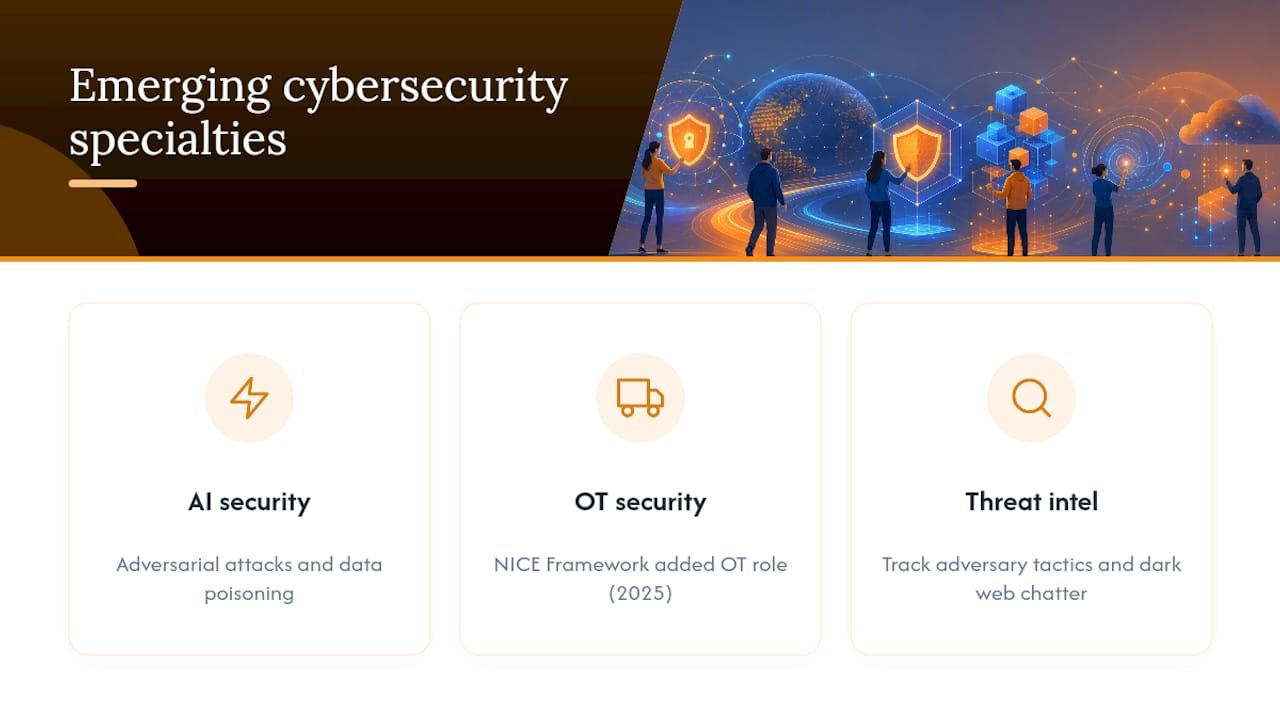
AI security is emerging fastest. As organizations deploy machine learning models in production, they need people who understand adversarial attacks on models, data poisoning, and how to secure the pipelines feeding AI systems. This role sits at the intersection of traditional security engineering and data science, and few candidates currently have both halves.
IoT and operational technology (OT) security has grown urgent as manufacturing, energy, and healthcare connect more physical equipment to networks. The 2025 update to the NICE Framework added a dedicated OT cybersecurity engineering work role, a direct signal that federal workforce planners see this as a distinct, growing specialty rather than a subset of general engineering.
Threat intelligence analysis rounds out the emerging tier. These analysts track adversary tactics, monitor dark web chatter, and turn raw indicators into decisions leadership can act on. It draws heavily from research skills and pattern analysis, and it often becomes a natural next step for experienced SOC or incident response professionals looking for more strategic work.
None of these specializations are truly entry-level. Each assumes a foundation in one of the six core families first, then layers specialized knowledge on top. If AI security or OT security interests you, the practical move is still to build core SOC, engineering, or analyst skills before branching out, since the specialization itself typically requires 2 to 5 years of general experience as a prerequisite.
Do You Need a Specific Degree for Cybersecurity?
A degree helps but rarely gates entry the way people assume. The Bureau of Labor Statistics notes that information security analyst roles commonly expect a bachelor’s degree in computer science, information technology, or a related field, but plenty of working analysts arrived through associate degrees, bootcamps, military training, or self-directed study paired with certifications.
What matters more than the degree title is whether your education produced provable skills. A computer science degree signals strong programming and systems fundamentals, useful for engineering and offensive security tracks. An information systems or business degree fits GRC and risk-focused paths better, since those roles lean on policy and communication as much as technical depth.
Career changers without a technical degree are not at a permanent disadvantage. A veteran with logistics or intelligence experience, or an IT professional with years of help desk work, often has transferable skills a four-year degree alone doesn’t teach: discipline, documentation habits, and comfort with ambiguity. In those cases, a focused certification track paired with hands-on labs can close the gap faster than returning to school. Graduate degrees become relevant later, mainly for people aiming at research roles, academic positions, or senior leadership tracks where a master’s in cybersecurity or an MBA adds credibility for cross-functional management.
Where Do Cybersecurity Professionals Actually Work?
Cybersecurity roles exist wherever sensitive data or critical infrastructure does, which means the work environment varies more than most people expect walking in.
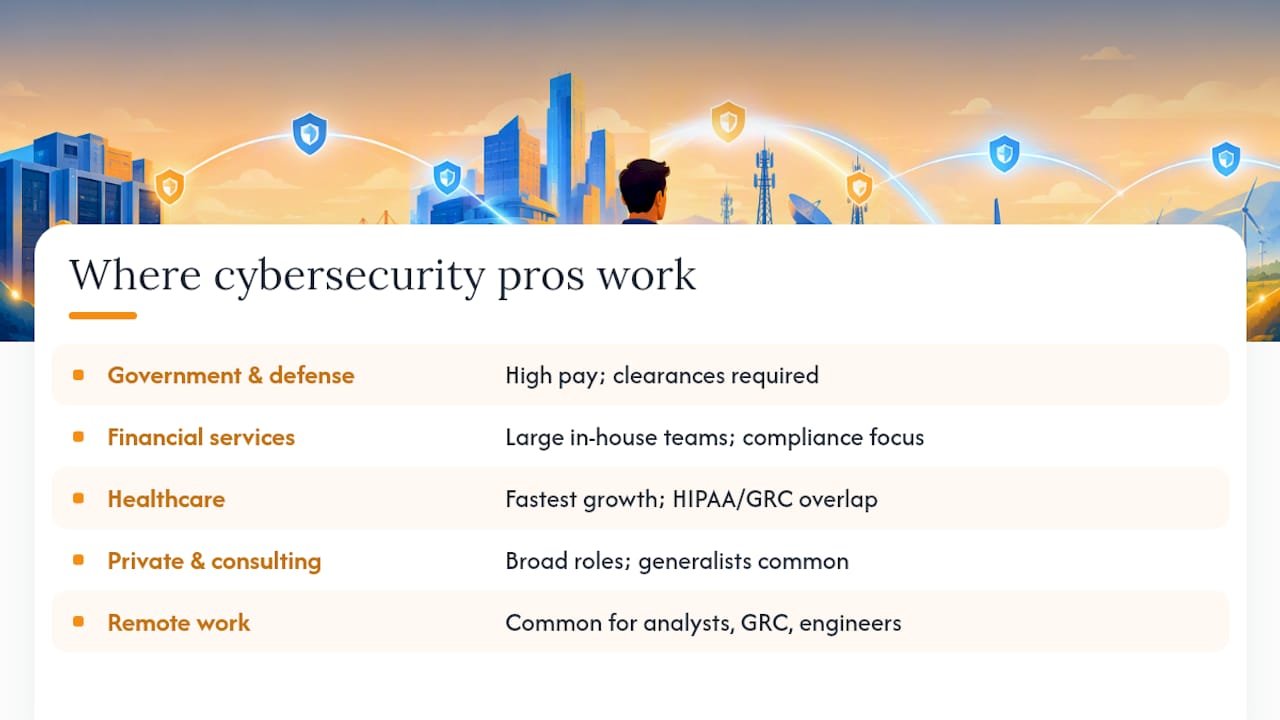
Government and defense roles often require security clearances and offer some of the highest compensation, particularly for cleared incident response and offensive security specialists. The tradeoff is a slower hiring process and stricter background requirements.
Financial services employs large in-house security teams because regulatory pressure and fraud risk never let up. These environments tend to favor GRC and detection-focused roles heavily, given how much compliance reporting the sector demands.
Healthcare has become one of the fastest-growing employers of security talent as electronic health records and connected medical devices expand the attack surface. HIPAA compliance work overlaps significantly with GRC career paths here.
Private sector and consulting firms offer the widest variety, from startups needing a single generalist security hire to consulting firms sending penetration testers to a different client every few weeks. This path suits people who want breadth over depth.
Remote work has become common for analyst, GRC, and engineering roles, though incident response and roles handling classified material still often require on-site or hybrid presence.
An Editorial Take on Starting Late (or Starting Over)
The idea that you need a computer science degree at 22 to break into this field doesn’t hold up against how the workforce actually fills its roles. Cybersecurity absorbs career changers, veterans, and IT generalists every year, and the deciding factor is rarely age or pedigree. It’s whether you can show, in a lab or a portfolio, that you can do the work. Pick one path family this month, not five, and start building proof instead of collecting more theory.
— Alden
How Totalcyber Turns Training Into Job-Ready Proof
Totalcyber’s advantage over generic self-study or exam-cram courses is simple: every program builds toward evidence, not just a passing score. The Cybersecurity Engineer Program, Penetration Tester Program, and IT Operations Specialist Program each map directly to the role families covered above, pairing certification prep with live mentor feedback from working cybersecurity professionals.

If you’re just starting out and need the foundational credential first, the full course catalog covers CompTIA Security+, Network+, and CySA+ alongside EC-Council’s CEH, all built around hands-on labs rather than lecture slides. The training includes extra instructor support and flexible scheduling designed around the realities of switching fields mid-career. Browse the program tracks, pick the one that matches your target work role, and enroll in the course that gets you your first credential.
Sources
- NICE Framework resources — NIST
- Cybersecurity Career Pathway – Cyberseek
- Information security analysts — Occupational Outlook Handbook (BLS)
- Cyber Career Pathways Tool — NICCS (CISA)
Use NICCS to map roles and find training, and use CyberSeek or BLS when you need market and salary data.
FAQ
What Is the Typical Career Path for Cybersecurity?
Most people enter through an IT feeder role like help desk or network administration, then move into a SOC analyst or junior security role after earning a foundational certification such as Security+. From there, progression splits into defensive, offensive, engineering, GRC, or leadership tracks depending on interest and experience.
Can You Make $200,000 a Year in Cybersecurity?
Six-figure pay is common at senior levels, especially in security engineering, penetration testing, and leadership roles with a government clearance or a high-cost-of-living location. Reaching that range typically requires several years of specialized experience rather than an entry-level credential alone.
What Careers Are Available in Cybersecurity?
Common roles include SOC analyst, incident responder, penetration tester, security engineer, cloud security specialist, GRC analyst, and security manager. Emerging specializations like AI security and threat intelligence analyst are adding new titles on top of these core families.
Is 30 Too Old to Start a Career in Cybersecurity?
No. Career changers regularly move into cybersecurity, often faster than younger candidates because they bring transferable skills like project management or systems experience. Hiring managers care more about demonstrated ability through labs and certifications than about age.