
The Transition Assistance Program (TAP) is a mandatory Department of Defense initiative that prepares separating service members for civilian workforce entry, covering counseling, core curriculum, and a final CAPSTONE review. For veterans pursuing IT and cybersecurity careers, the TAP program IT career pathway starts here, but it does not end here. TAP requires starting at least 365 days before separation and includes initial counseling, core courses, elective tracks, and a CAPSTONE event where a commander validates career readiness standards. Veterans who miss that window lose access to time-sensitive opportunities like SkillBridge and Benefits Delivery at Discharge.
TAP is a compliance and administrative process, not a job-placement engine. Employers in cybersecurity and IT expect candidates with verified technical credentials and hands-on experience, neither of which TAP directly provides. Understanding this distinction is the first step toward a successful transition.
TAP components relevant to IT career transition:
- Initial counseling: Establishes your Individual Transition Plan and financial baseline
- Core curriculum: Covers resume writing, VA benefits, and DoL Employment Workshop (DOLEW)
- Career and Credential Exploration (C2E): A two-day Vocational Track for career planning and credential identification
- CAPSTONE event: Commander-verified readiness checkpoint; unmet standards trigger a Warm Handover to local support resources
- Employment Navigator and Partnership Program (ENPP): One-on-one career counseling extending through the first year post-separation
Pro Tip: Treat TAP as your administrative floor, not your career ceiling. The C2E Vocational Track is the most IT-relevant component, but it only works if you pair it with independent certifications and hands-on training outside the program.
Table of Contents
- Programs and certifications that accelerate your IT career beyond TAP
- Strategies that give veterans a real edge in IT career transition
- How Total Cyber Academy prepares veterans for cybersecurity careers
- How to enroll in TAP with an IT career track in mind
- What the TAP timeline looks like for an IT career transition
- What veteran IT career transitions actually look like
- How to use TAP’s employer connections for IT and cybersecurity roles
- Key Takeaways
- Totalcyber gives veterans the technical training TAP cannot
Programs and certifications that accelerate your IT career beyond TAP
TAP opens the door. These programs and credentials get you hired.
Federal programs:
- SkillBridge: Lets veterans train with civilian employers during the final 180 days of service, providing real-world IT experience while still receiving military pay. Timing within your TAP timeline is critical.
- VET TEC 2.0: Funds cybersecurity bootcamps and certification courses in computer programming, information sciences, and data processing, while preserving GI Bill entitlement for future use. Graduates receive a certificate and employer job-placement support.
Industry certifications the DoD and employers recognize:
- CompTIA Security+: The baseline credential for most DoD cybersecurity roles; DoD 8140 mandates specific certifications by role for cybersecurity apprenticeships
- CISSP: Senior-level credential for security architecture and management roles
- CEH (Certified Ethical Hacker): Offensive security credential valued in penetration testing and red team positions
- CompTIA Network+ and A+: Foundational credentials for IT support and network administration entry points
| Program / Credential | Duration | Cost Coverage | Key Benefit | Best For |
|---|---|---|---|---|
| SkillBridge | Up to 180 days | DoD-funded (salary continues) | Real employer experience | Veterans within 6 months of separation |
| VET TEC 2.0 | Varies by provider | VA-funded | Preserves GI Bill | Veterans seeking bootcamp-style training |
| CompTIA Security+ | Self-paced | Out-of-pocket or GI Bill | DoD 8140 compliance | Entry-level cybersecurity candidates |
| CISSP | Self-paced | Out-of-pocket or GI Bill | Senior-level credentialing | Experienced IT/security professionals |
| CEH | Self-paced | Out-of-pocket or GI Bill | Offensive security focus | Penetration testing career track |
Strategies that give veterans a real edge in IT career transition
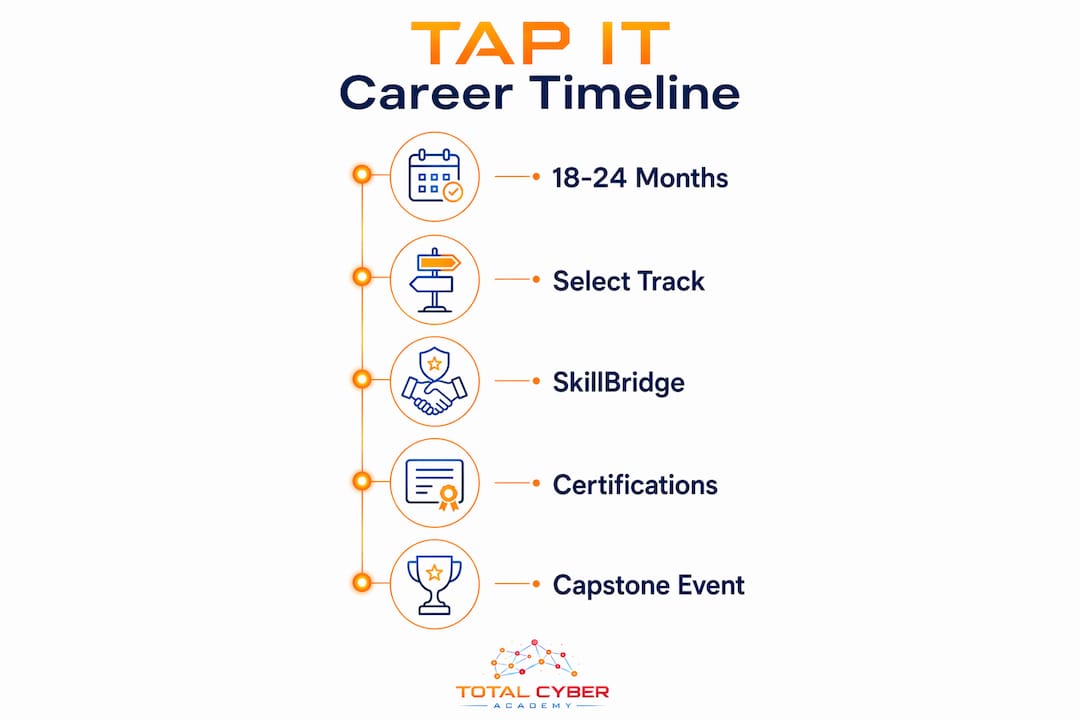
The biggest barrier veterans face is not skill acquisition. It is translating military experience into civilian job market language and avoiding the mistake of treating TAP as a complete solution. Military leaders recommend beginning TAP 18–24 months prior to transition for maximum benefit, yet only a minority of service members begin on time at 365 days or more before separation.
Veterans carry genuine competitive advantages in cybersecurity: leadership under pressure, adversarial thinking, and security clearances that civilian candidates rarely hold. The challenge is framing those strengths in terms civilian hiring managers recognize. Your military skills transfer directly to IT roles more than most veterans realize, particularly in threat analysis, network operations, and incident response.
Concrete steps to optimize your transition:
- Start TAP at 18–24 months before separation to access SkillBridge and Benefits Delivery at Discharge (BDD)
- Enroll in the C2E Vocational Track and use it to map specific IT certifications to your target role
- Pursue CompTIA Security+ or Network+ independently, parallel to TAP coursework
- Apply for SkillBridge with a cybersecurity-focused employer during your final six months
- Rewrite your resume using civilian IT role titles and quantified outcomes, not military occupational specialty codes
- Network actively with defense-tech employers, veteran organizations, and cybersecurity communities on LinkedIn
- Explore cybersecurity workforce veteran initiatives that connect transitioning veterans with hiring employers
Pro Tip: TAP’s C2E track is the right place to identify which certifications align with your target IT role. Use that output as your personal certification roadmap, then pursue those credentials through VET TEC 2.0 or GI Bill-funded programs before your separation date.

How Total Cyber Academy prepares veterans for cybersecurity careers
Totalcyber is a veteran-owned cybersecurity training organization built specifically to close the gap between military service and civilian IT employment. Its programs are designed to complement TAP timelines, not replace them, giving veterans the technical depth that TAP’s administrative curriculum cannot provide.
Flagship programs include SkillBridge integration, a Penetration Tester course, and a Career Prep Course structured around real-world scenarios and hands-on labs. Every course incorporates expert instruction and industry-recognized certification preparation, including CompTIA Security+, CEH, and ISC2 credentials. The cybersecurity training pathway at Totalcyber is built for beginners, career changers, and experienced IT professionals alike.
| Program | Certification Prep | Delivery Mode | Target Audience |
|---|---|---|---|
| SkillBridge Integration | Security+, CEH | In-person / Virtual | Separating service members |
| Penetration Tester Course | CEH, OSCP-aligned | Virtual, hands-on labs | Veterans with IT background |
| Career Prep Course | Security+, CompTIA | Self-paced / Virtual | Beginners and career changers |
Veteran-specific benefits at Totalcyber:
- GI Bill and VET TEC 2.0 compatible training pathways
- Flexible scheduling designed around TAP and SkillBridge timelines
- Career counseling and resume support focused on IT and cybersecurity roles
- Hands-on lab environments that mirror real enterprise security scenarios
- A veteran-owned mission focused on employment outcomes, not just course completion
Veterans can enroll before or during TAP participation. Starting a Totalcyber program during the C2E Vocational Track phase allows you to align certification goals with your Individual Transition Plan and complete hands-on training before your CAPSTONE review.
How to enroll in TAP with an IT career track in mind
The enrollment process begins at your installation’s TAP office, typically through your unit’s transition officer or S1. You register for initial counseling, which establishes your Individual Transition Plan and determines your track selection. For IT career seekers, the critical choice is selecting the C2E Vocational Track alongside the mandatory DOLEW workshop.
After completing core curriculum, you attend the CAPSTONE event. If your career readiness standards are not met, your commander initiates a Warm Handover to local employment resources. Registering for SkillBridge requires a separate employer agreement and unit commander approval, so that process should run parallel to, not after, your TAP enrollment.
What the TAP timeline looks like for an IT career transition
| Milestone | Recommended Timing |
|---|---|
| Begin TAP initial counseling | 18–24 months before separation |
| Select C2E Vocational Track | 12–18 months before separation |
| Apply for SkillBridge employer placement | 9–12 months before separation |
| Apply for VET TEC 2.0 | A year or more before separation |
| Complete core certifications (Security+, Network+) | 6–12 months before separation |
| CAPSTONE event | Final 180 days of service |
| Post-separation ENPP support | Through the first year post-separation |
Starting early is the single most controllable variable in this process. Veterans who begin at 18–24 months have time to complete SkillBridge, earn at least one certification, and enter the job market with verified credentials rather than a resume built on military titles alone.
What veteran IT career transitions actually look like
Veterans who successfully transition into cybersecurity roles share a consistent pattern: they used TAP as the administrative foundation, then layered SkillBridge employer placements and independent certifications on top. Those who relied on TAP alone typically found themselves competing against civilian candidates with hands-on lab experience and recognized credentials they lacked.
The cybersecurity industry trends driving demand for security professionals continue to favor candidates who can demonstrate practical skills, not just military service history. Veterans who translate their security clearance, operational experience, and adversarial mindset into certified, demonstrable competencies consistently outperform peers who skip the credentialing step.
How to use TAP’s employer connections for IT and cybersecurity roles
TAP’s Employment Navigator and Partnership Program (ENPP) provides one-on-one career counseling and connects veterans to partner organizations for job placement, hiring events, and employment mentorships. From April 2021 to June 2024, ENPP served more than 17,700 service members at 35 installations.
To use these connections effectively for IT roles, arrive at ENPP sessions with a specific target role and at least one certification in progress. Employment Navigators can connect you with defense-tech employers and cybersecurity hiring events, but they work best when you come prepared with a clear career objective and documented credentials. Pair ENPP networking with LinkedIn outreach to cybersecurity hiring managers and veteran-focused tech communities for the broadest reach.
Key Takeaways
TAP provides the mandatory administrative foundation for military-to-civilian transition, but veterans pursuing IT and cybersecurity careers must supplement it with certifications, SkillBridge placements, and specialized training to compete effectively.
| Point | Details |
|---|---|
| TAP is a baseline, not a placement tool | It covers compliance and career readiness standards, not technical IT credentialing. |
| Start TAP at 18–24 months out | Only 25% of service members begin TAP on time (at least 365 days prior); early starters access SkillBridge and VET TEC 2.0. |
| Certifications are non-optional | DoD 8140 mandates specific credentials by role; Security+ is the standard entry point. |
| SkillBridge and VET TEC 2.0 fill the gap | Both programs provide hands-on training and certification funding TAP does not offer. |
| Totalcyber aligns with TAP timelines | Its veteran-owned programs integrate with SkillBridge, GI Bill, and C2E track goals for direct career outcomes. |
Totalcyber gives veterans the technical training TAP cannot
Veterans who complete TAP still face a concrete skills gap when applying for cybersecurity roles. Totalcyber closes that gap with expert-led, hands-on training built specifically for the military-to-IT transition, without the administrative overhead of a traditional degree program.
Totalcyber’s programs are GI Bill and VET TEC 2.0 compatible, structured around real-world lab environments, and designed to produce certified, job-ready candidates. Whether you are starting from zero or building on an existing IT background, the Career Prep Course and SkillBridge-integrated tracks give you the credentials and practical experience employers in cybersecurity actually require. Browse all Totalcyber courses and enroll before your CAPSTONE review to enter the job market with verified skills, not just a transition certificate.
Recommended
- The Role of Military Skills in IT: A 2026 Career Guide – Total Cyber Academy!
- Cybersecurity Workforce Veteran Initiatives: 2026 Guide – Total Cyber Academy!
- GI Bill Cybersecurity Training Programs: 2026 Veteran Guide – Total Cyber Academy!
- Veteran Cybersecurity Certification Study Guide 2026 – Total Cyber Academy!