
The CISSP exam costs $749 for a single attempt in the United States, according to ISC2’s official pricing page. Beyond that base registration fee, budget for a $50 rescheduling charge, a $100 cancellation fee if you back out too late, and an annual maintenance fee charged by ISC2 to keep the credential active. Candidates who want a safety net can also add Peace of Mind Protection, a two-attempt bundle priced below the cost of two separate registrations.
TL;DR:
- The total cost of CISSP includes a $749 exam fee, plus additional expenses for rescheduling, cancellations, prep materials, and yearly maintenance fees.
- Buying a second exam attempt with Peace of Mind Protection costs less upfront than paying twice separately, especially valuable if doubt exists about passing the first time.
- Prep costs can vary from a few hundred dollars for self-study to several thousand for bootcamps, with three-year total expenses ranging from around $2,000 to over $4,900 depending on the chosen route.
- Annual maintenance fees and continuous education credits cost roughly $50 to $150 per year, adding ongoing costs to maintain the certification.
- Discounts, employer sponsorship, scholarships, and tax deductions can lower overall expenses, but careful planning and assessment of individual timelines and risk tolerance are crucial.
Table of Contents
- How Much Is the CISSP Exam? The ISC2 Pricing Breakdown
- What Are the Reschedule and Cancellation Fees?
- Is Peace of Mind Protection Worth the Extra Cost?
- How Much Should You Budget for CISSP Prep Materials?
- What Does It Cost to Keep CISSP Active Every Year?
- Where Can You Find CISSP Vouchers or Discounts?
- Free Resources vs. Paid Courses: Which Prep Route Actually Saves You Money?
- What’s the Real Total Cost of Earning and Keeping CISSP?
- Are There Other Ways to Lower Your CISSP Costs?
- What This Guide Gets Right That Most CISSP Cost Articles Don’t
- Total Cyber Academy’s CISSP Prep Options and What They Cost
- Sources
- FAQ
How Much Is the CISSP Exam? The ISC2 Pricing Breakdown
Every U.S. candidate pays the same base rate: $749 for the standard CISSP exam registration, confirmed on ISC2’s exam pricing page. That fee buys exactly one attempt at the exam, scheduled through Pearson VUE at a testing center or via online proctoring, depending on availability in your area.
ISC2 sells the exam in a few different configurations, and the packaging matters more than most candidates realize before they check out:
- Exam-only: the $749 registration fee, no study materials included, one attempt.
- Exam + Peace of Mind Protection: bundles a second attempt into the purchase, useful if you’re unsure about your readiness.
- Training + exam bundles: pairs official ISC2 courseware with the exam voucher, often at a discount versus buying each separately.
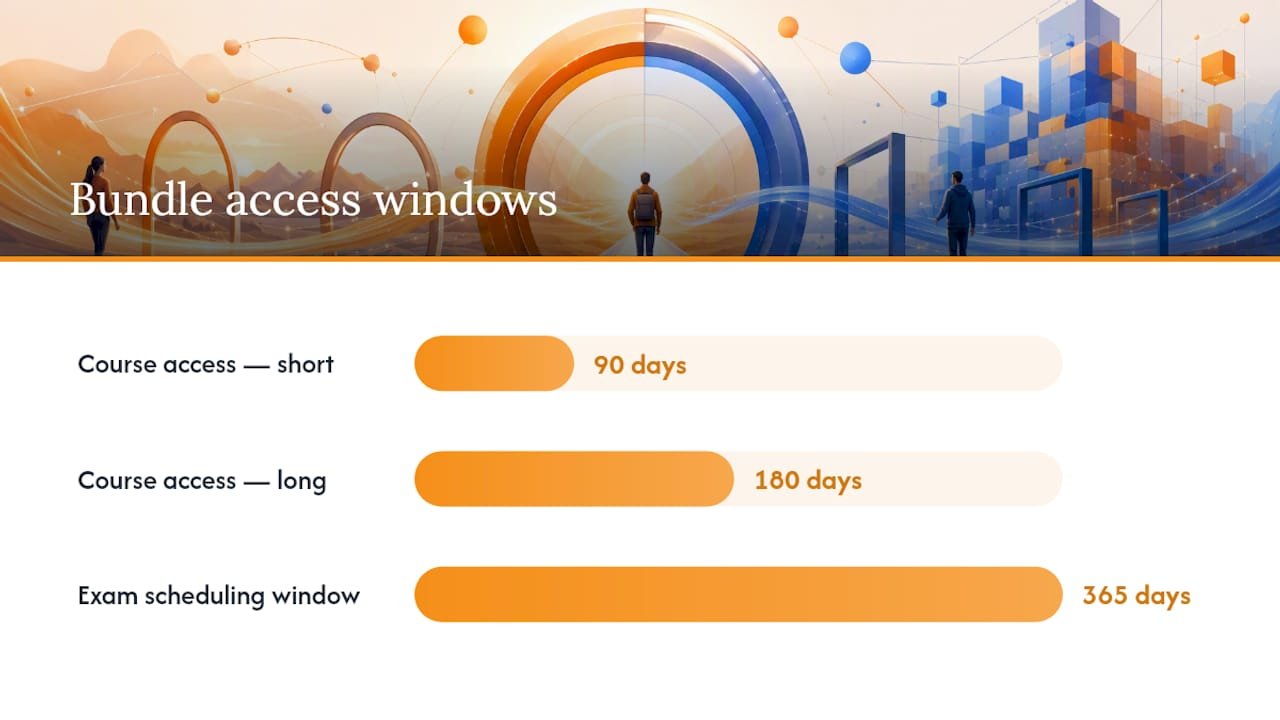
The CISSP certification page lays out access windows for these bundles, and they’re not uniform. Some bundled packages give you 90 days of course access, others stretch to 180 days, while the exam-scheduling window inside a bundle can run as long as 365 days. Read the fine print before you buy. If you purchase a training bundle expecting a year to study, but the course material access lapses at 90 days, you’ve effectively paid for content you can’t use during most of your prep window.
One more thing to watch at checkout: Pearson VUE, not ISC2 directly, processes the actual payment, and its checkout flow can tack on location-based taxes or administrative charges depending on your state and how you’re paying. The $749 figure is the exam fee itself. It is not always the final number on your card statement.
Pro Tip: Screenshot your registration confirmation the moment you complete checkout. If a dispute over fees or exam dates comes up later, having the original terms in writing saves you a frustrating call with Pearson VUE support.
What Are the Reschedule and Cancellation Fees?
Life happens, and ISC2 has built specific fee tiers around it. Here’s what changing your plans actually costs, based on the official ISC2 pricing schedule:
- Rescheduling: typically $50, charged when you move your exam date within the allowed window rather than canceling outright.
- Cancellation: typically $100, a steeper penalty than rescheduling, and it applies when you cancel your registration instead of picking a new date.
- Voucher restrictions: vouchers purchased through ISC2 or an authorized reseller carry their own rules on transferability and expiration. Check the ISC2 voucher policy before assuming a voucher can be rescheduled or refunded the same way a direct registration can.
- Timing matters: how close you are to your exam date when you make a change affects whether you pay the reschedule rate, the cancellation rate, or in some late-notice cases, forfeit the fee entirely with no refund.
Refunds are not automatic. If you miss your exam window without rescheduling or canceling in advance, ISC2 generally treats that as a forfeited attempt rather than a mistake it will retroactively fix. That’s the scenario Peace of Mind Protection exists to soften, since it builds a second chance into the purchase rather than making you pay full price again after a no-show or a fail.
Is Peace of Mind Protection Worth the Extra Cost?
Peace of Mind Protection gives you two exam attempts, both of which must be completed within 180 days of purchase, according to ISC2’s official Peace of Mind page. It’s essentially exam insurance: pass on the first try and the second attempt goes unused, but if you don’t pass, you’re not stuck paying another full $749.
A few rules govern how it works:
- Both attempts must fall inside that 180-day window. There’s no extension.
- A mandatory waiting period applies between your first and second attempt, so you can’t retake the exam the next day even if you wanted to.
- Missing the 180-day deadline on your second attempt typically forfeits it, the same way an unused voucher expires.
The math favors Peace of Mind Protection specifically for candidates who have real doubt about passing on the first try. Buying it upfront costs less than paying for two separate $749 registrations, which is the whole point of the bundle. If you’re walking in with strong practice-exam scores and months of consistent study behind you, the standard exam-only registration is the cheaper bet. If your practice scores are inconsistent or you’re compressing your study timeline, the bundle is the more rational purchase.
Pro Tip: Take at least two full-length practice exams under timed conditions before deciding. If your scores land within 5 to 10 points of the passing threshold, Peace of Mind Protection is worth the extra cost.
How Much Should You Budget for CISSP Prep Materials?
The $749 exam fee is often the smallest line item in a candidate’s total spend. Preparation costs vary enormously depending on the route you choose, and third-party training guides report that total certification costs, exam plus prep, commonly range from a few hundred dollars for pure self-study up to several thousand for instructor-led courses or bootcamps, according to InfoSec Institute’s cost breakdown.
Here’s how the three main prep routes stack up:
- Self-study: official study guides, practice question banks, and flashcard apps typically run $150 to $400 total. This route demands the most discipline and the longest timeline, often six months or more of consistent study.
- Online instructor-led courses: structured video lessons, live Q&A sessions, and guided practice labs generally cost $500 to $1,500. This is the middle ground: more accountability than pure self-study, without the price tag of a full bootcamp.
- Bootcamps and live immersive training: intensive, often week-long programs with hands-on labs and direct instructor access can run $2,000 to $5,000 or more, a range broken down in detail in Total Cyber Academy’s bootcamp cost guide.
A realistic total for most working professionals: the $749 exam fee, a mid-range instructor-led course around $1,000, and a quality practice-exam bank around $150. That lands you close to $1,900 before any discounts, vouchers, or employer reimbursement. Candidates who go the bootcamp route should expect that number to climb once travel, lodging, or time away from work gets factored in.
What Does It Cost to Keep CISSP Active Every Year?
Passing the exam isn’t the end of the spending. ISC2 charges an annual maintenance fee (AMF) to keep your CISSP designation active, and you’re also required to earn continuing professional education (CPE) credits every year to stay in good standing.
- The AMF is a recurring yearly charge, separate from the one-time exam fee, and it’s due regardless of whether you’re actively working in cybersecurity that year.
- CPE credits can often be earned for free through webinars, ISC2 chapter events, and vendor-hosted sessions, but many professionals supplement with paid conferences or courses that also count toward CPEs.
- A practical annual maintenance budget for most CISSP holders lands around $50 to $150, covering the AMF plus one or two low-cost paid CPE activities, though costs rise if you rely heavily on paid conferences to hit your credit requirement.
Skipping the AMF or falling short on CPEs risks suspension of your certification, which means the “cost” of neglecting maintenance isn’t just financial. It can mean re-earning a credential you already paid hundreds of dollars to pass.
Where Can You Find CISSP Vouchers or Discounts?
ISC2 vouchers and employer reimbursement programs are the two most reliable ways to knock money off your total spend. Vouchers occasionally surface through ISC2 promotions, authorized training partners, or employer bulk-purchase programs, but availability shifts, so check the ISC2 voucher policy page directly rather than trusting a third-party reseller’s claim.
Employer sponsorship is often the biggest lever. Many IT and security departments have a training budget line that covers certification exams outright, especially for a credential as widely recognized as CISSP. It’s worth asking your manager directly rather than assuming the answer is no.
Peace of Mind Protection saves money specifically when you have real uncertainty about passing on your first attempt. Scheduling carefully, locking in your exam date only once you’re confident in it, avoids the $50 reschedule and $100 cancellation fees that add up fast for indecisive planners.
Pro Tip: If your employer won’t cover the exam fee outright, ask about tuition reimbursement for prep courses instead. Total Cyber Academy’s on-demand CISSP course fits comfortably inside most mid-range employer training budgets.
Free Resources vs. Paid Courses: Which Prep Route Actually Saves You Money?
Free CISSP study material exists in abundance: ISC2’s own free webinars, community study groups, and countless YouTube walkthroughs of the exam’s eight domains. The catch is time. Free resources demand far more self-discipline and far longer study timelines, often stretching past a year for candidates juggling full-time work, because there’s no structured pacing or accountability built in.
Paid courses buy you structure, not necessarily better content. A $1,000 instructor-led course compresses what might take a self-studier eight months into a defined 10 to 12 week schedule with live instructors answering questions in real time. For candidates on a tight timeline, that compression is worth the money. For candidates with flexible schedules and strong self-motivation, free resources plus a paid practice-exam bank can get the same result for a fraction of the cost.
The honest comparison isn’t free versus paid. It’s time versus money. Every hour you don’t spend piecing together free content from scattered sources is an hour you’re effectively buying back with a paid course. Candidates who’ve failed once already, or who are working against a job-offer deadline, tend to find the paid route pays for itself in reduced retake risk alone.
What’s the Real Total Cost of Earning and Keeping CISSP?
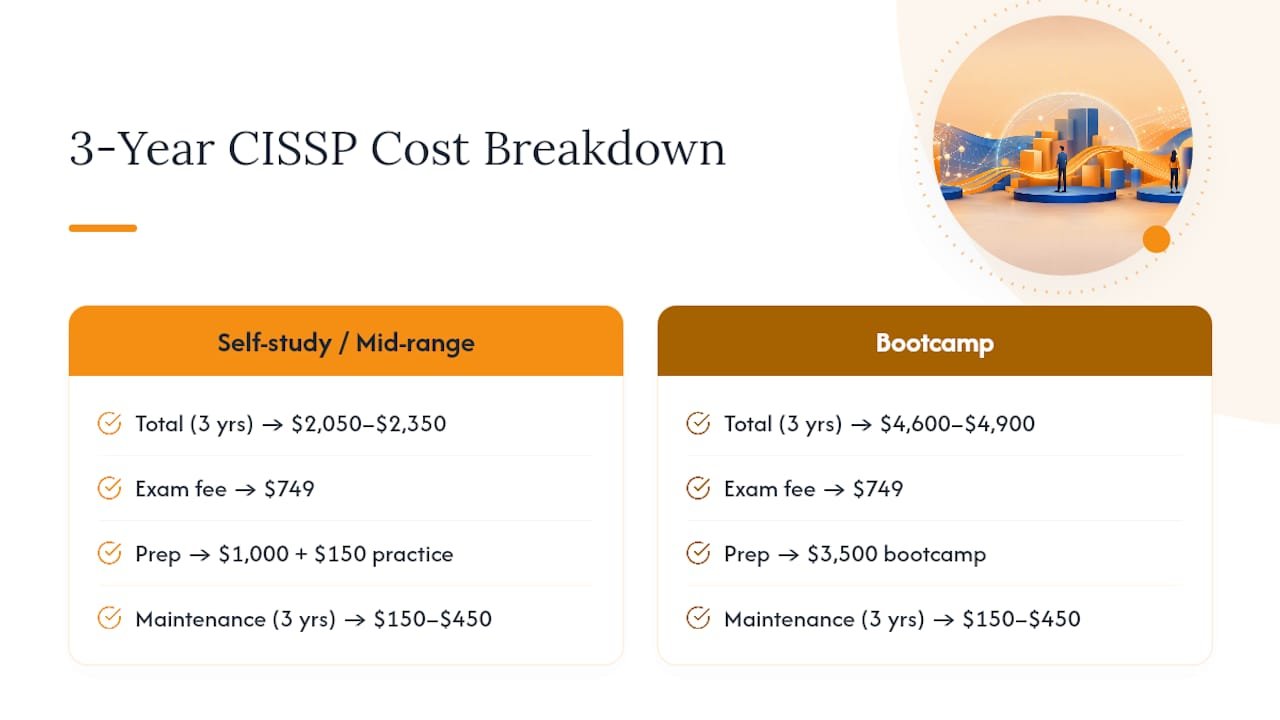
Add it up over a typical certification cycle and the numbers get clearer. The exam fee itself is $749. A mid-range prep course runs roughly $1,000, plus $150 for a solid practice-exam bank. That’s $1,900 before you’ve even scheduled a test date.
Layer on annual maintenance after you pass: roughly $50 to $150 per year for the AMF and CPE activities. Over a three-year certification cycle, that adds $150 to $450 in ongoing costs. Total realistic spend for most candidates using self-study or mid-range instructor-led prep: somewhere between $2,050 and $2,350 across three years, factoring in one round of exam registration, prep materials, and three years of maintenance.
Bootcamp-route candidates see a very different total. A $3,500 bootcamp plus the $749 exam fee plus three years of maintenance pushes the three-year total closer to $4,600 to $4,900. Neither route is wrong. They reflect different trade-offs between money and time, and the right choice depends on how quickly you need the credential versus how much you can spend upfront.
Are There Other Ways to Lower Your CISSP Costs?
Beyond vouchers and employer sponsorship, a few less obvious levers can shrink your total spend. Group discounts occasionally surface when several employees from the same organization register or train together through an authorized training partner, so it’s worth asking a training provider directly whether a multi-seat discount applies.
Scholarship programs exist through some ISC2 chapters and partner organizations, particularly aimed at veterans, students, and career changers entering cybersecurity from underrepresented backgrounds. These aren’t universally advertised, so checking with your local ISC2 chapter directly tends to surface more options than a general web search.
Tax deductions are worth a conversation with a tax professional rather than a guess. Work-related education expenses, including certification exam fees and prep courses, can sometimes qualify as deductible business expenses depending on your employment situation and how your work relates to the credential. This varies enough by individual circumstance that generic advice isn’t reliable here. A CPA who understands your specific filing situation is the right resource, not a blog post.
Staggering your purchases also helps spread the cost. Buy practice exams and study guides first, confirm you’re making progress, and only commit to the pricier instructor-led course or bootcamp once you know self-study alone isn’t getting you there fast enough.
What This Guide Gets Right That Most CISSP Cost Articles Don’t
Most guides to CISSP cost treat the $749 registration fee as the whole story, then bury the maintenance fees and reschedule penalties in a footnote nobody reads. That’s backwards. The exam fee is a single, predictable line item. The variable, and often larger, cost is prep, and that’s exactly where candidates most need a real number instead of a vague range.
The conventional advice, “just self-study and you’ll save money,” undersells how much time that actually costs someone working full time. Time has a price too, even when it doesn’t show up on a credit card statement. A candidate who takes 14 months to self-study instead of three months with structured instructor-led training hasn’t necessarily saved money. They’ve just spent it differently, in delayed promotions or delayed job offers instead of tuition.
What should come first: an honest self-assessment of your timeline and risk tolerance, not a hunt for the cheapest possible bundle. Decide how much time you can realistically give this, then match your prep budget to that constraint. The Peace of Mind bundle and mid-range instructor-led courses exist precisely for candidates whose time is worth more to them than the price difference.
— Alden
Total Cyber Academy’s CISSP Prep Options and What They Cost
Total Cyber Academy is a mid-range prep option built for candidates who want structured lessons, practice questions, and instructor guidance without the travel and lodging costs a live bootcamp adds.
Veterans, career changers, and IT professionals moving into security roles make up the core of who this course serves, and the course uses hands-on labs and real scenarios instead of pure slide decks. If you’ve read through this guide and landed on “I need structure but not a full bootcamp,” that’s exactly the gap the on-demand CISSP course fills. Candidates who want a broader look at how cybersecurity training programs are priced and structured before committing can also start with Total Cyber Academy’s training overview to compare course formats side by side.
FAQ
Can I Get CISSP for Free?
No. The exam registration fee is $749 in the United States, and there’s no free path to sit the exam itself, though free study resources can lower your total prep spend significantly.
Is the CISSP Still Worth It?
For most security professionals aiming at management or senior technical roles, yes: the credential is widely recognized across the industry, and the total cost, often under $2,000 for exam plus mid-range prep, is modest against the career advancement it typically unlocks.
Does CISSP Expire After 3 Years?
CISSP doesn’t expire outright, but it requires ongoing annual maintenance fees and continuing professional education credits to stay active, and lapsing on either can suspend your certification.
Is CISSP Very Hard?
It’s considered one of the more demanding security certifications due to its broad scope across eight domains, which is exactly why many candidates weigh Peace of Mind Protection or structured instructor-led prep instead of relying on self-study alone.