
Threat detection labs are hands-on, instructor-supported training environments where students learn to spot, analyze, and respond to real cyberattacks using the same tools working analysts rely on. They exist to close the gap between certification study and job readiness. Beginners, career changers, veterans, and entry-level IT professionals use them to build detection and incident-response skills that map directly to NICE Framework work roles like Cyber Defense Analyst and Incident Responder.
TL;DR:
- Threat detection labs are accessible to beginners with basic computer skills and focus on real-world skills like SIEM tuning and malware analysis.
- Effectiveness depends on realistic setups, instructor facilitation, and clear linkage to industry frameworks such as NICE, with outcome-focused practices like incident reporting.
- Structured, week-by-week courses that follow the incident response lifecycle and produce a tangible portfolio piece are more likely to prepare students for actual SOC work.
- Choosing a program involves verifying framework alignment, instructor credentials, lab realism, and assessment methods, avoiding courses that lack practical reporting or technical checks.
- Authentic labs emphasizing documentation and decision-making under stress outperform certification-only courses in building job-readiness and employability.
Table of Contents
- What Do Threat Detection Labs Actually Teach?
- Who Are These Labs For, and What Do You Need Before Starting?
- What Makes a Lab Experience Actually Effective?
- What Does a Typical Course Roadmap Look Like?
- How Do You Choose the Right Threat Detection Lab Program?
- Why Realistic Labs and Real Reporting Change Outcomes
- Ready to Build Job-Ready Detection Skills?
- Where to Verify the Frameworks and Try Official Labs
- Sources
- FAQ
What Do Threat Detection Labs Actually Teach?
A serious lab program builds skills in a specific order, and each one ties to a task a SOC analyst performs on a real shift. Students learn SIEM configuration and alert tuning, log analysis, and network forensics using tools like Wireshark to read packet captures. They practice identifying indicators of compromise (IOCs) and indicators of attack (IOAs), running basic malware triage, and writing the incident reports that document every step for later review.
These skills map onto the incident response lifecycle taught by CISA’s Incident Response Pathway, which structures a four-week course around detection, analysis, containment, recovery, and lessons-learned reporting. That order is not arbitrary; it mirrors how a real breach unfolds.
- Detect and triage suspicious activity before it spreads
- Analyze logs, packet captures, and malware samples
- Contain and eradicate the threat
- Recover systems and confirm integrity
- Document lessons learned for the next incident
The gap labs close: CISA’s own guidance on incident response triage notes that attacker lateral movement now happens on a compressed timeline, which is exactly why triage and instrumentation training in a cyber range matters more than memorizing exam objectives.
Who Are These Labs For, and What Do You Need Before Starting?
Threat detection labs work for anyone with basic computer literacy, not just people already in IT. You should be comfortable navigating Windows and Linux, know your way around a command line, and understand basic networking concepts like IP addressing and ports. A working grasp of the CIA triad (confidentiality, integrity, availability) and common threat types helps, but most beginner-track programs teach that alongside the labs themselves.
Before day one, most programs run a mandatory technical check to confirm your VPN or remote desktop connection works and your system meets the lab requirements. CISA’s own cyber range events require this the day before training starts, specifically to avoid burning live lab time on connectivity troubleshooting.
- Confirm your system meets minimum specs (RAM, OS version, browser)
- Schedule and complete the pre-course technical check
- Review basic networking and OS fundamentals if it has been a while
- Bookmark your program’s prerequisite checklist for quick reference
Pro Tip: Treat the technical check as part of the course, not a formality. A failed connection on lab day one costs you real training hours you cannot easily get back.
What Makes a Lab Experience Actually Effective?
Not all labs are built the same, and the format matters more than most course brochures let on. Three formats dominate the market: hyper-realistic cyber ranges that simulate live network traffic and attacker behavior, virtual machine or container labs (sometimes built on frameworks like Labtainers) that isolate exercises for repeatable practice, and game-like simulation tools that gamify detection scenarios for quick skill checks.
Each has trade-offs. Cyber ranges deliver the most realism but need more setup and instructor oversight. Container-based labs are faster to spin up and reset, which supports the kind of staged, repeated practice with escalating complexity that research on skill retention favors over one-off exercises. Gamified tools are useful for engagement but rarely substitute for full incident scenarios.
Instructors matter just as much as the platform. A quality program has live facilitators who inject new evidence mid-scenario, give real-time feedback, and enforce documentation standards so every lab ends with a written report, not just a completed checklist. Some programs record sessions for replay, which lets you revisit a scenario you struggled with.
- Rubric-based grading tied to specific competencies, not pass/fail completion
- Explicit mapping of lab tasks to NICE Framework KSAs
- Certification exam prep built into the same course track
- Mentorship access from instructors with SOC or IR backgrounds
The best labs feel less like a quiz and more like a flight simulator: time-pressured, realistic, and focused on decisions made under stress rather than rote recall.
What Does a Typical Course Roadmap Look Like?
A well-structured hands-on threat-hunting program usually runs four weeks and builds skills in a deliberate sequence rather than throwing everything at students at once.
- Week 1, fundamentals: OS and network basics, log structure, intro to SIEM dashboards
- Week 2, detection and analysis: configure SIEM alert rules, analyze packet captures in Wireshark, identify and extract IOCs from a live scenario
- Week 3, containment and recovery: isolate compromised hosts, walk through eradication steps, restore systems, and confirm clean state
- Week 4, advanced triage and reporting: work multi-stage attack scenarios, including cloud-based intrusions, and write a full after-action report (AAR)
This sequence closely follows the module structure in CISA’s Incident Response Pathway course catalog, which pairs SIEM work, network forensics, and malware analysis with formal reporting at each stage. By week four, you should have a portfolio piece: a written incident report you can reference in interviews. That AAR is often the single artifact that separates a certification-only candidate from one who can demonstrate applied judgment, which is exactly what role-based lab paths are designed to produce.
How Do You Choose the Right Threat Detection Lab Program?
Course marketing pages tend to sound alike, so the real evaluation happens in the details. Start with framework alignment: does the program explicitly state NICE Framework alignment or list specific KSAs and work roles in its module descriptions? That is a practical proxy for whether employers will recognize the training.
- Instructor credentials and live availability during labs, not just recorded video
- Student-to-instructor ratio and actual hands-on minutes per student
- Lab realism (live-fire cyber range vs. static walkthrough)
- A required technical check before the course starts
- Rubric-based assessment with individual feedback, not a pass/fail quiz
- Career support: mentorship, certification vouchers, or job-placement guidance
Ask admissions directly about lab access hours, whether sessions are recorded for replay, and whether certification vouchers or exam discounts are included. Some centers, including programs cited by Texas A&M’s Cybersecurity Center, pair technical labs with vouchers and mentorship specifically to improve employment outcomes, and that combination is worth asking about directly.
Pro Tip: If a program cannot describe what a student produces by the end of the course, that is a red flag. “You’ll learn SOC skills” is not an answer. “You’ll write an AAR after a simulated ransomware incident” is.
Watch for vague outcome language, no technical check requirement, and syllabi that stay entirely in slide decks with no lab component. Those are signs the course was built for certification pass rates, not job readiness.
Why Realistic Labs and Real Reporting Change Outcomes
Most training conversations focus on exam pass rates. That misses what actually gets someone hired. Employers care whether a candidate can triage an alert, document it clearly, and hand off a report a teammate could act on without asking ten follow-up questions. Labs that skip the documentation step teach half the job.
At Total Cyber Academy, that belief shapes course design directly, including in tracks like the 30 to 90 Day Hands On Threat Hunting Basics for Beginners program, built with instructor mentorship and veteran-focused support baked in from day one. Choose a program on that basis, not the shortest path to a certificate.
— Alden
Ready to Build Job-Ready Detection Skills?
Total Cyber Academy is the direct route into a SOC-ready skill set, without the guesswork of piecing together free tutorials and hoping they add up to something an employer recognizes. Every course pairs live instructor mentorship with lab time, and every module ties back to the same NICE-aligned competencies hiring managers actually screen for.
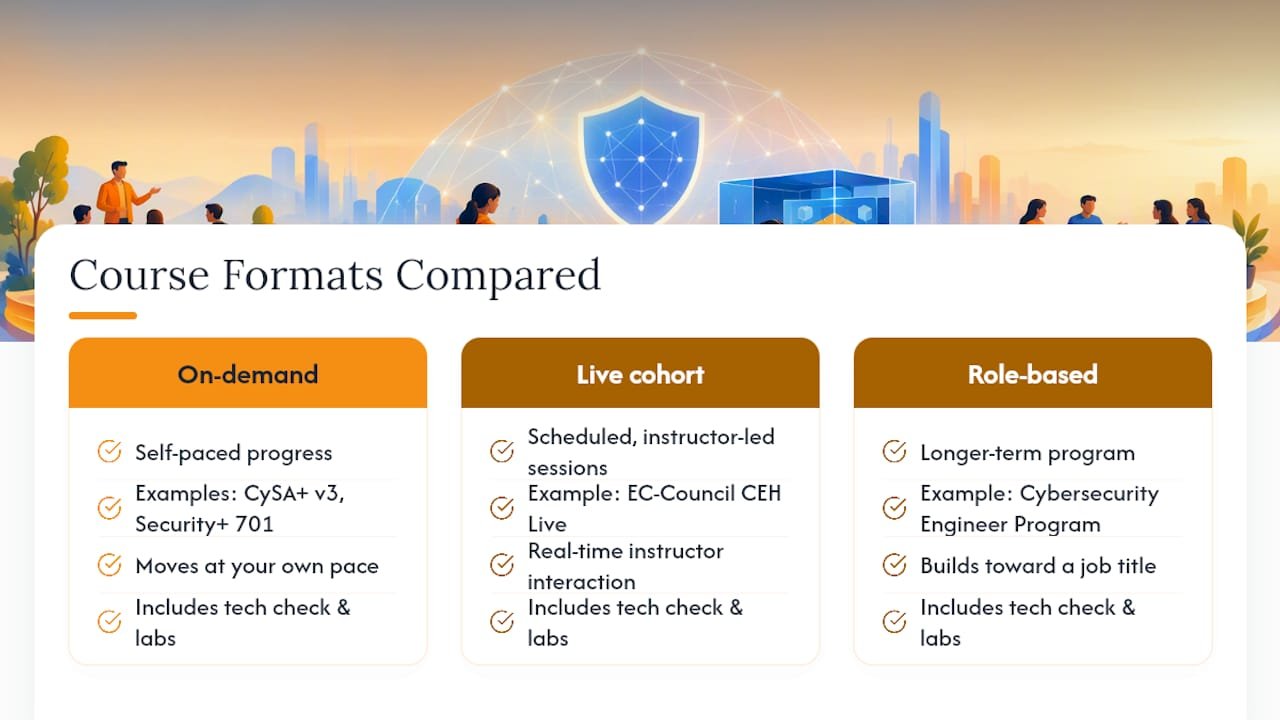
The catalog covers both self-paced and live formats. On-demand tracks like the CompTIA CySA+ v3 On-Demand Course and CompTIA Security+ 701 On-Demand Course let you move at your own pace, while live cohort options such as the EC-Council CEH Live Course put you in front of an instructor in real time. For a longer-term path, the Cybersecurity Engineer Program and other role-based tracks build toward a specific job title rather than a single exam.
Every course includes the technical check, instructor-led labs, and mentorship access covered in the checklist above. Before you enroll anywhere, run through the prerequisites checklist to confirm you are ready, then browse the full course catalog to pick your starting point.
Where to Verify the Frameworks and Try Official Labs
The NICE Framework defines the KSAs training providers map their labs to. CISA’s cyber range events and Incident Response Pathway offer free official exercises worth trying before committing to a paid program.
Sources
- NICE Success Story: Cyberbit Skill Development and Readiness Platform | NIST
- Incident Response Pathway | CISA (course catalog)
- NIST SP 800-181r1: NICE Cybersecurity Workforce Framework
- Texas A&M Cybersecurity Center programs
FAQ
What Is the Difference Between a Threat Detection Lab and a Certification Course?
A certification course prepares you to pass an exam like CompTIA Security+ or CySA+. A threat detection lab teaches the applied skills, like log analysis and incident reporting, that certification alone does not test. The strongest programs combine both, mapping labs to NICE Framework KSAs while also preparing you for the exam.
Do I Need a Cybersecurity Background to Start?
No. Most entry-level threat detection lab programs are designed for beginners, career changers, and veterans with basic computer literacy. You should be comfortable with a command line and general networking concepts, but programs like Total Cyber Academy’s threat hunting basics course build foundational skills into the early weeks.
How Long Does a Typical Lab-Based Course Take?
Course length varies by program and format. CISA’s Incident Response Pathway runs four weeks with weekly hands-on modules, and Total Cyber Academy’s beginner threat-hunting track follows a similar 30 to 90 day structure depending on pace and format chosen.
What Does Total Cyber Academy Charge for Its Courses?
Pricing depends on the course and format. On-demand courses like CompTIA Security+ 701 run 2499.99 one-off, while live instructor-led courses such as the EC-Council CEH Live Course run 3499.99 one-off. Full pricing for every course and role-based program is listed on the course catalog.
Are Free Threat Detection Labs Worth Trying First?
Yes, free official exercises from CISA’s cyber range events are a solid way to test your interest before enrolling in a paid program. They lack the mentorship, technical check support, and certification prep a structured course provides, which matters most once you are trying to build a job-ready portfolio.