
A CompTIA stackable certification is a credential awarded automatically when you hold the right combination of active CompTIA certifications, with no additional exam or fee. These stacks map to two career pathways, Infrastructure and Cybersecurity, and to three experience tiers. For most IT professionals, one exam decides which stacks unlock next: Security+ or Network+.
TL;DR:
- Most candidates can unlock multiple stacks with just one or two exams by starting from their current certifications and following the recommended paths.
- Passing Security+ immediately opens several cybersecurity stacks, making it the most versatile exam for role advancement.
- Certifications are automatically awarded as soon as the required active credentials are detected, but lapsing certifications can break existing stacks if not renewed within the grace period.
- Combining hands-on, role-specific training with exam prep reduces study time and helps candidates achieve their target stacks faster.
- Tracking expiration dates and active certifications prevents unnecessary exams or lapses that could invalidate current stacks before renewal.
Table of Contents
- 1. Infrastructure pathway stacks and how to prioritize them
- 2. Cybersecurity pathway stacks and why Security+ anchors them all
- 3. How CompTIA awards stacks and the renewal rules that protect them
- 4. Recommended exam pathways from common starting points
- 5. Why stack-aware training shortens time to a new role
- 6. Preparing for the exams that build your next stack
- Sources
- FAQ
1. Infrastructure pathway stacks and how to prioritize them
The Infrastructure pathway rewards candidates who build outward from A+ and Network+. Each stack requires a specific pair of active certifications, and no single exam covers every combination, so sequencing matters.
- CIOS requires A+ and Network+.
- CSSS requires A+ and Linux+.
- CCAP requires Network+ and Cloud+.
- CNIP requires Network+ and Server+.
- CLNP requires Network+ and Linux+.
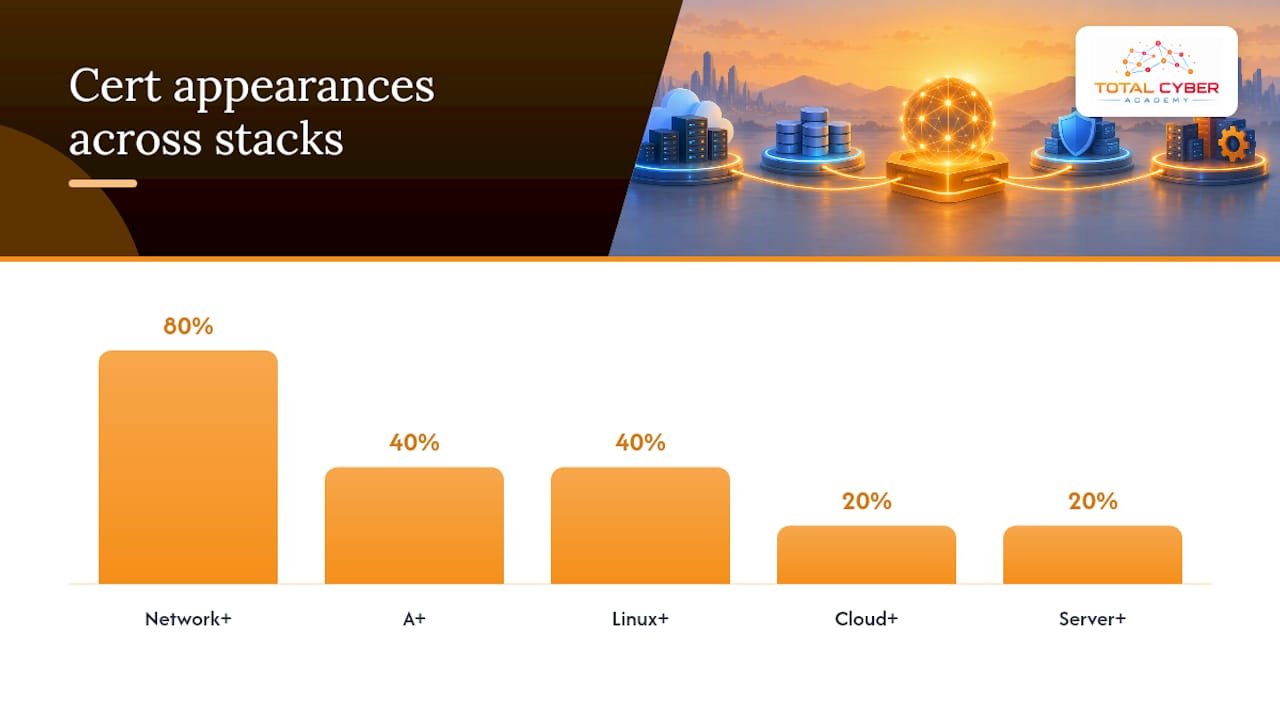
Network+ shows up in four of the five infrastructure stacks, which makes it the highest-leverage exam on this pathway. Cloud+ and Linux+ each open a distinct alternative route once Network+ is active, letting a candidate choose between cloud administration and open-systems work without duplicating study effort.
For someone who holds A+ only, the next move is Network+, since it converts a single certification into an active CIOS stack immediately. Someone holding A+ and Linux+ gains the same benefit: passing Network+ opens both CIOS and CLNP at once. And anyone sitting on Network+ and Cloud+ already has CCAP locked in, so the next efficient step is Security+, which begins the cybersecurity side of the ladder rather than adding another infrastructure combination.
Pro Tip: Track your certification expiration dates closely. When you pass a higher-level exam, it can renew a lower-level certification automatically, which protects an existing stack from lapsing while you study for the next one.
2. Cybersecurity pathway stacks and why Security+ anchors them all
Security+ appears in every cybersecurity stack CompTIA publishes, which makes it the single most efficient exam a career-focused learner can take. CompTIA’s stack structure shows why: one pass opens multiple doors at once, rather than committing a candidate to a single narrow track.
- CSIS requires A+, Network+, and Security+.
- CSCP requires Security+ and Cloud+.
- CSAP requires Security+ and CySA+.
- CNVP requires Security+ and PenTest+.
- CNSP requires Security+, PenTest+, and CySA+.
- CSAE and CSIE, the expert-level stacks, require SecurityX on top of the lower combinations.
Because Security+ is the common thread, a candidate who already holds A+ or Network+ gets the most value from adding Security+ next rather than another infrastructure exam. From there, the choice splits by role interest: CySA+ builds toward analyst and detection work, while PenTest+ builds toward offensive testing. Both compound with an active Security+ to produce a new stack rather than a standalone credential.
Pro Tip: Pick CySA+ if you want to move into security operations or threat analysis, and PenTest+ if offensive security work appeals to you more. Either choice, paired with an active Security+, produces a recognized stack rather than an isolated certification.
3. How CompTIA awards stacks and the renewal rules that protect them

Stacks are not applied for. CompTIA’s system checks your active certifications and awards the stackable credential the moment the required combination is in place, with no extra exam and no separate fee.
Keeping a stack intact depends on CompTIA’s Continuing Education (CE) program, which runs on a set cycle:
- Certifications renew on a three-year cycle, with CEU requirements that vary by certification.
- Renewal fees also vary by tier: CompTIA lists A+ at $75 over three years against $150 for many other certifications, according to its published fee schedule.
- Passing a higher-level exam, such as SecurityX, can renew several lower-level certifications at once, preserving the stacks built on them.
The most common pitfall is letting a certification lapse past its 30-day grace period. Once that window closes, standard renewal is no longer available and the exam has to be retaken at its current version, which can quietly break a stack you had already earned.
4. Recommended exam pathways from common starting points
The fastest way to see your next stack is to map what you already hold against what one more exam unlocks.
- Hold A+ only: take Network+ next to earn CIOS, then add Security+ to unlock CSIS as well.
- Hold A+ and Network+: Security+ is the next move, since it opens CSIS immediately and positions you for the cybersecurity stacks beyond it.
- Hold Security+ only: choose CySA+ or PenTest+ based on role interest. Either one produces CSAP or CNVP and starts compounding toward expert-level stacks.
- Hold Network+ and Cloud+: you already qualify for CCAP. Security+ is the logical next step, since it unlocks CSCP and moves you toward combined cloud and security stacks.
Before booking your next exam, list every CompTIA certification you currently hold active, then check it against the stacks above. Most candidates find they already qualify for one stack and are one exam away from a second.
Pro Tip: Write down your active certifications and their expiration dates side by side. It takes a few minutes and prevents the common mistake of studying for an exam that adds little value because a related certification is about to lapse.
5. Why stack-aware training shortens time to a new role
The academy is built around hands-on labs rather than exam memorization alone, which matters when the goal is a stack, not just a single passing score. Training that maps directly to Security+, Network+, and the other stack-building exams cuts wasted study hours and keeps CE planning aligned with the renewal pyramid instead of fighting it.
Instructor-led courses suit candidates who want structured pacing and live mentorship toward a specific stack deadline. Self-paced, on-demand courses fit those who already have some field experience and need flexibility more than oversight.
— Alden
6. Preparing for the exams that build your next stack
The academy offers instructor-led and on-demand preparation for the exams that create CompTIA stacks, so the study path you follow lines up with the credential you are actually trying to earn. Beyond exam content, courses include hands-on labs and direct instructor access, which matters most when a single exam pass is meant to unlock more than one certification at once.

Course options built for stack building include:
- CompTIA A+ 220-1201 and 220-1202 for candidates starting from zero.
- CompTIA Network+ (009), available on demand or as a live course, for the highest-leverage infrastructure exam.
- CompTIA Security+ 701, available on demand or live, for the exam that anchors every cybersecurity stack.
- CompTIA CySA+ v3, on demand or live, for analyst-track stacks.
- CompTIA Cloud+ and CompTIA Server+ on demand, for infrastructure stacks built around cloud and server administration.
Readers who want a structured, role-based route rather than exam-by-exam planning can review the Cybersecurity Engineer, Penetration Tester, IT Operations Specialist, and Cloud Engineer programs or browse the full course catalog to enroll directly.
FAQ
What CompTIA certs are stackable?
Stackable combinations span two pathways: Infrastructure, built from A+, Network+, Cloud+, Linux+, and Server+, and Cybersecurity, built from Security+, CySA+, PenTest+, and SecurityX. CompTIA lists the exact required combinations, such as A+ and Network+ forming the CIOS stack, on its stackables page.
Are CompTIA stackable certifications worth IT?
Stacks give hiring managers a clearer signal of layered, verified skill than a single certification alone, since each stack requires multiple active credentials working together. They also cost nothing extra beyond the exams you would likely take anyway to advance, since the stack itself carries no additional exam or fee.
Is CompTIA still relevant in 2026?
CompTIA continues to publish and update its stackable certification framework, career pathway diagrams, and Continuing Education program, which points to active investment in keeping the credentials current. The pathway structure itself, spanning Specialist, Professional, and Expert tiers, is designed around ongoing career progression rather than a one-time credential.
Can I skip A+ and do Network+?
Network+ does not require A+ as a formal prerequisite, so candidates with existing networking experience can go straight for it. Skipping A+ does mean missing the CIOS and CSSS stacks unless you circle back to add it later, so the decision depends on whether those specific infrastructure stacks matter for your target role.