
Pick the runway that matches your hours: a longer plan with a manageable weekly study commitment, or a shorter accelerated plan if you can study full-time. Whichever you choose, take a timed diagnostic practice test first and log every miss. Then study your weak domains hardest, weighted by the ISC2 outline, and keep testing under the clock.
TL;DR:
- The six month template suits people with 6–10 study hours weekly, adds a lab in month three, and schedules three simulated exams.
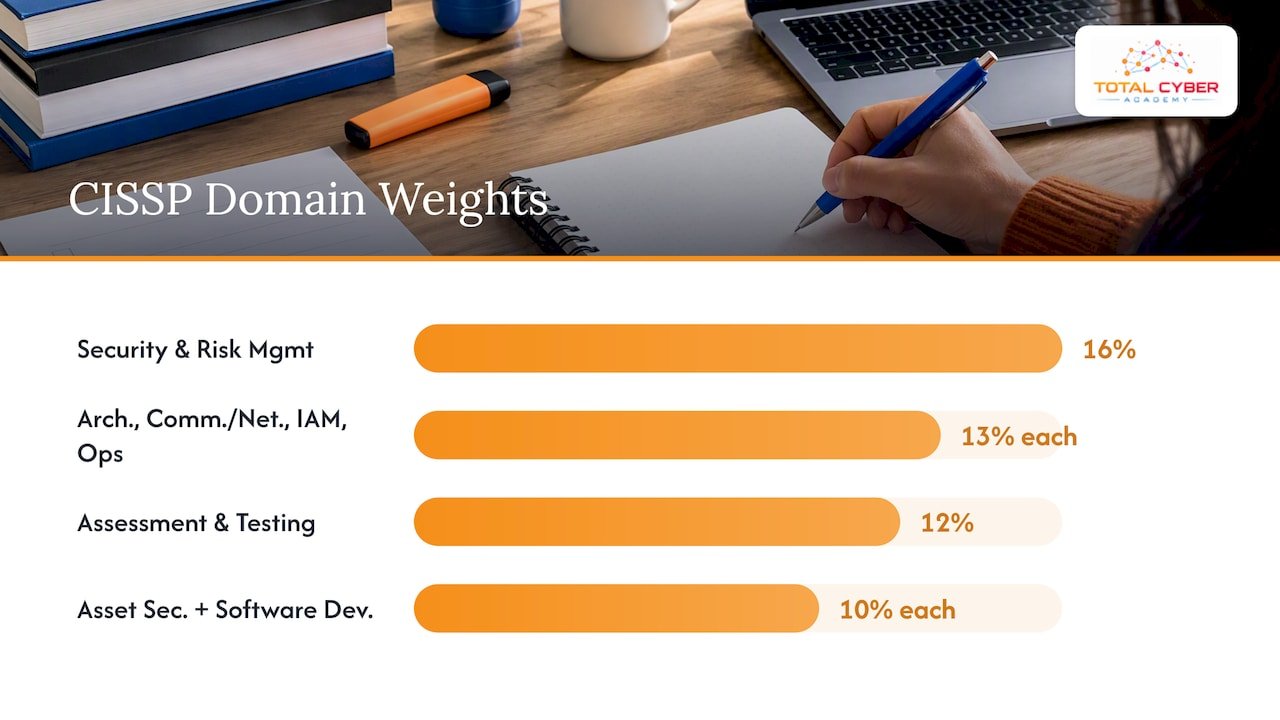
- Security and Risk Management carries 16%; four domains carry 13% each, Security Assessment and Testing carries 12%, and the remaining two carry 10% each.
- Most candidates need one study guide, one question bank, and one lab or course; extra sources can distract from weak areas.
Table of Contents
- Which CISSP study schedule fits your week?
- How do you set a baseline and use domain weights?
- What does a daily CISSP study routine look like?
- Which CISSP study resources do you actually need?
- How should you use practice exams?
- What do you need to know about exam logistics and fees?
- How do you prepare in the final two weeks?
- Which study habits make CISSP knowledge stick?
- How do you balance CISSP study with a job or military duties?
- How do you stay well during intense study weeks?
- Why does hands-on learning make this plan work?
- Ready to put this plan into action with guided support?
- FAQ
- Sources
Which CISSP study schedule fits your week?
Choose the runway by the hours you can honestly protect, not by the date you wish you could test. A schedule you can keep beats an ambitious one you abandon early. Each template below assumes you start with a diagnostic (covered in the next section) and shift extra hours toward your weakest domains.
The 3-month template (12 weeks, about 15 hours a week)
This runway suits people with a solid security background who can study most evenings plus a weekend block.
- Weeks 1–2: Diagnostic test, then Security and Risk Management and Asset Security.
- Weeks 3–4: Security Architecture and Engineering, then Communication and Network Security.
- Weeks 5–6: Identity and Access Management, then Security Assessment and Testing.
- Weeks 7–8: Security Operations and Software Development Security.
- Week 9: Mixed review of your three weakest domains, plus a full-length simulated exam.
- Weeks 10–11: Mixed question sets daily, targeted re-study of missed concepts, a second simulated exam.
- Week 12: Taper, light review, logistics check.
The 6-month template (about 6–10 hours a week)
Working professionals with families, shift work or deployments usually land here. The lower weekly load buys you room for labs and for repeating material until it sticks.
- Month 1: Diagnostic, then Security and Risk Management, Asset Security.
- Month 2: Security Architecture and Engineering, Communication and Network Security.
- Month 3: Identity and Access Management, Security Assessment and Testing, with a hands-on lab each week.
- Month 4: Security Operations, Software Development Security.
- Month 5: Mixed questions, weak-domain rebuilds, two simulated exams spaced about two weeks apart.
- Month 6: Taper, third simulated exam, scheduling and logistics.
The accelerated template (6–8 weeks, full-time study)
This runway only works if you can devote substantial daily time to study without work interrupting. It compresses the longer plan, so there is little slack for a bad week.
- Week 1: Diagnostic plus Domains 1 and 2.
- Week 2: Domains 3 and 4.
- Week 3: Domains 5 and 6.
- Week 4: Domains 7 and 8, then a simulated exam on the weekend.
- Weeks 5–6: Daily mixed question sets, weak-domain deep dives, a second simulated exam.
- Weeks 7–8 (optional): Extra practice and taper if your scores have not stabilized.
Adapting any template to your life
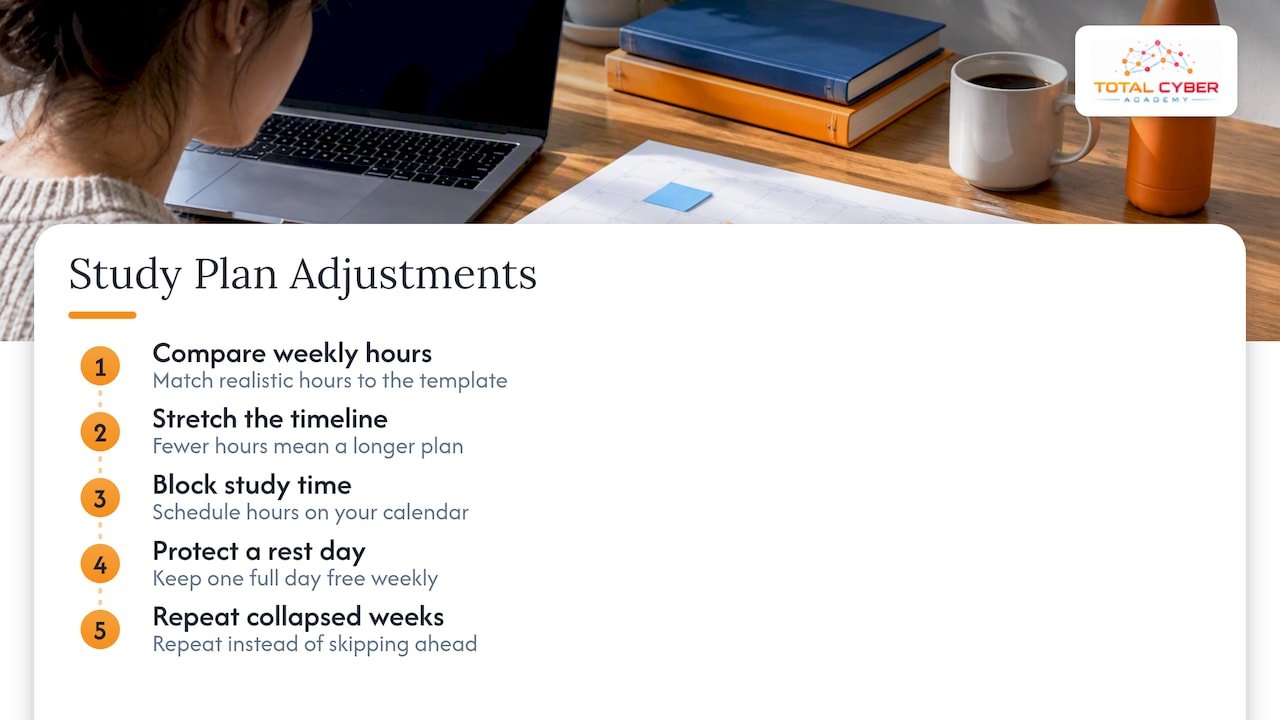
Compare your realistic weekly hours with the template’s commitment and stretch the timeline accordingly. With fewer available hours, expect the plan to take longer. Block the hours on your calendar the way you would block a client meeting, and protect one full rest day each week. If a week collapses, repeat it rather than skipping ahead. Gaps in early domains hurt more than a slightly later test date.
How do you set a baseline and use domain weights?
Start with a timed diagnostic before you read a single chapter. It shows where your professional experience already covers the material and where it does not. Most candidates are surprised: a network engineer may ace Communication and Network Security and stumble on Security and Risk Management, which is more about governance and judgment than technology.
Take the diagnostic under real conditions, then sort every miss by concept, not just by domain. “Missed a question on BIA” and “missed a question on business impact analysis versus risk assessment” tell you different things. Use this process:
- Record each missed or guessed question with the concept behind it.
- Group concepts under the eight domains.
- Compare your misses to the domain weights below and devote more study time where weight and weakness overlap.
- Re-test those concepts later to confirm the gap closed.
The official CISSP exam outline sets the domain weights, and they are close together:
Security and Risk Management carries 16%, while Security Architecture and Engineering, Communication and Network Security, Identity and Access Management, and Security Operations each carry 13%. Security Assessment and Testing carries 12%, and Asset Security and Software Development Security carry 10% each. Because no domain is trivial, a weak 13% domain costs you more than a skipped 10% one saves.
Mastering a weak concept beats skimming everything. If your diagnostic shows three shaky domains, give them a substantial share of your study hours and spread the rest across the others.
What does a daily CISSP study routine look like?
A routine turns a template into habit. Here are two you can copy, one for people with a day job and one for full-time study.
Evening worker:
- Recall recently studied key concepts without notes.
- Study a new topic from your primary book or course.
- Take a break away from screens.
- Answer practice questions on that topic and review every explanation.
- Finish by writing flashcards from what you missed.
Full-time study day:
- Morning: reading or video blocks on the day’s domain, with breaks between.
- Midday: a lab or applied exercise tied to that domain.
- Afternoon: mixed practice questions, then review every miss.
- Early evening: flashcard review and a short written summary of the day.
- Stop at a fixed time. Evening cramming rarely sticks.
Layer a weekly rhythm on top: a mix of domain study, mixed questions, lab work, review, and simulated exams when the schedule calls for it. Work in focused blocks, and rely on active recall rather than rereading.
Pro Tip: Schedule your rest day before you schedule anything else. Candidates who skip recovery tend to stall in the middle weeks, and a stalled week costs more than a day off.
Which CISSP study resources do you actually need?
Fewer resources, used well, beat a shelf of unopened books. Match each resource type to a job, then pick one of each.
- The official exam outline. It defines what can be tested and how the domains are weighted. ISC2 recommends you review the exam outline to find areas that need extra attention, so keep it open all semester.
- One primary study guide. Use it for structured reading. ISC2 gathers official reading and training links on its study tools page, which is a sensible place to choose from.
- One question bank. Questions teach you to apply concepts the way the exam does. Pick a bank with detailed explanations, since the explanation is where the learning happens.
- Hands-on labs or a course. Labs turn abstract controls into things you have configured. Our ISC2 CISSP On-Demand Course pairs structured modules with labs and instructor support for people who want guidance rather than self-assembly.
- Flashcards. Build your own from missed questions. Cards you write yourself carry context that premade decks lack.
Labs are also where small operational details become memorable. Certificate lifecycle work is a good example: a certificate expiry calendar gives you a concrete scenario for thinking about cryptographic key management and operational risk, which show up repeatedly in scenario questions.
Avoid overbuying. One book, one question bank and one lab or course is enough for most people. Adding a fourth source can mean repeating material you already know while ignoring the weak spots your diagnostic found.
How should you use practice exams?
Practice exams are training tools, not report cards. The CISSP uses computerized adaptive testing for English exams, so the test adjusts to your answers. Practicing under the clock builds pacing and stamina, and reviewing each miss builds judgment.
- Diagnostic first. One timed test before you study, to set the baseline.
- Regular short mocks. A set of questions by domain or mixed, to keep recall active.
- Full-length simulations. Take simulations during your preparation and as your date approaches. Treat at least one as a true rehearsal: no interruptions, no looking things up, and the full time limit.
- Score trends over single scores. Look for steady improvement across several tests and for scores that hold up in your weakest domains. Do not book the exam off one lucky result.
- Miss log. Record each wrong or guessed answer by concept, re-study it, then re-test with similar items a few days later.
Review time should rival test time. Spend ample time understanding why the right answer was right, and why the tempting wrong answer was wrong. The exam often rewards the most appropriate management-level choice rather than the most technical one, and reviewing explanations trains that instinct.
Pro Tip: Flag every question you guessed correctly, not just the ones you missed. A lucky guess is an unclosed gap, and it will not stay lucky on exam day.
What do you need to know about exam logistics and fees?
Plan the mechanics early so scheduling does not surprise you. The exam outline states that the CISSP runs as a computerized adaptive test, with 100–150 items and a passing score of 700 out of 1000.
- Registration flow: create or use your ISC2 account, purchase the exam, then schedule through Pearson VUE, as laid out in ISC2’s registration and scheduling guide.
- ID must match. The name on your registration has to match your identification exactly, so check it before you pay.
- Time to schedule: check ISC2’s current scheduling policy for how long after purchase you can schedule and sit for the exam.
- Reschedule and cancel: fees apply, and windows apply, so read the policy before you book.
ISC2’s published fee table lists standard CISSP registration at U.S. $749, with rescheduling at U.S. $50 and cancellation at U.S. $100. Local taxes and regional pricing can change what you pay.
Build some buffer time around your target date in case you need to move it, and read the proctoring policies ahead of time.
How do you prepare in the final two weeks?
Stop learning new material and start sharpening what you have. As the exam approaches, shift to mixed questions and simulations, review your miss log, and protect your sleep.
- Take a final full-length simulation, then review its misses. Work mixed sets regularly.
- Use shorter question sets and flashcards on your weakest concepts, and avoid new books or videos.
- Keep review light. Confirm your ID, test center route, arrival time and what you may bring.
- Exam day: Eat, arrive early, and pace yourself. If a question stalls you, choose the best answer and move on. Use the break to stretch, drink water and reset.
- If you do not pass: Diagnose by domain, rebuild the weakest areas, and choose a new study plan. A focused tune-up may be enough.
Which study habits make CISSP knowledge stick?
Technique matters as much as hours. Three habits carry most of the benefit.
- Spaced repetition. Turn each missed question and each key reading into a flashcard, then review at widening intervals. Concepts you keep missing stay in the short cycle.
- Active recall. Close the book and answer a scenario prompt from memory: “A vendor breach exposes customer records. Which risk treatment applies first, and who decides?” Writing the answer exposes gaps that rereading hides.
- Deliberate practice. Aim sessions at the concepts you fail, not the ones you enjoy. Comfortable review feels productive and changes little.
- Timeboxing and single-tasking. Set a timer, silence your phone, and work on one domain at a time.
- Weekly consolidation. Spend one session rewriting the week’s notes into a one-page summary per domain.
Pro Tip: Write every flashcard as a question about a decision, not a definition. The exam asks what you would do, so practice the same way.
How do you balance CISSP study with a job or military duties?
Work and service obligations will not shrink for your exam, so build the plan around them. Start by choosing the slower runway if your schedule is unpredictable. A steady, longer plan beats an ambitious one that fails.
Study in small, reliable windows: early mornings before duty or work, a lunch-hour question set, or a fixed block after the kids are asleep. A short flashcard session on a commute or during downtime adds up over time. Keep question sets on your phone so a delayed shift or a field day does not erase your progress.
If you are in the military, or recently transitioned, plan around known tempo changes. Front-load heavy reading before a deployment, exercise or training cycle, and switch to flashcards and short question sets when you cannot sit down for long blocks. Tell your supervisor or family your exam date so they can help protect your hours.
Be honest about experience, too. CISSP has work-experience requirements, and our article on whether you can take the CISSP without experience explains the real path if you are still building yours. Many veterans carry relevant security, intelligence or systems experience that maps well to several domains. Count it, and study the domains your service did not touch.
How do you stay well during intense study weeks?
Fatigue erodes recall faster than a missed chapter does. Treat sleep, movement and stress as part of the study plan.
- Sleep first. Aim for consistent bed and wake times. Memory consolidates during sleep, so late-night cramming works against you.
- Move daily. A walk between study blocks clears your head and lowers tension.
- Fuel and hydrate. Regular meals and water keep concentration steady in long sessions.
- Cap caffeine. Stop early enough in the day that it does not cost you sleep.
- Manage stress deliberately. Slow breathing before a practice exam, a short walk after a bad score, and a rule against doomscrolling forums the night before your test all help.
- Keep one thing outside the exam. A hobby, a meal with friends or a workout keeps the plan sustainable.
A bad practice score is data, not a verdict. Log it, find the pattern, adjust the next week, and move on.
Why does hands-on learning make this plan work?
I have found that this schedule works best when reading is paired with doing. The CISSP is a management-level exam, but its questions are scenarios, and scenarios are easier to reason through when you have configured the control, watched it fail, or seen an audit finding firsthand. Labs turn “least privilege” and “defense in depth” from vocabulary into judgment, which is what removes the ambiguity from the exam’s trickier questions.
Instructor feedback does the same job for reasoning. A mentor who tells you why your answer was defensible but not best teaches you how the exam thinks. That is why we build our programs around hands-on labs and live mentoring from working cybersecurity professionals, and why students who follow the templates above tend to arrive at their test date with fewer surprises.
— Alden
Ready to put this plan into action with guided support?
If you would rather follow a structured path than assemble your own, we built our ISC2 CISSP On-Demand Course around the same weak-spot-first approach: labs, practice tests and instructor support mapped to the schedules above. Our ISC2 hub and full catalog are one click away, so you can start the week your diagnostic is done.

- Review our ISC2 training options
- Browse the full course catalog and programs
FAQ
How long should I study for the CISSP?
How long you need depends on the hours you can protect each week and how much of the material you already use at work. Full-time candidates may be able to follow a shorter, accelerated plan. Let your diagnostic score and your weekly hours choose the runway.
Is the CISSP very hard?
It is demanding because it tests broad judgment across eight domains rather than deep technical detail in one. Even candidates with real experience may struggle with management-level reasoning. Our look at the CISSP pass rate explains why headline numbers can mislead your planning.
What is the best way to study for the CISSP?
Take a timed diagnostic, then focus your hours on weak domains weighted by the official outline. Combine one study guide, one question bank and hands-on labs, and review every missed question by concept. Finish with timed full-length simulations.
What is a CISSP salary?
Pay varies by role, region and experience. ISC2 reports a global average of $119,577 for CISSP holders, with North American medians above that average. Check the ISC2 salary study for the breakdown that fits your location.