
Cybersecurity job readiness means you can show an employer three things: you understand the fundamentals (networks, operating systems, how attacks work), you can do the work in a lab or on a real system, and you can describe your military experience in civilian terms. A certification is the usual way to prove the first. A portfolio of hands-on work proves the second. A translated resume proves the third. This guide walks through each, with the federal programs that can pay for or shorten the path.
TL;DR
- Readiness is a combination of foundational knowledge, demonstrated hands-on skill and a resume written in civilian language, not a single credential.
- CISA says the abilities built in service, such as situational awareness and fast decisions under pressure, transfer to cybersecurity work.
- Federal tools can cut the cost and the guesswork: SkillBridge, MilGears, the GI Bill and CISA’s free training.
- Demand is strong: the Bureau of Labor Statistics projects 29 percent growth for information security analysts from 2024 to 2034.
- “Entry-level” is rarely zero experience. Plan for a stepping-stone role such as help desk, network or systems work if you need one.
Table of Contents
- What job readiness actually means
- Is the entry-level bar higher than it looks?
- Is cybersecurity hard to learn without a technical background?
- The skills employers expect
- Translate your military experience
- Build proof: certifications and hands-on practice
- Free and funded routes for veterans
- What the job market looks like
- Our perspective
- Where our training fits
- A 90-day readiness plan
- FAQ
- Sources
What job readiness actually means
Employers do not hire a certificate. They hire someone who can be given a ticket, an alert or a configuration task and be productive with limited supervision. NIST’s workforce guidance defines an “entry” level of proficiency as familiarity with basic concepts and the ability to apply them with frequent, specific guidance. That is a useful bar. You are not expected to work alone on day one. You are expected to learn quickly and to apply what you know.
For a veteran, CISA describes the starting point this way: abilities developed in service, including quickly processing information for security decisions, maintaining situational awareness and responding to challenging situations, can carry over into cybersecurity. Those are real assets. What is usually missing is the technical vocabulary and a record of hands-on work that a hiring manager can verify.
A practical way to judge yourself is to ask five questions:
- Can I explain how data moves across a network, and where it can be intercepted or blocked?
- Can I administer Windows and Linux systems at a basic level: users, permissions, logs, updates?
- Can I show a lab, project or exercise where I found and fixed a security problem?
- Do I hold at least one recognized certification that matches the role I want?
- Can I describe my military duties without acronyms a civilian recruiter will not know?
If you can answer yes to four or five, you are close. If you answer no to most, that is a normal place to start, and the rest of this article is the route.
Is the entry-level bar higher than it looks?
Honestly, yes, in some cases. The Bureau of Labor Statistics lists a bachelor’s degree as the typical entry-level education for information security analysts, and notes that some positions call for experience in a related occupation. NIST experts have also observed that “entry-level” in cybersecurity is debated, because many practitioners see the field as a progression from IT, network management or software development rather than a first job.
This does not close the door. It changes the plan. Many successful career changers take a two-step route: first a role in IT support, networking or systems administration, then a move into a security analyst or similar position. Others go straight into a security operations role at employers who weigh skills and certifications over degrees. Our guide to entry-level cybersecurity jobs covers which titles to search for and what to expect from each.
Is cybersecurity hard to learn without a technical background?
It is demanding, but it is learnable, and most of the difficulty comes from volume, not from a single hard concept. Beginners tend to be overwhelmed by acronyms and by how much changes, and common advice is to start with core concepts such as networks, operating systems and how attacks work before trying to cover everything at once. That matches what we see in students.
The order matters more than the pace:
- Computers and operating systems first. Know what a process, a file permission and a log entry are.
- Networking second. Addressing, ports, protocols, firewalls.
- Security concepts third. Threats, controls, risk, identity and access.
- Tools last. Scanners, SIEMs and exploit frameworks make sense only once the layers below them do.
If you skip ahead to tools, you will memorize commands without understanding results. If you want a checklist of what to know before you enroll in anything, see our cybersecurity training prerequisites checklist.
The skills employers expect
NIST recommends that employers describe roles using the NICE Framework as a common vocabulary for position descriptions, and the framework breaks cybersecurity work into tasks, knowledge and skills statements. That means the job posting you are reading is often a translation of NICE language. Reading the framework yourself shows what a role really involves. We explain it in plain terms in our piece on the NICE framework.
Across entry-level security roles, the recurring skill clusters are:
| Skill area | What it looks like on the job | How to show it |
|---|---|---|
| Networking | Reading traffic, understanding segmentation, troubleshooting connectivity | Network+ or equivalent, packet-capture lab write-ups |
| Operating systems | Managing accounts, hardening Windows and Linux, reading logs | Home lab, A+ or Server+ coursework |
| Security fundamentals | Identifying threats, applying controls, following incident procedures | Security+ |
| Monitoring and analysis | Triaging alerts, correlating events, documenting findings | CySA+ and SIEM lab exercises |
| Offensive testing | Scanning, exploiting and reporting weaknesses with permission | CEH or penetration testing labs with a written report |
| Cloud | Securing identities, storage and workloads | Cloud+ and hands-on cloud labs |
Soft skills are not filler. Writing a clear incident summary, briefing a non-technical manager and staying calm during an outage are the skills military service trains well, and they are tested in interviews.
Translate your military experience
A NIST workshop report on veteran transitions notes that service provides relevant training, yet veterans often find it hard to translate their experience into civilian cybersecurity terms and find employers who value it. Two free federal tools help with that.
- MilGears, from the Department of Defense, helps service members match military transcripts to civilian career requirements and identify gaps.
- The NICCS Cyber Career Pathways Tool lets you explore cyber work roles and pathways, so you can see which roles resemble what you already did. The same federal listing points veterans to it.
Write each past duty as an outcome with a civilian label. “Managed a communications section of 12 people during field exercises” becomes “Led a 12-person team maintaining secure radio and network communications; documented and corrected equipment faults.” Keep clearance information accurate, and list it plainly if it is active, since many employers value it. For more on how service skills map to IT roles, read the role of military skills in IT.
Build proof: certifications and hands-on practice
CISA’s guidance for veterans says certifications validate specific skills or experience and help applicants stand out in a competitive market. They work as a filter for recruiters who cannot judge your skills directly. They are not enough alone, which is why lab work matters.
A sensible sequence for many veterans with no IT background:
- A+ to build hardware, operating system and troubleshooting fundamentals.
- Network+ to learn how traffic moves.
- Security+ as the common baseline for security roles.
- CySA+ for defensive analysis, or CEH and penetration testing training for offensive work.
If you already have IT experience, you can start at Security+. Our overview of why Security+ is worth earning explains what it covers.
Whatever you choose, attach evidence. Keep a record of each lab: the objective, what you did, what you found, how you fixed or reported it. Three to five such write-ups, a simple home lab and a clean profile make a stronger application than a certification number alone. If you are drawn to offensive work, our penetration tester roadmap shows how to turn lab work into a portfolio.
Free and funded routes for veterans
Cost should not be the first obstacle. Several federal options exist, and each has eligibility rules you should confirm on the official page before you plan around it.
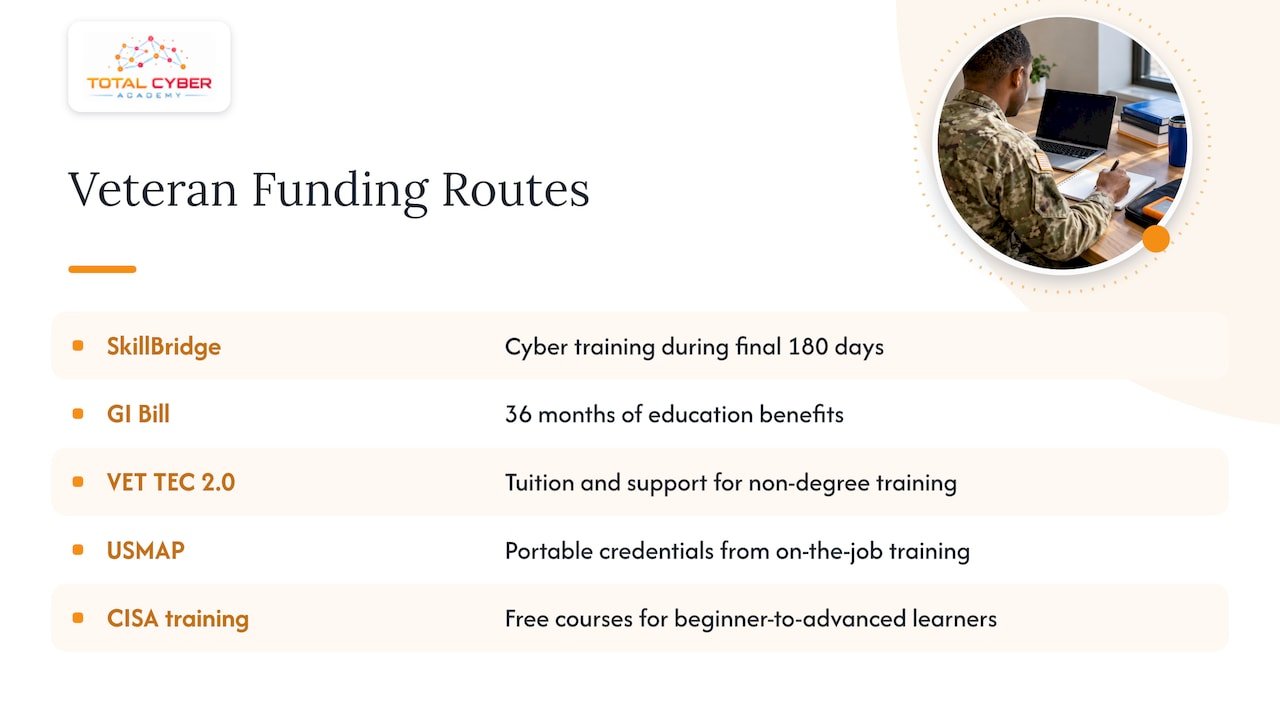
SkillBridge. The Department of Labor notes that DOD SkillBridge lets transitioning service members gain civilian cybersecurity experience through training, apprenticeships or internships during their final 180 days of service. It requires command approval, so talk to your leadership early. We cover the details in our SkillBridge guide for veterans and in SkillBridge cybersecurity training explained.
GI Bill. The Post-9/11 GI Bill generally provides 36 months of education benefits, including vocational or technical training. Whether a specific program qualifies depends on approval, so check before enrolling. Our veteran roadmap with the GI Bill lays out a 6 to 12 month plan.
VET TEC 2.0. The VA describes VET TEC 2.0 as a program providing tuition and support for veterans to gain skills in high-demand technical areas through non-degree programs. Check the VA page for current eligibility and participating providers.
USMAP. The United Services Military Apprenticeship Program lets service members document on-the-job training and earn nationally portable credentials while they are still serving.
CISA training. CISA points veterans to free CISA Learning courses for beginner-to-advanced learners and the NICCS Education and Training Catalog, listed in its veterans guide. They are a good way to test your interest before you spend anything.
What the job market looks like
The Bureau of Labor Statistics projects employment of information security analysts to grow 29 percent from 2024 to 2034, with about 16,000 openings per year, driven by the frequency of cyberattacks and the need to secure new technologies. The same page reports a median pay of $124,910 per year as of 2024.
Treat that median with care. It reflects the occupation as a whole, including experienced analysts. Entry-level pay is lower, and the first goal is to get into the field and build a record. Growth in openings does not remove competition for junior roles, which is why demonstrated skills matter.
Our perspective
We have trained veterans and career changers long enough to see the same pattern. People who stall are rarely short on ability. They are short on proof and on translation. They have the discipline, but their resume does not show a lab, and their experience is described in language no recruiter can read.
So we build training around work, not only exam objectives. A certification gets you through a filter. What gets you the offer is explaining, in an interview, exactly how you investigated an alert or secured a misconfigured server in a lab, and doing it calmly. That is why our courses combine hands-on labs, live tutoring and mentorship from active cybersecurity professionals, and why we pay attention to how a veteran’s background fits each path.
Our advice is simple. Pick one target role, not five. Build the foundation in the right order. Earn the certification that role asks for, document every lab and ask for help early. Readiness is a project with a start and a finish, and it is closer than most people think.
— Alden
Where our training fits
If you want structure, our on-demand and live courses prepare you for CompTIA and EC-Council exams with labs, practice quizzes and instructor support. Current published prices include CompTIA A+ on-demand at $1,999.99, Security+ SY0-701 on-demand at $2,499.99 and Security+ SY0-701 live at $2,999.99. EC-Council CEH on-demand is $2,999.99. You can see every course on our course catalog, or review our career-focused cybersecurity, penetration testing, IT operations and cloud programs. If you are unsure where to begin, our beginner’s guide to cybersecurity training helps you choose.
A 90-day readiness plan
A plan keeps the effort concrete. Adjust the pace to your schedule.
- Days 1 to 15: Run your military transcript through MilGears, browse the NICCS pathways tool and pick a target role. Confirm your benefit options.
- Days 16 to 45: Study fundamentals: operating systems and networking. Start a simple home lab with virtual machines.
- Days 46 to 75: Work through your first certification’s objectives with labs, not only reading. Write up each lab.
- Days 76 to 90: Rewrite your resume in civilian language, publish your lab write-ups, and take the exam or schedule it.
After that, apply while you continue to study. Waiting until you feel fully ready is the most common mistake we see.
FAQ
How long does it take to become job-ready for cybersecurity?
For most people starting from little technical knowledge, several months of consistent study and lab work is a realistic range for a first certification and a basic portfolio. Your pace, your background and the role you target change this. A person with IT experience can move faster than someone starting from basic computer skills.
Do I need a degree to get a cybersecurity job?
Not always, but the Bureau of Labor Statistics lists a bachelor’s degree as the typical entry-level education for information security analysts. Many employers accept experience, certifications and demonstrated skills in its place, especially for IT and security operations roles. Check the postings for your target role to see what they ask for.
Which certification should a veteran start with?
If you have no IT background, A+ and Network+ build the base before Security+. If you already work with systems or networks, Security+ is a common first security credential. Choose by the role you want, not by popularity.
Can I use SkillBridge or the GI Bill for cybersecurity training?
SkillBridge is open to service members in their final 180 days of service with command approval, and the GI Bill generally provides 36 months of education benefits. Each program has its own approval rules, so confirm the specific training provider and course with the official program pages before you commit.
Sources
- CISA, How Veterans Transition to a New Career After Military Service
- NIST SP 1500-16, Improving Veteran Transitions to Civilian Cybersecurity
- NIST, Employer Project for MTM
- NIST, Draft NISTIR 8193
- U.S. Department of Labor, Federal Resource Listing for Cyber Careers
- U.S. Department of Labor, USMAP Cyber Apprenticeships
- U.S. Department of Veterans Affairs, VET TEC 2.0
- VA Annual Benefits Report, Education
- Bureau of Labor Statistics, Information Security Analysts
- NordVPN, Is cybersecurity hard to learn?