
You can study cybersecurity while holding down a job, and most people who enter the field this way do it in the evenings, on weekends and in short blocks during the week. The workable approach is to pick one certification target, commit to a fixed weekly schedule, put hands-on labs ahead of passive reading, and use any education benefits you have earned to reduce the cost. This guide covers each of those steps, with particular attention to veterans in the United States who are balancing service-related obligations, family and a paycheck.
TL;DR
- Choose one certification path first (for most beginners, CompTIA A+, Network+ or Security+) and build the schedule around its exam objectives.
- Plan for a sustainable weekly load, protect a full rest day, and treat study blocks like fixed appointments.
- Labs matter more than reading: employers hire for what you can do, not for how many videos you watched.
- Veterans may be able to offset costs through the GI Bill, VET TEC 2.0 or SkillBridge, depending on eligibility and the provider.
- Online, on-demand and live evening formats all exist, so a full-time job does not rule out structured, instructor-led training.
Table of Contents
- Is it realistic to study cybersecurity and work at the same time?
- Pick the route that fits your job
- Build a weekly schedule you can actually keep
- Put labs ahead of reading
- Can you do the training and the job remotely?
- Free and low-cost resources to start with
- Using veteran benefits to pay for training
- Our perspective: certification is the door, skill is the job
- Training options that fit around a full-time job
- Common mistakes working learners make
- FAQ
- Sources
Is it realistic to study cybersecurity and work at the same time?
Yes, with caveats. Working adults are the normal case in this field rather than the exception: career changers, help desk staff moving up, and service members preparing for civilian jobs. What decides success is not raw intelligence but whether the schedule survives a bad week at work.
Veterans face a recognizable set of pressures. A U.S. Government Accountability Office review found that veterans in STEM programs contend with academic rigor and course sequencing while balancing work and family responsibilities, and that service-connected physical or mental conditions can also affect progress. The Student Veterans of America’s large records study describes student veterans as typically older, supporting families, and juggling employment and school. Its sample also showed that 51.7% of nearly 1 million student veterans in the 2002 to 2010 period earned a degree or certificate, which says that persistence under nontraditional conditions is common.
There is also an advantage. A peer-reviewed study of female student veterans found that veterans viewed military discipline as an academic asset, and the same study noted isolation and reluctance to ask for help as risks. Discipline gets you to the desk every night. Asking for help when a topic stalls is the habit worth adding.
Pick the route that fits your job
Before you open a single study guide, decide which kind of program you are building. The main options differ in cost, time and what employers see at the end.
| Route | Typical fit with a full-time job | Strength | Watch out for |
|---|---|---|---|
| Online or part-time degree | Multi-year, flexible pacing | Matches degree requirements for some roles | Slow, and a degree alone rarely shows hands-on skill |
| Certification prep, on-demand | Self-paced, any hour | Lowest scheduling friction | Needs self-discipline and a plan for labs |
| Certification prep, live instructor-led | Fixed sessions, accountability | Questions answered in real time | Requires a regular schedule slot |
| Self-study with free resources | Completely flexible | Low cost | No feedback, easy to drift |
| Apprenticeship or SkillBridge | Built into work or the final months of service | Paid or supported experience | Limited seats and eligibility rules |
Degrees have a place. The Bureau of Labor Statistics lists a bachelor’s degree in a computer field plus related experience as the typical entry requirement for information security analysts. The same page projects 29% employment growth from 2024 to 2034 with about 16,000 openings a year, and reports a 2024 median pay of $124,910. Those numbers explain the demand. They also show why many working adults pair a certification with a stepping-stone job such as help desk, network support or security operations center (SOC) analyst, then add credentials as they move up, rather than waiting years for a degree before they start.
If you are unsure where to begin, our IT and cybersecurity certification roadmap lays out the order in which most people take A+, Network+, Security+ and the specializations that follow. If you are starting from zero, this beginner’s guide to cybersecurity training explains what the training covers and what entry-level work looks like.
Build a weekly schedule you can actually keep
A study plan fails when it is built for your best week. Build it for your average week, then add margin.
Here is the structure we recommend to students who work full time:
- Count your real hours. Subtract commuting, family commitments and any shift work. For many people, about ten hours a week is realistic: roughly 90 minutes on six evenings, or a mix of short weekday sessions and one longer weekend block. If your job is demanding, eight hours consistently beats twelve hours for two weeks and nothing for the third.
- Fix the blocks. Put the sessions on your calendar at the same times each week and treat them like meetings. Identify your peak hours. If you think best at 5:30 a.m., do the conceptual material then and keep evenings for labs, which tolerate tiredness better.
- Split every week four ways. Include new material, hands-on practice, review, and testing yourself with practice questions. A week that is only video lectures feels productive and produces weak recall.
- Protect a rest day. Take one full day off each week, and plan a lighter week every month or so. Certification study is closer to marathon training than a sprint, and burnout is the usual reason people quit at the halfway point.
- Work backward from an exam date. Book the exam when you are about two-thirds through the material. A date on the calendar converts “someday” into a deadline.
A sample week for Security+
| Day | Block | Focus |
|---|---|---|
| Monday | 90 min | New domain material (for example, threats and vulnerabilities) |
| Tuesday | 90 min | Lab: apply Monday’s topic in a virtual environment |
| Wednesday | 60 min | Flashcards and review of missed questions |
| Thursday | 90 min | New material or live class session |
| Friday | 60 min | Lab or short practice quiz |
| Saturday | 2 to 3 hours | Longer lab, then a timed set of practice questions |
| Sunday | Rest | None |
Adjust the volume to your life. The shape matters more than the exact minutes: new content, practice, review and rest, repeated.
Put labs ahead of reading
Cybersecurity employers screen for practical ability. A learner who has configured a firewall rule, parsed logs, and run a vulnerability scan in a controlled lab can describe it in an interview, and that tends to carry more weight than a list of completed chapters.
For each study week, ask what you will actually do. Examples that map to common entry-level work:
- Networking: build a small virtual network, capture traffic, and identify what normal looks like before looking for abnormal.
- Security operations: read logs, trace a simulated alert from detection to containment, and write a short incident summary.
- Offensive basics: in an isolated lab you own, run reconnaissance and exploit a deliberately vulnerable machine, then document the fix.
- Cloud: deploy a small workload, set permissions, and see what happens when they are too broad.
The NICE Framework, which the federal government uses as a common vocabulary for cybersecurity work, is useful here: veterans can use its components to plan and advance their careers by matching the tasks and skills in a role to what they practice. Choose a work role that interests you and let its listed tasks shape your lab choices.
Veterans often bring more than they realize. NICCS notes that military service may build situational awareness and the ability to respond to challenging situations, and that exposure to security procedures, systematic problem-solving and a security clearance may help veterans compete for federal positions and speed onboarding. Put those on your resume in civilian language.
Can you do the training and the job remotely?
Much of it, yes. Study and labs are almost entirely remote, since virtual environments run in a browser. You do not need to travel for a class if you choose an on-demand or live online format.
Exams are the other piece. CompTIA, for example, allows candidates to take certification exams online through Pearson OnVUE from any location where a private area is available. The policies are strict: you take the exam on the same computer and network used for the system test, you must close every other application, and your time zone setting in your testing account needs to match your intention. Run the system test days ahead, not an hour before. If your home is noisy or your connection is unreliable, an in-person test center is the safer choice.
Jobs are mixed. Some security analyst and cloud roles are remote or hybrid. Others, particularly those involving classified systems, on-site hardware, or a secure facility, need you in the building. Entry-level help desk and network roles frequently involve some on-site work, which is also where you gain the hands-on exposure that later makes remote roles reachable. Read each posting’s location line closely rather than assuming.
Free and low-cost resources to start with
You do not need to pay for anything to test whether the field suits you. Federal resources aimed at veterans include:
- CISA learning. The NICCS veterans guide says CISA Learning offers 24/7 on-demand courses at varying proficiency levels and has replaced several earlier learning platforms, including FedVTE.
- The NICCS Education and Training Catalog. A federal listing of cybersecurity courses, online and in person across the country, mapped to the NICE Framework, described in the federal resource listing for cyber careers.
- CyberSkills2Work. NICCS lists it as a source of free cybersecurity education resources available to veterans.
Free material is a good on-ramp. Its limit is structure: no one checks your understanding, and labs are often thin. That is the point where many working learners move to a guided program with an instructor.
Using veteran benefits to pay for training
Cost is where veterans have a real edge, but the rules are specific, so check the current official page before you commit.
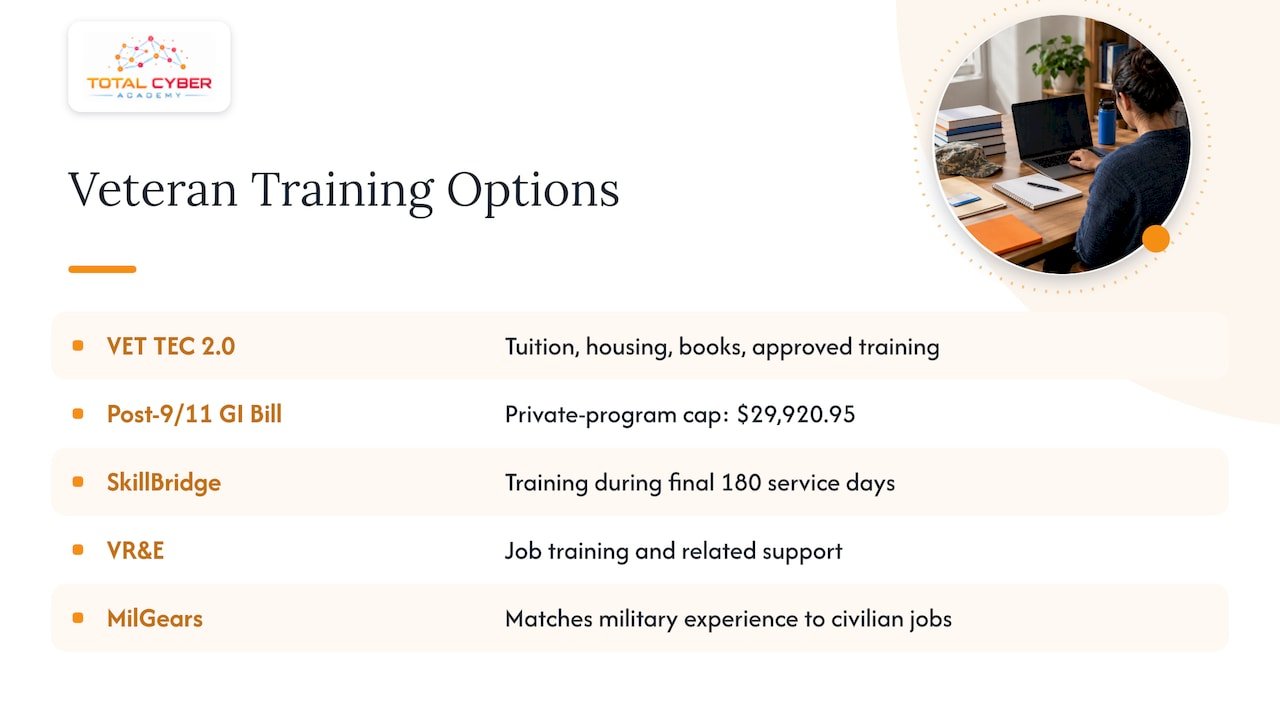
VET TEC 2.0. The VA describes this high-tech program as covering approved non-degree training, tuition and fees, housing during training, and books and supplies. It is limited to 4,000 participants per fiscal year. Eligibility includes a discharge under conditions other than dishonorable, at least 36 months of active duty, and being under 62 when approved. If you have remaining entitlement under the Post-9/11 GI Bill, Montgomery GI Bill Active Duty or Survivors’ and Dependents’ Educational Assistance, the VA charges one month of entitlement for every month of full-time training. Because seats are capped, read our VET TEC 2.0 enrollment guide and confirm status with the VA.
Post-9/11 GI Bill. For the 2025-26 award year, the VA capped payments for private institutions and certain non-college degree programs at $29,920.95. For online-only courses, the housing allowance is calculated at half the national average, capped at $1,169 per month for those who began using benefits on or after January 1, 2018. Those figures are reset every August, so look up the current year’s rates. Our GI Bill cybersecurity training guide walks through how the benefit applies to training programs.
SkillBridge. The federal resource listing says eligible transitioning service members can do industry training, apprenticeships or internships during their last 180 days of service. It is the closest thing to studying while “working” for someone still in uniform. See our guide to SkillBridge cybersecurity training for how it fits with a certification plan.
Vocational Rehabilitation and Employment (VR&E) and MilGears. The same listing says veterans whose service-connected disabilities limit or prevent work may use VR&E for job training and related support, and that MilGears can match military experience to civilian jobs.
More context on employer-side programs is in our overview of veteran cybersecurity workforce initiatives.
Our perspective: certification is the door, skill is the job
We teach working adults every term, and the pattern is consistent. The students who finish are rarely the ones with the most free time. They are the ones who protected a small, regular block and who got unstuck quickly when a topic would not click. That is why we pair on-demand access with live tutoring and mentorship from active cybersecurity professionals: an hour with someone who has done the work often saves a week of confusion.
We also push back on exam-only preparation. Passing Security+ shows you know the vocabulary and concepts. A hiring manager still wants to hear what you did in a lab, what broke, and how you fixed it. So we weight our programs toward practical work, and we encourage students to keep a short lab journal they can talk through in interviews.
For veterans, our advice is to stack the pieces: start with the foundational certification that matches your current skills, use your benefits for the training that has the most structure, and translate your service experience into civilian terms early. Do not wait until you feel ready to apply for entry-level roles. Start applying when you are two-thirds through the material.
— Alden
Training options that fit around a full-time job
If you want structure without leaving your job, Total Cyber Academy offers both formats. On-demand courses let you study at whatever hour you have, and live courses add an instructor and a fixed rhythm for accountability. Current published prices on our courses page include:
| Course | Format | Price |
|---|---|---|
| CompTIA A+ 220-1201 or 220-1202 | On-demand | $1,999.99 |
| CompTIA Cloud+ | On-demand | $1,999.99 |
| CompTIA Network+ (009) | On-demand | $2,499.99 |
| CompTIA Security+ 701 | On-demand | $2,499.99 |
| CompTIA CySA+ v3 | On-demand | $2,499.99 |
| EC-Council CEH | On-demand | $2,999.99 |
| CompTIA Security+ SY0-701 | Live | $2,999.99 |
| CompTIA Network+ N10-009 | Live | $2,999.99 |
| EC-Council CEH | Live | $3,499.99 |
If you are aiming at a job role rather than a single exam, our career programs cover cybersecurity engineering, penetration testing, IT operations and cloud engineering. Not sure about prerequisites? The prerequisites checklist will help you choose a starting point.
Common mistakes working learners make
- Starting with an advanced certification. Jumping straight to an ethical hacking exam without networking fundamentals leads to frustration. Match the first credential to your current experience.
- Collecting courses. Three half-finished video series teach less than one finished course with labs.
- Skipping rest. Quitting in week six is usually a scheduling failure, not an ability problem.
- Studying alone for too long. Join a study group, use live sessions, or find a mentor. Isolation was among the transition challenges reported in the veteran student research cited above.
- Ignoring the job search until certified. Update your resume and professional profile while you study, and describe your labs as projects.
FAQ
How many hours a week do I need to study cybersecurity while working?
Most working adults can sustain about eight to ten hours a week. At that pace, a foundational certification typically takes a few months, depending on your background. Consistency across weeks matters more than the length of any single session.
Can I use the GI Bill if I work full time?
Often yes, but the details depend on the program and how it is approved. Housing allowance rules vary with enrollment and whether training is online-only, as the VA’s rate pages explain. Check your eligibility with the VA and ask the training provider whether its program is approved for your benefit.
Do I need a degree to start a cybersecurity career?
The Bureau of Labor Statistics lists a bachelor’s degree as the typical entry-level education for information security analysts, but many people enter through help desk, network or SOC roles using certifications and demonstrated hands-on skill. A degree can help later, especially for federal or management roles.
Can I take the certification exam from home?
For CompTIA exams, yes. Online testing through Pearson OnVUE is available from any location with a private area, subject to system checks and strict testing policies. An in-person testing center is an alternative if your home setup is not suitable.
Is it too late to start at 30 or older?
No. Career changers and veterans in their thirties and beyond are common in entry-level security. Your prior work and service experience, especially in procedures, communication and pressure situations, are assets you can bring to the role.
Sources
- GAO: Higher Education, VA could improve support for veterans
- Student Veterans of America Million Records Project
- Female Veteran Students’ Transition Experiences (University of Tennessee)
- BLS Occupational Outlook: Information Security Analysts
- NICCS Veterans User Guide
- Federal resource listing for cyber careers (Apprenticeship.gov)
- Cybersecurity for Veterans (NICCS)
- VET TEC 2.0 (VA)
- 2025-26 Post-9/11 GI Bill rates (VA)
- How Can I Take a CompTIA Test Online? (CompTIA)