
Start with CompTIA Security+ and a documented home lab. That single combination appears in roughly 70% of entry-level cybersecurity job postings and satisfies DoD 8140 baseline requirements for many federal and contractor roles. For veterans, VET TEC can cover the training cost entirely.
Your two immediate actions:
- Enroll in a Security+ prep course with hands-on labs (not just video lectures).
- Open a free account on a lab platform or build a home lab using Security Onion or Splunk Free, and document every exercise.
The debate over whether to pursue an associate degree or a career-focused certificate is real, but for most veterans and career changers targeting entry-level IT and cybersecurity roles, the cert-first path gets you to an interview faster. An industry-recognized certification paired with demonstrated lab work is what most hiring managers screen for first.
Table of Contents
- Which certifications do employers actually list for entry-level roles?
- Which certification maps to which entry-level job title?
- What do realistic timelines and costs look like?
- How do you evaluate a certification program before enrolling?
- How does Totalcyber support the recommended path?
- Key Takeaways
- The cert-first path is not a shortcut — it is the right tool
- Totalcyber: your next step starts here
- Useful sources
Which certifications do employers actually list for entry-level roles?
Research analyzing nearly 12,000 entry-level cybersecurity job postings found that 60% required a college degree, while 29% preferred or required certifications. That gap matters: certifications appear as a direct filter in nearly one-third of postings, and for roles where a degree is listed, a relevant cert often substitutes or supplements it in practice.
The certs that appear most frequently in employer job ads:
- CompTIA Security+ — The single highest-frequency entry cert, satisfying DoD 8140 baseline for roles like Information Systems Security Officer (ISSO) and Cyber Defense Analyst.
- CompTIA Network+ — Standard prerequisite for help-desk and network admin roles; often listed alongside Security+.
DoD 8140 recognition is not a minor detail. If you plan to work in federal IT, defense contracting, or any role touching classified systems, Security+ is effectively mandatory. No other entry-level cert carries the same dual weight of civilian employer demand and DoD compliance.
Which certification maps to which entry-level job title?
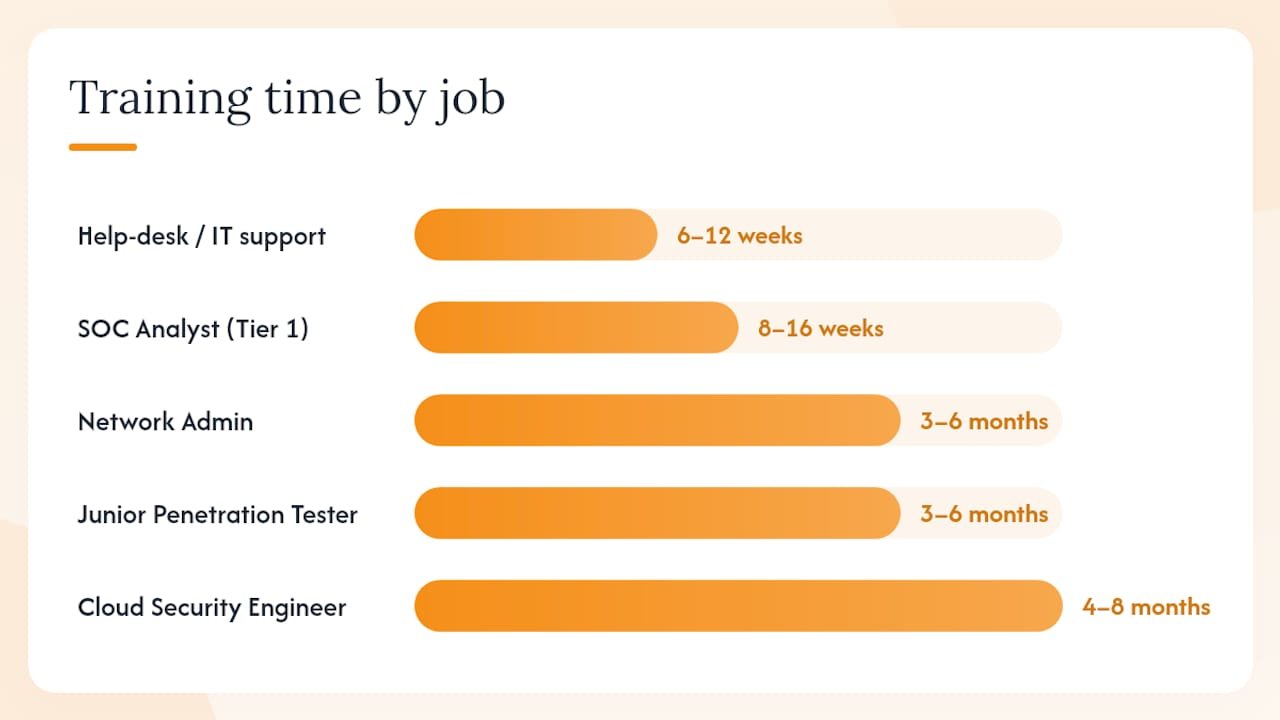
| Job Title | Best-Fit Cert | Labs Included | Time to Complete | Prerequisites | DoD/Employer Recognition |
|---|---|---|---|---|---|
| Help-desk / IT support | CompTIA A+ or Network+ | Varies by provider | 6–12 weeks | None | Broad civilian employer recognition |
| SOC Analyst (Tier 1) | CompTIA Security+ | Required for quality programs | 8–16 weeks | Network+ recommended | DoD 8140 baseline; appears in roughly 70% of postings |
| Network Admin | Cisco CCNA | Included in Cisco courses | 3–6 months | Network fundamentals | Strong in network-heavy roles |
| Junior Penetration Tester | CompTIA PenTest+ or eJPT | Performance-based exam | 3–6 months | Security+ recommended | Growing employer recognition |
| Cloud Security Engineer | CompTIA Cloud+ or AWS Security | Lab-heavy | 4–8 months | Security+ recommended | High in cloud-native orgs |
A typical hire path looks like this: help-desk role (6–12 months) → Security+ → home lab with Splunk or Security Onion → Tier 1 SOC analyst application. That progression realistically takes 12–24 months in most private-sector settings without a four-year degree.
Vendor-neutral certs like Security+ open more doors across industries. Vendor-specific certs like CCNA are more decisive for roles where the employer runs Cisco infrastructure. The standard certification ladder runs Security+ at entry, CySA+ or PenTest+ at mid-level, and CISSP or CISM at senior levels requiring five or more years of experience.
What do realistic timelines and costs look like?
| Path | Time to Job-Ready | Typical Total Cost |
|---|---|---|
| Self-study + certs | 6–18 months | $400–$2,000 |
| Instructor-led prep course | 8–16 weeks per cert | $500–$3,000 |
| Hands-on bootcamp | 3–9 months | $8,000–$20,000 |
| Associate degree (academic) | 2 years | $20,000–$120,000+ |
Cost and timeline data confirm that self-study with certifications is the fastest and cheapest route to an entry-level role. Bootcamps cost more but compress the timeline and produce portfolio evidence.
Veteran funding options:
- VET TEC: Covers tuition for approved high-tech training programs; enrollment guide for veterans available through Totalcyber.
- Fortinet Veterans Program: Provides certification vouchers, self-paced labs, and job-readiness support in partnership with VetSec.
A practical 6–12 month plan for a career changer: months 1–2 (Network+ prep and exam), months 3–5 (Security+ prep, lab setup, exam), months 6–12 (home lab documentation, CTF participation, job applications).
How do you evaluate a certification program before enrolling?
Not every program that promises “Security+ prep” delivers the same outcome. Use this checklist before committing.
What to verify:
- Does the program align with the specific job title you are targeting?
- Are hands-on labs included, not just video content?
- Is the cert DoD 8140 recognized or listed in major employer job postings?
- Are instructor credentials verifiable (active certifications, industry experience)?
- Does the provider offer career services: resume review, interview prep, job placement support?
- Is veteran support available (VET TEC approval, SkillBridge partnership, voucher guidance)?
- What are the refund and guarantee terms if you do not pass the exam?
Questions to ask any training provider:
- Is a proctored exam voucher included in the course price?
- How many lab hours are in the curriculum?
- What is the pass rate for students who complete the full program?
- Are instructors currently certified in the subject they teach?
Red flags: no lab access, vague instructor bios, no mention of exam proctoring, and no veteran funding guidance. On the degree-versus-cert question: pursue a cert-first path if your goal is employment within 12 months. A parallel associate-style course load makes sense once you are employed and your employer offers tuition assistance, not before.
How does Totalcyber support the recommended path?
Totalcyber is a veteran-owned training organization built specifically for the cert-first, hands-on path described throughout this article. Its CompTIA course catalog covers Security+ and Network+ preparation with lab environments, interactive quizzes, and live mentoring, not just passive video content.
What Totalcyber offers:
- Security+ and Network+ prep with hands-on lab components and practice exams.
- ISC2 pathways covering the CC and SSCP entry tracks.
- A career prep course that includes resume building, ATS optimization, and interview coaching.
- VET TEC and SkillBridge guidance for veterans navigating funding and eligibility.
- Alignment with the Fortinet Veterans Program and VetSec for vouchers and placement support.
Veterans can confirm VET TEC eligibility and program approval directly through Totalcyber’s enrollment team. Career changers without military benefits can access self-paced and instructor-led options at multiple price points. The cybersecurity apprenticeship guide on Totalcyber’s site explains paid on-the-job training alternatives for those who want to earn while they learn.
Key Takeaways
For veterans and career changers, CompTIA Security+ paired with a documented home lab is the single highest-ROI starting point for entering cybersecurity in 2026.
| Point | Details |
|---|---|
| Start with Security+ | It appears in roughly 70% of entry-level postings and satisfies DoD 8140 baseline requirements. |
| Labs beat lectures | Document three hands-on lab projects in GitHub to convert your cert into interview-ready proof. |
| Realistic timeline | Self-study plus certifications costs $400–$2,000 and takes 6–18 months to job-ready status. |
| Veterans: use VET TEC | VET TEC can cover full tuition for approved programs; apply before enrolling in any paid course. |
| Totalcyber’s path | Totalcyber offers Security+, Network+, and ISC2 prep with labs, career coaching, and veteran funding support. |
The cert-first path is not a shortcut — it is the right tool
The conventional framing of “associate degree or certificate” treats these as academic choices. For anyone targeting an entry-level cybersecurity role in 2026, that framing misses the point. Employers screening for a SOC analyst or junior security engineer are not comparing transcripts. They are filtering for Security+, checking for lab evidence, and looking at whether the candidate can describe a real detection scenario.
Veterans bring something most career changers do not: documented experience operating under pressure, following procedures precisely, and working within structured security environments. That background maps directly to SOC work, incident response, and compliance roles. The credential gap is real, but it is a 6–12 month problem, not a four-year one.
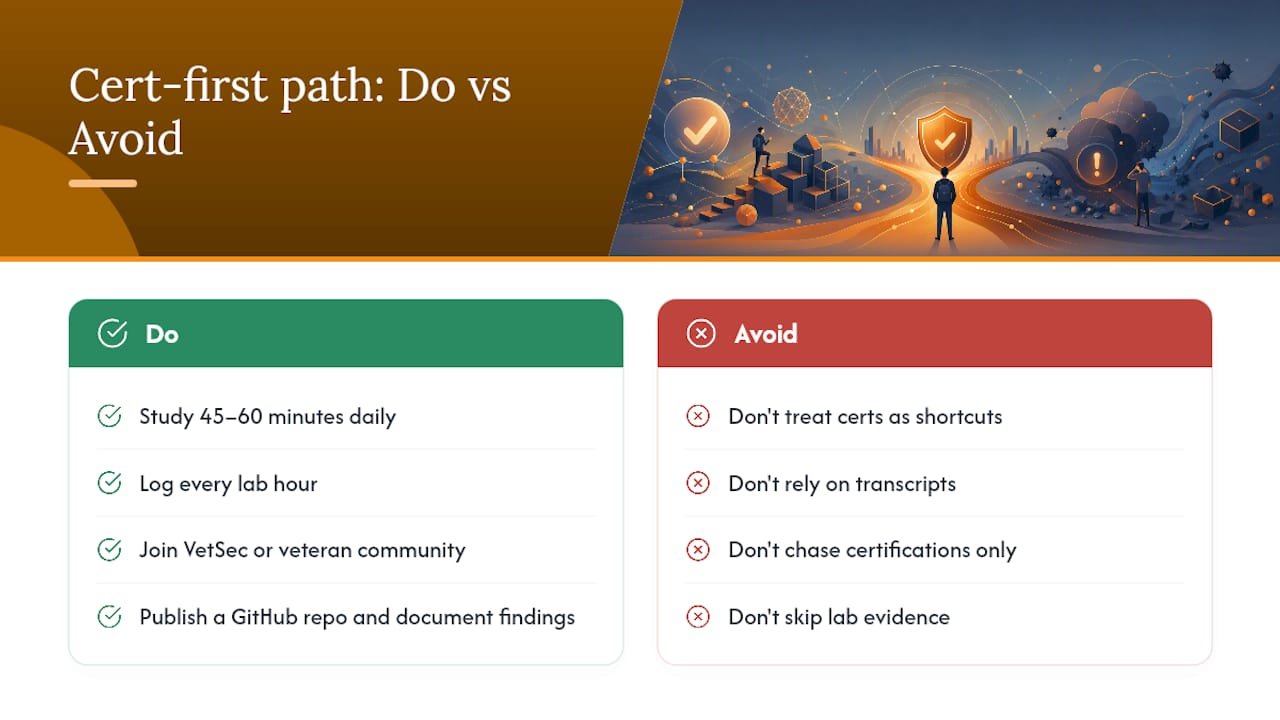
The practical advice here is simple. Set a daily study target of 45–60 minutes, log every lab hour, and connect with VetSec or a similar veteran community for accountability and job leads. The candidates who land roles fastest are not the ones with the most certifications. They are the ones who can point to a GitHub repo, describe what they built, and explain what they found.
Totalcyber: your next step starts here
Totalcyber gives veterans and career changers a direct path from zero to job-ready, without the cost or time of a traditional degree program. Where most training options force you to choose between exam prep and practical skills, Totalcyber combines both: structured Security+ and Network+ courses with real lab environments, live mentoring, and a career prep course that covers resume building and interview strategy.
Veterans can access VET TEC and SkillBridge pathways through Totalcyber’s enrollment team, with guidance on vouchers and program approval built into the process. Career changers can start with the beginner’s career guide to confirm which course fits their current skill level, then move directly into a Security+ prep program with hands-on labs included. Review the training prerequisites checklist to confirm your readiness, then contact Totalcyber’s team to select your starting course and confirm any veteran funding options that apply to you.
Useful sources
- Best Cybersecurity Certifications for Beginners 2026 | CertCompass
- Skills, Certifications, or Degrees: What Companies | EJ1246234.pdf
- A practitioner’s guide to designing and developing hands-on cybersecurity Skilling Continuation Labs | SEI
- Fortinet training helped veterans launch cybersecurity careers | Fortinet Blog
- Are Cybersecurity Certifications Worth It Without a Degree? | CertSelect
- Cybersecurity: Degree vs Self-Taught vs Bootcamp | MyCyberSecurityPath
- Cybersecurity Certifications — Compare & Choose | Certalyze